
Оригинал материала
Losing to Putin
How Turkish President Erdogan got what he wanted from Washington but settled for far less from Moscow
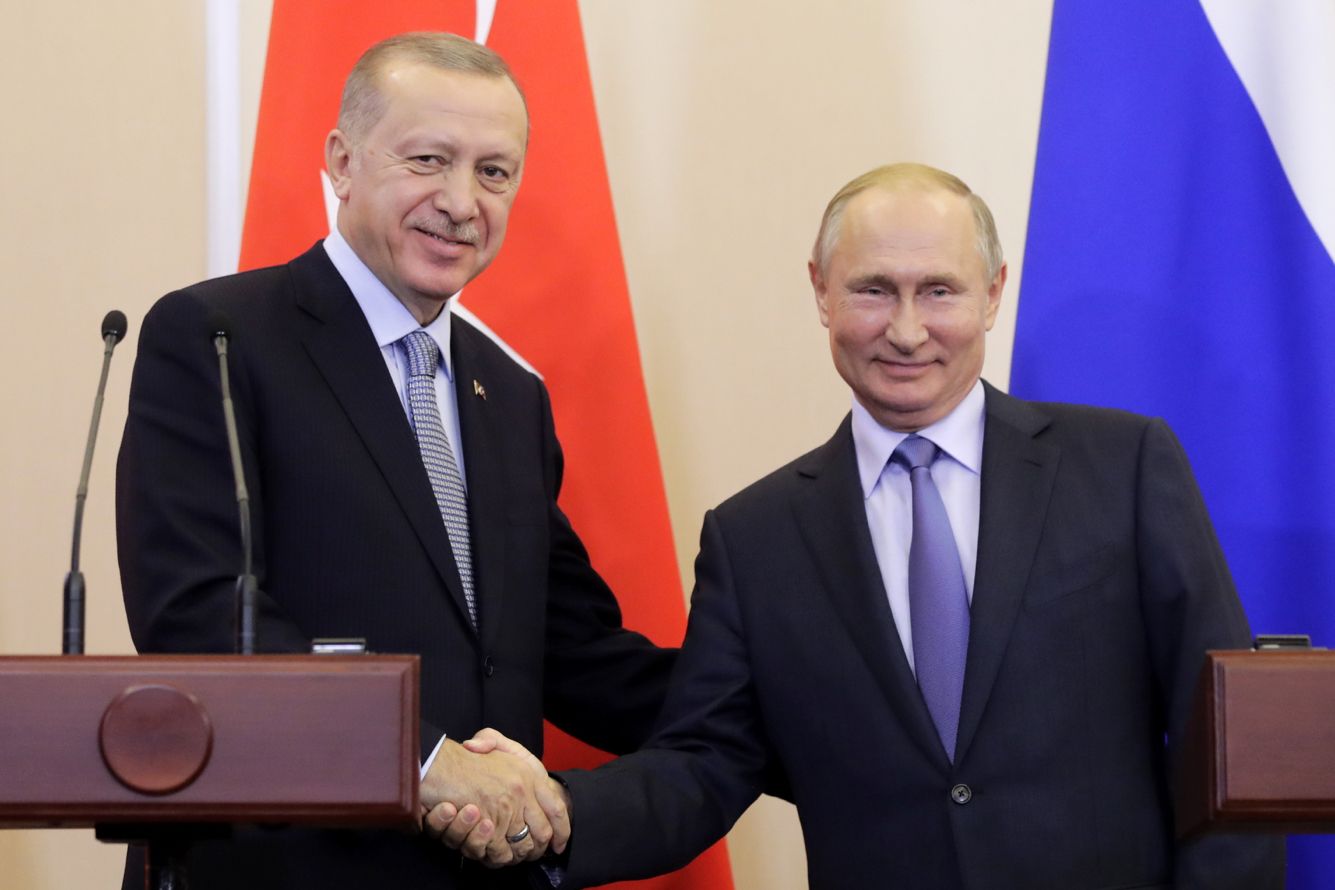
President Recep Tayyip Erdogan has ceded most of Kurdish autonomy in Syria to Vladimir Putin. The Turkish leader had claimed a region that stretches more than 250 miles along the Turkish-Syrian border and includes dozens of major Kurdish cities, which he planned to capture, in order to resettle more than 2 million Syrian refugees now living in Turkey. On October 22, Erdogan and U.S. Vice President Mike Pence focused on exactly this vast region. After talks with Putin in Sochi on October 22, however, Erdogan’s claims were reduced to a stretch of land just 60 miles wide that contains only the two Kurdish cities Turkish armed forces managed to seize since the start of the operation against the Kurds. The Syrian government and Russian military police will now control nearly all the remaining autonomous Kurdish territory. Meduza explains why Erdogan had to revise his agreement with the United States and abandon his military campaign.
Before the deal
On October 7, President Trump abandoned the Kurds, declaring that the U.S. military would no longer protect them in Syria. Two days later, Turkish troops invaded Syria’s autonomous Kurdish region, but conquest proved elusive. The Kurds turned to Syria and Russia for defense, forcing Turkey to fight against Damascus and Moscow, if it wished to continue. Meanwhile, U.S. Vice President Mike Pence agreed that America would guarantee the exit of Kurdish armed groups in Syria along Turkey’s entire 250-mile border. The Kurds, however, no longer looked to Washington, and they now hoped that Russian President Vladimir Putin could negotiate better conditions with Erdogan.
The deal between Putin and Erdogan
On the evening of October 22, the presidents of Russia and Turkey came to the following agreement:
- Turkish troops will indefinitely retain control over the territory they managed to capture after October 9 (the agreement calls this “maintaining the status quo”).
- Syrian border guards and Russian military police will occupy the rest of the border region, which will be off limits to Turkish troops, though Turkey will get the right to participate in joint patrols alongside Russian forces up to 10 kilometers (6.2 miles) from the border.
- The Kurdish armed formations that Erdogan considers to be terrorist groups must leave the entire border region within a week. The agreement says nothing about what happens next to these groups, but both Russia and Turkey committed to “fighting terrorist in all forms.”
- The document doesn’t mention Kurdish autonomy, but it says all questions about Syria’s political structure will be determined later by a constitutional committee convened by Russia, Turkey, and Iran.
- The agreement also doesn’t mention the resettlement of Turkey’s Syrian refugees in Kurdish territory, except for vague language about both parties making efforts to ensure that refugees return to Syria “safely and voluntarily.”
What’s it all mean?
The key thing to grasp here is that Erdogan lost a complicated game, but managed to save face. Turkey had to abandon nearly all the objectives of its Syria campaign, accepting just a fifth of the “gains” it wanted. Erdogan won control over just a small piece of Kurdish territory, losing any hope to expand this zone to a 19-mile strip of land along the entire border, which was the military's minimum objective. (Turkey had even entertained the possibility of occupying the entire northeastern third of Syria.)
Erdogan failed because he forgot the rules of modern “hybrid war”; Turkey didn’t pair the invasion with the necessary diplomatic and media cover, and it went to war with bad allies.
Almost effortlessly, the Syrian government and Russia gained the right to take control over almost a third of Syria’s territory, which until recently was in the hands of Kurdish politicians and their American allies. This was possible thanks to the withdrawal of American and European troops, which Damascus and Moscow sought unsuccessfully for years, and Recep Tayyip Erdogan finally achieved.
Turkey will retain control over the territory it’s already occupied, since Ankara believes the land can only be returned to a new Syrian government, not the current regime, which it says is illegitimate. This new government will be formed at some future time according to a still unwritten new constitution (which Turkey, together with Russia, is helping to draft).
Erdogan’s new agreement with Putin doesn’t address the fate of another Syrian border region: Idlib, which remains under the control of revolutionary Islamists. Some of the anti-Assad Islamist groups in this area work closely with Turkey, and it was in Idlib that Ankara found most of its “proxy forces” who acted as its shock troops in the short campaign against the Kurds. According to reports from Syria, Damascus has Russian support to resume its offensive in Idlib, which was interrupted in late August by the latest armistice requested by Turkey. In this sense, tensions between Turkey and Russia in Syria are far from over, despite the Sochi agreement on October 22.
So what happens to the Kurds?
We don’t really know yet. There are rumors that they reached a political settlement with Moscow and Damascus to surrender their autonomy in everything except local self-government. The Syrian government’s promises to leave them some level of independence, moreover, aren’t much of a guarantee.
In 2012, in the middle of the Syrian Civil War, Syria’s Kurds withdrew from government control, leading to a situation of “neither peace nor war” with Turkey. Returning voluntarily to the Assad regime doesn’t offer much. For example, arrests and the murder of opposition activists followed in Daraa in 2017, after rebels surrendered to the government in exchange for amnesty, the suspension of conscription, and the right of former opposition members to participate in local government.
But the Kurds' other options were even worse. The United States urged the Kurds to abandon Syria’s entire northern territory, which is home to the community’s biggest cities and agricultural lands. This withdrawal of armed formations would have also required most civilians to leave.
Syria’s Kurds knew what defeat by the Turks would entail. Last year, for example, Turkey and its proxies captured the city of Afrin (with Russia’s consent), which forced Kurds in the area to give up their autonomy, and subjected them to violence, robbery, and displacement by the Arab population.
So Russia and Syria have won?
Not entirely. There’s still Idlib, which is controlled by Islamists, including organizations tied to Al-Qaeda. It would take another long fight to destroy these forces, and that’s impossible without further negotiations with Turkey, which acts as Idlib’s guarantor of peace, according to a 2017 agreement. Ankara, meanwhile, clearly has no interest in a conflict that would flood Turkey with millions more refugees from this province.
And Moscow and Damascus have another problem. Under pressure from his own advisers, Donald Trump has changed his mind about abandoning Syria entirely. The U.S. president now says that one of America’s main achievements in the war, in addition to crushing ISIS, was “securing the Oil” on the banks of the Euphrates. After Kurdish and American forces retook the oil fields (which were the basis of the ISIS economy), the Syrian government and Russian mercenaries from the “Wagner” private military company also lay claim to the resources.
The Assad regime needs these oil fields to end an ongoing energy crisis that’s only aggravated by U.S. sanctions prohibiting other countries from exporting oil to Syria.
Trump has now apparently decided that U.S. troops must “secure the oil” in Syria and keep it out of the Syrian government’s hands. Roughly 200 American soldiers are still stationed in Syria's oil region outside the city of Deir ez-Zur.
Story by Dmitry Kuznets
Translation by Kevin Rothrock