
Оригинал материала
17.1 million stuffed ballots
The elected officials who paved the way for Russia’s invasion of Ukraine weren’t really elected, according to video records obtained by Meduza
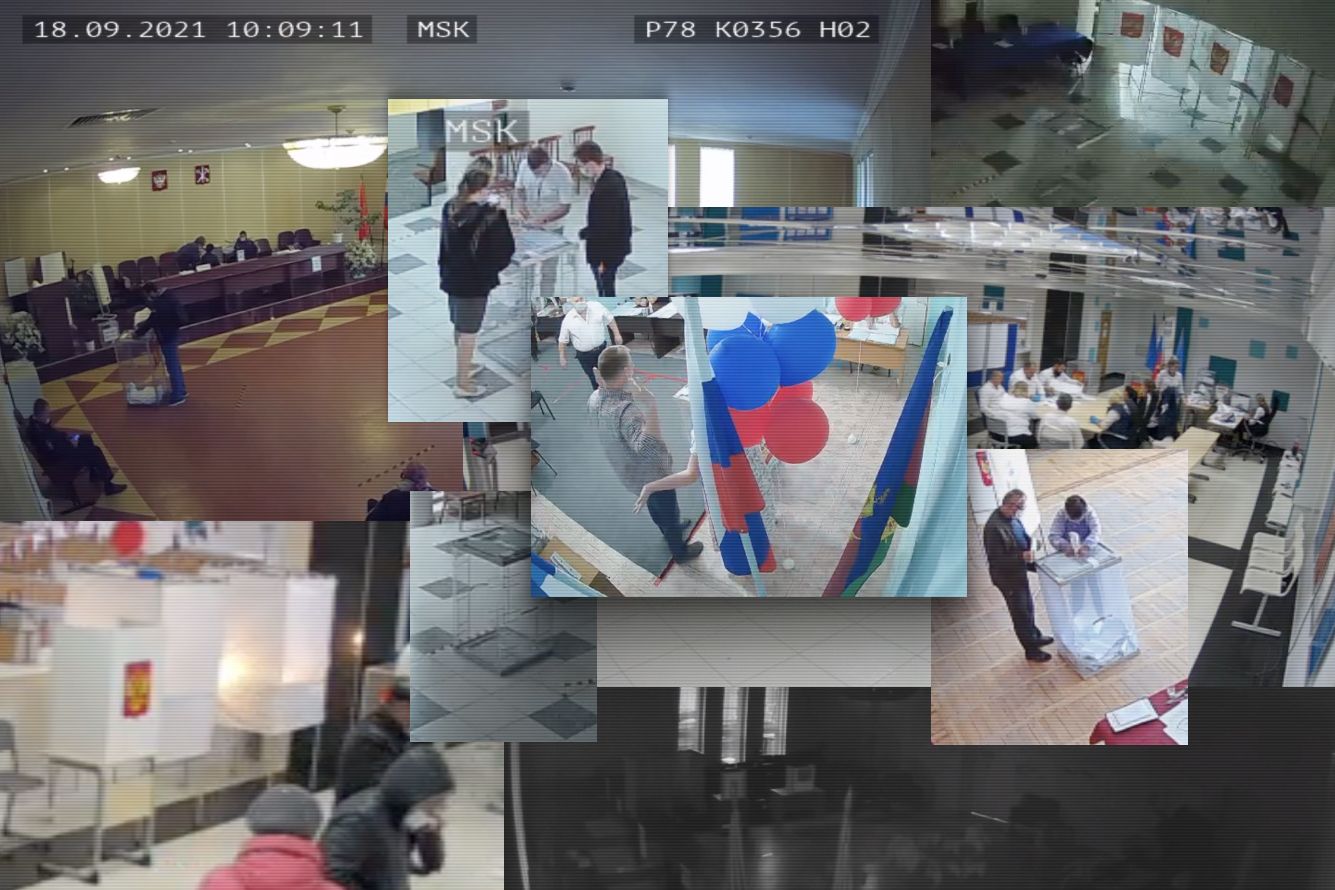
Days before Russian troops poured into Ukraine in a full-scale invasion in late February, 400 deputies in the State Duma voted to ratify an agreement on “friendship, cooperation, and mutual assistance” between the Russian Federation and the self-declared Donetsk and Luhansk People’s Republics. The document would become one of Russia’s formal justifications for its “special military operation” (though the pact didn’t take effect until after the invasion began). The lawmakers who endorsed the agreement won their parliamentary seats in September 2021, which were the first elections in a decade that weren’t streamed online using webcams. Russia’s Central Elections Commission said it lacked the funds to offer video transmissions at all polling stations. Direct access was limited to monitors from the parties participating in the elections, candidates, and the local election commissions themselves. Almost a year later, however, Meduza has obtained an archive of video footage from polling stations during those elections. A group of independent video monitors (whose names we are withholding for safety reasons) has analyzed the records and concluded that the number of stuffed ballots cast in September 2021 could have surpassed 17 million.
Meduza’s key findings
- Despite the reduction of video transmissions from polling stations in Russia’s September 2021 elections, Meduza obtained more than 1 million hours of footage from webcams installed on the premises of more than 9,000 local election commissions in 19 different regions across the country.
- With the help of artificial intelligence (software based on neural networks called “Revizor,” i.e. “Inspector”), a group of independent monitors examined the video archive. Revizor cannot identify voters or determine how they voted, but it can count in the videos how many people voted at a particular polling station.
- Footage from 3,505 of the polling stations was sufficiently uninterrupted and high quality to be analyzed using the Revizor system. According to official data, 3.2 million people voted at these polling stations, but the videos we examined showed only a little more than 2 million voters. In other words, roughly a third of the ballots cast in these precincts were apparently fake.
- If we assume that this same pattern of falsification holds true nationally, the total number of stuffed ballots in Russia’s September 2021 elections surpasses 17.1 million.
How this works
Russia first introduced public broadcasts from polling stations in the 2012 presidential election (in the aftermath of large protests against alleged fraud in the December 2011 parliamentary elections). The innovation made it possible for far more observers to track the ballot stuffing, “carousel voting,” and turnout discrepancies that monitors had reported for years. From the comfort of their homes, Russians could now count the number of voters who walked into a polling station and the number of ballots reported at the station.
Six years later, for Russia’s next presidential election (Vladimir Putin’s fourth time on the ballot), several monitoring groups united to mount the country’s first-ever attempt at a mass analysis of broadcasts from polling stations across Russia. At that time, according to the Central Elections Commission, video cameras had been installed at 46,000 of more than 97,000 polling stations. The monitoring project examined the footage from 8,000 polling stations (working with videos from 16,494 different cameras).
The project relied on volunteers to study the videos and look for inconsistencies. “They sat there and counted how many people came up to the ballot box [at the polling station] and dropped a ballot inside. Then they compared the number they got to the official data. That’s how they developed the methodology where volunteers found fraud without seeing the actual criminal act,” recalled an election observer who also analyzed the records obtained by Meduza.
This approach allows monitors to determine the scale of fraud. “We can’t count how many ballots are stuffed into the bundles that [violators] throw into ballot boxes, but we can count the people who come up to the box and vote and then compare our numbers with the numbers they release. If we don’t see the thousand people listed officially, it means either the voters were invisible, or a crime was committed,” the observer explained.
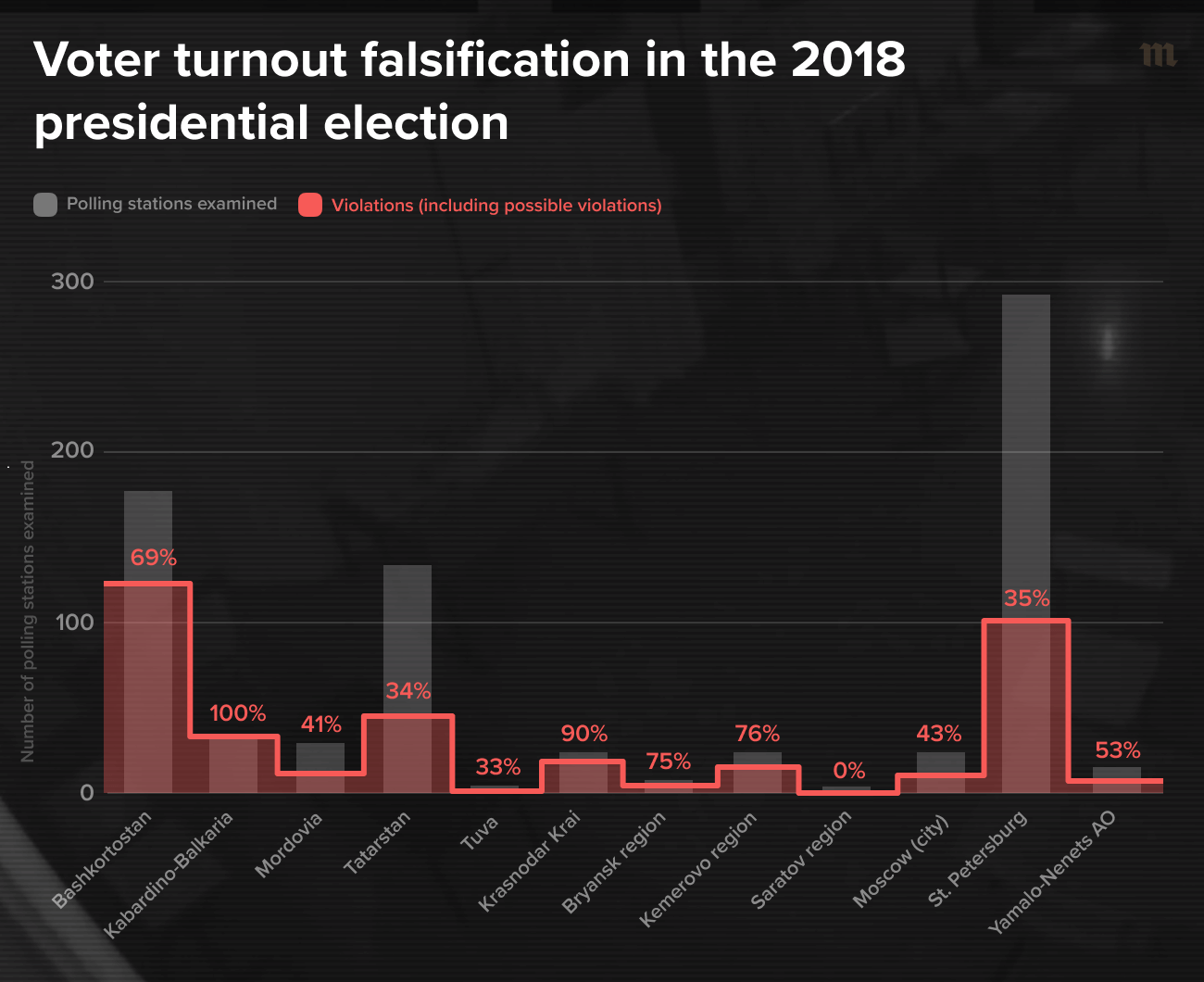
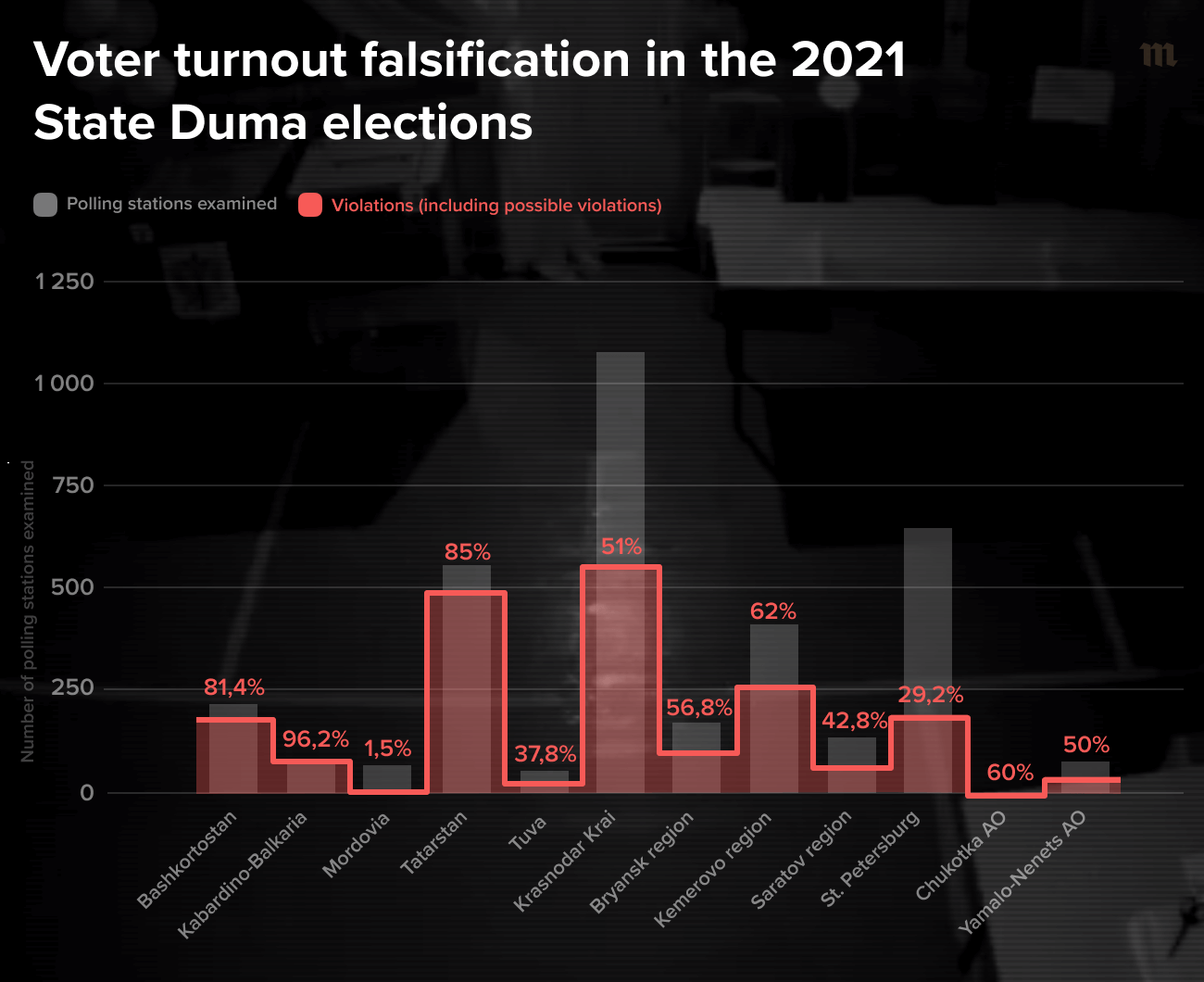
To tackle the video archive obtained by Meduza, monitors concocted a way to automate the counting process by using neural networks. “It’s rocket science, but it’s a very common kind of rocket science,” one observer said. “The [volunteer search and rescue organization] LizaAlert has a project like this: a helicopter flies over a forest and looks for someone. Searching in piles of leaves and through trees is a problem, but neural networks can manage it.”
The software needed to perform this kind of monitoring work on footage from polling stations became available in February 2020. It’s called “Revizor” (“Inspector”). Revizor cannot identify voters or determine how they voted, but it can count in the videos how many people drop ballots into ballot boxes at a polling station. (At-home voting for people with disabilities remains unverifiable for monitors using this software, and the observers who reviewed voting results in the precincts where Meduza obtained video records decided to assume that the official at-home ballot numbers are accurate.)
“The system works like a sieve, selecting just the polling stations where turnout was suspiciously high, triggering a manual review by the observers. This enormously simplifies the volunteers’ work looking for violations, but Revizor itself can count, too, and with a certain accuracy,” a source explained to Meduza.
Compared to manual counts by volunteer observers, Revizor showed a total error margin of just 1.8 percent, though turnout calculations did fluctuate more dramatically at some polling stations where the video footage rendered voters “hard to distinguish.” (For example, ballot boxes placed in hallways or in front of mirrors could confuse the software. At the other extreme, Revizor sometimes undercounted turnout, as well.)
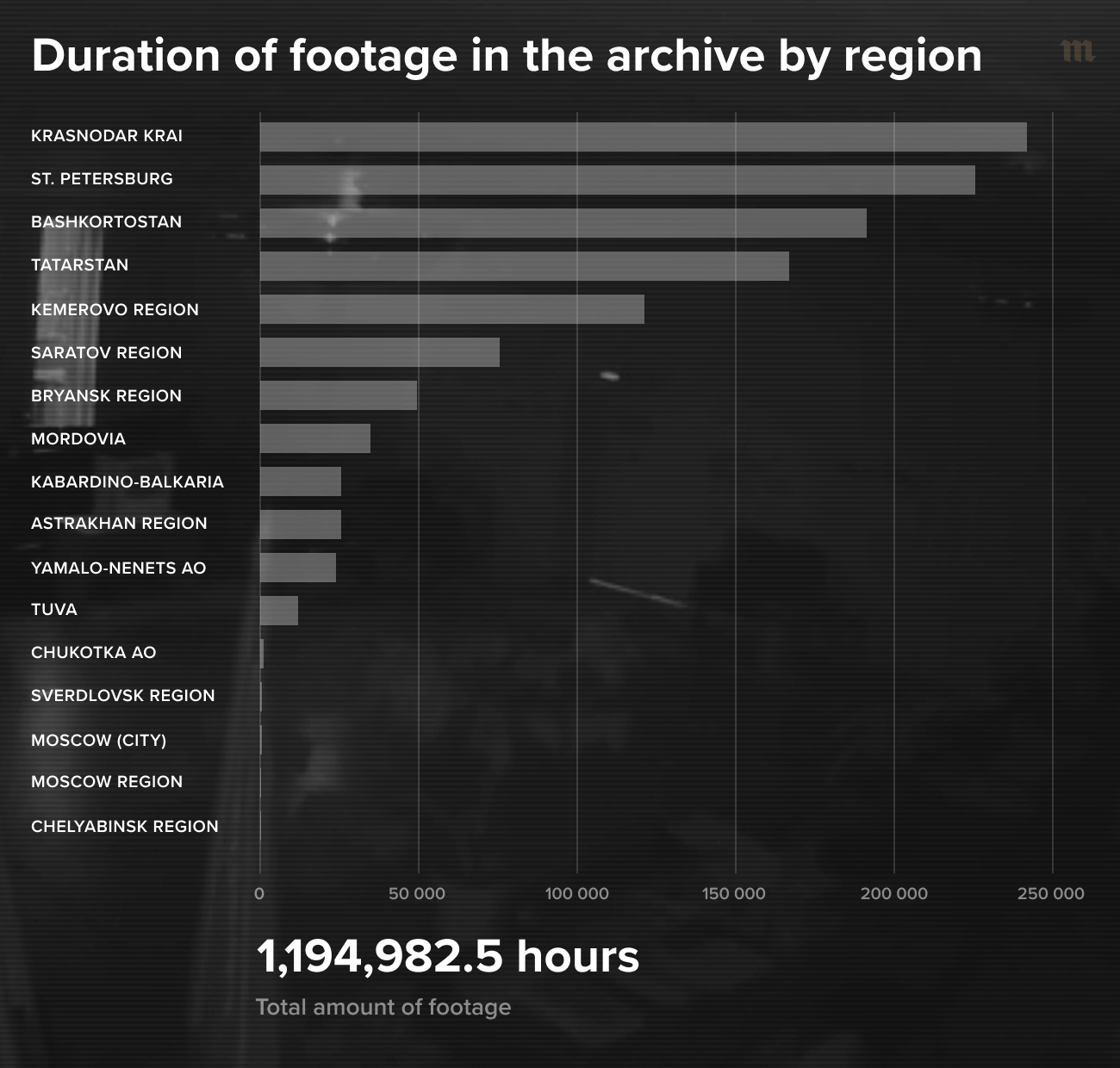
The archive obtained by Meduza contains videos from 9,252 local and regional polling commissions. The recordings from 7,378 of these commissions are without pauses that exceed six hours over the course of three days of voting. But observers used Revizor to analyze the footage from just 3,505 polling stations in 12 different regions across Russia. This was the footage that was sufficiently high quality and nearly uninterrupted (the longest recording gap in these videos is just 90 seconds).
And what did Revizor find?
Five political parties were awarded enough votes in September 2021 to gain seats in the State Duma:
- United Russia — 49.82 percent of the vote (with victories in single-mandate races, the party won 324 seats and maintained a majority strong enough to amend the Constitution without votes from deputies in other parties)
- The Communist Party of the Russian Federation — 18.93 percent
- The Liberal Democratic Party of Russia — 7.55 percent
- Just Russia for Truth — 7.46 percent
- New People — 5.32 percent
According to the Central Elections Commission, voter turnout was 51.72 percent. Commissioner Ella Pamfilova announced that the number of reported irregularities was “an order of magnitude lower” than the violations flagged in previous voting. Russia’s electoral system, Pamfilova declared proudly (if unconvincingly), had become “one of the most, if not the most transparent in the world.”
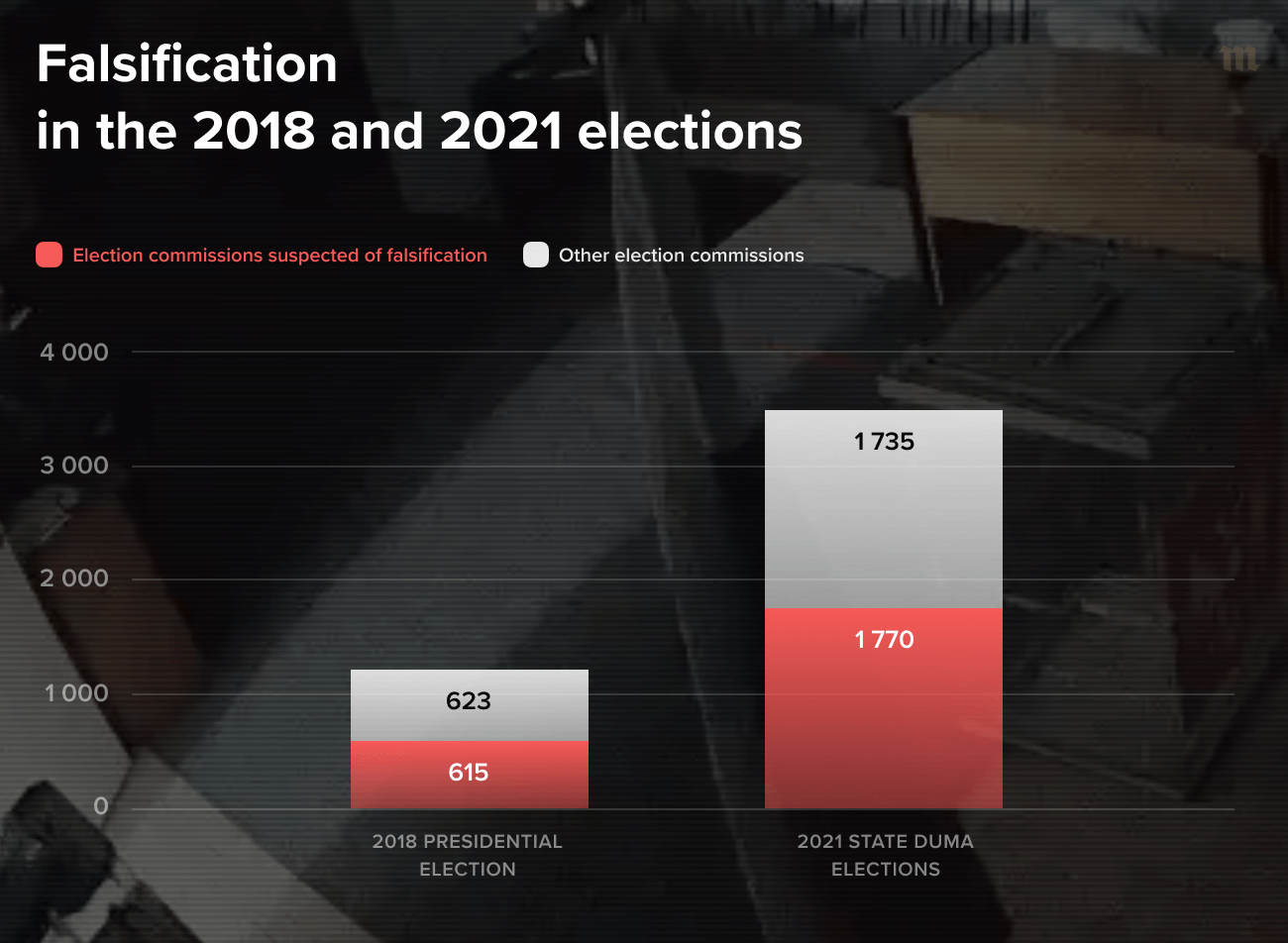
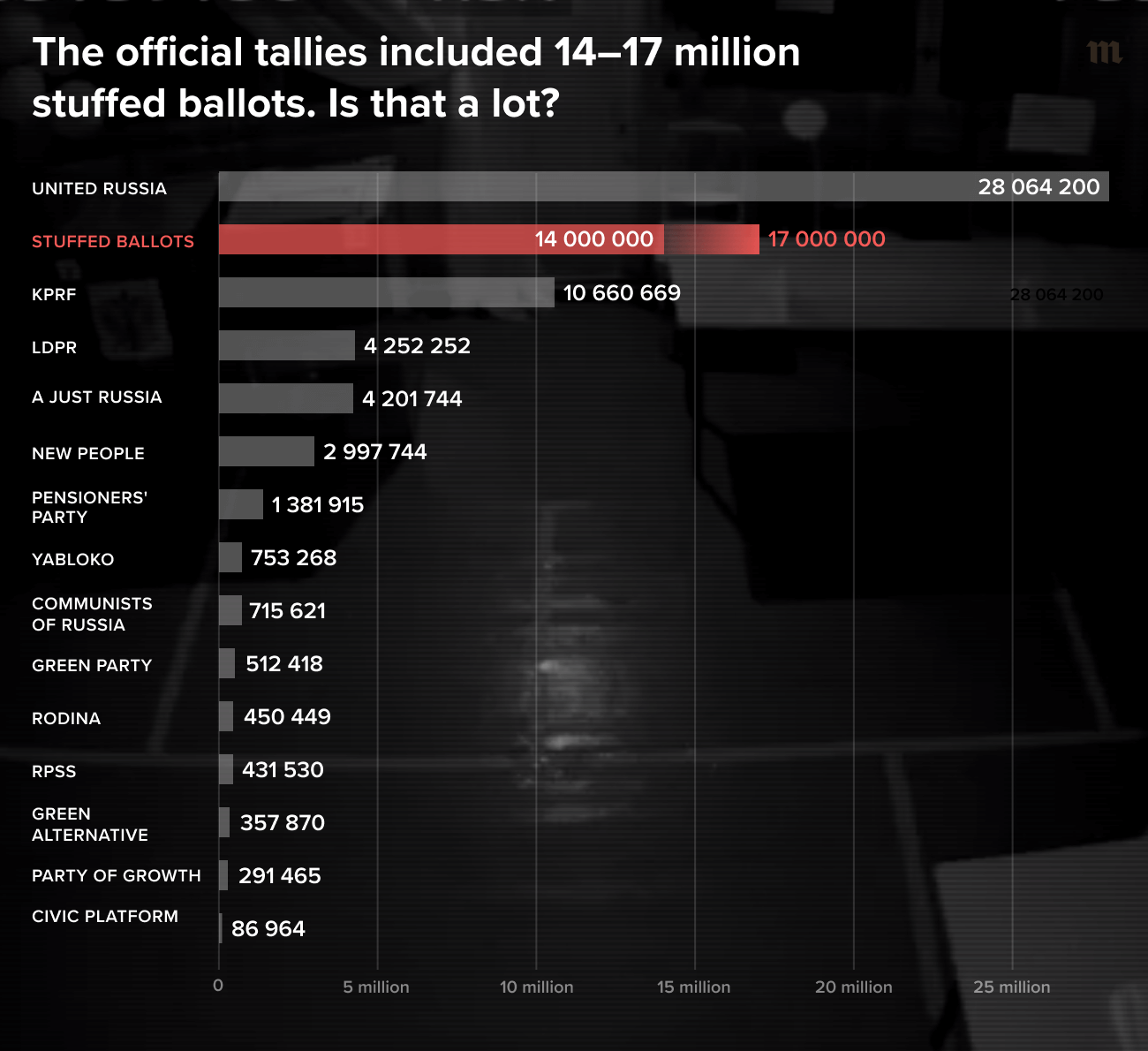
The observers who reviewed the election footage obtained by Meduza beg to differ. Revizor studied videos from 3,505 polling stations and found turnout-related violations at roughly 1,770 of the stations. Official data show that 3.2 million people voted at these locations, but monitors counted more than a million fewer people submitting ballots. In other words, a third of all votes reported at these stations were apparently fake.
Approximating these numbers to the total official turnout in Russia for the elections (almost 56.5 million people), we can estimate that 17.1 million votes were fabricated.
Admittedly, this conclusion is only an approximation, but Russia’s Central Election Commission can publish its internal records from September 2021 to dispel the doubts raised here about the voting results that gave the State Duma’s current members their seats and the power to enable the Kremlin’s war of aggression against Ukraine.
Note: This is a summary of a longer article first published by Meduza in Russian on August 12, 2022. That text is available here.