
Оригинал материала
The Real Russia. Today.
RIP, Oksana Baulina and Konstantin Olmezov
Wednesday, March 23, 2022
For ongoing coverage of the invasion of Ukraine and its consequences back in Russia please Meduza’s our live transmission. Please note that the authorities are now blocking our website in Russia, and we’re turning to you, our global audience, for financial support.
What you’ll find in today’s newsletter
- Obituaries for journalist Oksana Baulina and mathematician Konstantin Olmezov
- Russia’s mysteriously missing defense minister
- Moscow’s air strikes kill a man who evaded the Nazis
- The Kremlin’s growing fixation with focus groups
- Peskov spins the civilian death toll
- Photos of life in Kharkiv’s subway-station bomb shelters
Remembering slain journalist Oksana Baulina (2-min read)
On March 23, an air strike in Kyiv killed two civilians, one of whom was Oksana Baulina, a Russian investigative journalist and former activist at Alexey Navalny’s Anti-Corruption Foundation. News of Baulina’s death shocked her friends and colleagues in Russia’s news media and human rights community. On social media, people described their last interactions with her, often sharing screenshots of what proved to be their final correspondence.
Olga Shakina, a friend who now works for the media wing of the human rights group Department One, remembered Baulina in a message shared on the organization’s Telegram channel. Meduza translated Shakina’s obituary.
A mathematician from Ukraine died by suicide in Moscow after trying and failing to escape from Russia. (12-min read)
On March 20, mathematician Konstantin Olmezov died by suicide in Moscow. Originally from Donetsk, Olmezov moved to Russia to pursue a career as a mathematician. After Russia invaded Ukraine, Olmezov tried to leave the country, but was arrested and sentenced to administrative detention; after being released, he died by suicide. In his suicide note, he wrote, “For me, not being free is worth than death.”
Sergey Shoigu, where are you? Amid war against Ukraine, Russia’s defense minister hasn’t been seen in public for 12 days (3-min read)
It’s been 28 days since Russia went to war against Ukraine. And it’s been 12 days since the public has laid eyes on Russian Defense Minister Sergey Shoigu. Indeed, as first pointed out by Mediazona journalist Dmitry Treshchanin, Shoigu hasn’t appeared in public or in the press since March 11.
Holocaust survivor killed by Russian shelling in Kharkiv: 96-year-old Boris Romanchenko survived four Nazi concentration camps. On March 18, he was killed in his home. (6-min read)
On March 18, 96-year-old Kharkiv resident Boris Romanchenko, who survived four Nazi concentration camps, died when his apartment was hit by a Russian shell. Romanchenko lived in North Saltovka, a district that’s been under fire since the earlier days of the war. According to his granddaughter, his apartment building "burned down completely."
The Kremlin wants to know what Russian people are most concerned about. Their solution: focus groups. (4-min read)
Russia’s war against Ukraine has gone on for almost a month now. As pressure from sanctions and other restrictions on the Russian economy grows, Russia’s domestic situation is looking worse and worse — despite the authorities’ successful repression of the anti-war movement through threats and arrests. Meduza has learned of recent efforts by the Russian presidential administration to determine which problems concern the population most. Unfortunately for them, the hard part will be solving them.
‘These aren’t our stories’: Meduza asks the Kremlin’s spokesman about the growing number of civilian casualties in Ukraine (4-min read)
Russia’s war against Ukraine has been raging for almost a month. In that time, the UN Human Rights Office has recorded more than 2,510 civilian casualties in Ukraine: 953 people killed and 1,557 injured. The UN says the actual toll is much higher. During a press briefing on Wednesday, March 23, Meduza’s correspondent asked Kremlin spokesman Dmitry Peskov about the Russian military’s role in the growing number of civilian casualties in Ukraine.
Snapshots from underground: A photographer captures life in Kharkiv’s subway station bomb shelters as shelling continues
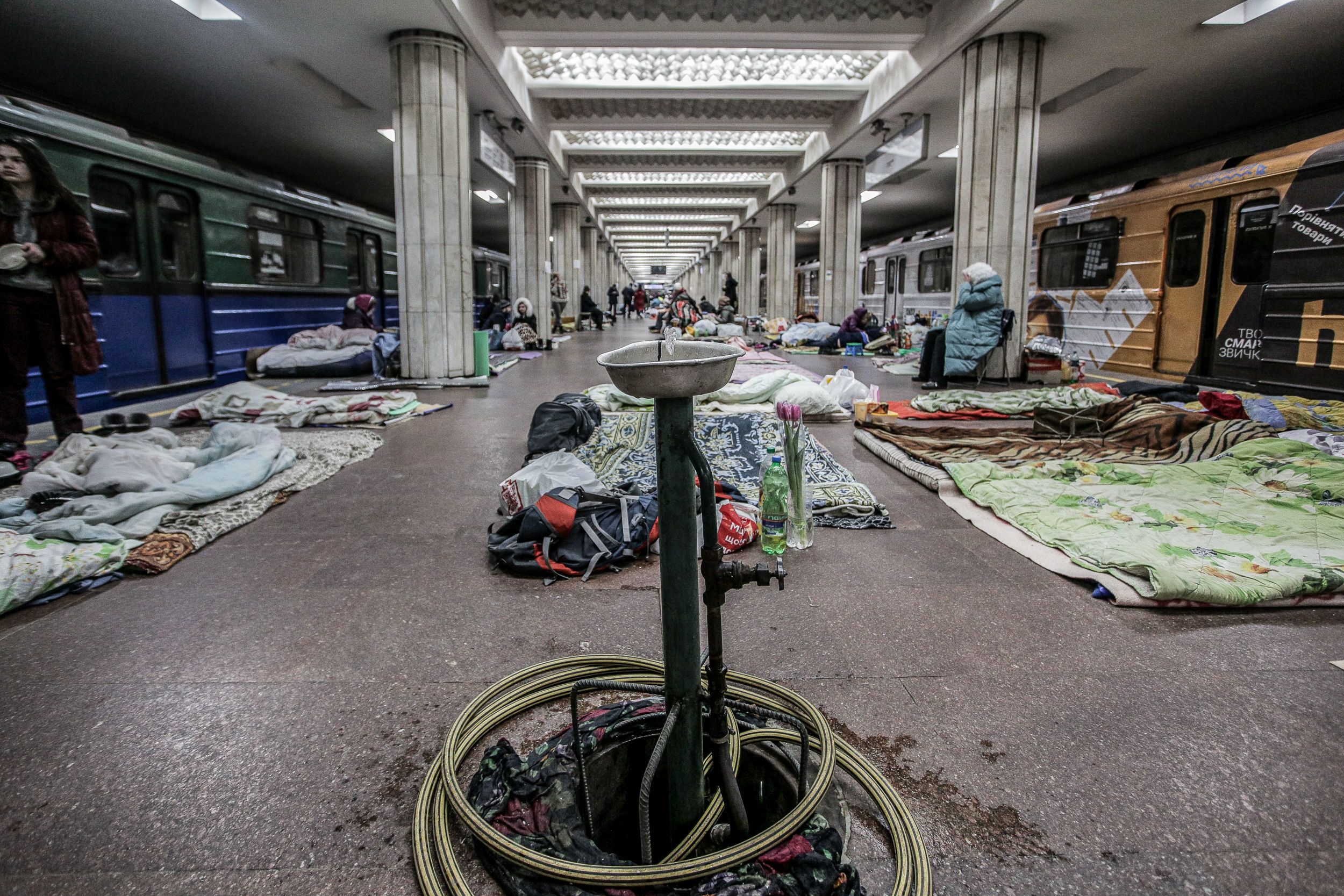
Before the war came to Kharkiv, Pavel Dorogoy specialized in documentary and archival photography, and captured his hometown’s architecture. Today, Pavel mainly works as a volunteer, but he continues to document life in the city during the war. In early March, he started taking photos and videos in the subway stations in one of Kharkiv’s outlying neighborhoods, where thousands of local residents hide during air raids. According to Pavel, a single station can shelter up to 500 people in the evenings — volunteers prepare food (serving children and women first) and, when not taking turns sleeping under piles of blankets, people try to catch a few moments to themselves. Pavel has been living in the subway throughout the war, along with his wife (a station worker) and their two children. With his permission, Meduza shares Pavel Dorogoy’s photos and videos of life in Kharkiv’s underground.
Yours, Meduza