
Оригинал материала
The Real Russia. Today.
More revelations and an unexpected admission in Russia's Syria mercenary mess; the presidential race bumbles along; and Navalny goes to war against Moscow's censor
Friday, February 16, 2018 (Meduza's newsletter will return on Tuesday, February 20. Happy President's Day, Americans!)
- Russia's dead mercenaries in Syria: unofficial evidence mounts as Moscow makes a reluctant admission
- Ksenia Sobchak loses a lawsuit and a prominent endorsement
- Election officials continue to take a hands-off approach to campaign regulations
- Navalny goes to war against Russia's federal censor
- Crimea sentences a Ukrainian “saboteur” to prison
- Suspicious envelopes are showing up in the mail at embassies throughout Moscow
- Russia's Central Bank writes an obituary for all those currency-exchange signs
Russia's mysterious Syrian dead mercenaries 🇸🇾🇷🇺💥🇺🇸
Ekho Moskvy has identified yet another Russian mercenary who died in the recent U.S. airstrikes against pro-Assad militants in Syria. Four people who knew Oleg Tereshchenko confirmed to the radio station that he perished in Deir ez-Zor on February 7. Tereshchenko’s friends say roughly 200 people died in the attack. Open-source investigators at the Conflict Intelligence Team have identified another eight Russians who were killed in the airstrikes. Meduza wrote about some of them here.
Wait — how many Russians died in Deir ez-Zor?
The estimates vary from a few dozen to more than two hundred. Moscow isn’t making the guessing game any easier. After initially denying that it knew anything about Russians killed in the U.S. airstrikes, Foreign Ministry spokeswoman Maria Zakharova said on Thursday that five Russian citizens may have died in the attack, adding that none of them was a Russian soldier. Western and Russian reporters believe the Russian combatants were mercenaries fighting in the “Wagner” private military company, though some observers say the PMC acts as a front for the Kremlin’s clandestine armed operations. Russia’s Defense Ministry denies that it lost any personnel in the U.S. attack.
What's the Russian state media have to say about this?
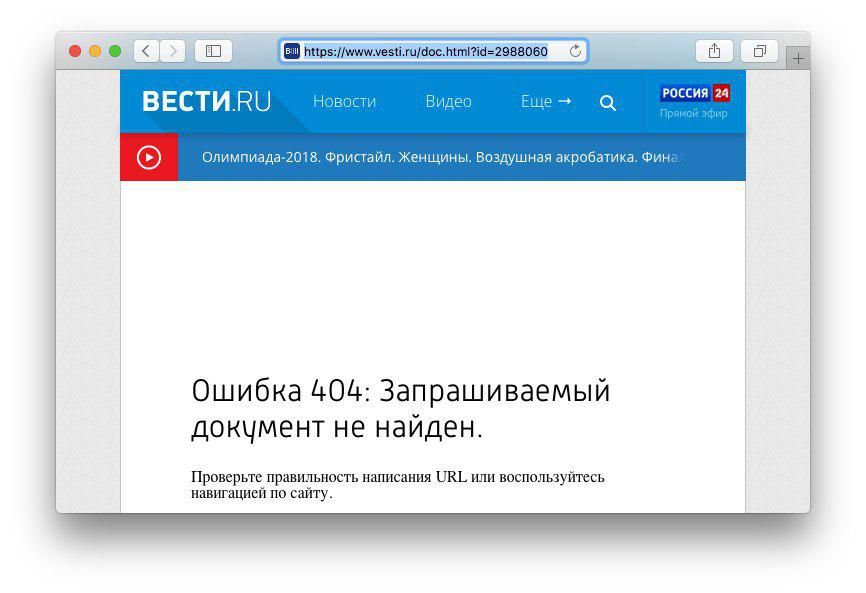
On the evening of February 15, the news agency Reuters published a story citing three sources who claim that the February 7 U.S. airstrikes killed 100 and wounded 200 mercenaries working for the “Wagner” PMC. The state-run news outlet *Vesti.ru promptly shared a summary of the report, which then *disappeared hours later. When you try to view the story now, you’re greeted by an “Error 404**: Requested document not found” message.
Staged election madness 🗳
🤡 Don't call her a stooge
Russia’s Supreme Court has rejected a lawsuit by Ksenia Sobchak asking the judges to throw out Vladimir Putin’s registration as a presidential candidate in this year’s election on the grounds that he’s already served three terms in office. Sobchak, who’s also running for president this year, argued that Putin “bypassed the law” by inviting Dmitry Medvedev to serve as a Kremlin placeholder from 2008 to 2012. The Russian Constitution, however, only limits individuals to two consecutive terms, meaning that Putin’s “castling move,” as it’s known in Russia, is perfectly legal.
- Sobchak’s lawsuit was widely viewed as a political stunt to convince skeptics that she’s not Vladimir Vladimirovich’s lapdog.
🎙 Gab on, Mr. Candidate. The commish said it’s okay
Russia’s Central Election Commission has rejected a complaint that Sergey Baburin, the Russian All-People's Union’s presidential candidate, violated campaign laws by giving an interview to the radio station Ekho Moskvy. According to the commission’s spokeswoman, the radio interview doesn’t constitute “campaigning” because it occurred on an “informational” program. The commission reached this decision, even though Baburin was asked directly: “What specifically do you want to change?” Election officials also say it’s fine that Ksenia Sobchak appeared on Vladimir Pozner’s television show because it’s not strictly a news program, meaning that it doesn’t fall under the commission’s monitoring for equal TV news coverage.
What’s the law say about this?
Russian election rules describe campaigning as “any description of the possible consequences of electing or not electing a particular candidate.” Campaigning in the mass media isn’t allowed in this year’s presidential race until Saturday, February 17.
What about the constant coverage of Putin’s presidential feats?
The Central Election Commission recently ruled that it’s legal for news outlets to report on Vladimir Putin’s work as sitting president, saying this doesn’t violate requirements that all candidates receive equal access to Russia’s airwaves.
So who’s enjoyed the most TV limelight, so far?
According to the commission’s media monitoring between January 26 and February 11, Putin got the most presidential campaign coverage on Russia’s national TV networks, followed by Communist Party candidate Pavel Grudinin and LDPR head Vladimir Zhirinovsky.
📹 Beware of Sobchak's camera crew
On February 14, the human rights activist Sergey Kovalev announced that he was ending his cooperation with Ksenia Sobchak’s presidential campaign, just a day after the collaboration was announced. Kovalev accused Sobchak's film crew of “arrogant behavior.” The television star’s campaign initially accused the liberal political party Yabloko of pressuring Kovalev into leaving, before later issuing a rather reluctant apology.
- Read all about Sobchak’s latest campaign scandal, and why it’s no surprise her film crew is causing problems, given its history: “Russian human rights icon Sergey Kovalev joined Ksenia Sobchak’s presidential campaign, and then he bailed one day later. What happened?”
Navalny vs. Roskomnadzor 👊
The Navalny campaign says it managed to “break” the Russian government’s ban on his website through the “brilliant work of their technological team.” “It was pretty easy,” says Leonid Volkov, who managed Navalny’s presidential run last year. In an interview with the newspaper Vedomosti, Volkov declined to specify exactly how the campaign managed to re-establish access to Navalny.com, but several Russian Internet users confirmed that the website was loading for them again, after ISPs started blocking it earlier on Thursday.
- On February 15, Roskomnadzor ordered Russian ISPs to start blocking access to Navalny.com on the grounds that the website refuses to delete photos and videos blacklisted by a court order in oligarch Oleg Deripaska’s lawsuit against a self-described escort who calls herself “Nastya Rybka” (whose real name is Anastasia Vashukevich). Five media outlets, as well as Instagram, have complied with Roskomnadzor’s takedown orders. The Russian authorities and Google are reportedly still in negotiations about deleting the Deripaska content from YouTube, including a 25-minute video uploaded by Navalny that currently has more than 5.1 million views.
It's prison for a Crimean “saboteur” 🚨
Crimea’s Supreme Court has sentenced Andrey Zakhtei, who has dual Russian-Ukrainian citizenship, to six and a half years in prison for planning acts of sabotage in the peninsula in 2016. His case was heard in a special procedure after Zakhtei agreed to a plea bargain with investigators last summer, confessing to the charges and declining legal counsel. Beforehand, he claimed through his attorneys that his confession had been obtained through torture.
- Russian federal agents arrested Zakhtei in August 2016, saying he was planning a series of explosions in Crimea. After his arrest, investigators published a video where Zakhtei describes his plans to set off the bombs.
- In March 2017, before he capitulated to the authorities, Zakhtei demanded that he be stripped of his Russian citizenship.
Hey, Mr. Postman, look and see 💌
If you work at an embassy in Moscow, think twice before opening a letter addressed from State Duma deputy Sergey Zheleznyak. Posing as the deputy secretary of United Russia’s General Council, somebody has been mailing envelopes containing a suspicious powder to embassies throughout Russia’s capital. According to the news agency TASS, at least 13 embassies have been targeted, so far. Police say the powder is harmless, but you’d be wise not to eat it (obviously) — sources tell Interfax that it’s insect poison.
What’s so special about Zheleznyak?
Sergey Zheleznyak, who categorically denies any involvement in the threatening letters, serves on the State Duma’s committee on international affairs. He’s also been blacklisted by the United States and European Union for his role in Russia’s annexation of Crimea.
This all sounds a bit familiar...
In 2001, after the September 11 terrorist attacks in the U.S., American post offices received several envelopes containing anthrax spores, killing five people and hospitalizing another seventeen. Around the same time, several U.S. politicians and state officials were repeatedly sent letters containing ricin (perhaps you’ll recall the role this poison played in the TV series “Breaking Bad”), though no one was reportedly harmed.
So long, ugly signs 🏦
Prepare yourself for a startling change to Moscow’s urban landscape. Russia’s Central Bank plans to prohibit banks from displaying currency exchange information outside their premises, including on electronic signs mounted outside their buildings. The new provision is part of a series of amendments to the rules regulating banks that are authorized to conduct foreign-currency transactions. The Central Bank has not explained the need for this new restriction.
Yours, Meduza