
Оригинал материала
The Real Russia. Today.
One month of war
Thursday, March 24, 2022
For ongoing coverage of the invasion of Ukraine and its consequences back in Russia see Meduza’s live transmission. Please note that the authorities are now blocking our website in Russia, and we’re turning to you, our global audience, for financial support.
What you’ll find in today’s newsletter
- Latest developments in Russia and Ukraine
- One month of Russia’s war against Ukraine, in photos
- An economist’s take on the fallout for Russia
Latest major developments in Russia and Ukraine
- Displacement crisis continues: Russia’s war in Ukraine has displaced 4.3 million children — more than half of the country’s estimated child population, according to UNICEF. This includes more than 1.8 million children who have fled abroad as refugees and 2.5 million children who are displaced inside Ukraine. The UN Human Rights Office reports that 90 children have been killed and 118 have been injured in since February 24. The actual toll is believed to be higher.
- Wrong building: Chechen leader Ramzan Kadyrov announced that the Mariupol city administration building had been taken over by Chechen troops. He posted a video on Telegram that showed Chechen fighters surrounding a building, including one flying the Chechen flag from the building’s roof. The video quickly spread through pro-Russian media outlets; the building shown, however, was the Levoberezhny District Prosecutor’s Office, not the Mariupol city administration building.
- First official prisoner exchange: Ukraine and Russia have conducted their first official prisoner exchange since the war began. According to Ukrainian Deputy Prime Minister Iryna Vereshchuk, Ukraine traded 10 of its soldiers for 10 Russian soldiers. Russia also returned 19 Ukrainian civilian sailors, who were captured as they tried to escape from Snake Island in the early days of the war, in exchange for 11 Russian sailors who were saved from a sinking ship by Ukrainian forces.
- Zelensky addresses G7: Volodymyr Zelensky addressed G7 leaders in a video call on Thursday, warning them that Russia will “will not” stop at Ukraine if they succeed in the current war and criticizing NATO for not instituting a no-fly zone over Ukraine (something NATO leaders have repeatedly said is a non-starter). “Better to give Ukraine the weapons we need now than to search for weapons for other countries later — Georgia, Moldova, the Baltic states, Poland, and Central Asian countries,” Zelensky said.
- Trading is back: The Moscow Stock Exchange partially resumed trading on Thursday, for the first time since February 28. Russia’s MOEX stock index rebounded over the course of the day, making early gains of more than 11 percent and closing at 4.4 percent.
- The return of Shoigu: On the heels of journalists pointing out that Sergey Shoigu hasn’t been seen in public since March 11, Russian state media published a video of the defense minister attending a National Security Council meeting with President Vladimir Putin via video link. Journalists later reported that the video appears to be spliced together from old footage of Shoigu. Also on Thursday, Kremlin spokesman Dmitry Peskov refuted media reports that Shoigu is suffering from health problems.
- Getting serious: The G7 countries announced their commitment to reducing dependence on Russian energy companies. The leaders called on countries that produce oil and gas to “act responsibility and increase supplies to international markets,” adding that OPEC “must play a key role.” The group also reiterated its commitment to making sure the sanctions already imposed on Russia are carried out fully, including by working with other countries to prevent “evasion, circumvention, and backfilling that seek to undercut or mitigate the effects of our sanctions.”
- More Western sanctions: The UK announced 65 new sanctions on Thursday, targeting key Russian industries, banks, and business elites. Restrictions were imposed on Russian Railways, the Wagner Group, and multiple defense companies. Among the individuals sanctioned are Tinkoff bank founder Oleg Tinkov, Sberbank CEO German Gref, and Polina Kovaleva — the step daughter of Russian Foreign Minister Sergey Lavrov. In addition, the UK sanctioned Galina Danilchenko, the Russian-installed puppet “mayor” of Melitopol, making her the first individual sanctioned for collaborating with Russian forces in Ukraine. Washington also imposed new sanctions, targeting all 328 of Russia’s State Duma lawmakers and 48 Russian defense companies, among others.
- Biden warns Putin: Joe Biden announced that if Russia uses chemical or biological weapons in Ukraine, the U.S. will respond. “The nature of the response would depend on the nature of the use,” said Biden, who traveled to Brussels on Thursday to meet with NATO and EU leaders. Vladimir Putin has accused Ukraine of possessing the banned weapons with increasing frequency in recent weeks, leading many to suspect he plans to use them himself.
Twenty-eight snapshots that capture Russia’s destructive war against Ukraine (4-min read)
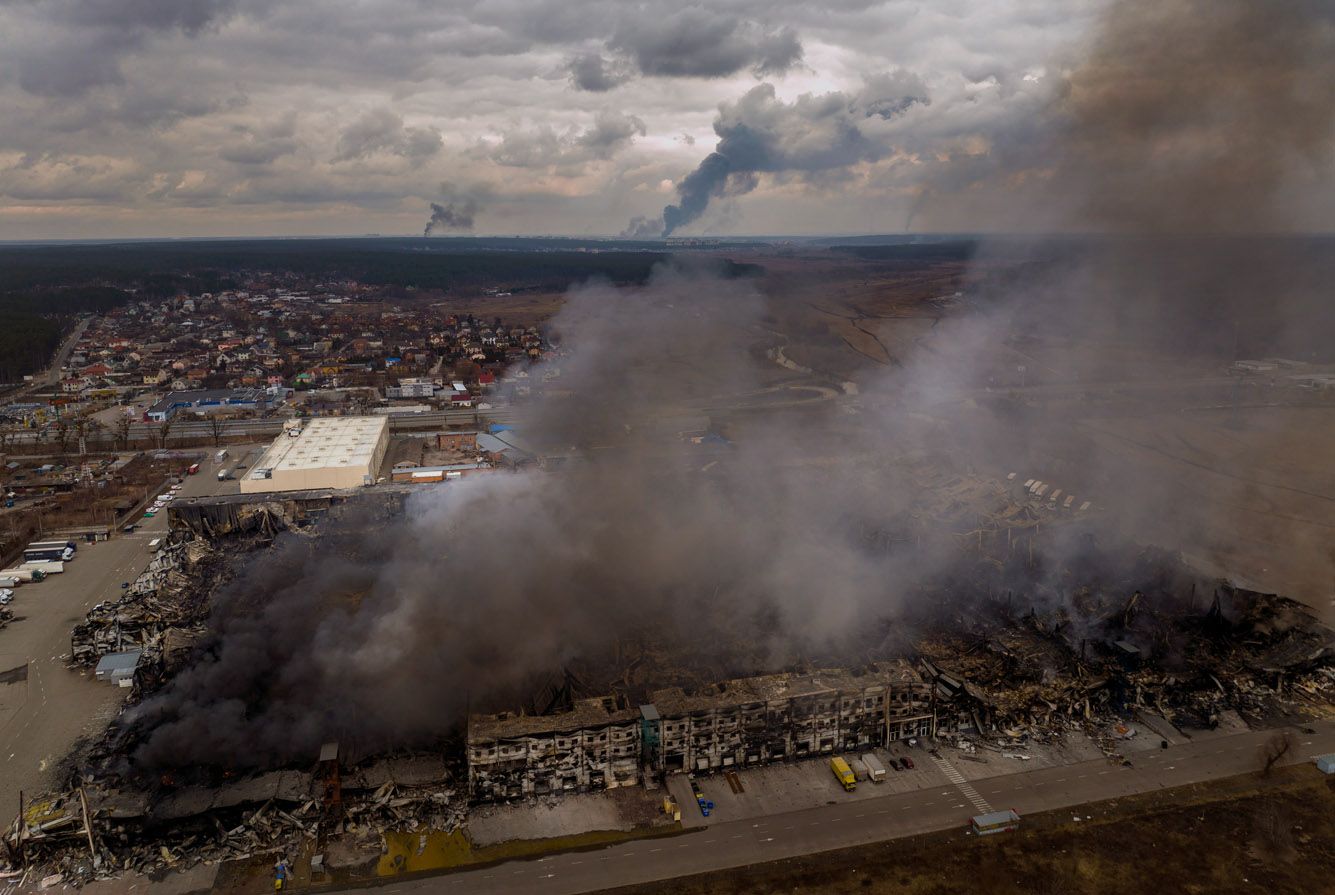
Today, March 24, 2022, marks one month since Vladimir Putin ordered Russian troops to undertake a full-scale invasion of Ukraine. These four weeks have changed the country beyond recognition: Ukrainian cities — from Kharkiv to Volnovakha, and Mariupol to Kherson — have suffered widespread damage and destruction from bombardments; more than 3.6 million people have been forced to flee abroad as refugees. The United Nations has recorded at least 2,685 civilian casualties, including 1,035 killed and 1,650 injured. The real toll is much higher — thousands have reportedly died in besieged Mariupol alone. The actual number of military casualties, both Russian and Ukrainian, also remains unknown as yet. To bear witness to this catastrophic month, Meduza shares one photo from each day of Russia’s war against Ukraine.
Economist Maxim Ananyev on the subtle consequences of war and sanctions for Russia (15-min read)
Since the beginning of the war in Ukraine, the United States and European countries have imposed harsh sanctions against Russia in an attempt to force the country to halt its attacks and withdraw its troops. Russian citizens are already experiencing economic difficulties, including losing their jobs and businesses. Supporters of the sanctions contend that President Vladimir Putin is to blame for this. Could economic losses impact Russian politics and compel the government to reconsider its course? Research Fellow Maxim Ananyev from the Melbourne Institute of Applied Economic and Social Research explains.
Yours, Meduza