
Оригинал материала
The Real Russia. Today.
Russian atrocities in Bucha
Monday, April 4, 2022
For ongoing coverage of the invasion of Ukraine and its consequences back in Russia, follow Meduza’s live updates. Please note that the authorities are now blocking our website in Russia, and we’re turning to you, our global audience, for financial support.
What you’ll find in today’s newsletter:
- Latest major developments
- Hundreds of civilians killed outside Kyiv
- Expert analysis: Andrei Zorin on Russian state ideology, Andrey Kortunov parses hawks and doves, Timofei Sergeitsev advocates genocide in Ukraine, Farida Rustamova and Ivan Timofeev warn that sanctions aren’t weakening Putinism, and lawyers fight for conscientious objection
Latest major developments in Russia and Ukraine
- A treason trial gets underway: Journalist Ivan Safronov’s treason case finally began behind closed doors on Monday. Prosecutors say he collected and sold data on Russian defense capabilities to intelligence agencies in Germany and the Czech Republic. He categorically denies the charges. Safronov’s lawyers say the case is riddled with procedural violations that have been ignored.
- Taking on the Wikipedians: Russia’s federal censor has ordered Wikipedia to remove information from entries about Russian war atrocities committed in Ukraine. Ekaterina Mizulina (the head of the Safe Internet League and the daughter of the reactionary senator by the same surname) claims credit for alerting Roskomnadzor to the offending content.
- No more hidden fees: The housing rental marketplace Airbnb has suspended service to all users based in Russia and Belarus, including any individuals who identified themselves using documents issued in either country. The company previously suspended all operations in Russia and Belarus.
- Cursed classrooms: The Russian authorities have issued new guidelines to schoolteachers, recommending special lessons devoted to the supposed benefits for Russia from Western sanctions, as well as how the sanctions are actually hurting other countries.
- Criminalizing evidence of atrocities: Russia’s Federal Investigative Committee and Attorney General’s Office have both threatened to press felony charges against anyone who disseminates “false claims” that Russian troops massacred civilians in Bucha. (Moscow both blames Ukrainian forces for these killings and argues that the corpses themselves were “staged.”)
A massacre in Bucha
Eyewitness accounts of life in Bucha under Russian occupation (6-min read)
For the third day in a row, international media remains flooded with horrifying reports about hundreds of civilians killed in Bucha, Ukraine. Russian forces began occupying this and other satellite cities of Kyiv in early March but have since retreated from the Kyiv region altogether. In their wake, independent journalists have recorded haunting scenes: in Bucha, the lifeless bodies of civilians were left lying in the streets — some of the victims had their hands tied behind their backs. Predictably, the Russian Defense Ministry claimed that the photos and videos emerging from Bucha were “staged” by the authorities in Kyiv. Meduza compiles eyewitness accounts of life in Bucha under Russian occupation, as told to journalists.
Ukraine’s President Zelensky visits Bucha in the aftermath of Russian occupation
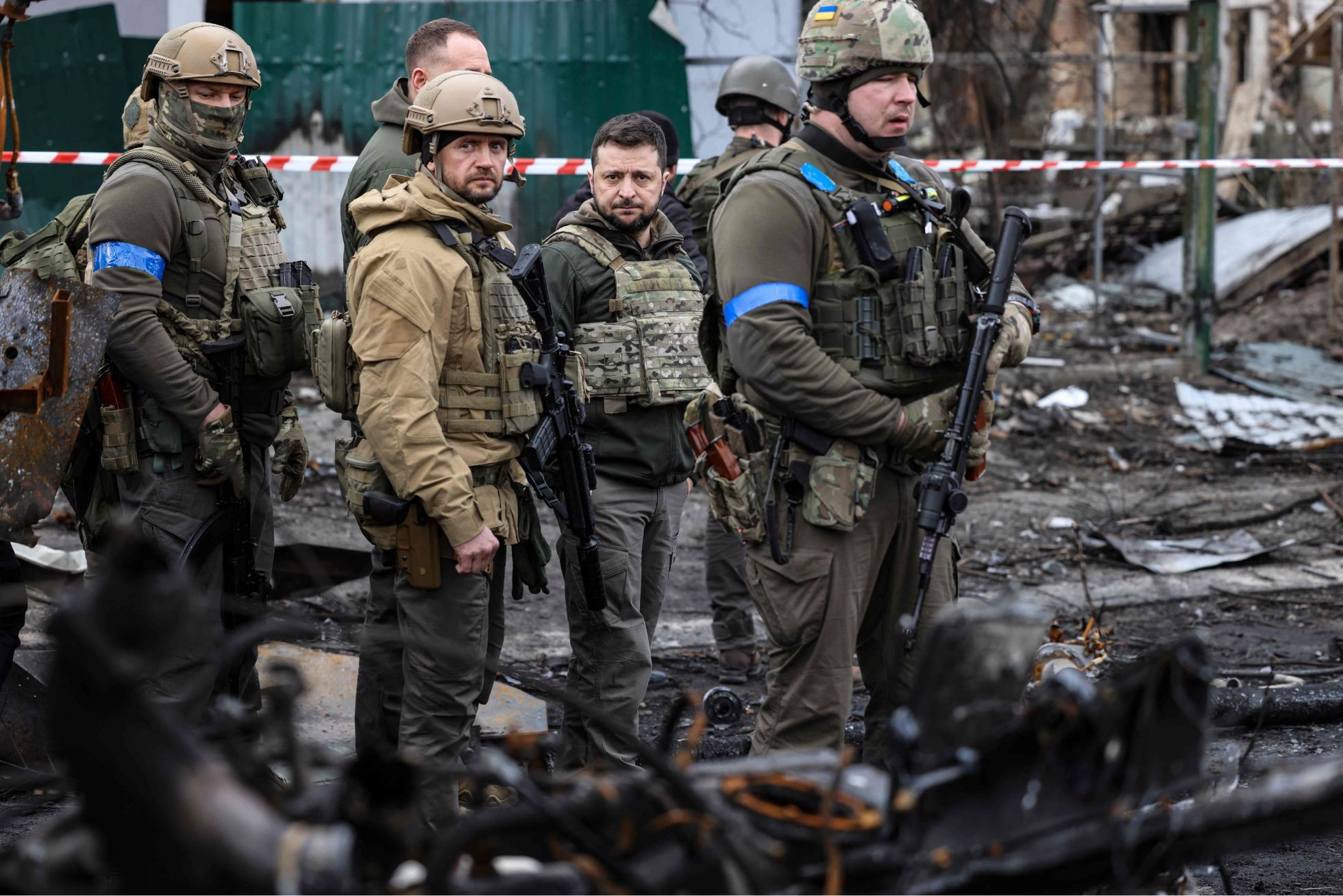
On Monday, April 4, Ukrainian President Volodymyr Zelensky visited liberated towns on the outskirts of Kyiv, where the bodies of hundreds of civilians were uncovered following several weeks of occupation by Russian forces. “With my own eyes I saw Bucha, Irpin, Stoyanka after the occupation. We will do our best to bring them back to life as soon as possible,” Zelensky wrote on his official Telegram channel. While in Bucha — the site of apparent atrocities against civilians — Zelensky told journalists that although it will be difficult to engage in peace talks with Russia, Kyiv will continue to seek a diplomatic end to the war.
Bucha City Council Deputy Kateryna Ukraintseva describes life under Russian occupation (15-min read)
After the Russian army’s retreat from Ukraine’s Kyiv region, dozens of civilians were found dead in the city of Bucha, some of them with their arms tied behind their backs. As of April 4, 410 civilian bodies have been removed from the recently liberated towns. The Russian Defense Ministry said that the images and videos from Bucha were “staged by the Kyiv regime” — this is Russia's standard reaction to both statements from the Ukrainian authorities and materials from independent journalists reporting on the war. To learn what life was like under Russian occupation, Meduza spoke to Bucha City Council Deputy and Ukrainian Territorial Defense Forces volunteer Kateryna Ukraintseva.
The world reacts to evidence of Russian atrocities in Bucha (5-min read)
On April 2, the Internet was flooded with photos showing dozens of murdered civilians on the streets of Bucha and other towns in Ukraine’s Kyiv region that were recently freed from Russian occupation. Since then, new eyewitness accounts and official reports of the crimes committed in the occupied territories have appeared; meanwhile, the Russian authorities have declared the images and accounts “fake” and a “provocation.” Meduza has compiled the world's reactions to the news so far.
Expert analysis
Why Russia’s war against Ukraine is the logical continuation of Russian state ideology (17-min read)
For years, Russia’s official ideology has revolved around the myth that the country is in danger and its enemies are trying to destroy it. The war in Ukraine is the logical continuation of this myth. To learn how deep the historical foundations for this conflict go, Meduza turned to Andrei Zorin, a professor at the University of Oxford who studies the history of Russian state ideology and the cultural and political myths that support it.
Hawks and doves in Russia can’t agree on the legitimacy of Zelensky and Ukrainian statehood
In an op-ed for Forbes Russia, Russian International Affairs Council director-general Andrey Kortunov argues that there are no clear socioeconomic conditions that determine support for either a negotiated political settlement or military ultimatum in Ukraine. The main division, he says, is ideological: those who view Zelensky as the legitimate leader of a major European country are inclined to favor peace talks. On the other hand, those in Russia who believe that Zelensky and his team are merely puppets of the West see no value in negotiations with Kyiv and think the war in Ukraine is a geopolitical battleground between Russia and the West.
Rejecting diplomacy assumes that Russia must pursue a “complete reset of the Ukrainian project,” tearing down and rebuilding Ukraine’s entire state structure. In other words, Moscow would need Kyiv’s total capitulation. This would require “victory at any cost” and long-term commitments throughout Ukraine to prevent guerrilla resistance and terrorist attacks. Meanwhile, continued hawkish rhetoric undermines Moscow’s capacity to convince the public later that a negotiated settlement could ever constitute victory.
A blueprint for genocide in Ukraine
In a shocking essay that openly advocates the “de-Ukrainianization of Ukraine,” columnist Timofei Sergeitsev offers what is essentially a blueprint for the genocide of Russia’s neighbor. In the text (published as an op-ed by the state-run news agency RIA Novosti), he develops ideas about the illegitimacy of Ukrainian statehood that Vladimir Putin has endorsed, adding that most of Ukraine’s population has “passively” enabled a “Nazi regime.”
To rectify this supposed situation, Sergeitsev proposes “reeducation” built on “ideological repression” that features control of the mass media and school curriculum, among other things. (He clarifies, however, that Ukraine’s “Banderite” high command and any “hopeless Nazis” should be “liquidated” outright.) Sergeitsev insists that Ukraine must lose its sovereignty in this process, which will last at least a generation. Russia has to manage this process, he says, claiming that Ukraine’s “artificial ethnocentrism” is a perversion of Greater Russia’s “natural borders.”
Sergeitsev concludes by claiming that Russia is actually the world’s last defender of “historical European values,” having performed selfless services to the West by developing socialism, defeating German fascism, and offering its friendship to the West in the 1990s. He also argues that Russia will now turn from the West and embark on its own path as a “leader in the global process of decolonization.” Given the West’s efforts to “tempt” Ukraine, Russia’s actions there now also constitute a form of decolonization, Sergeitsev says.
The sanctions have consolidated Putinism
Last week, on March 31, journalist Farida Rustamova published an article on her Substack blog warning that foreign sanctions have actually consolidated the Russian elite’s support for Vladimir Putin — a feat that has eluded Putin himself throughout his rule. According to her unnamed sources, state pollsters have concluded that Western economic warfare has enraged and offended the general public in Russia, rallying them to the president. “Society and the elites now feel like they’re in the same boat,” says Rustamova. Few who oppose the invasion of Ukraine can even meet with Putin anymore, she says. Resignations by unpopular figures like Arkady Dvorkovich and Anatoly Chubais do nothing to undermine support for the war, and Roman Abramovich’s role in negotiations with Kyiv says more about his unique relationship with Putin than anything else.
Echoing the sentiments of Rustamova’s sources, Valdai Discussion Club program director Ivan Timofeev argues in a Kommersant op-ed that Russians see Western sanctions as an attempt to humiliate them for being Russian, which only exacerbates anti-Western (not anti-Putin) perceptions. Broadly speaking, he says, Russians “fatalistically” believe that the West’s sanctions will remain in place “forever.”
Avoiding Russia’s draft
Human rights lawyers told Meduza that young men who wish to avoid conscription into Russia’s military can file for “alternative civil service” by declaring conscientious objections to serving in the armed forces. The activists say interest in the alternative civil service has skyrocketed since Russia’s full-scale invasion of Ukraine. (Even though the deployment of conscripts to Ukraine is technically prohibited, there have been confirmed reports of some of draftees being sent into battle or pressured or tricked into signing contracts and then deployed.)
Warning that draft boards sometimes reject legitimate conscientious-objection requests, the lawyers urge young men to insist on thorough medical exams, both to search for medical exemptions but also to document their state of health, so the military can be held responsible for any subsequent harm. Additionally, the human rights lawyers point out that conscripts are legally permitted to leave the country until their medical exam is complete (and poor communication among the state agencies often means it’s possible to sneak out, even after the medical board affirms an individual’s physical fitness).
Conscientious objections to serving in armed forces now engaged in an invasion of Ukraine can also rely on family commitments — namely, the fact that many Russians have relatives living in Ukraine. (In other words, they can insist that their blood ties prevent them from taking up arms in a military conducting a “special operation” in Ukraine.)
Yours, Meduza