
Оригинал материала
The Real Russia. Today.
Telegram's day in court is tomorrow, more State Duma mayhem, and Russians disagree with the Kremlin
Thursday, April 12, 2018
- When it comes to blocking Telegram, Russia's censor wants to get this over with already
- The State Duma passes a final reading of legislation that will make it easier to block “defamatory” online content
- Igor Sechin finally testifies in court against Alexey Ulyukayev
- Russians disagree overwhelmingly with the Kremlin: oligarchs still exist
- A man in Krasnoyarsk gets caught evading taxes on his lottery winnings
- Leonid Slutsky evades corruption charges, as the State Duma asks police to investigate his accusers
- The U.S. Treasury apparently “designated” the main bank Russia and Syria use for intergovernmental payments
- Moscow regional police continue their crackdown on businesses tied to the protests against an overflowing landfill
Story of the day: The “end” of Telegram in Russia draws near ⚰️
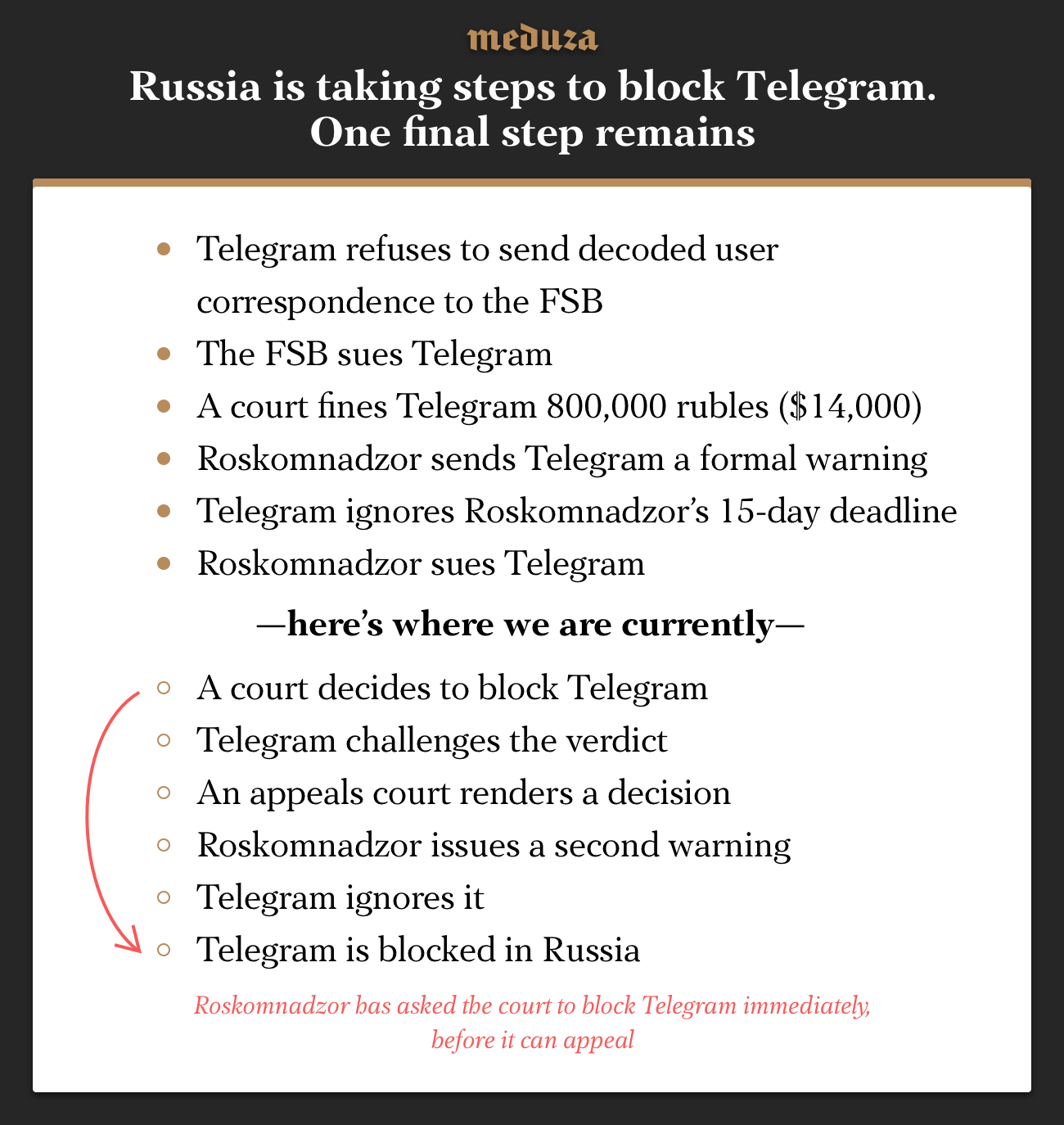
Russia’s federal censor isn’t angling for a long trial in its lawsuit against the instant messenger Telegram. In a preliminary case hearing on Thursday, Roskomnadzor asked Moscow’s Tagansky District Court to block Telegram “immediately.” The case itself starts on Friday, April 13. Telegram’s representatives didn’t attend the preliminary hearing.
If and when the court sides with the government, Russian law technically gives Telegram the chance to challenge the ruling in an appellate court. According to this procedure, the verdict wouldn’t take effect until after that court upholds the initial decision. Roskomnadzor would then issue a final warning. If Telegram ignores it, Russian ISPs would be ordered to block access to Telegram, and Google and Apple could also be told to remove Telegram from their app stores in Russia.
But Roskomnadzor has asked the Tagansky District Court to skip these last steps and sanction the blocking of Telegram right away.
What does the government want? The Federal Security Service has ordered Telegram to surrender the encryption keys for all user correspondence. Telegram insists that this is technically impossible because its software architecture doesn’t store these keys centrally (the keys are created and stored on users’ own devices). Russian lawmakers say Telegram must redesign its software, if it’s not currently capable of complying with the country’s new “anti-terrorism” laws.
The journalists Oleg Kashin and Alexander Plushev have filed a lawsuit against the Russian government in the European Court of Human Rights, arguing that the FSB’s demands violate their rights to privacy and free expression guaranteed by the European Convention on Human Rights. According to the Internet rights group “Roskomsvoboda,” another 40 Telegram users will soon file similar appeals with the ECHR. Telegram users have already tried to challenge the FSB’s demands in Russian court, but judges refused to hear the cases.
Russia will be blocking more online “defamation” soon 🙈
The State Duma has passed a third and final reading of legislation that will allow the government to block access to websites and online content that contain information deemed by a court to be defamatory. Currently, courts can only fine people periodically for disobeying orders to delete defamatory content
For example, since May 2017, when a judge ruled that his investigative report into Prime Minister Dmitry Medvedev defames billionaire Alisher Usmanov, Alexey Navalny has simply been incurring occasional fines for refusing to take down the report. The court ordered Navalny to delete the segments of his report that refer to Usmanov, but he has refused, and the report is still available online.
What will be different under this law? Under the new legislation, Russia’s Bailiff Service would be empowered to ask the federal censor, Roskomnadzor, to block Navalny’s blog and YouTube for failing to remove the claims about Usmanov.
Sechin finally faces Ulyukayev in court (behind closed doors) ⚖️
He never bothered to attend the first trial, but Rosneft CEO Igor Sechin has finally appeared in the flesh at Alexey Ulyukayev’s appellate hearing. Sechin’s 90-minute testimony came in a closed session on Thursday. Journalists were asked to leave the courtroom because he apparently divulged trade secrets in his remarks.
In December 2017, former Russian Economic Development Minister Alexey Ulyukayev was convicted of soliciting a $2-million bribe from Sechin. Ulyukayev was sentenced to eight years in prison and fined more than 130 million rubles ($2.1 million). The former minister denies the charges, saying that Sechin and Rosneft’s former head of security, FSB General Oleg Feoktistov, framed him.
- Ulyukayev gave a pretty memorable closing statement in his first trial. Read it here in English: “An elderly gladiator and his cardboard sword”
What’s the big deal about Sechin showing up in court today? Sechin was subpoenaed repeatedly in Ulyukayev’s first trial, but he never came to testify, insisting that his written statement would suffice as evidence. Ulyukayev’s lawyers said this wasn’t good enough, but the judge did not agree.
When it comes to oligarchs, Russians agree with the White House, not the Kremlin 💰
A day before the U.S. Treasury Department announced its latest sanctions against “Russian oligarchs,” Kremlin spokesman Dmitry Peskov told reporters that oligarchs long ago ceased to exist in Russia. According to a new national survey by the state-run pollster VTsIOM, the country overwhelmingly disagrees with Putin’s press secretary.
Ninety-four percent of respondents told VTsIOM that there are still oligarchs in Russia, and 44 percent of these people said oligarchs are responsible for more harm than good. Thirty-six percent of respondents said oligarchs do about as much harm as good, and just 9 percent of people said oligarchs are mostly good. According to VTsIOM director Valery Fedorov, Russians view oligarchs “as a reality” and as an “integral part of the country’s business landscape.”
Why do so many Russians hate oligarchs? Fedorov says the two main grievances are the semi-criminal origins of their assets and their excessive political influence.
Should five percent appear too small... 🤲
A man in Krasnoyarsk faces criminal charges for failing to pay taxes on his lottery winnings. In 2014, a man whose name hasn’t been disclosed to the public won 10 million rubles (about $161,000, by today’s exchange rate) in a local lottery. According to regulations, he owed a 13-percent tax on this prize. Russian Criminal Code 138 provides that the suspect can avoid prison time for a first offense, if he can pay the overdue taxes. If not, he faces up to three years behind bars.
The teflon lawmaker 🖕
In early March, researchers from Alexey Navalny’s Anti-Corruption Foundation reported that State Duma deputy Leonid Slutsky (the same man later exonerated by the Duma’s Ethics Committee for sexually harassing several journalists) failed for a decade to declare a hectare (2.5 acres) of land in the Rublyovka (a prestigious suburb outside Moscow). On April 12, the head of the parliament’s Income Monitoring Commission, Natalia Poklonskaya, said she would appeal to the police — not to investigate Slutsky, but to find out if Navalny broke the law when digging up this information.
The Anti-Corruption Foundation based its report on publicly available satellite footage and data pulled from Russia’s Federal Cadastral Records.
They’re letting Slutsky off the hook, again. The monitoring commission wasn’t even scheduled to discuss Slutsky’s income declarations today. According to BBC Russian, Slutsky was merely “passing by,” when he popped in and told his colleagues that he’d failed to declare the real estate for the past 10 years due to a “technical mistake” and would be listing it in his 2017 documents. The commission said, “Cool.”
Sanctioning Russia's main cash waterway with Syria 🏦
Earlier this month, when the U.S. Treasury sanctioned the Russian Financial Corporation Bank (RFC Bank), Washington apparently targeted the main financial institution used for settlements between the Russian and Syrian governments, according to the newsletter The Bell. RFC Bank was “designated” for being owned by Rosoboroneksport, which supplies weapons to Syria. “I’m not aware of any other banks through which these payments could be possible,” a source told The Bell. In terms of assets, RFC Bank is Russia’s 186th largest. The bank’s main clients are Rostech’s business partners, which includes Rosoboroneksport.
The crackdown in Volokolamsk 🚨
On Thursday, police in Volokolamsk (the Moscow suburb where residents have protested against an overflowing local landfill) raided the home of Yulia Kulikova, one of the defense attorneys for Artem Lyubimov, a businessman recently arrested “for resisting police.” Lyubimov has helped organize many of the town’s protests against the “Yadrovo” garbage dump. Officers also reportedly raided his home.
On April 12, law enforcement also raided the offices of the newspaper Volokolamsk Weekly and the “Moscow Raceway” sporting arena — both owned by the businessman Rustem Teregulov. According to the newspaper’s chief editor, police officers and investigators were looking for evidence of affiliations with several other companies suspected of criminal activity. Volokolamsk Weekly has reported extensively on the local protests against air pollution caused by the Yadrovo landfill.
This isn’t the first time the Moscow regional authorities have raided the offices and homes of local businessmen who supported Volokolamsk’s protesters. Read Meduza’s special report: “The consultant, the cosmetologist, and the car washer”
Yours, Meduza