
Оригинал материала
The Real Russia. Today.
The role of two billionaires, trained fighters, and Sverdlovsk's governor in the Yekaterinburg protests
Wednesday, May 15, 2019
This day in history: 128 years ago, on May 15, 1891, the Russian writer Mikhail Bulgakov was born in Kyiv. He is perhaps best known for his genre-defying novel “The Master and Margarita,” which was published posthumously.
- Yekaterinburg: Two billionaires are bankrolling a controversial construction project, and just wait until you see the multifunctional center they've got planned for across the street
- ↑ Who were the trained fighters who tried to break up the protests?
- ↑ Sverdlovsk's governor spends two hours in negotiations with protesters, and here's how that turned out
- ↑ Demonstrators illuminate public square in protest against cathedral construction
- Opinion: RTVI digital director Ilya Klishin thinks the Yekaterinburg protests are boring, and Muscovites are just seeing what they want to see
- Opinion: Carnegie Moscow Center director Dmitri Trenin says Pompeo’s visit wasn't about a reset or even detente
- Eco-operas and bloody museums: What Russia and Lithuania had to show the world at the 2019 Venice Biennale
- Burned Sukhoi Superjet 100 experienced partial power outage after lightning strike, source claims
- Renowned director Kirill Serebrennikov to adapt award-winning Alexey Salnikov novel for the screen
- Russian authorities may charge man with disrespecting the government for posting ‘Putin is an actual fuckwit, not an unbelievable one’
- Renewed autopsy of journalist Sergey Dorenko reveals no signs of poisoning
- Federal censor plans to create public registry of fake news sites
Yekaterinburg's protests
🏗️ St. Catherine’s Cathedral LLC
Supporters of a project in Yekaterinburg to build a new cathedral over one of the city’s few public parks have denied any commercial motivations. “We’re not talking about another shopping mall here,” one spokesman told a group of protesters this week at a meeting assembled by Sverdlovsk Governor Yevgeny Kuivashev. “An Orthodox cathedral would add both spiritually and aesthetically to the city,” the man explained. Based on a new report by Irina Pankratova at The Bell and earlier investigative work by other media outlets, however, St. Catherine’s Cathedral was in fact developed as part of a sweeping redesign of the entire October Square area. The church will join a colossal multifunctional center with housing, office space, a gym, and a shared underground parking lot, as well as several other new buildings.
Read Meduza's summary: “Two billionaires are bankrolling a controversial construction project in Yekaterinburg, and just wait until you see the multifunctional center they've got planned for across the street”
👊 The ‘Ural Hulk’ and friends
Protests against the destruction of a city square in central Yekaterinburg have entered their third day. Hundreds and sometimes thousands of the city’s residents have taken to the streets to oppose the planned construction of a cathedral in place of the square. Protesters began their first day of protests on May 13 by knocking down the fence surrounding the proposed construction site. Several hours later, groups of young men wearing athletic clothing pushed them out of the square. Although the men acted aggressively, the police officers present did not interfere. Meduza asked journalist Grigory Leiba to find out who the young men were. The bands of ‘cathedral defenders’ turned out to include champion martial arts fighters, members of the recently founded RMK Martial Arts Academy, and regulars at local gyms. The latter group, sources told Meduza, were offered money in exchange for dispersing protesters.
Read Meduza's story: “Who were the trained fighters who tried to break up protests in Yekaterinburg?”
✊ ‘We woke up in an occupied city’
On the evening of May 13, Yekaterinburg witnessed the start of mass, unplanned protests against the construction of a new cathedral in one of the city’s central parks. Demonstrators toppled a chain link fence that appeared around the site earlier that morning, before a group of men identifying themselves as “church supporters” forced the protesters back to the perimeter and restored the fence. The next day, Sverdlovsk Governor Yevgeny Kuivashev sat down together with representatives on both sides of the issue to hear their arguments. The meeting lasted more than two hours. Meduza presents a summary of the opposing positions.
Read Meduza's story: “Sverdlovsk's governor spends two hours in negotiations with protesters, and here's how that turned out”
🎆 Fireworks, flares, and a thousand lights
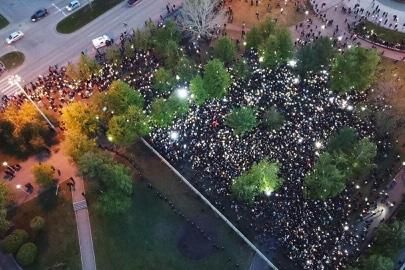
On May 15, crews in a Yekaterinburg public park started replacing the fence around a controversial construction site with a wall. The stronger barrier guards an area that will host a new cathedral. On May 13 and 14, thousands of protesters against the construction project repeatedly toppled the chain link fence, leading to dozens of arrests for disorderly conduct. Despite the demonstrations, city officials have refused to suspend the cathedral's construction.
See more photos: “Demonstrators illuminate public square in Yekaterinburg in protest against cathedral construction”
Opinion and analysis
🔎 Klishin: everyone sees what they want to see in Yekaterinburg, no matter how boring is really is
Who cares about a crowd standing around, chanting slogans about a park? In an op-ed for Vedomosti, RTVI digital director Ilya Klishin says Russia’s sudden interest in demonstrations against the construction of a cathedral in Yekaterinburg is the latest manifestation of changes in Moscow that have shifted the political class’s attention away from the capital to conflicts across the nation.
Klishin thinks the trend is problematic. Whether it’s gubernatorial elections in Primorye, the harassment of Alexey Navalny’s supporters in small towns, protests against landfills outside Moscow, environmentalists in Arkhangelsk, or protests in Ingushetia against a deal redrawing the boundary with Chechnya, political commentators are too eager to see these isolated events as symbols of greater power struggles that could topple the establishment. In Yekaterinburg, for example, liberals see a clash between Russia’s past and future, and the paralysis of the Putinist bureaucracy, while the Kremlin witnesses another attempt to import Ukrainian revolutionary tactics, and the trampling of traditional values.
In fact, Klishin argues, what’s happening now in Yekaterinburg is actually a “pretty boring story,” not unlike a dozen incidents that play out in Moscow every year. Local demonstrations, he says, are about simple, immediate things, like public parks and clean air, and these activists have no interest in serving as living proof of whatever grand theory some Muscovite political consultant cooked up most recently.
Where does Russia go from here? The news media will stay on this course, Klishin says, and analysts and activists both for and against the Kremlin will go on viewing each new conflict as the promise of regime change, for better or for worse. This will likely continue until it becomes a self-fulfilling prophecy, he warns.
🕊️ Trenin: Pompeo’s visit wasn't about a reset or even detente
In a new article, Carnegie Moscow Center director Dmitri Trenin says U.S. Secretary of State Mike Pompeo’s visit to Sochi this week was about reducing misunderstandings and miscalculations in Russian-American relations, not developing full-fledged cooperation between the two adversaries.
Trenin says Pompeo’s meetings with Foreign Minister Sergey Lavrov and President Vladimir Putin were the latest steps in the White House’s push to reestablish high-level contacts. But what does Trump hope to accomplish by re-engaging Moscow?
The timing of the decision, which follows the release of the Mueller Report, is suspicious to many of Trump’s critics, and the president still faces a two-party consensus against Russia in Congress, the “U.S. political class,” and much of his own administration. But Trenin thinks Trump’s motivations are no mystery, arguing that the president has consistently tried to use America’s remaining global hegemony to force Washington’s adversaries to play by its rules internationally.
On the one hand, the president’s realist view of the world appeals to the Kremlin, but on the other hand Trump’s handling of China, Iran, and North Korea suggests that Russia can expect ultimatums and impositions, not a search for balanced interests.
What each side wants most, the other cannot offer, Trenin says. The United States would like to see Russia distance itself from China, and join the diplomatic pressure on Iran and North Korea. Moscow, meanwhile, still wants an end to U.S. sanctions. Unfortunately for Washington, nothing America can provide or threaten will be enough to change Russian foreign policy, which Trenin insists is based on Russia’s fundamental national interests.
That said, there’s still negotiating room in U.S.-Russian relations for talks on strategic arms control (New START expires in February 2021), the stabilization of Afghanistan (where Washington and Moscow have pursued “parallel diplomatic paths” to include the Taliban in a political settlement, and prevent the region from becoming another terrorist base), and containing the conflicts in North Korea, Iran, and the Donbas. Whatever happens, Trenin cautions Russians against pinning their hopes on Donald Trump or any “specific American partner.”
The 58th Venice Biennale began in Italy on May 11. The famed contemporary art exhibition’s theme for 2019 was “May you live in interesting times,” and its curator was Ralph Rugoff, the director of the Hayward Gallery in London. One of the event’s Golden Lion prizes went to Lithuania for its ecological opera performance piece Sun & Sea (Marina). The American director Arthur Jafa, whose film The White Album is featured at the Biennale, won the Golden Lion award for the best artist in the main exhibition. Meduza’s correspondent reported on the Lithuanian pavilion and the controversial decision to allow St. Petersburg’s Hermitage Museum to represent Russian art at the Biennale. The exhibition will remain open until November 24, 2019.
Read Meduza's story: “Eco-operas and bloody museums: What Russia and Lithuania had to show the world at the 2019 Venice Biennale”
News briefs
- ✈️ Citing a source close to the investigation surrounding the deaths of 41 people in a Moscow airplane fire, Kommersant reported that key power systems on the plane failed after a lightning strike in the air. Read the story here.
- 📽️ Award-winning director Kirill Serebrennikov will lead a film adaptation of Alexey Salnikov’s novel The Petrovs in Various States of the Flu. Salnikov received two of Russia’s most prestigious literary prizes, the NOS prize and the National Bestseller prize, for the novel, which describes a family’s illness in haunting language critics have compared to that of Gogol and Bulgakov. Read the story here.
- 🤬 Police have filed misdemeanor charges against Vologda Oblast resident Yury Shadrin under Russia’s recently passed administrative law against insulting state officials online. Pavel Chikov, who leads the human rights group representing Shadrin, wrote about the case on Telegram. Read the story here.
- 👩⚕️ Experts found no trace of any toxic substances in the blood and tissues of Sergey Dorenko, a well-known Russian journalist who died on May 9. Interfax, RBC, and Bazareported on the results of the autopsy. Interfax’s source said natural causes remain the primary explanation for Dorenko’s death. Read the story here.
- 📰 During a media forum on “Truth and Fairness” in Sochi, the leader of Roskomnadzor, Russia’s regulatory agency for communications, said the agency intends to publish a registry of unreliable or fake news sources on its website. Read the story here.
Yours, Meduza