
Оригинал материала
The Real Russia. Today.
Reactions to a bombshell investigation implicating Russia’s FSB in Navalny’s poisoning, plus an unwelcome tail in Grozny
Monday, December 14, 2020
- Bellingcat joint investigation implicates FSB in Navalny poisoning
- Meduza marks the 25th anniversary of the end of Europe’s bloodiest inter-ethnic conflict since World War II
- New podcast episode: What monetary policy and banking say about Russian politics
- Opinion and analysis: Milashina investigates her followers in Grozny, and Shablinsky explains Putin’s need for more authority
- News briefs: courtroom updates on the Ivan Golunov and Anastasia Yeshchenko cases
Navalny’s poisoners unmasked 🕵️
A group of operatives from a secret sub-unit of Russia’s Federal Security Service (FSB) were responsible for the assassination attempt on opposition figure Alexey Navalny in Tomsk this summer, says a joint investigation from Bellingcatand The Insider, in cooperation with Der Spiegel and CNN.
- Read Meduza’s summary of the report here.
Early reactions to the investigative report:
- On Telegram, journalist Timur Olevsky noted that conspiracy theories about Bellingcat and The Insider leaking information for the CIA and MI-6 (see Kashin’s comments below) appeal to people outside Russia’s circle of paid propagandists. Olevsky has a rhetorical question for these individuals: how did Western spies get access to classified records in Russia? Either this information is widely available on the black market (which is what researchers say) or it’s guarded behind the Kremlin’s impenetrable wall of secrecy.
- On Facebook, Navalny’s righthand man Leonid Volkov mocked the cynics who dismiss the Bellingcat report’s conclusion that the FSB tried to kill his boss. Volkov’s approach is novel: facetiously but with deadpan delivery, he retells the events leading up to Navalny’s illness, citing the travel and phone calls discovered by Bellingcat, narrating as though the federal agents surveilling Navalny were devoted single-mindedly to protecting him in order to guard President Putin against false blame for any potential harm to the opposition star.
- In an appearance on Alexander Plushev’s Ekho Moskvy radio show, columnist Oleg Kashin claimed that Bellingcat leaks materials from Western intelligence agencies. As with a recent false claim that Alexey Navalny’s father-in-law is a London-based KGB general, Kashin offered no evidence for his allegations. In fact, he now openly refers to himself as a “conspiracy theorist.”
- On Twitter, media personality Lesya Ryabtseva (perhaps best known for trashing the reputation of Ekho Moskvy’s opinion section) argues that Navalny is “basically a criminal on the run,” claiming that the West is now “using him” to defame Russia.
- In a commissioned Telegram post (written by the popular anonymous channel “ia_steklomoy”), Russia Today compared Navalny’s YouTube video identifying his FSB assailants to “another schoolgirl on Twitter” conning people out of money by “lying” about being raped and beaten by her stepfather.
Feature stories
💥 The Bosnian War, in photos
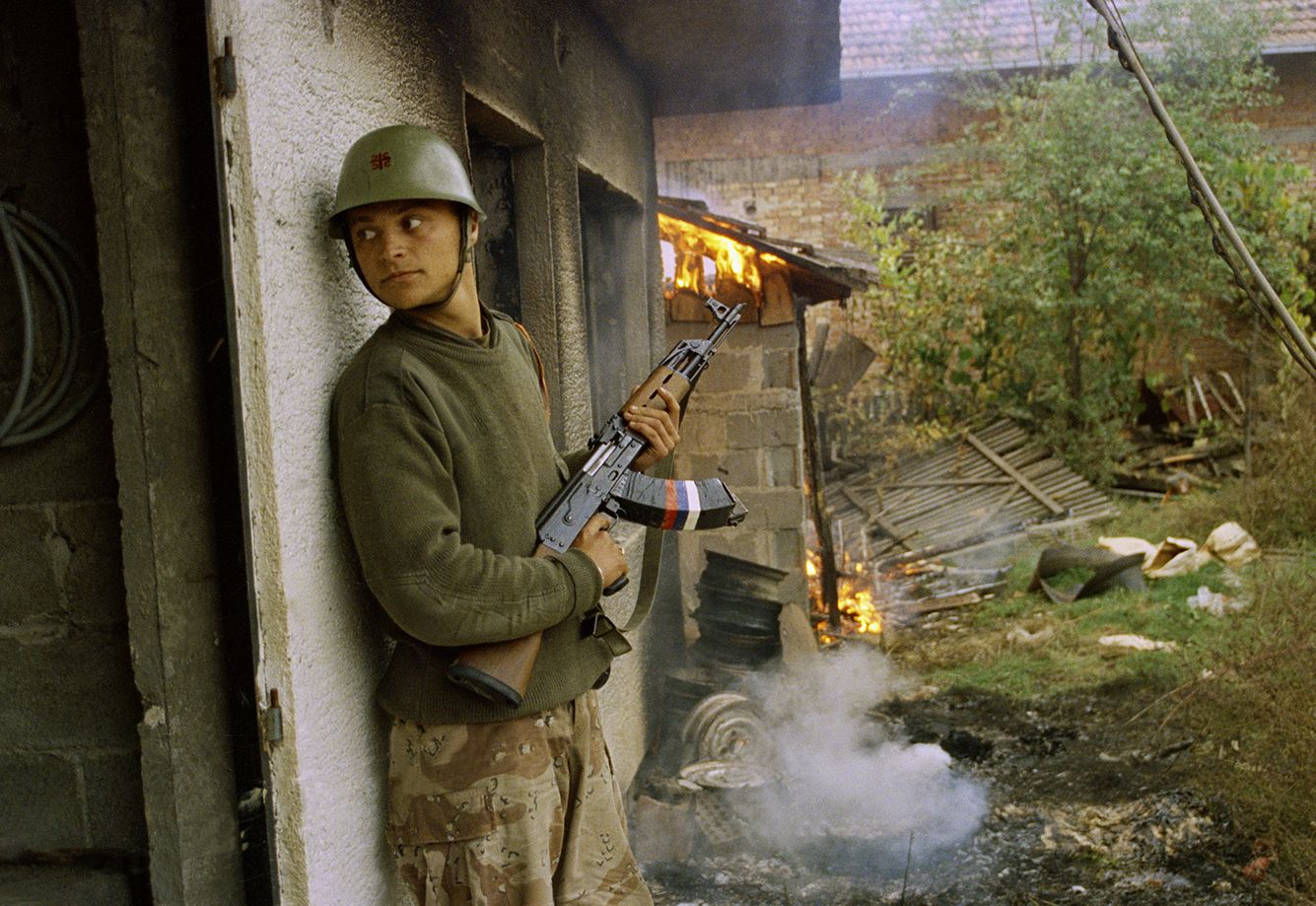
On December 14, 1995, the Dayton Accords were signed in Paris, officially ending the Bosnian War — the bloodiest interethnic conflict in Europe since World War II, which saw about 100,000 people killed between 1992 and 1995. To mark the 25th anniversary of the end of the conflict, Meduza shares photographs from the three-and-a-half years of fighting.
🎧 “The Naked Pravda”: Follow the money
Even if you follow news in Russia regularly, you might be unaware or only vaguely aware that Russia’s Central Bank printed an enormous sum of money over the past decade in a sweeping campaign to restructure the country’s major banks and liquidate smaller failing financial institutions. In a recent joint investigative report, Meduza and its media partners spoke to sources and obtained testimony from witnesses who described major abuses of authority by banking executives and senior regulatory officials.
For further discussion about these events, and for more background and context about Russian monetary policy, “The Naked Pravda” turns to two experts: Tom Adshead, the director of research at Macro-Advisory Ltd. (an independent strategic advisory and macro analytics firm), and Stephanie Petrella, the editor-in-chief of BMB Russia and Ukraine and a fellow at the Foreign Policy Research Institute’s Eurasia program.
Opinion and analysis
🕵️ Not-so-secret police surveillance in Grozny
Elena Milashina, correspondent — *Novaya Gazeta*
Back in February 2020, a group of women in Grozny attacked Novaya Gazeta correspondent Elena Milashina and Marina Dubrovina, the lawyer who initially defended Islam Nukhanov, a man arrested and allegedly tortured months earlier after he shared footage on YouTube showing some of the mansions owned by Ramzan Kadyrov’s family. Nukhanov was later sentenced to four years in prison for what he says are false charges. Earlier this month, on December 9, 2020, he was returned to court in a failed bid to challenge his conviction.
Nukhanov isn’t the only one who’s struggled with Russia’s authorities. Also without success, Milashina and Dubrovina have sought police protection in Chechnya, following the attack in February. The two nevertheless returned to Grozny to attend Nukhanov’s appeals trial and to visit Chechnya’s Investigative Committee headquarters in person, which is the only way they can access the materials collected involving the attack against them.
Dubrovina later noticed two men following her. After some additionally suspicious phone calls, she decided to leave Chechnya ahead of schedule. Milashina and Nukhanov’s new lawyer, “Memorial” attorney Alexander Karavaev, remained in Grozny, and soon noticed that they, too, were being followed by someone driving a white Toyota Highlander. Using the license plate number, Karavaev found that the car is registered to a man named Zelimkhan Dokkaevich Mutsaev, who — it turns out — is the brother of Alikhan Dokkaevich Mutsaev, a murdered ex-bodyguard for Alu Alkhanov, Chechnya’s former president and Ramzan Kadyrov’s erstwhile political rival.
Alikhan Mutsaev was shot in Moscow in October 2007, a year after Anna Politkovskaya. Milashina suggests that their murders, along with the killings of several senior law-enforcement officials, were part of Ramzan Kadyrov’s campaign to consolidate power against the conspirators who allegedly backed Alu Alkhanov against Kadyrov at a rumored meeting in Nalchik in September 2006.
After Novaya Gazeta published the story, the newspaper’s Chechen sources in the Federal Security Service confirmed the surveillance operation and explained that Zelimkhan Mutsaev sold his car to one of the police officers ordered to tail Milashina and Karavaev. Before learning this information, however, Milashina developed an elaborate theory arguing that sending Alikhan Mutsaev’s brother to follow her was intended as a signal: Ramzan Kadyrov’s “last warning” not to meddle in his regime’s affairs. (The information from Novaya Gazeta’s FSB sources apparently deflates this theory.)
⚖️ What’s the perfect Christmas gift for the authoritarian who already has everything?
Ilya Shablinsky, legal expert with the Moscow Helsinki Group — *Proekt*
When Russia amended its Constitution earlier this year, there was plenty of fluff — “decorative and declarative” reforms — but the changes relating to the president were stonecold serious, says Shablinsky, who tries to explain why Putin keeps expanding his authority, despite the president’s already sweeping executive powers. According to Shablinsky, the two biggest changes in terms of presidential competence are (1) the head of state (not the Federation Council) now appoints Russia’s attorney general, and (2) the president can now initiate the dismissal of judges serving in Russia’s Constitutional Court and Supreme Court.
But why does the Kremlin bother with these reforms, if the president already enjoyed nearly absolute power? Shablinsky says it’s because the Putin administration has effectively embraced an unwritten “state ideology” built on the concept of constantly expanding its own power. The two tenets here are (1) the president is always right, and (2) the outside world is a hostile place and Russia needs the president to protect it.
Shablinsky says the authoritarian components of Russia’s Constitution (he doesn’t acknowledge this, but these components are tricky to distinguish, given the enormous executive powers embedded in Russia’s pre-Putin 1993 Constitution) won’t likely outlive Vladimir Putin himself. He bases this projection on observations in collapsed European and Latin American dictatorships. In free elections, he says (without explaining why democracy would emerge after Putin) that Russians would vote to increase the parliament’s authority and restore the judiciary’s independence.
Other news in brief
- ⚖️ Another false start.Just minutes after the start of today’s hearing in the trial of the former police officers accused of staging Meduza correspondent Ivan Golunov’s false arrest last summer, the Moscow City Court decided to postpone further consideration of the case until December 17.
- ⚖️ A murderous mentor. The prosecution has requested 15 years in a maximum-security prison for former St. Petersburg State University professor Oleg Sokolov, who killed his former graduate student Anastasia Yeshchenko in November 2019.
🕯️ This day in history: 31 years ago today, on December 14, 1989, Soviet human rights icon Andrei Sakharov died in Moscow at the age of 68. A chief architect of the USSR’s thermonuclear weapons, he later became an advocate of civil liberties and civil reforms, winning the Nobel Peace Prize in 1975.
Yours, Meduza