
Оригинал материала
Love works wonders?
Russia's curiously mixed reactions to the legalization of same-sex marriage in the US

The US Supreme Court’s decision last week to recognize a constitutional right to same-sex marriage in all 50 states has prompted a wave of reactions in Russia—some expected in a country that’s become notorious for homophobia in public life, and others surprisingly tolerant.
According to sociologists, people in Russia are overwhelmingly critical of the LGBT community. In a national poll conducted in March this year, the Levada Center found that just 11 percent of Russians consider homosexuality to have the same right to exist as heterosexuality. A whopping 37 percent of the country thinks gays require medical attention—and the most highly educated Russians are the most likely to believe this. Yet, for all their dislike of gays, most Russians routinely show little interest in the “LGBT threat.” Other issues, like national security and the economy, always rank higher as public concerns, and polls show that Russians aren’t even interested in news that involves the LGBT community.
Russia’s government and media have been able to use homosexuality to frighten the public and remind Russians of their differences with the West. But how long can this go on, and are we witnessing signs of fatigue?
The “gay-propaganda” guy
Following Facebook’s release of a special tool that allows users to “celebrate pride,” Vitaly Milonov, the conservative St. Petersburg city councilman who spearheaded Russia’s laws against “gay propaganda,” immediately advocated banning Facebook in Russia. Milonov even implied that the rainbow-avatar phenomenon was the work of the “gay lobby” collaborating with “anti-conservative, ultra-liberal groups in Russia,” saying the LGBT pride celebration amounts to a “reconnaissance mission.”
Trolling for equality
Though his role in elevating the ban on “gay propaganda” has had a major impact on the climate of gay rights in Russia, Milonov in recent years has become something of a parody of himself, quarreling with young women on airplanes, shouting at peaceful demonstrators, and even protesting homoerotic artwork on Finnish stamps. Each time he does or say something outlandish, his public persona undoubtedly benefits from the publicity, which likely motivates further stunts and outbursts.
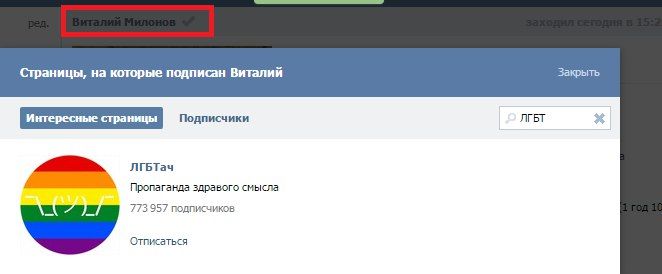
Last week, amid worldwide celebrations about the US Supreme Court’s decision on same-sex marriage, the controversial online group Lentach (a community on VKontakte with more than 770,000 members) briefly changed its name to LGBTach and added the rainbow pride colors to its avatar. Thousands of users suddenly joined and left the group—either out of support, disgust, pride, or who knows what—and Lentach was left with 2,000 fewer followers the next day.
The group’s administrator, Mark Shein, says he’s glad to be rid of the dead weight, however, declaring that the experiment proved to be a “self-cleansing” for the community. Shein also pointed out that Lentach’s brief reinvention meant that Milonov himself, one of the group’s followers, was unwittingly recruited into an LGBT community.
One flag deserves another?
Milonov wasn’t the only man in Russia who felt challenged by Facebook’s pride initiative. Graphic designer Oleg Chulakov soon created a similar tool that allows users of Facebook and VKontakte to decorate their avatars in the colors of the Russian flag.
While Chulakov says his tool isn’t homophobic, most people using the Web app clearly intend it as a gesture of opposition to same-sex marriage.
Gay panic
The day of the of the US Supreme Court ruling, Duma deputy Alexander Sidyakin tweeted his congratulations to the citizens of the United States, writing that their government had at last responded to the will of the people. “Love and be loved,” said Sidyakin, a member of United Russia, the country’s ruling political party.
An hour later, Sidyakin tweeted again, clarifying that he’d meant the congratulations “ironically.” Afterwards, he deleted both tweets, apparently concerned that readers might mistake his joke for a heartfelt expression of tolerance.
Can’t we all just get along?
Three days later, a sitting member of Russia’s Senate did something even more unexpected, proposing that the country codify the principle of “don’t ask, don’t tell,” which once allowed homosexuals to serve in the US military. “It is necessary to get rid of quasi-politicians who are exploiting the fight against gay people and engaging in political and legislative spamming on the political arena. The faster we get rid of them, the better,” Senator Konstantin Dobrynin said. “It is these people, and not gay people, who are presenting an obvious threat to Russia’s security.”
In what has been the most surprising public statement of all, TV news anchor Dmitry Kiselyov earlier this week endorsed same-sex civil unions in Russia, telling viewers on air, “In the end, love works wonders, and who’s against that?” This comes from a man who, three years ago, advocated “burying or burning” the hearts of gay car accident victims, as their organs are “unfit for extending anyone’s life,” suggesting that sexually transmitted diseases in the LGBT community pose too great a risk.
Kiselyov now says, “We can manage to make life easier for adults who want—both informally and formally—the responsibility of taking care of each other.”
Kevin Rothrock