
Оригинал материала
Exhausting work
Available battlefield videos suggest that Russia and Ukraine are ‘knocking out’ each other’s tanks and artillery equipment at roughly the same pace
In this article, Meduza’s editors try to assess the battlefield situation in Ukraine using available information. Meduza opposes the invasion of Ukraine and holds Russia responsible for its military aggression against a peaceful neighbor.
For several months, the Ukrainian Armed Forces have waged a counteroffensive that has alternated between (1) attempts (so far unsuccessful) to break through near Bakhmut and in the south of the country and (2) long periods of “enemy exhaustion,” during which Ukrainian troops try to weaken Russia’s Armed Forces by attacking its equipment and fortifications. Exhausting the Russian Army is one of the summer-fall campaign’s official goals. Spokespeople for the UAF claim that Ukrainian soldiers will be able to liberate currently occupied territories upon winning this battle of attrition.
Meanwhile, Russia’s Defense Ministry says its main task in Ukraine is to “knock out” the enemy’s equipment by relying on “active defense.” Moscow likely plans to recommence its offensive once enough Ukrainian equipment is destroyed.
It’s unclear who exactly is winning this “war of attrition” and who’s exhausting whom. Some answers can be found in videos showing damaged and destroyed equipment on both sides, but any conclusions based on available footage are inherently cursory and incomplete. Even with the equipment that finds its way to published videos, it’s often difficult to judge its condition in footage recorded from a great distance by drones or Russian attack helicopters (as is the case with some guided missiles).
Despite these limitations, however, a large number of videos clearly show specific types of equipment in various conditions, which is enough to identify general patterns on the battlefield. Comparing the footage available in pro-Russian and pro-Ukrainian databases, Meduza found that both armies’ losses of most types of equipment are roughly equal, and this ratio barely fluctuates by the month.
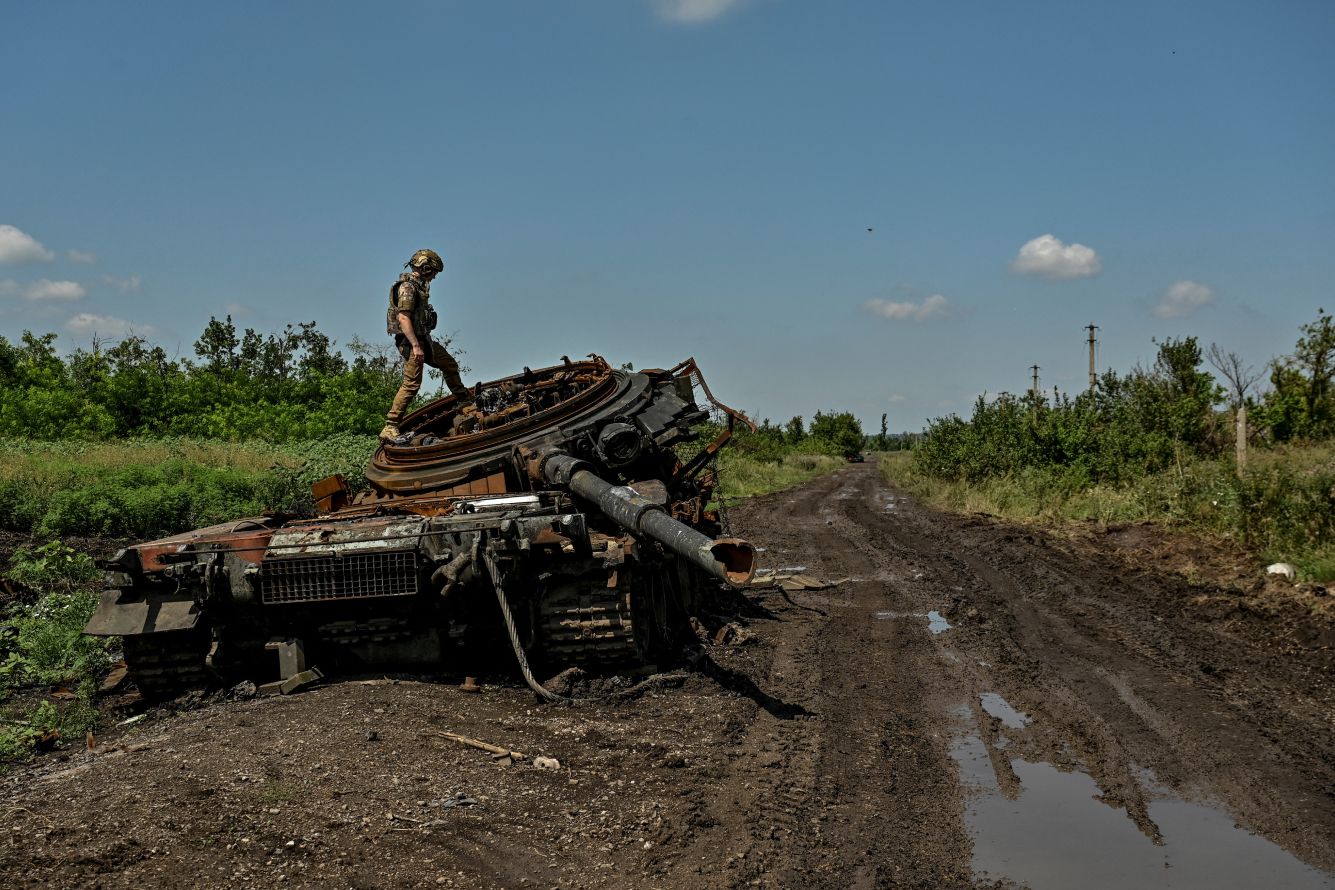
- According to available videos, Russia’s Armed Forces have lost 1.5 times more tanks than Ukraine (252 versus 152) since early June. In September alone (until September 29 at least), the ratio held steady at 47 Russian tanks lost versus 34 Ukrainian tanks. In August, the losses were 47 and 30, respectively. Russia’s more significant losses here are probably due to Moscow’s greater willingness to use them in advanced forward units in the counteroffensive that Ukraine is willing to field in its attempts to break through Russian lines.
- In the current round of fighting, like at all other stages of the war, both sides rely on cannon and rocket artillery as their main tool for suppressing and destroying the enemy. Therefore, it’s reasonable to view artillery losses as the most important indicator of “exhaustion.” Throughout the summer and the start of the fall, both sides have lost roughly equal amounts of guns, mortars, and multiple rocket launchers (with calibers greater than 120 millimeters). However, In recent weeks, Ukraine’s Armed Forces have enjoyed marginally more success suppressing the enemy’s artillery fire. Videos available since June 4, when Kyiv’s counteroffensive began, indicate that Ukraine has destroyed 220 of the enemy’s guns and multiple rocket launchers while losing 192 artillery systems of its own. In September alone, the losses were 51 versus 39. A month earlier, it was 46 to 38.
- But Ukraine is losing significantly more armored vehicles (infantry fighting vehicles, armored personnel carriers, mine-clearing vehicles, and other engineering and armored equipment), probably because Kyiv is using these vehicles to deliver infantry to the front lines through minefields, to clear the minefields, and so on. On the other hand, the Russian military uses this equipment mainly to provide covering fire from concealed positions for troops. Meduza found video evidence of 518 damaged or destroyed Ukrainian armored vehicles and just 420 Russian vehicles. Russia lost 70 armored vehicles in September while “knocking out” 104 of Ukraine’s.
In general, judging only by this limited evidence, the Russian and Ukrainian militaries are exhausting each other at similar rates, though it’s impossible to establish how these losses could affect either side’s combat effectiveness. First, the available footage isn’t comprehensive and doesn’t present us with the war’s real losses. Second, it’s unclear how both armies will try to compensate for their losses.
For example, in 2022 and 2023, Ukraine has been promised and received almost 800 tanks, including nearly 300 Western models. Deliveries will continue into 2024, exceeding this plan, but the volume of new supplies will depend partly on Ukraine’s losses at the front lines.
How Russia covers its own losses is even more uncertain. Officially, Moscow has talked about deliveries in 2023 of 1,500 tanks (according to Dmitry Medvedev) or even 1,600 tanks (as Vladimir Putin said in March). But these seem radical exaggerations, even if we include repaired tanks returned to the battlefield and the ancient T-62 and T-55 tanks removed from storage. In reality, Uralvagonzavod — the only manufacturer of modern tanks in Russia — has failed for decades to produce more than 300 new tanks in a single year.