
Оригинал материала
We turned out to be third-class citizens without rights. If I no longer believe in anything, what should I believe in?
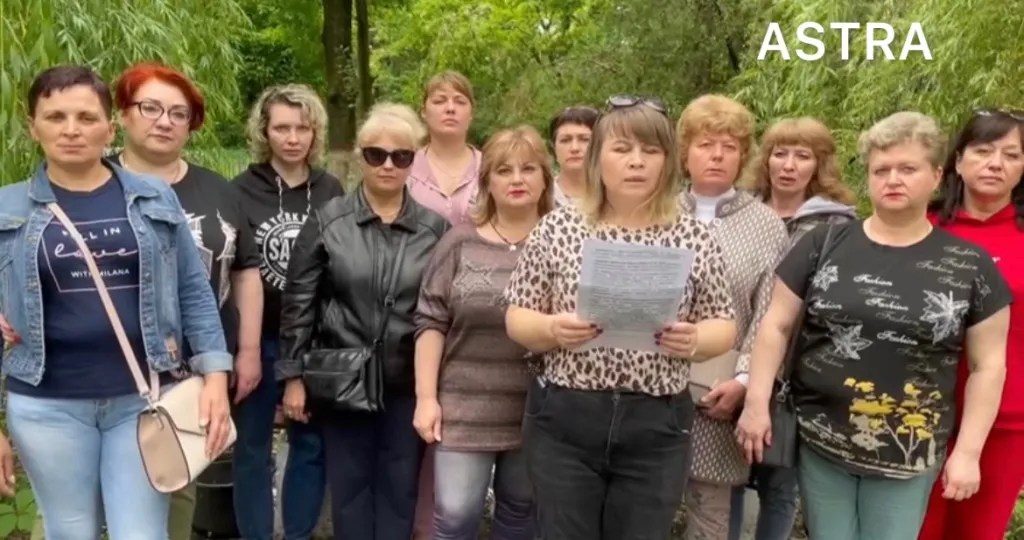
Men over 50 who were mobilized in the “DPR” (Donetsk region) were not released from the front despite serious illnesses, decisions of the military prosecutor’s office on dismissal from the army, orders of the command of the Southern Federal Military District, and commanders from the General Staff of the Russian Federation. The wives of the mobilized cannot achieve justice.
ASTRA note: This text shows the position of women residents of the “DPR.” According to Ukrainian law, the territories controlled by the “DPR” and “LPR” (Lugansk region) are considered “temporarily occupied” by Russia. The international community also considers the “LDPR” territories belong to Ukraine.
Elvira’s (name changed) husband was mobilized on February 22, 2022 (Mobilization in the “DPR” began on February 19, 2022 – editor’s note).
“At the company where he works, they were told that they would go to two-week military training. He has no military specialty; he served as a conscript back in the Soviet Union. He is a miner – a miner with occupational diseases. My husband has two vertebral hernias, displacements of the vertebrae. He can’t wear a bulletproof vest for long. But none of those mobilized had a medical examination. And now he has been at the front for a year and a half. No vacations, no layoffs. Only on December 31 was he allowed to go home. He still has no military ID, personal file, or badge. And he is not dismissed from the army, despite two reports of dismissal upon reaching the age limit, which he wrote in the spring.”
Your husbands should be released.
Thousands of women are caught in a similar vicious circle — walking between the garrison military prosecutor’s office, the command of the Southern Federal District, the Ministry of Defense, and the presidential administration. They go on a “journey” from Donetsk to Rostov to Moscow, standing on the threshold of military officials at various levels.
“The worst thing is that our patriotism, the sense of belonging to Russia, and faith in the truth are being killed. Nobody needs our problems. Just like ourselves!” – says one of the mobilized wives.
The women recorded video messages and sent a collective letter to the Ministry of Defense signed by 107 people. They received a response from A. Tulyaganov, head of the 2nd Directorate of the Main Organizational and Mobilization Directorate of the General Staff of the Armed Forces.
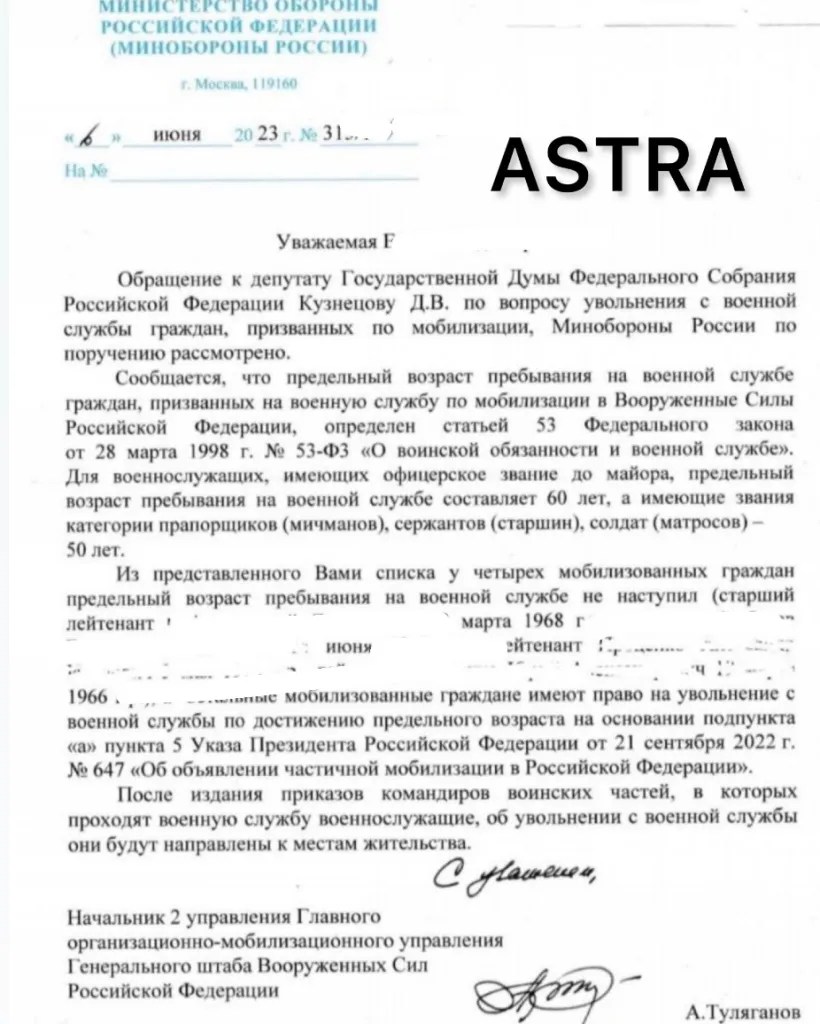
“It is reported that the maximum age for military service for citizens called up for military service upon mobilization into the Armed Forces of the Russian Federation is determined by Article 53 of the Federal Law of March 28, 1998 No. 53 – Federal Law “On Military Duty and Military Service.” For military personnel holding the officer rank up to major, the age limit for military service is 60 years. For those classified as warrant officers, sergeants, or soldiers, it is 50 years. From the list you provided, four mobilized citizens have not reached the age limit for military service (all are in the officer ranks), and the remaining mobilized citizens have the right to be dismissed from military service upon reaching the age limit based on subparagraph “a” of paragraph 5 of the Decree of the President of the Russian Federation dated September 21, 2022 No. 647 “On the announcement of partial mobilization in the Russian Federation.”
( Editor’s Note: According to the new legislation, (https://t.me/astrapress/32779) in the Russian Federation, from January 1, 2024, the age of being in the reserve will gradually increase from 50 to 55 years, which will increase the service life of those mobilized and call up citizens over 50 for military service).
Also, the wives of the mobilized received a response from the head of the 4th Directorate of the Main Organizational and Mobilization Directorate of the General Staff of the Armed Forces of the Russian Federation, Rear Admiral V. Tsimlyansky.
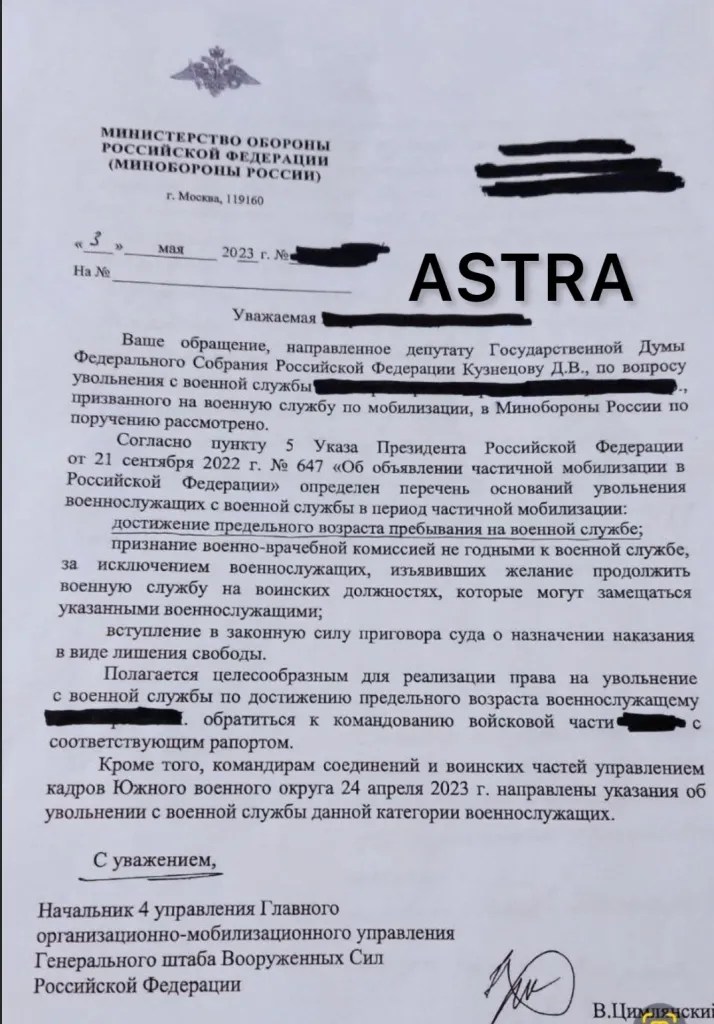
“On April 24, 2023, the Southern Military District personnel department sent instructions to the commanders of formations and military units regarding the dismissal of this category of military personnel from military service.”
But Elvira’s husband was never dismissed. The first appeal about the failure of the commander of a military unit to comply with the law of the Russian Federation (residents of the territories of the “DPR” are forced to live according to the laws of the “DPR” and the Russian Federation – editor’s note) and the order of the General Staff was written to the garrison military prosecutor’s office in Donetsk by Elvira’s daughter.
“When dad was taken away, she was in shock. At her school graduation, she stood and cried on stage because her dad was not there. When it became clear that father was not being dismissed from the Army, although he should, according to the law, she wrote a statement to the prosecutor’s office,” says Elvira.
She wrote with her heart on her sleeve: “My father acted honestly; he acted nobly. When he received the summons, he got up and went. He did not stay at home to protect his family; he went to defend his homeland. Mom and I were left defenseless together – in wartime, in a military city. He went for everyone. He didn’t hide. I’m not asking you to do anything illegal but to obey the law.”
A month later, in April, Elvira came to Donetsk for an answer. The answer was simple—Elvira’s daughter’s application had been lost. She wrote a new statement.
When she came a month late for the second time, she was surprised to learn that the answer had been mailed two weeks prior.
“I still haven’t received the reply. Where did they send it? There, in the military prosecutor’s office, there were many people, and everyone asked: “Where are you sending the replies? Why don’t we receive them?” I demanded that they answer me. He surprised me when he did. It said, “The inspection passed, no violations were found.” There was a note at the end: “Your husband can turn to his command with a report of dismissal.”
On May 17, my husband wrote a second letter of resignation. We sent it as a certified letter to the military unit via Russian post. We have a receipt that part of it was received on June 20. They didn’t pick it up for a month.
In spring, Elvira went to Rostov-on-Don to the military prosecutor’s office of the Southern Federal District. But they told her that this was not within their competence. At the end of June, Elvira filed a statement to the Rostov garrison court about the inaction of the command of her husband’s unit.
“My lawyer assured me that there was nothing to worry about. Truth and law are on our side. Moreover, my husband served for a year. We have attached documents indicating that the military unit received the report. The judge wrote in her decision that my husband did not submit a report for dismissal, and he is not 65 years old, so she sees no reason for his dismissal. She referred to the law (https://www.interfax.ru/russia/908843) passed on June 24 that men can serve under contract until they are 65. But my husband did not sign the contract! We provided the court with a document from the military unit about this. I held on as best I could, but when the court made this decision, I sobbed right in the office; I didn’t hear or see anything. I said: “Lord, is there justice in life? Well, it must be somewhere, mustn’t it? It can’t be like that; it just can’t be done. You can’t do this to us; we’re humans. We are people! ”
Now Elvira has arrived in Moscow. The Ministry of Defense told her they would forward her application to the Southern Federal District.
“I again traveled thousands of kilometers to stumble upon this vicious circle. The presidential administration told us that this is not their competence – this is the competence of the military prosecutor’s office; the military prosecutor’s office said that this is the competence of the joint group of troops… Where in this circle is the way out? My husband is a miner; he has an occupational disease. And now thousands of elderly miners are sitting in the trenches; they all have occupational diseases – sore knees, backs. Our men cannot carry armor, helmets, or weapons. And they meet their old age in a trench. My main question is: where to look for the truth? In every office I ask, “Where do you look for the truth?” I won’t give up. I will go to the end. I’m ready for anything.”
You are not Russians.
Elena (name changed – editor’s note) is from Ilovaisk. Her husband is 53 years old. He worked in a mine for 30 years and suffered a hernia. He was mobilized on February 19.
“It’s like we’ve entered another dimension. We have no rights, none at all. Our husbands are not considered people. I have answers from the Ministry of Defense, the investigative committee, and the military prosecutor’s office of the Southern Federal District (available to the editors—editor’s note) that my husband should be dismissed from the Army because he has reached the service age limit,” says Elena.
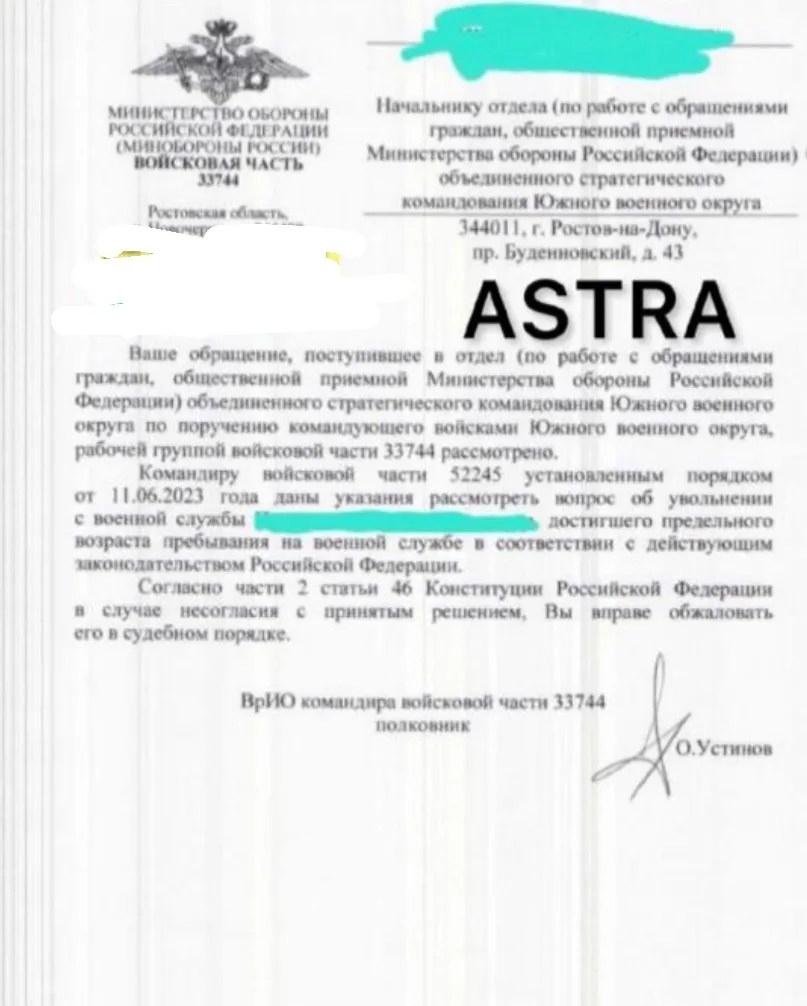
Elena has a response from the Joint Strategic Command of the Southern Military District, which says:
“In accordance with the established procedure dated June 11, 2023, the commander of military unit 52245 was instructed to consider the issue of dismissal from military service, full name (Elena asked not to indicate the name of her husband—editor’s note), who has reached the age limit for military service in accordance with the current legislation of the Russian Federation. But the command of unit 52245, despite the instructions from the higher command, does not fire him,” says Elena. I come to the personnel department with all these answers, and they tell me in plainly: “Bring whatever you want; they won’t fire him. If you fire one, everyone will want the same. Our age group comprises 50% of the unit. Let’s release them. Who will serve then?”
At the same time, the garrison military prosecutor’s office of the “DPR” found a loophole where they explained to wives in writing and orally that non-compliance with Russian laws by unit commands is legal.
Women receive these answers:
“In accordance with the legislation of the Donetsk People’s Republic, the age limit for military service for mobilized military personnel is set to 55 years – decree of the head of the Donetsk People’s Republic dated March 19, 2022. Under current Russian legislation, the general age limit for military service is 50 years. According to Article 36 of the federal constitutional law, “on the admission of the Donetsk People’s Republic to the Russian Federation…” from the date of admission of a new subject to the Russian Federation until 01.01. 2026, there is a transition period during which the issues of integration of the new subject of the Russian Federation into the economic, financial, and legal system will be resolved.”
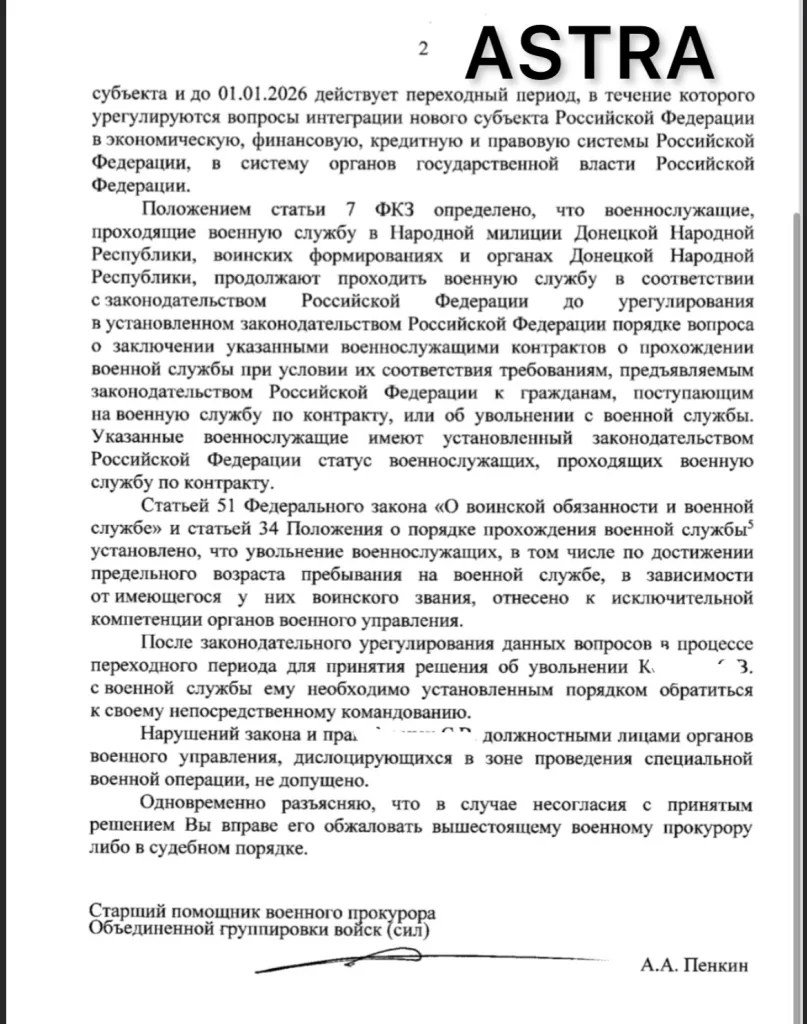
“The answers from the Ministry of Defense and the garrison military prosecutor’s office in Donetsk contradict each other,” Elena is indignant. “In January 2023, all our husbands took the oath to the Russian Federation and were transferred to units that are part of the Russian Army. What other transition period? Nowhere in the documents does it say that the acquisition of the “DPR” should concern the military. Moreover, it says that if a law contradicts the laws of the Russian Federation, it cannot be applied in the “DPR.” They serve in the Army of the Russian Federation, but for some reason, according to the laws that apply to the people’s militia of the “DPR.” But this people’s militia no longer exists in nature. Our husbands are like third-class citizens. They were transferred to Russian units but were never given military IDs. Because it would be illegal. According to Russian law, providing a military ID for someone over 50 is prohibited. They only have old Soviet military ID cards. Military officials twist the laws how they want to, in order to not let our husbands go. Our men are old, sick, exhausted like slaves, and have been sitting in the trenches for a year and a half without vacation. In essence, this is discrimination based on place of residence; we have Russian passports, and we are citizens of the Russian Federation, but for some reason, the Constitution of the Russian Federation, according to which all citizens have equal rights and responsibilities, does not apply to us. There is no transition period for elections or for raising the retirement age in our territory. Nevertheless, to release our men after 17 months of hell, they have it. Here should be an unconditional advantage of federal laws over regional ones and an advantage of the Constitution over local laws. We want this to be remembered.”
Like everyone who was mobilized in the “DPR” in February 2022, Elena’s husband was told that he would go to military training. The men were brought to an abandoned factory in Makiivka.
“They slept on bare slabs, on the ground. For five days, they were neither given food nor water, only what wives could bring them. There 12 people died because everyone was mobilized with a variety of diseases. Then my husband called me and said: “Come to the station tomorrow, they are taking us somewhere,” says Elena.
As Elena recalls, there was chaos at the station. Hundreds of women were looking for their husbands to say goodbye.
“I didn’t recognize my husband,” says the woman, “he was in military uniform.” They were given helmets and rifles from the 50s. He took my hand and said: “After this, maybe we won’t see each other again.” They were loaded into wagons to be transported to who knows where. There was a massive crowd of women with children; everyone was crying. They were taken away, and all contact with them was lost.
Only a month later, Elena’s husband was able to call her.
“They were brought to a bare field and told to dig trenches. They weren’t given any shovels. They got a terrible commander – maybe it was better in other units. He bullied them. Most of the products they received were then seen in stores. The men remained hungry as dogs. They were given one thin piece of bread and a bowl of porridge daily. My husband said, “I just couldn’t imagine that this could happen in the 21st century.” He had a piece of lard; he cut it off a little at a time and sucked it at night to relieve the feeling of hunger. This went on for two months. All this time, they did not wash. It was terribly cold, and they were sitting in the trenches. He tried not to sleep at night so as not to freeze. Many guys gut frostbitten on their arms, legs, fingers, and toes there. This is how they lived there – cold, hunger, and dirt. One gas station had showers. One guy came in and washed himself, and the commander almost shot him for it. Just because he washed. Then, the commander was changed, and food appeared. But the new command of the unit collects 15 thousand rubles a month from military personnel. If you refuse, they call and demand. I don’t know where this money goes. But now it’s a vicious circle; we no longer know who to turn to. It turns out that the command of the units has more power than the entire Ministry of Defense if they freely do not carry out their instructions. My husband is a miner; he has a hernia. I came home only for 7 days during this year and a half. He has turned all gray, his back and legs hurt – he says, “I don’t know how much longer I can stand it.”
The report is not taken.
In many units, those mobilized from the “DPR”, who were over 50 years of age in February 2023, organized reports on their dismissal from the Army upon reaching the age limit. But they weren’t dismissed.
The Federal Military Prosecutor’s Office often responds to women that
“It is considered advisable to exercise the right to dismissal from military service upon reaching the age limit for a serviceman to contact the command of the military unit with a corresponding report.”
“My husband is 53 years old,” says Irina (name changed, editor’s note), “Since January 1, all our men have been reassigned to the Russian Federation; they were transferred to a standard list. Already at that time, my husband was 53. All men over 50 wrote reports of dismissal from the Army because, according to Russian law, they had already reached the service age limit. My husband saw his report got to the battalion commander, but beyond the battalion commander, it didn’t go anywhere, and that’s it. He wrote another resignation letter. We sent a valuable letter with a notification by mail to our military unit 8803. But they don’t take it. The military unit explains this by saying they do not have a contract with the post office.”
According to the wives’ stories, the command does not accept the reports, or they accept them but do not sign them. They are thrown out, lost, or put in a box. As a rule, soldiers do not know the names of their commanders, even battalion commanders. At best, they know the code names. Complaining about command can be dangerous.
“We tried to fight,” says Irina, “but my husband always asked not to mention his last name anywhere,” I say, “well, I have to achieve justice!” He replies: “I saw how people here disappear without a trace and without a fight.” He’s seen too much. They have a place there where commanders and battalion commanders are located. They call it a “wicket.” They take all the undesirable people there, all the guilty ones – and there they pressure the guys – they beat them up and whatever. Now, there is massive pressure to sign the contract. The guys were promised that if you don’t sign the contract, you will go to zero positions with the prisoners, and you will never escape from there, either wounded or killed. This is how we sign a contract voluntarily. On behalf of my husband, I wrote a refusal of the contract and sent it to the Southern Military District. I wrote: “If a document appears that my husband signed a contract, consider it a forgery – it was signed under pressure from the command.”
Irina says the command communicates with the soldiers only with obscenities.
“The commander who led our military unit appeared often,” she says, “he brought his lady with him, who was often drunk. She would fire a pistol at the trailers where the soldiers slept, sometimes breaking windows. Her husband says, “We just pressed ourselves against the wall, stayed quiet because we understood that these people were not sanel.” The commander told them: “You’re all going to die here.”
Irina wrote an appeal to the investigative committee with a request to open a criminal case against the command of the military unit. But she doesn’t know the names of the commanders, only their code names. The wives of those mobilized from military unit 8803 went to Moscow to see the president. They tried to get the command of the military unit to open a criminal case.
“They didn’t succeed,” says Irina. “We don’t know how else to achieve justice. We turned out to be third-class citizens without rights. What should I believe in if I no longer believe in anything? How do we go about living? We will fight until the end for our husbands”.
We want justice
Now, mobilized men are forced to sign a contract, including those over 50 years old.
“In our unit 42038, there are men who are both 57 and 64. They are not going to dismiss them. They forced everyone to sign the contract with threats. There is no hope at all anymore. I really want justice so that at least someone will answer for this lawlessness and be punished for our relatives. They haven’t been home for a year and a half. Many men 50+ have already had dozens of diseases, most have worked in the mines for 30 years, and they are still going without treatment. Mine progressed to tuberculosis. He was treated for pneumonia for four months, now tuberculosis. Rotation is carried out this way – they are transferred from one regiment to another, and that’s it. It seems like “the change has happened.” People simply changed places and were not allowed to rest. And these new military units cannot be found – there are no phones. We are not asking for any outlandish benefits; we simply ask to comply with the law. The law that the president signed. Everything about us has already been killed! You no longer feel anything except pain and hopelessness!” says one of the mobilized wives.
If you or your family have also encountered violations of rights in the territories of the “LDPR,” and you would like to talk about it, write to the ASTRA editors: astrasmi@pm.me, telegram bot: @redastrabot