
Оригинал материала
Be a lifeline
One year after Russia’s landmark prisoner swap with the West, over 1,500 people remain jailed on political charges. Here’s how you can reach them.
Exactly one year ago, multiple Western countries came together to carry out the biggest prisoner swap with Russia since the Cold War. Eight suspected Russian intelligence agents were returned to Moscow, while 16 people were sent to the West — including prominent Russian political prisoners and a number of foreign nationals convicted or accused of espionage and other crimes. Among those released were Russian opposition politicians Ilya Yashin and Vladimir Kara-Murza; human rights advocate Oleg Orlov; political activists Ksenia Fadeeva, Andrey Pivovarov, and Lilia Chanysheva; artist Sasha Skochilenko, and others.
Unfortunately, their release did not signal the start of a less repressive course for the Russian authorities. On the contrary, Russia’s pretrial detention centers and penal colonies have continued to fill with new political prisoners over the past year. Today, more than 1,500 people are behind bars in Russia on politically motivated charges.
Writing letters is a simple yet powerful way to support them. The human rights project OVD-Info recently published a detailed guide explaining who you can write to, what you should say, and how to send your message. Meduza has translated these instructions so you can send your own letters of support to Russia’s political prisoners.
If you’re in a position to support political prisoners not just with letters but also financially, click here. The link will take you to a website for a fundraising campaign organized by Meduza together with other independent media outlets and human rights advocates. For security reasons, we can’t accept payments in rubles, but there are other projects that do.
Why write to political prisoners?
According to OVD-Info, more than 1,500 people in Russia are currently imprisoned on politically motivated charges. Letters from supporters help ensure they aren’t left to face the system alone. They do this by:
- Creating a connection to the outside world and easing the isolation of life behind bars. As Mikhail Zharikov, one of OVD-Info’s clients, wrote: “You can do the most important thing for someone: for the time it takes to read your letter and write a reply, you transport them from their cell to the world of freedom.”
- Providing moral support. A letter is a reminder that someone still cares.
- Offering protection. When prison staff know someone on the outside is paying attention, they understand that if anything happens to that prisoner, the world will hear about it.
Writing these letters can benefit you as well. For one thing, it’s a way to show civic solidarity at a time when free speech is under threat across the globe. Plus, you’re likely to find thoughtful and engaging correspondents among political prisoners — people whose words can offer comfort or new perspectives.
Who should I write to? And how do I know where to send the letter?
Before writing, you’ll need to choose a recipient. If you’re unsure who to write to, OVD-Info’s Lifeline project can help by suggesting a random recipient each time you open the site. You can also search for prisoners manually using filters like region, hobbies, or profession. The site allows you to type your letter online; once submitted, the team will print and mail it for you.
What should I write?
It’s helpful to share news, thoughts, or joyful moments from the outside world, whether that’s a book you’ve read, something you noticed on a walk, or a trip you took. People in prison are cut off from everyday experiences and emotions; your letter can bring those experiences back into their lives.
- Include quotes from your favorite books or poems.
- Ask questions. This invites the recipient to express themselves and helps you get to know them. You can even ask what kinds of letters they enjoy receiving — a simple way to show care and attentiveness.
- Offer words of encouragement, like “We haven’t forgotten you” or “I admire your strength.”
- If the person’s birthday is coming up, be sure to mention it.
And remember: you don’t need to be “original” or “interesting.” What matters most is sincerity and attention to the person you’re writing to.
What language should I write in?
Under Russian law, Russian citizens in prison have the right to correspond in Russian or in the official language of the region where they are held. Foreign nationals and stateless persons may write in their native language or any language they know, and can request a translator if needed.
In practice, however, letters not written in Russian may be blocked or go undelivered. But don’t worry: if you write in English and use OVD-Info’s Lifeline service, volunteers will translate your letter into Russian before mailing it (more on that below).
How can I send letters to political prisoners online?
Luckily, several online services exist to ensure your letters to political prisoners reach their recipient.
Lifeline — Free letters, no registration
Through OVD-Info’s Lifeline platform, you can write to either a random recipient or a specific person. The project covers all printing and mailing costs; all you have to do is write a message of up to 2,400 characters.
No registration is required — just provide your name (or a pseudonym) and email address. This information is only visible to the Lifeline team and won’t be shared.
You can also attach your own image to the letter or choose from a selection of postcards created by the project. Once your letter is sent, you can continue the correspondence via the same platform. When the prisoner replies, you’ll receive their letter by email, along with instructions for sending a follow-up message. That part is free, too.
F-Pismo — Free letters with tracking
With F-Pismo, you can only send letters to facilities connected to the service’s delivery system. Letters are delivered electronically, printed out by prison staff, and — if approved by censors — handed to the recipient.
ZT — Paid service with phone verification
Unlike F-Pismo, ZT doesn’t offer tracking. Otherwise, the service is similar and includes its own app for Android and iPhone, allowing you to send letters directly. The cost of a page depends on the facility, and reply forms must be purchased separately. Payments can be made using a foreign bank card, Russia’s Fast Payment System, Sberpay, or your ZT account. Verification with a mobile phone number is required.
Mémorial France — Free letters in English or French
This service allows you to write in English or French. Volunteers will translate your letter into Russian and send it for free, since letters in foreign languages are rarely get past censors. If the prisoner replies, you’ll receive the response by email.
RosUznik — Free delivery to specific recipients
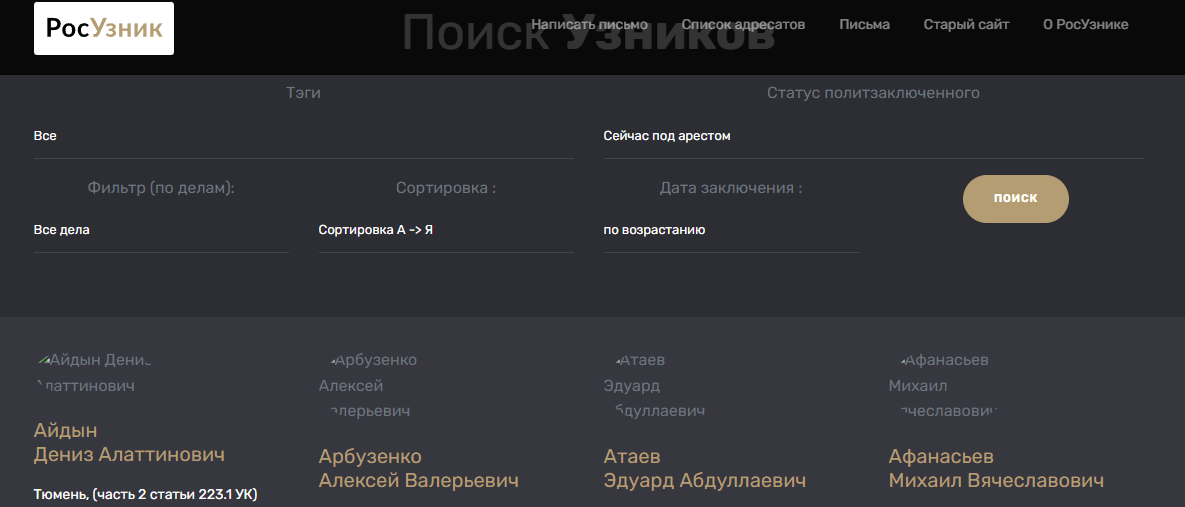
RosUznik is a volunteer-run, donation-funded project. Sending a letter is free. You only need to provide your name and email address, which the project states will not be shared. If the recipient responds, the reply will be forwarded to your email.
Can I send an old-fashioned paper letter from abroad?
Yes — as long as the country you’re in maintains postal service with Russia. It’s best to write both the return address and the prison’s address in Russian. You can also include them in your local language, if required by your postal service.
If you’re worried the letter might not be delivered, you can write it digitally and ask friends in Russia to send it on your behalf — or use one of the online letter-sending services mentioned above.
We usually do the talking at fundraisers. This time, we’ll let our readers speak for us. “For years, Meduza’s been one of the only news outlets keeping me from going nuts. I’m still in Russia, still holding it together, but just barely. I know I’m not the only one. So, please show some love for Meduza and help keep us from going cuckoo!” — Lyu
Guide by OVD-Info