
Оригинал материала
‘It's either Dr. Jekyll or Mr. Hyde with the Russians’
‘Meduza’ interviews the US State Department's Rose Gottemoeller
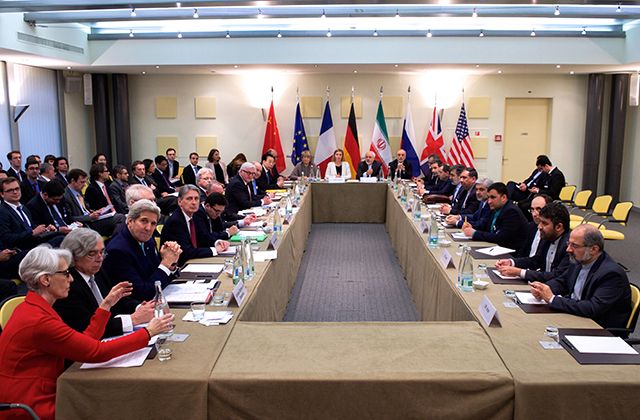
In early April, Barack Obama announced the signing of a preliminary deal on the Iranian nuclear program. Obama called the achievement a “historic agreement” that would rid Iran of its nuclear program and make the world a safer place. The same month, Poland and the Baltic states got a visit from Rose Gottemoeller, US Under Secretary of State for Arms Control and International Security. Meduza’s Konstantin Benyumov sat down with Gottemoeller in Riga to discuss Iran’s nuclear program and the conflicts in the Middle East and in Ukraine, as well as a host of other challenges facing global security.
How do you think the West’s new deal with Iran provides for a safer world and a safer Middle East?
It’s good to remember that this is a framework that builds on the framework that was agreed last September, and now this is a more detailed framework, but there is still work to be done between now and June, to put the implementation details in place. That will take some more hard work. So the basic point is that the deal isn’t done yet, and as we like to say in negotiations, nothing is agreed until everything is agreed. So, just an important caveat, but nevertheless I will say that I’ve been very impressed as an old arms-controller by the degree of precision already in the joint framework.
It will take some very strong steps to halt the production of fissile material in Iran. Why is that important? Fissile material—either plutonium or highly enriched uranium is material that goes directly into a nuclear bomb, and the steps that they have taken to end the production of fissile material, and also to insure that it is ended by very stringent monitoring and verification measures, I believe are very impressive and fulfill the overarching goal of this negotiation from the very outset, which is to create the conditions for Iran to return to its stature as a non-nuclear-weapons state under the Non-Proliferation Treaty—a non-nuclear-weapons state in good standing, with both the International Atomic Energy Agency and the NPT community.
So I think it’s a very good deal, and I hope that all the technical details can be completed now, and it can enter force.
Trust is always a major factor in such negotiations. Do you think that we’re at a point now where the West and the United States can trust Iran? After so many years of distrust?
Trust is involved in the negotiating process, of course. You have to get through a lot of technical detail. In fact, we had a very good situation, in that we had Secretary of Energy Ernie Moniz working together with Minister Zarif, both of whom are MIT physicists. [Under Secretary Gottemoeller likely had in mind not Zarif, but Ali Akbar Salehi, an Iranian academic and diplomat, who received a PhD in nuclear engineering from MIT in 1977.] And the fact that they were in the same university created that basic background of trust that allowed them to negotiate in good faith.
So I think that’s important, but trust cannot play the only role in implementation. The old Reagan cliche is, of course, “trust but verify.” And in this case, I think that the strength of the verification regime—the monitoring regime—is an inherent part of the agreement, and it means that we will be able to verify as well as to trust.
Do you believe that a stronger Iran—once the sanctions have been lifted and its economy improves and it gains more influence—will lead ultimately to a more stable Middle East?
That is the view that President Obama conveyed when he talked about the deal, saying there is potential here for broader stability and mutual security, but there are many steps that we’ll have to take. For one thing, Iran is going to have to take what very difficult steps to undo its nuclear program, and they will have to be verified by the International Atomic Energy Agency before we will be ready to begin to remove sanctions. So we’ve got many, many steps to get through.
Certainly, in dealing with the nuclear threat to the region, the United States has felt that this focus on getting a handle on the nuclear program in Iran is an important contributor to regional security, as well as international security (or we wouldn’t have proceeded with the negotiations in the first place).
The Israelis seem to disagree, saying the Iranians will continue to pursue a nuclear program, despite whatever agreements it reaches with the West. Israeli’s Plan A is presumably to maintain the capability of destroying Iran’s nuclear infrastructure with airstrikes. But now Russia promises to deliver these new and improved air defense systems, the S-300. How do you expect this to play out?
First of all, I have been saying to Israeli colleagues the same thing I, as well as others on our negotiating team, have said publicly: wait and see, when the deal is done, and then judge. Because it will be important to understand the very stringent verification measures and monitoring measures, some of them technologically quite challenging, that will make up this final deal. So I have really been urging a wait-and-see attitude, telling them not to pass judgment until we can see what the final contours of the program are. I think that is very important.
I also agree with those analysts in the United States, as well as some American officials, who have said that the goal here is to give ourselves plenty of warning time of an Iranian breakout, and we believe that we have at least a year of warning time, if the Iranians for some reason decide to break out of the agreement. We have adequate strategic warning to be able to adapt and address such a breakout. I think proceeding with a bombing campaign against the Iranian facilities would, in our view, would not produce that kind of warning time. The analyses I’ve seen in various quarters are that they could reconstitute rather quickly. And so I think there’s been a sense in Washington for some time that a bombing campaign of the type that at times has been envisioned would not buy you much really. And I think that’s an important thing to consider.
With regard to the S-300, I have to say we are disappointed. Pulling the plug on that deal was pursuant to UN Security Council resolution, and we feel that it must have the weight of the UN system behind it. For Russia now to be treating this as somehow a voluntary move on their part, to me, does not accord with its link to the UN Security Council resolution, which was the basis for pulling the plug on the S-300 to begin with.
Do you think that this unilateral move by Russia could be described as backstabbing?
Well, you’ll have to ask the Russians that question, to find out what their rationale was.
What about the new deal with Iran? Does it undermine its effectiveness?
By no means, not necessarily. Again, I think we need to focus on what will be in the finalized deal. To have eyes on the Iranian program, to be inside in the way this deal will allow us to be, will be a remarkable benefit in terms of understanding that the program has actually been dismantled. Of course, in the worst case, if the Iranians are proceeding to back out of the deal and to violate its terms, we’ll have plenty of strategic warning that that’s happening. So that again is key to being able to respond.
Is there any response plan in place, should that happen?
We’d certainly respond with adequate measures, if that happened. One of the things that has been folded in to the emerging agreement is this notion of “snapback” for the sanctions. If the Iranians are suddenly beginning to pull out or move away from the arrangement, then we’d be able to put sanctions back in place very quickly.
Do you think the Iranians have a strong enough interest in seeing the sanctions lifted?
I think that is what brought them to the negotiating table in the first place, and believe me I’ve been involved in efforts to work with Iran on this since the Clinton Administration. For twenty years, we’ve been trying to get the Iranians to come and be serious at the negotiating table. I think the strength of the international sanctions regime and the weight of those sanctions on the Iranian economy were key in getting the Iranians to come and seriously negotiate.
During his speech, President Obama said it wasn’t just the United States that brought about this deal with Iran, but also its partners internationally, and Russia is of course one of these partners. Do you believe Russia has been helpful in bringing out about this deal?
Yes. I do. Despite the serious crises in our relationship with the Russian Federation and our very grave concern about its egregious behavior, seizing the Crimean peninsula and supporting the separatists in Donetsk and Luhansk, nevertheless the Russians have in certain areas been very good partners. Like in the P5+1 negotiations, where Russian political support has been very important, and also Russian technical knowhow. Russia has very experts on the nuclear fuel cycles. So the technical help has been very valuable, too, I understand.
By the way, I’ll comment quickly that, in my experience, there have been two other areas that have been small areas of bright spots in our otherwise negative bilateral relationship [with Russia] is the implementation of the New START Treaty, which I was responsible for negotiating, and the second area is the removal of chemical weapons from Syria last year. We worked very closely with the Russians on that effort. So there are a few bright spots that have to do with weapons of mass destruction.
What about rhetoric out of Russia that Moscow now considers it its right to deploy strategic arms to Crimea? How much of that do you believe is just saber rattling?
It’s very irresponsible for regional stability and for international security, as well. Ukraine took a major and historic step at the point of its independence of becoming a non-nuclear-weapons state under the Non-Proliferation Treaty. We do not accept the Russian seizure of the Crimean peninsula. From our perspective, it is Ukrainian territory, and so the notion of reintroducing nuclear weapons to Crimea is really an egregious affront to that historic action that the Ukrainian took to become a non-nuclear-weapons state. As far as I see it, the Ukrainians are the real heroes of the non-proliferation regime.
That’s number one, but number two is the point about the very serious blow to regional stability and international stability, as well.
By the way, we don’t see any evidence, so far, that Russia has reintroduced nuclear weapons into Crimea, although yes there have been both official statements and also some media statements.
So do you believe this mostly just talk to provoke the West without taking action? Is this like Russian jets buzzing NATO airspace?
Well I think we have to the two things out. Russia has been flying a lot more air sorties, both their bomber aircraft and fighter aircraft. And, honestly, we do the same thing: we train. We fly our aircraft, and if it’s a matter of training, that’s one thing. The matter that has been of terrible concern recently is the unsafe way in which the Russians have been operating, turning off their transponders, flying close to commercial flight paths coming out of airports, like in Copenhagen, for example, and creating air incidents in that way, but also by flying even too close to military jets that have been scrambled to go after them when they’ve flown into NATO airspace. So it’s a matter of dangerous activities creating these military incidents. No country should be training this way.
Training is fine, but it has to be done in a responsible way.
Obviously Russia’s behavior has unsettled the nations that share a border with Russia, namely the Baltic states.
Right.
We know NATO has been very eager to show its support for these states, to reassure its allies, and Operation Atlantic Resolve is one of those measures. But there’s been concern here that Atlantic Resolve literally brings just two tanks to each of the Baltic countries. We know the Estonians seem to think that’s inadequate, and they’ve been asking for a permanent, standing NATO force in Estonia, which would put a NATO station right at Russia’s doorstep. Do you believe either NATO or the United States would ever offer this kind of support? How responsible would that be?
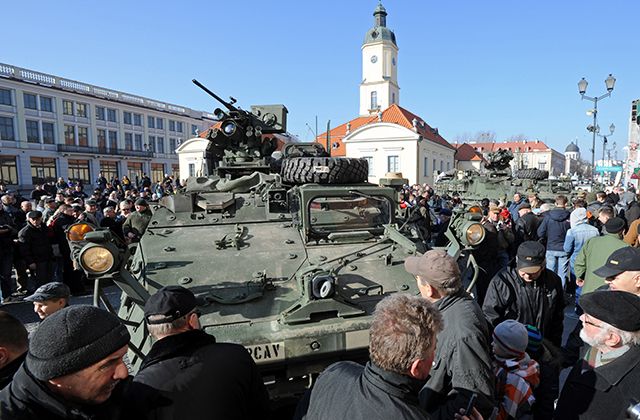
You know, we’ve had a persistent presence since the Ukraine crisis exploded that spring. In my mind, I actually agree with my military colleagues when they say that the notion of having a persistent presence, where you are constantly bringing new forces in for training, working together with the local armed forces, bringing equipment through—it’s training to be able to react very quickly, even at a distance, to a crisis as it emerges. To my mind, that is a very powerful statement.
We had this exercise the last couple of months called Dragoon Ride, where we had a significant number of US forces moving through the three Baltic states (Estonia, Latvia, and Lithuania), going into Poland and down to the Czech Republic, and showing that we can move efficiently and effectively and they we’re mobile and very capable. So those are very strong messages that I think are very important deterrence messages, as well.
I was in Poland the last couple of days, and the notion that we could bring Patriot air defense capabilities to Poland and exercise within a two-day period very quickly—that kind of mobility and very capable military force is something that, for example, the Russian Federation has been seeking for a long time. So I think they will be noting with great interest that this capability is now cycling through this neighborhood on a very regular basis.
So this means that you have an efficient strategy that doesn’t entail provoking Russia by stationing substantial forces near its border?
I think it’s a very efficient strategy that has significant deterrent power to it, but also is maxing out the training value for all of the armed forces in the region, and also is a judicious and proper use of resources. We’ve got a lot of resource challenges inside the NATO alliance. We’re concerned about what’s happening in this neighborhood, and we’re also really wrapped up now in the counter-ISIL coalition, as well, in the Middle East. And so I think we need to combine the necessity of strong deterrence, very good creation of military capabilities through active training, and efficient and effective use of resources. All those things have to work together. But I don’t think there’s any denigration of the goal that the capitals here, whether it’s Tallinn, whether it’s Riga, whether it’s Vilnius, the goals that they have, which are for a deterrence capability.
Do you think Iran or Russia might be brought in to join the counter-ISIL effort?
You know, there is some parallel activity going on. We do not coordinate with Iran, for example, but there are some common goals in some areas that we are addressing. I would say it is the same with Russia. I don’t have much more than that to say on that matter.
I had a chance to speak to some people at NATO several weeks ago, and they told me that, as of now, no functioning military channels between NATO and Russia are active, and all cooperation has effectively been ceased. Is the same true about the United States and Russia? Do you still maintain some level of coordination?
Well, military-to-military cooperation has been halted—it’s not business as usual at the moment with the Russian Federation. We do have the opportunity though, and I mentioned the fact that in certain settings we have quite effective cooperation with the Russian Federation, so there are means of getting in touch with the Russians, if we need to.
I won’t point a finger here, but do you think that over the past year and a half Europe has become one of the major regions of instability in the world?
No, no. No. I am gravely concerned, again, about this egregious set of actions in Ukraine, but I think the fact of the strength of the NATO alliance in this region of the world is an important factor in saying that this is still one of the most stable areas of the world, despite the continuing crisis in Ukraine.
Do you see a way out of this crisis?
Sadly, no. It’s one where we, of course, hope that the parties to the Minsk Accords, phase one and phase two, will step-by-step continue to implement their commitments to the Minsk Accords. That is the way out. That is the answer as to how we get a solution to this problem. But we continue to be very, very concerned about the separatists in the eastern provinces of Ukraine not fulfilling their responsibilities, not letting the OSCE monitors have access—I just saw a map not so long ago of all the areas in Donetsk and Luhansk, where they are keeping away OSCE monitors, and the amount of territory is just remarkable. And [there’s] evidence of continued presence of heavy armor in that part of the world, so, honestly, I have to say that I’m worried that commitments under Minsk are not being fulfilled properly, or fully.
You’ve had your fair share of experience negotiating with the Russians. I wouldn’t think that such things can change overnight, but do you think the Russians today, the ones who signed the Minsk agreement for instance, are the same kind of people who negotiated the START treaties? Is it still possible to negotiate with Moscow, or has something changed?
I mentioned at the outset that we have still very good cooperation on the implementation of New START, and it’s not only the normal implementation activities, like exchanging notifications, data exchange, exchange of inspections: 18 times a year we go to Russia to inspect strategic nuclear forces, and they come to the United States. Everything is totally reciprocal about the agreement. But we also have an implementing body called the Bilateral Consultative Commission, and twice a year we get together there and talk about implementation issues that come up during inspections. Sometimes you can’t negotiate everything in the course of a treaty negotiation—there are some small issues that have to be worked out, but the inspectors run into problems.
So I can say that in the setting of the Bilateral Consultative Commission, our Russian interlocutors have been very pragmatic, very problem-solving. So I know from the history of the US-Soviet, and now the US-Russian arms control relationships, that there’s a pragmatism and a problem-solving attitude among Russians that sometimes comes to the fore, and we can really do business. In other areas, well, we’re just not solving problems.
Sometimes I say the Russians can be either Dr. Jekyll or Mr. Hyde. Sometimes we have a Dr. Jeckyll, and a problem-solving, pragmatic approach to things, and sometimes we have Mr. Hyde, where there’s obviously not that kind of problem-solving approach.
So, in your opinion, is it a matter of phases, that over the last couple of years the ideological approach has replaced, or phased out, the more pragmatic approach?
No, and that’s why I brought up the BCC. I think it continues to be interwoven. It’s a complicated picture at the moment: what is the Russian Federation? There continue to be aspects of it that are cooperative with the international system, solving important problems, helping to get things done. I understand that the Russian Federation—whether it was the Air Force or the Navy, I’m not sure—just helped to get some American citizens out of Yemen in the midst of the terrible crisis there. So, obviously, sometimes we’re working together, and working together very well. But in other areas we’re butting heads, and we’re not making any progress. That’s a tragedy in my view.
Konstantin Benyumov
Riga