
9 leading Russian scholars discuss ‘Putin’s Russia’
Meduza’s live blog from the AEI’s special Russia event in Washington
As the West’s eyes turn to 2018 and Vladimir Putin’s likely reelection run, the American Enterprise Institute has gathered nine of the world’s most respected Russian experts for an all-day conference in Washington, DC. The event consists of four panels, each featuring three Russian experts and one American moderator. The panels’ subjects are (1) “Regime, ideology, public opinion, and legitimacy”; (2) “Civil society: Defeat and radicalization?”; (3) “Political economy, geography, and the politics of federalism”; and (4) “What’s next for Russian foreign policy, society, and economy?” Meduza’s Kevin Rothrock is in attendance and will live-blog the entire conference.
14 мая 2015 г. 23:26:29
AND THATʼS THE END. THE CONFERENCE IS OVER. THUNDEROUS APPLAUSE. Good bye, everyone. Thanks for tuning in!
14 мая 2015 г. 23:25:56
Natalia Zubarevich now explaining why Russian women might prefer Chinese men to their male compatriots.
14 мая 2015 г. 23:21:11
Guriev says a lot of the vaunted Russian-Chinese new relationship is based on «memorandums,» not finalized deals. (He cites an in-development railroad to Kazan.)
14 мая 2015 г. 23:20:24
Guriev points out that the new deals with China remain unsigned, and final negotiations arenʼt going very well. (Moscow hoped for far more cooperation.) A large loan to Sberbank has been finalized, however.
14 мая 2015 г. 23:19:08
Verona says circumstances in Europe (not just santions but broader trends) make Putinʼs new interest in China «real.» But what danger is there of Russia becoming dependent on Chinese consumers?
14 мая 2015 г. 23:17:46
Ed Verona, former President of the US-Russia Business Council, will ask the final question. He says «Putinʼs pivot to the East» is about making a virtue of necessity.
14 мая 2015 г. 23:16:43
Gontmakher says the new buddy-buddy ties with China are «just part of Putinʼs geopolitical game.» He says Chinese investments in Russia are state-driven and therefore significantly different from Western investments (which are primarily private).
14 мая 2015 г. 23:15:10
Now a self-identified Voice of America reporter asks about Russiaʼs new relationship (partnership?) with Russia.
14 мая 2015 г. 23:10:32
When Russia is in crisis, Gudkov says, Russians want a «cozy, small state,» but when it passes, we see the emergence of «self assurance» and the symbols of power, says Gudkov. This is an old phenomenon, he says—a complex that affects all states lagging behind the developed world.
14 мая 2015 г. 23:09:29
Gudkov says Russian nationalists' «complex» is a reaction to being dependent on and constantly humiliated by their own authorities.
14 мая 2015 г. 23:07:28
Gudkov says superpowerdom is first and foremost about the military. («Donʼt mess with my Iskanders»?)
14 мая 2015 г. 23:06:30
Someone who says sheʼs a «national security fellow» asks what Russians expect of the «return to superpower status.» Whatʼs the Russian public anticipating here?
14 мая 2015 г. 23:05:19
Malashenko says youngsters' nationalistic fervor isnʼt going anywhere. Then he says, «but it must be changed.» THEN HE ASKS, «BUT HOW?»
14 мая 2015 г. 23:04:13
Zubarevich says she doesnʼt know about todayʼs young people, but she knows her generation was socialized in the 1960s—during Khrushchevʼs thaw. This bred a dream that would later be crushed and sour the generationʼs political perceptions.
14 мая 2015 г. 23:02:45
Angela Stent now asks a question about «the younger generation.» She starts about the skepticism of youngsters. Why are all these free-to-travel, Internet surfering twerps suspending their normal skepticism?
14 мая 2015 г. 22:58:03
Gudkov says Russiaʼs «unhappy minority» will consolidate immediately, as soon as a real political alternative emerges. (But what will ice cubes do when they get to hell, Lev Dmitrievich?)
14 мая 2015 г. 22:52:35
Gontmakher is done talking. Iʼm not sure what he said.
14 мая 2015 г. 22:50:44
Evgeny Gontmakher is speaking again. I cannot promise that Iʼll be able to understand/convey anything he says.
14 мая 2015 г. 22:50:07
Dmitriev reminds the audience that Russia is an extremely complex society. «One-way pessimistic forecasts» are wrong and experts made that mistake in 1999, he says.
14 мая 2015 г. 22:48:55
Anders Åslund now asking a question: everyone, he thinks, is saying that the Putin regime is doomed to collapse. But the short-term seems to promise nothing very new, and nobody is ready to predict change anytime soon. Does everyone really believe in stability now and total collapse later?
14 мая 2015 г. 22:47:20
Makarenko says, citing Tocqueville, people donʼt rebel during a crisis, but afterwards, when thereʼs less risk in asking who is to blame.
14 мая 2015 г. 22:43:35
Dmitriev says again that the ruble is improving and the economy is likely to improve. (Guriev turns to Makarenko and laughs.)
14 мая 2015 г. 22:37:42
Zubarevich says Russiaʼs institutional degradation will continue. As a result, itʼs impossible to know where this will end, or even be in a yearʼs time. A «turn to the East is impossible,» she says. Chinese investment in Russia in miniscule. Itʼs not a real alternative.
14 мая 2015 г. 22:29:22
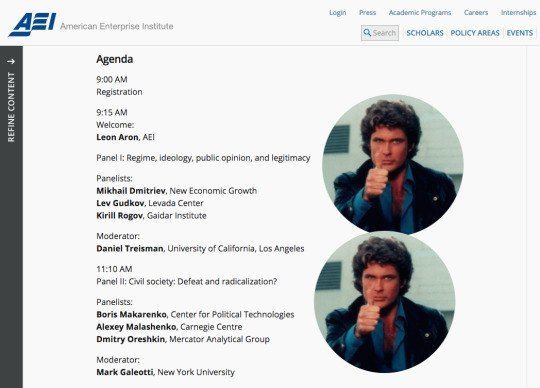
By the way, two of todayʼs panels have earned entries on the important Congrats, you have an all male panel! Tumblr blog! Welcome to the land of opportunity, boys!
14 мая 2015 г. 22:23:41
Makarenko says 2011-12 protesters didnʼt fill the streets to support an opposition they voted for; it was instead a response to a perceived violation of electoral ritual and legitmacy. Putinʼs sin, he says, isnʼt staying around too long—itʼs that heʼs left the nation without a vision of the future.
14 мая 2015 г. 22:21:07
Makarenko says Putin may have missed the opportunity for serious structural reforms in 2004. They closed again for Medvedev in 2011. With Ukraine, opportunities for the Putin regime closed forever, he says. Putin bought popularity internally, but it didnʼt resolve any of Russiaʼs existing problems.
14 мая 2015 г. 22:19:59
Makarenko says Russiaʼs elites «will not split.» They may be unhappy with whatʼs happening and have their doubts about the system, but they know they owe their success to their loyalty. There are the accepted «transaction costs» of doing business, he says. The problem, however, is that thereʼs no vision of the future.
14 мая 2015 г. 22:15:50
Guriev says itʼs uncertain if Putin will survive Russiaʼs next regime-change moment. He says it will depend on all the compromises arranged in the establishment of a «provisional government.»
14 мая 2015 г. 22:13:26
That said, Guriev doesnʼt expect free elections in 2016 (the next Duma elections). He anticipates increased propaganda, censorship, and repression.
14 мая 2015 г. 22:12:36
Guriev says Putinʼs massive support can collapse «overnight.» This could end in a sudden coup or an unexpected electoral defeat.
14 мая 2015 г. 22:03:02
Dmitriev insists, «Russian society is not derailed.»
14 мая 2015 г. 22:02:34
Dmitriev says Russiaʼs next big economic, social challenge is achieving accelerated growth rates. Even given existing political and institutional constraints, Dmitriev says, Russiaʼs convergence with the West will continue, and be nearly complete within a few decades (provided the economy doesnʼt stagnate).
14 мая 2015 г. 21:59:53
Dmitriev says 2014 was all about the (1) Ukraine crisis, and (2) the economic recession. These two factors were crucial to shaping the publicʼs priorities. He says he strongly disagrees with Guriev, predicting that the recession will be short-lived, provided the Ukrainian conflict doesnʼt renew.
14 мая 2015 г. 21:57:55
Dmitriev says itʼs a misinterpretation to think of Russia as a case of «derailed modernization.» Dmitriev says the material progress of post-Soviet Russia was so rapid that there is still lag in social forces. Russia today faces «non-linear progress» (one step forward, two steps back).
14 мая 2015 г. 21:56:18
«We live in a world of propaganda,» Oreshkin says of Russia. The fantasy of Russia (the superpower) vs. the world is the reality ordinary Russians know. The imaginary world sounds better, but it wonʼt last, and Russians will come crashing back to reality, eventually (and painfully).
14 мая 2015 г. 21:53:30
Oreshkin says crises «across all vectors» await Russia: economic, federal (Moscow vs. Chechnya), and electoral (fraud).
This ainʼt your Yankee mommaʼs crisis.
14 мая 2015 г. 21:51:45
Oreshkin says Russiaʼs current economic decline has been compensated by victories in Ukraine, leading to cognitive dissonance, which the regime has harnessed well.
14 мая 2015 г. 21:50:11
Oreshkin says Russian crises arenʼt like the Westʼs crises. In Russia, he says, the regime hides from one economic crisis behind success in another sector.
14 мая 2015 г. 21:47:51
Gudkov says the struggle for power in Russia creates spaces of uncertainty.
14 мая 2015 г. 21:45:22
Gudkov says Russia has no mechanism for a peaceful transfer of power. The system is always built around a personal clique.
14 мая 2015 г. 21:42:52
Final Panel—GO!
The final panel—a free-for-all roundtable—is now getting underway: Whatʼs next for Russian foreign policy, society, and economy? All nine panelists are crowded on stage to chatter and answer questions.
14 мая 2015 г. 21:27:21
By the way, folks, a TV crew from Russia-1 is here. Thatʼs Dmitry Kiselyovʼs outfit. Theyʼre almost certainly here to get some footage of Russiaʼs great minds rubbing elbows at an American neoconservative think tank. Smile for the camera, gentlemen!
14 мая 2015 г. 21:26:04
Gontmakher says he agrees with Guriev that the annexation of Crimea was improvised, but now heʼs saying the plan has long been to «buy» Ukraine and control it from within.
14 мая 2015 г. 21:23:38
Zubarevich says Russiaʼs metal and fertilizer export industries are enjoying boom times, despite some rather inhospitable tariffs.
14 мая 2015 г. 21:22:18
Guriev says property rights and courts («good institutions») are necessary for a successful high-tech imports industry. But once Russia transforms, the world will be surprised to see what Russia is capable of.
14 мая 2015 г. 21:20:42
On Crimea, he says the steps leading up to the Olympics (Pussy Riot, Khodorkovsky, etc.) to improve Russiaʼs image abroad suggest that the decision to annex Crimea was improvised.
14 мая 2015 г. 21:18:39
Guriev says Russia does have sufficient reserves to maintain the ruble for at least another 2–3 years. «The ruble is stronger than it should be,» he says.
14 мая 2015 г. 21:15:31
Question from the crowd: are there any services in Russia, other than resource-extractive, that can be exported successfully abroad?
14 мая 2015 г. 21:07:52
Zubarevich says the amount of money being redistributed to regions (from the federal government) is shrinking. The «rules of this game» (of getting money from Moscow) she says, is «informal.»
14 мая 2015 г. 21:06:15
Giving an example of Potemkin villages in Russia today, Gontmakher says regional governor «even paint the grass» when Putin visits. This isnʼt federalism, he says—itʼs feudalism.
14 мая 2015 г. 20:56:39
Zubarevich on the «geography of Russiaʼs crisis»: it will hit the big cities hardest. But, she repeats, this is a gradually unfolding crisis—not a sudden collapse, making it a weak stimulus for protests and collective action. (Itʼs like cooking a frog on a frying pan—right? Why isnʼt she using this metaphor? Anybody?)
14 мая 2015 г. 20:53:50
Zubarevich says Russiaʼs current crisis is unfolding for most Russians very slowly. The results in big cities are concentrated in market services (hotels, banks, retail, and so on). These are shrinking industries—but it a decline, not a collapse.
14 мая 2015 г. 20:52:05
Zubarevich now summarizes big problems facing Russia: «manual control» (the over-centralization of the Russian government), low investment, and income declines.
14 мая 2015 г. 20:47:57
Zubarevich says itʼs important not to overlook Russian values that date back to the Soviet era and probably earlier in history. Wealth, education, and urban living doesnʼt erase it. «It means we do not know our country very well,» she says.
14 мая 2015 г. 20:46:43
Natalia Zubarevich, todayʼs only female speaker, is now delivering her remarks. She says sheʼs very surprised by the demographics of support for the annexation of Crimea: they loved it in Moscow, and they loved it in the provinces.
14 мая 2015 г. 20:43:57
Guriev says Russiaʼs Reserve Fund will dry up by 2016, making political change inevitable. The political equilibrium «will have to shift.» Though another foreign adventure—another war—could rescue the regime, again.
14 мая 2015 г. 20:42:29
Guriev says Russian military spending is accelerating rapidly, at a rate thatʼs unsustainable. Money will run out by the end of 2016.
14 мая 2015 г. 20:39:38
Guriev says Russiaʼs budget deficit is no longer small (itʼs almost at 4% now, which is several times higher than projections). In absolute terms, this isnʼt so big, it means something different in the Russian scenario. Guriev says this yearʼs recession will continue, possibly into 2016, when he anticipates a «time of reckoning.»
14 мая 2015 г. 20:36:50
Guriev adds that poorer voters are easier to manipulate and buy.
14 мая 2015 г. 20:36:00
Why donʼt Russian officials pursue a bigger Russian economy? Guriev asks. «A bigger pie with bigger slices» isnʼt win-win, if growing the «pie» requires certain steps and various sacrifices. Sometimes political equilibrium favors a big piece of a «small pie.» (Itʼs easier to extract rents from a smaller economy.)
14 мая 2015 г. 20:34:30
Guriev describes how state officials have grown gradually to distrust Putinʼs economic projections. The reason for the economic downtown is poor governance.
14 мая 2015 г. 20:31:18
Guriev now starts his remarks. He acknowledges the economic miracle of Russiaʼs transition from Yeltsin, the dangerous border zones, and a «dictatorship bent on foreign expansion.»
14 мая 2015 г. 20:24:46
Gontmakher says Russia isnʼt even a confederation, let alone a federation. What else isnʼt Russia, according to Gontmakher? Well, itʼs not Singapore, for instance. (Heʼs talking about Singapore now.)
14 мая 2015 г. 20:19:45
Gontmakher says Russia is not a unitary state—the Vertical of Power is a myth, at least in part, he says.
14 мая 2015 г. 20:14:45
Frye says Russia is an «ideal test case» for differences between major schools of thought in political science.
14 мая 2015 г. 20:14:02
Frye says «structuralsits» anticipate that Russiaʼs urban and human development makes the countryʼs liberal development most likely.
14 мая 2015 г. 20:13:13
Frye now cycling through some «ideal type» political regimes. «Personalist regimes» and their vulnerability to coups, collapses, and other words that begin with the letter «C.»
14 мая 2015 г. 20:10:08
Professor Timothy Frye introduces Sergei Guriev, saying heʼs «best known as the husband of Ekaterina Zhuravskaya, a famous professor at the Paris School of Economics.» (Laughter.) Gontmakher punches Guriev in the arm, smiling.
14 мая 2015 г. 20:08:26
Weʼre back from lunch everybody! Mind explosions! Verbal laser beams of truth! Stay tuned for more earth-shattering Russia commentary from another three experts at AEIʼs event today.
14 мая 2015 г. 19:27:30
Lunch break!
Panel 2 is over! Now comes lunch!
Next up: panel 3! Political economy, geography, and the politics of federalism featuringpanelists Evgeny Gontmakher (Institute of World Economy and International Relations), Sergei Guriev (Sciences Po), and—todayʼs only woman!—Natalia Zubarevich (Moscow State University), and moderator Timothy Frye (Columbia University).
Stay tuned!
14 мая 2015 г. 19:25:52
Malashenko says Kadyrov and Putin are «twins.» Kadyrov, he says, is both a radical and «moderate.» They both defend «values.» Malashenko then adds, «they both are radicals!»
14 мая 2015 г. 19:24:33
Makarenko says there may be an enormous amount of propaganda, but Russians arenʼt passive, he insists. (This includes aggression, such as efforts to raise funds for Novorossiya.)
14 мая 2015 г. 19:24:01
The National Endowment for Democracyʼs Miriam Lanskoy asks if some of the Muslim groups Malashenkoʼs cited are Makarenkoʼs «GONGOs.» Lanskoy cites the supposedly forced marriage of a 17-year-old girl to a police captain.
14 мая 2015 г. 19:18:36
In response to a somewhat rambling question about Occupy Wall Street, Makarenko says 99 percent of Russians never heard about it.
14 мая 2015 г. 19:17:48
The first question from the audience, from a self-identified «lawyer and happy American,» is about the Tsarnaev brothers. Malashenko says Chechen leader Ramzan Kadyrov has avoided the issue almost entirely.
14 мая 2015 г. 19:15:45
Oreshkin says he is certain that Moscow will, in the end, defeat «Putinstan,» though he fears it might not come about before the country itself collapses. (Leon Aron makes sure the interpreter gets this bit about «Putinstan.»)
14 мая 2015 г. 19:14:22
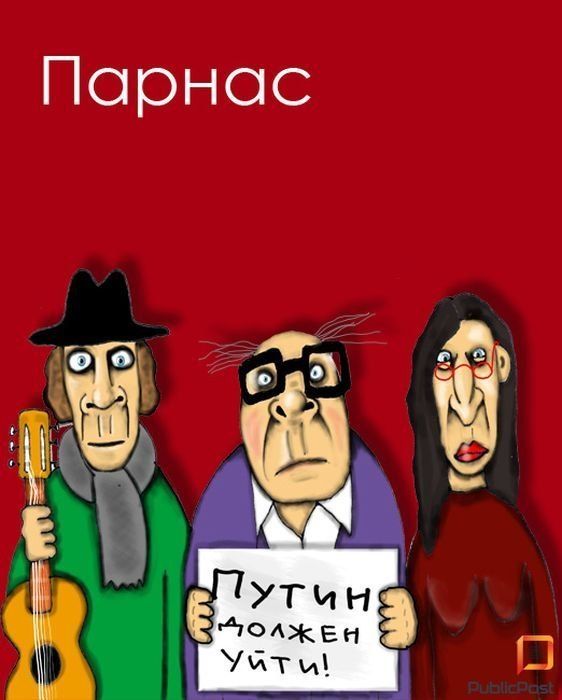
Oreshkin is now showing political cartoons by the artist Vasya Lozhkin. He says this one (parodying the liberal democratic party RPR-Parnas) represents his political faction:
14 мая 2015 г. 19:10:47
Oreshkin says the 2013 Moscow mayoral election confounded Russian political experts, who predicted higher support for Sobyanin because they were anticipating the usual falsification (which, Oreshkin says, didnʼt occur).
14 мая 2015 г. 19:10:04
Oreshkin now breaks down a map of voting results, showing Moscowʼs micro-geography and the political breakdown of its neighborhoods.
14 мая 2015 г. 19:08:20
Oreshkin does say there was some falsification in Moscowʼs 2013 election (where Navalny lost), but it was minimal and within the margin of error.
14 мая 2015 г. 19:06:55
Oreshkin says Moscow Mayor Sergei Sobyanin had to adapt to the cityʼs civil-society activism. In the 2013 mayoral elections, the vote-counting was almost flawless.
14 мая 2015 г. 19:04:06
Audience now chuckling at graphs showing the irregular voting results from districts outside Moscow. (Dagestan gets big laughs.)
14 мая 2015 г. 19:01:47
Oreshkin says only Moscow (at first?) resisted the 2011 election results. The rest of the country, he says, remained silent.
14 мая 2015 г. 19:01:09
Oreshkin says Citizen Observer recorded figures in the 2011 Duma elections that differed from the official data. People then disseminated this information on Internet social networks, leading to mass, peaceful protests. Oreshkin stresses how peaceful these demonstations were.
14 мая 2015 г. 18:56:29
Oreshkin points out that Moscowʼs 2011-12 winter protests were provoked by electoral grievances. He mentions Citizen Observer as a civil society response.
14 мая 2015 г. 18:55:27
Oreshkin says nobody protests the status quo in Chechnya, but itʼs another story in Moscow. Oreshkin says heʼll discuss the resources of Moscowʼs «resistance.»
14 мая 2015 г. 18:54:04
Oreshkin says Russia currently has two poles in terms of electoral results: Moscow (where Putin wouldnʼt have won the first round of voting) and Chechnya (where he recieved nearly every vote).
14 мая 2015 г. 18:52:31
Oreshkin says heʼll address two issues: (1) Russia is deeply non-homogenous, and (2) Putin is returning Russia to «primordial syncretism.» (People are laughing at the translatorʼs troubles managing Oreshkinʼs hifalutin language.)
14 мая 2015 г. 18:50:08
Dmitry Oreshkin is up next, and heʼs using Gudkovʼs Russian-to-English translator.
14 мая 2015 г. 18:49:30
Malashenko says something dramatic will happen in Russiaʼs Muslim communities (not just in the North Caucasus), if the countryʼs political situation destabilizes. «I donʼt want to exaggerate, but donʼt be astonished if this happens.»
14 мая 2015 г. 18:46:26
A woman in the audience just corrected Malashenkoʼs statistics on something. «I know because Iʼm a Crimean Tatar,» she says. (Laughter.)
14 мая 2015 г. 18:45:09
Malashenko says we have no idea how many Russian Muslims are leaving the country to go fight for ISIS or elsewhere in the conflicts of the Middle East.
14 мая 2015 г. 18:40:01
Malashenko says he canʼt predict Muslimʼs expansion in Russia over the next ten years, implying that it will grow «problematically.» («Itʼs in Siberia, too, by the way!»)
14 мая 2015 г. 18:38:54
«We have a problem with the expansion of Islam,» Malashenko says. «I donʼt mean to use this word, perhaps. Maybe 'movement' not 'expansion' is the right word.»
14 мая 2015 г. 18:37:49
Malashenko says Muslim immigrants «insist on their religious identity,» and this presents a «challenge» to Russian officials.
14 мая 2015 г. 18:36:53
Malashenko says about 16 million Muslims now live in Russia. About 5 million of these people (or was it in addition to?) are migrants, but itʼs impossible to know, he says, because of all the undocumented workers.
14 мая 2015 г. 18:35:55
Malashenko, ever the maverick, begins with his conclusion. «And then I can leave,» he says. (Laughter.)
14 мая 2015 г. 18:35:12
Alexey Malashenko is now speaking. «I will not talk about civil society,» he says. «I will talk about Muslim society.» Okay then!
14 мая 2015 г. 18:31:54
Makarenko shares an anecdote from his neighborhood in Moscow, saying Putinʼs party gains the least support in areas where civil society mobilizes most effectively. «Collective action» and «activism»—even «small deeds»—are a challenge to the Putin regime, he says.
14 мая 2015 г. 18:30:23
Makarenko says Russiaʼs political leaders «arenʼt rooted in any way» to Russian society. He says none of the parliamentary leaders, for instance, would ever try to break bread with «angry citizens.»
14 мая 2015 г. 18:28:54
Makarenko says Russia finally has a bourgeoisie to bring about democracy, à la Barrington Mooreʼs «no bourgeoisie, no democracy» axiom.
14 мая 2015 г. 18:26:51
Makarenko says the economic impact of civil-society organizations remains woefully tiny in Russia, when compared to the US or Europe.
14 мая 2015 г. 18:25:26
Makarenko is still talking about civil society in the abstract. Hopefully he ties this to Russiaʼs «foreign-agent» legislation sooner or later.
14 мая 2015 г. 18:23:16
Makarenko says Russiaʼs authorities fear civil society for many reasons: thereʼs no hierarchy, itʼs participatory, and itʼs pro-active (they are «pro-change»).
14 мая 2015 г. 18:22:08
«The faces of civil society» gets Makarenkoʼs holy trinity treatment: (1) apolitical, non-profit, (2) «GONGOs» (government-organized NGOs), and (3) the politicized sector.
14 мая 2015 г. 18:19:45
Makarenko now singing an ode to civil society. «It paddles its own canoe,» he says. Itʼs not pro- or anti-government—you cannot simply equate it with the political opposition.
14 мая 2015 г. 18:18:15
Boris Makarenko kicks off panel numero two. Heʼs happy to join this «celebration of Russian free thought,» though he wishes it were possible in Russia, not only in Washington, DC. «Free thought,» he says, «is a resource, not a danger.»
14 мая 2015 г. 18:12:54
Mark Galeotti isnʼt coming. :-(The train crash in Philadelphia prevents him from reaching Washington from New York as planned.
14 мая 2015 г. 17:57:46
The audience is awake now. The first panel has ended!
Iʼll be back in a few minutes to report on the second panel: Civil society: Defeat and radicalization? featuring Boris Makarenko (Center for Political Technologies), Alexey Malashenko (Carnegie Centre), and Dmitry Oreshkin (Mercator Analytical Group), and moderated by Mark Galeotti (New York University).
14 мая 2015 г. 17:54:08
I just looked around the room and I count precisely two people sleeping. One young woman and one old man.
14 мая 2015 г. 17:50:04
Question from the audience: whatʼs the effect in Russia today of the fact that you can always emigrate? (Пора валить?)
14 мая 2015 г. 17:48:22
Rogov says Putinʼs ideologists arenʼt the heads of Putinʼs Presidential Administration, but people like Konstantin Ernst (of Channel One) and others leading the countryʼs contemporary mass media outlets. These are very talented people working for ideological purposes. They ainʼt just selling sneakers and shampoo, people.
14 мая 2015 г. 17:47:01
Rogov starts talking about «puzzles» again, says there need to be more conferences and books about Russian propaganda.
14 мая 2015 г. 17:45:06
New question from the audience cites Andrey Illarionov, compares Russian propaganda to the Nazis', askes why Russian propaganda is so wildly wild. Dmitriev answers first, and starts to cite his recent research, which shows the limits of Russian propaganda.
14 мая 2015 г. 17:43:33
Gudkov says Russiaʼs new middle class failed to understand the countryʼs majority, who live primarily in the «provinces» and have these conservative, «Soviet» priorities. The opposition will need to understand these people, to have any success.
14 мая 2015 г. 17:41:59
Gudkov also says the Russian masses cling to «paternalist, Soviet» ideals. (He then starts listing Russians' expectations of state benefits, welfare, universal healthcare, social support—all that backward stuff,yaʼknow?)
14 мая 2015 г. 17:40:25
Question from the audience: what would it take to «shock» Russiaʼs democratic opposition «into action»? Gudkov says «oy, that would take a long time to answer.» Then he lists all the ancient woes of Russiaʼs opposition: no good agenda, no access to the media to share their lousy agenda, and the «propaganda machine» is working against them. You canʼt fight the «absolute mass media monopoly.»
14 мая 2015 г. 17:37:02
Gudkov says average careers in the nomenclature jumped from 3-years to about 21-years between Stalin and Brezhnev. This led to a build up of intra-bureaucratic conflict. This same thing—the erosion of vertical mobility—is happening under Putin now, as his regime ages.
14 мая 2015 г. 17:34:03
Gudkov says Putinʼs regime is more vulnerable to a palace coup than mass protests. And it will be very sudden, he warns.
14 мая 2015 г. 17:29:35
Gudkov says he believes that Putinʼs regime is internally unstable, though Russia lacks mechanisms and institutions for change. Without these channels, the regime can continue, while there is no viable «idea of the future.»
14 мая 2015 г. 17:26:25
Rogov says Ukraine could be Putinʼs Afghanistan. (Both wars began during economic decline, and both wars werenʼt traditional military defeats.)
14 мая 2015 г. 17:25:30
Responding to a question from the audience, Dmitriev says post-Soviet Russia is enduring today its longest-ever period of «foreign crisis» obssession. But it wonʼt last forever, heʼs certain.
14 мая 2015 г. 17:20:46
Rogov says Russia today relies on, what he calls, resource nationalism. In Putinʼs first two terms, rents on Russiaʼs oil and gas revenue were distributed through «market channels,» while this process has shifted to the public sector in more recent years. «Russiaʼs public sector today feels like Russiaʼs market sector did in the 2000s.»
14 мая 2015 г. 17:18:16
Rogov says Putinʼs fundamental agenda today is different from what it was last decade; itʼs changed from «Putinʼs Stability» to aggressive anti-Westernism.
14 мая 2015 г. 17:12:49
Iʼve told a few people here that Iʼm live-blogging this event, and they all laughed and asked if anyone actually cares about an event like this. (The rest of this live blog will be written over my soft weeping.)
14 мая 2015 г. 17:10:20
Rogov implies that opinion polling is influenced by Putinʼs «super majority,» insofar as the question of support is loaded with the assumption that «everybody else supports Putin,» making a negative response something special—a near act of rebellion.
14 мая 2015 г. 17:09:21
Rogov says Putinʼs «super-majority effect» discourages funding of the oppposition and makes it harder for oppositionists to cooperate, collaborate, and rally.
14 мая 2015 г. 17:08:29
Rogov says the most basic thing to understand about Russia is Putinʼs popularity. He says there are 3 main pillars of Putinʼs high approval ratings: (1) economic performance, (2) «political-mobilization» episodes (the rally-around-the-flag—around the Vova?—moments), and (3) the «super-majority effect» (the public impression of overwhelming support).
14 мая 2015 г. 17:05:46
Kirill Rogov now addresses the audience. He begins by saying Russia presents many «puzzles» and unexpected crises.
14 мая 2015 г. 17:04:23
Gudkov says Putin has succeeded in building up enough popularity reserves to win the next presidential election without any serious problems. He also says the Russian opposition wonʼt have established a convincing alternative program that could win wide appeal.
14 мая 2015 г. 17:00:16
Gudkov says experts underestimated the trauma of the USSRʼs collapse on the Russian people.
14 мая 2015 г. 16:57:01
Gudkov credits Russian propaganda with playing a crucial role in Putinʼs enduring popularity, which positions the United States as Putinʼs main opponent. (Youʼre either with him or youʼre with the Yanks.)
14 мая 2015 г. 16:56:02
Putin the Teflon Prez: Gudkov says Russians' views of the government are wildly critical (lots of people see it as a mafia state), but approval of Putin personally remains largely unaffected.
14 мая 2015 г. 16:53:40
Gudkov says Putinʼs spikes in popularity are closely correlated to Russiaʼs three wars under his regime: Chechnya in 1999, Georgia in 2008, and Ukraine in 2014.
14 мая 2015 г. 16:48:54
Gudkov says the Kremlin has used the rhetoric of World War II and the USSRʼs battle against fascism to recapture the publicʼs support.
14 мая 2015 г. 16:46:43
Gudkov says Russiaʼs actions in Ukraine has more to do with discrediting Russiaʼs own opposition than halting Ukraineʼs European integration.
14 мая 2015 г. 16:44:35
Lev Gudkov is going to speak through an interpreter. (He apologizes for the inconvenience.)
14 мая 2015 г. 16:43:54
Itʼs just been brought to my attention that this panel is made up of 9 people, only one of whom is a woman. (Natalia Zubarevich, break a leg!)
14 мая 2015 г. 16:42:21
Dmitriev anticipates economic protests «scattered outside the capital.» These usually begin after crises, not during, he says.
14 мая 2015 г. 16:41:18
The Kremlinʼs new challenge is delivering the fastest possible exit from the countryʼs recession. Dmitriev says 2016 looks to be a year of modest recovery, though he isnʼt sure this will «defuse the tensions.»
14 мая 2015 г. 16:40:19
With more recent indications, however moderate, that the conflict in Ukrane is settling down, Russian public opinion is «responding rapidly,» Dmitriev says. (Wink, nod, poke to Levada's Lev Gudkov, sitting next to him.) Anti-Americanism has already peaked. Russians are «refocusing on the domestic agenda.»
14 мая 2015 г. 16:38:17
Dmitriev says 2014 was a year of «threats» for Russians' perceptions of what is important: foreign (war) and domestic (currency instability). Almost all other issues were «crowded out,» he says.
14 мая 2015 г. 16:36:01
Dmitriev says the surge of patriotism resulting from the «incorporation of Crimea into Russia» was a «social lightning rod» in 2014, increasing the authorities' approval ratings, raising trust in the state-controlled media, and so on.
14 мая 2015 г. 16:34:03
(Dmitriev is now recycling points he made a few weeks ago at another Russia event in DC at the Center for Strategic and International Studies, discussing shifts in Russians' priorities: consumption vs. development.)
14 мая 2015 г. 16:30:58
Dmitriev says experts focused on Russiaʼs domestic politics in early 2014 didnʼt see coming the dominance of the «Ukraine issue.»
14 мая 2015 г. 16:27:56
Dmitriev says weʼre at a critical turning point now in Russian history. «Itʼs no wonder thereʼs so much interest [in Russia] today,» he says.
14 мая 2015 г. 16:25:20
Treisman credits Rogov with introducing the concept of the «middle-income trap» into Dmitry Mededevʼs political discourse.
14 мая 2015 г. 16:22:49
Daniel Treisman (Professor of Political Science, UCLA) now introduces his panelists: Mikhail Dmitriev (New Economic Growth), Lev Gudkov (Levada Center), and Kirill Rogov (Gaidar Institute).
14 мая 2015 г. 16:19:34
Leon Aron says more than 18 months went into producing the edited volume at the center of this conference, Putinʼs Russia: How It Rose, How It Is Maintained, and How It Might End.
14 мая 2015 г. 16:17:47
After these introductory thank-yous, the first panel will be on Russiaʼs «regime, ideology, public opinion, and legitimacy.»
14 мая 2015 г. 16:17:12
Weʼre getting underway, everyone! Our host, Dr. Leon Aron, kicks off with some perfunctory book-plugging. (Laughter.)