
Оригинал материала
A ‘sensitive protest’
Carnegie Moscow Center explains why today’s protests in Armenia aren’t another Maidan
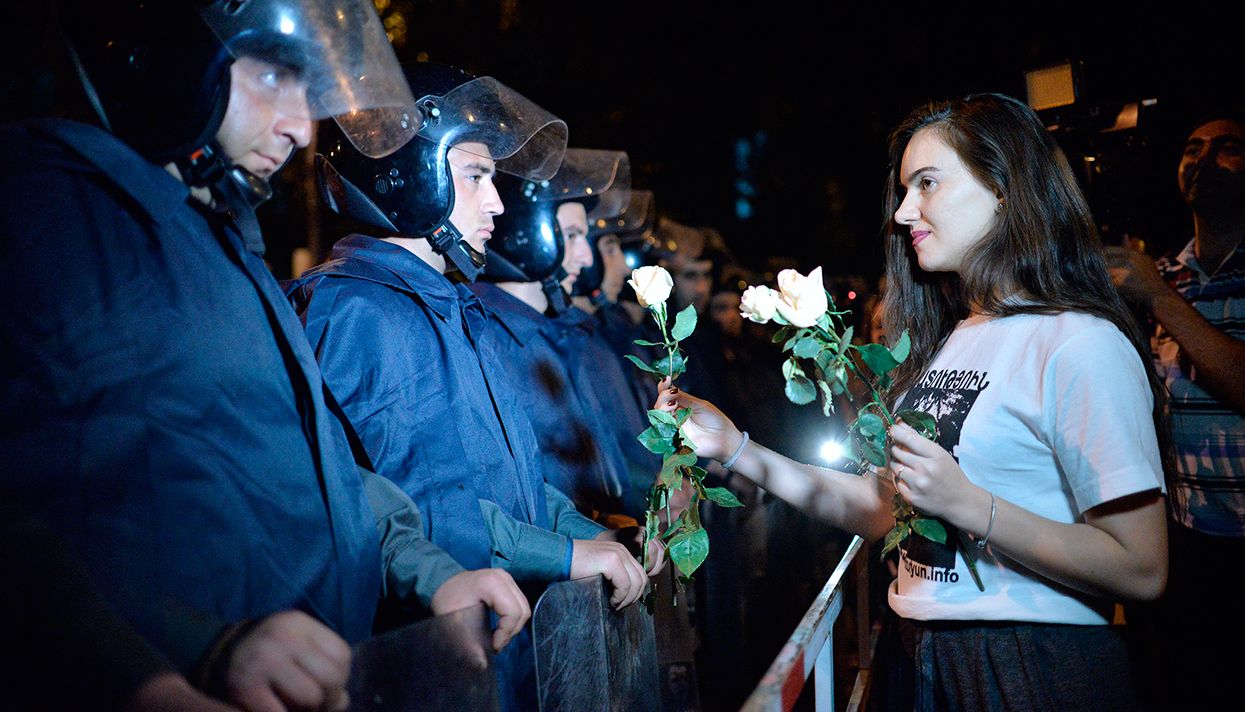
Protests against rising electricity prices have continued for the past week and a half in Yerevan and other cities across Armenia. Though demonstrators have largely avoided political slogans, fears in Moscow have spread that Armenia’s unrest could portend another “Ukrainian scenario.” Leonid Slutsky, the head of the Duma’s committee on relations with the Commonwealth of Independent States, has noted a “political color” to the protests and an apparent interest in changing a regime that’s currently a Russian ally. Konstantin Kosachev, the chairman of the Federation Council’s committee on foreign affairs, says he suspects foreign NGOs of having a hand in the demonstrations. In an article for the Carnegie Moscow Center, journalist Vadim Dubnov argues that nothing like Ukraine’s Maidan revolution awaits Armenia today.
In his article, Dubnov says the protests in Armenia are a “sensitive issue.” Demonstrators are carefully avoiding political demands, and even steering clear of “ambiguities and dangerous generalizations.” The reason for the protests and their main substance revolves around sevens dram (a little more than a single US cent), which is how much the price of electricity rose. The pricing change amounts to a 17 percent tax increase, Dubnov explains. “It’s all about these seven dram, without any sidestepping—especially not in some anti-Kremlin direction.”
There is no drastic conflict or split in Armenian society today, according to Dubnov, who argues that the “historical myth” of friendship with Russia still appeals to most Armenians. “Any politicization of the Armenian protests,” Dubnov writes, “would inevitably lead to a debate about fundamental myths, and this doesn’t factor into anyone’s plans today. It’s before their own people more than in Moscow’s eyes that no one wants to look like they’re staging a new Maidan or even be suspected of antipathy toward Russia.”
The good thing about the social [not political] focus of these protests is that the authorities may actually have to act. But there are drawbacks, too: if the authorities meet the public's electricity demands, they’re not obligated to change anything else. That said, no problem can be postponed indefinitely, and, if a Maidan movement ever does come to Armenia, its precursor will most likely be the seven dram that fuel today’s unrest.