
Why did Russia fire cruise missiles at targets in Syria?
Leading theories about Moscow's startling show of strength
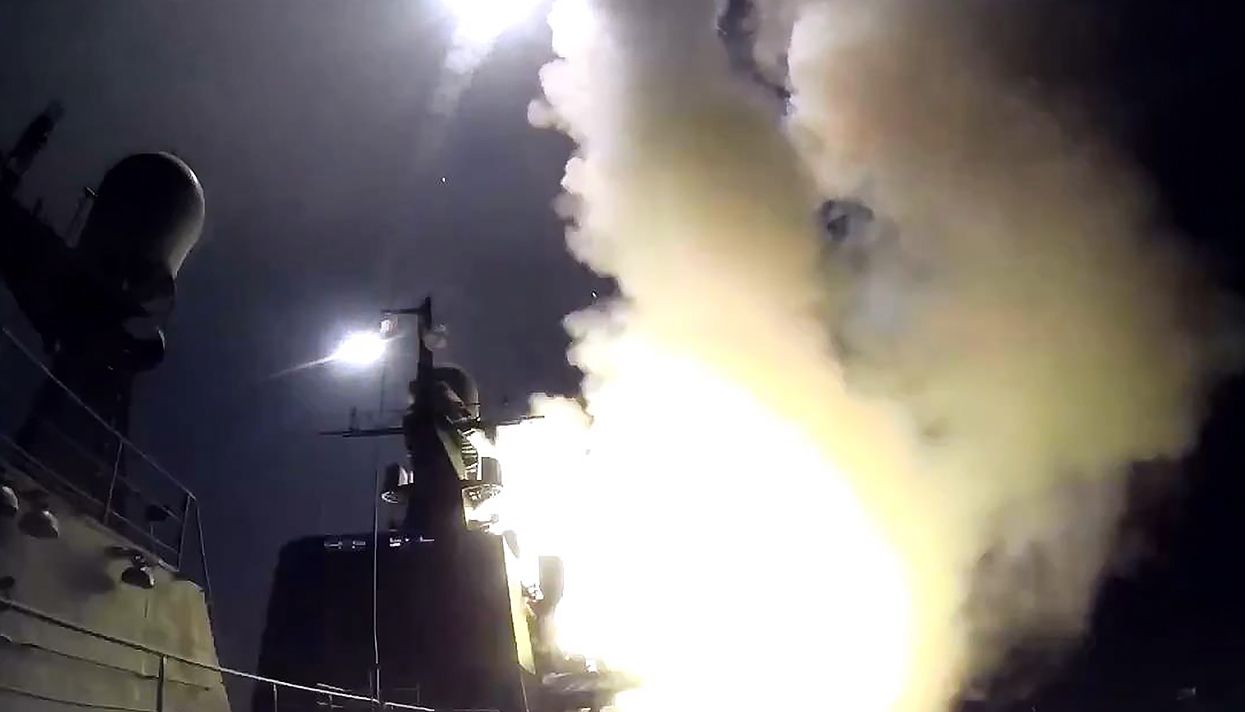
On October 7, Russian warships in the Caspian Sea launched 26 "Caliber" cruise missiles at targets in Syria roughly 930 miles away. Experts have offered different explanations for why Moscow decided to use such advanced weapons in a local conflict against an irregular army so far away. Meduza reviews the leading theories.
A show of strength and a useful propaganda move
What's the idea here? There is no obvious practical reason to use cruise missiles against forces in Syria, other than exploiting the opportunity to flex the military's muscles. This is the first time in Russian history that it's used cruise missiles to attack targets from such a distance. The rockets traveled roughly 1,500 kilometers (930 miles) and passed through the airspace of both Iran and Iraq. Russia demonstrated its strength not only to the world, but to its own people, in what is indisputably an effective piece of propaganda.
Who argues this? Jeremy Binnie, the Middle East and Africa editor at IHS Jane's 360, a political risk consultancy, and Christopher Harmer, a senior naval analyst with the Middle East Security Project at the Institute for the Study of War.
A message to the United States
What's the idea here? Launching cruise missiles at Syria isn't just a show of strength—it's a play for equal power militarily with the United States. Some experts consider the "Caliber" missile to be Russia's version of the "Tomahawk," which the US military is known to use in its foreign operations. By firing cruise missiles at targets 930 miles away, Russia also responds to US accusations that Moscow has violated an agreement on the elimination of intermediate- and short-range missiles. Using the "Caliber" rockets might be seen "as a covert Russian confirmation" that their missiles "can indeed fly well beyond 300 miles, and thus, a reminder that Putin continues to flout the greatest arms control success of the Cold War."
Who argues this? Justin Bronk, a research analyst with the military sciences program at the Royal United Services Institute, a British think tank.
Testing new weapons
What's the idea here? The Russian authorities and military high command decided to test new weaponry that the armed forces have only acquired in recent years. Testing such weapons in eastern Ukraine was not an option. This was also an opportunity to test the US military's detection system, to see if the Americans are able to track Russia's latest cruise missiles.
Who argues this? Viktor Murakhovsky, the chief editor of Arsenal of the Motherland, Gregory Celestan, CEO of Celestar, a political risk consultancy, and a retired Lieutenant Colonel in the US Army.
Increasing the intensity of attacks against Islamic terrorists
What's the idea here? Russia fired cruise missiles at targets in Syria because military decisionmakers deemed it appropriate to the mission. Representatives for the Defense Ministry have repeated warnings that Russia plans "to increase the intensity of attacks against targets controlled by the terrorist groups ISIL and Jabhat al-Nusra." Kremlin officials say the use of its Caspian Sea fleet is simply the next logical step in taking Russia's military operation to a more sophisticated technical level. Firing cruise missiles also allows Russia to expand its attack capacity, as the number of planes it has available in Syria is minimal, due to security risks on the ground.
Who argues this? Russia's Ministry of Defense, and Ruslan Pukhov, head of the Moscow-based Center for Analysis of Strategies and Technologies.