
Оригинал материала
‘It feels like it did in the 1990s’
Russians talk about visiting the French embassy in Moscow to express solidarity after Paris attacks
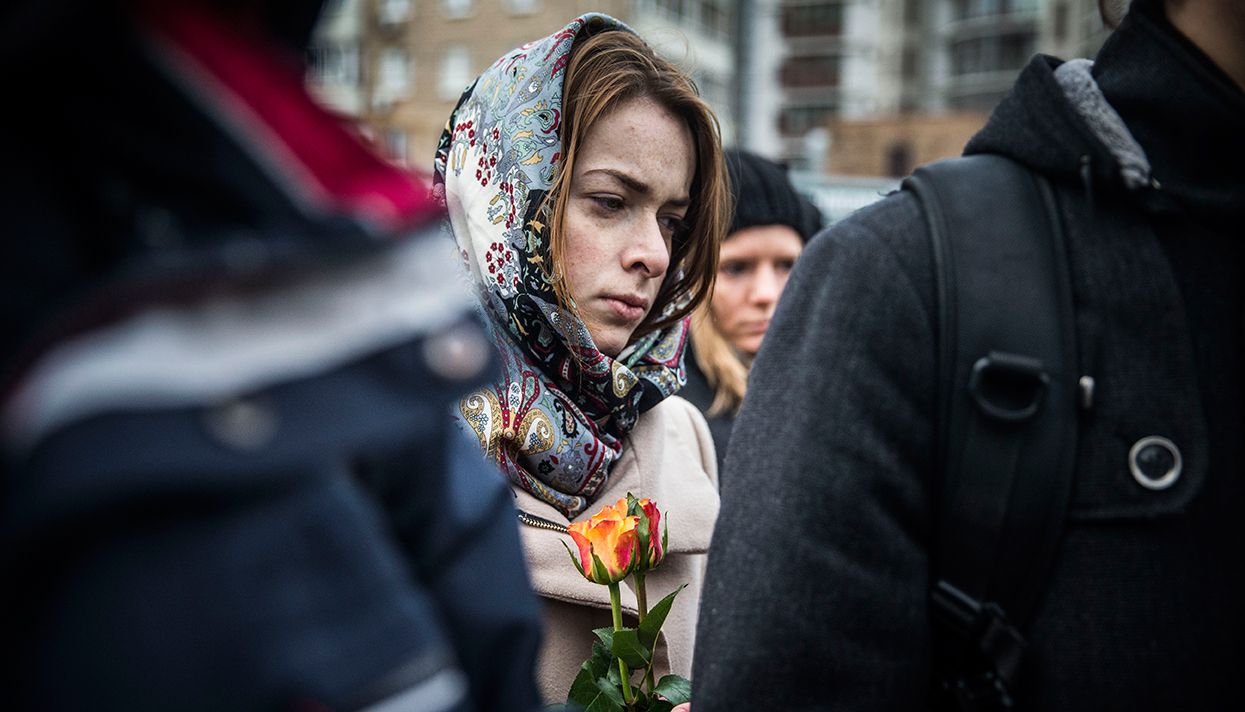
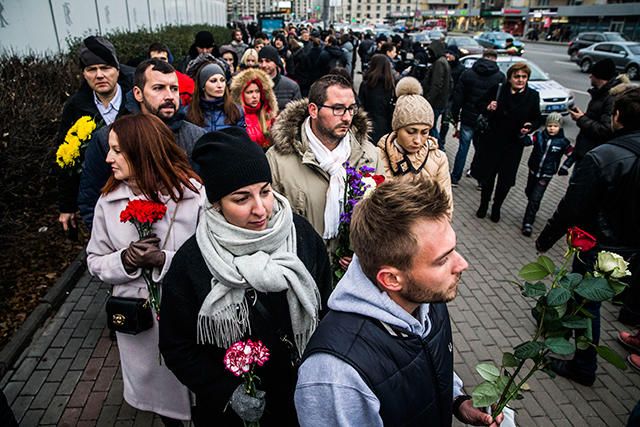
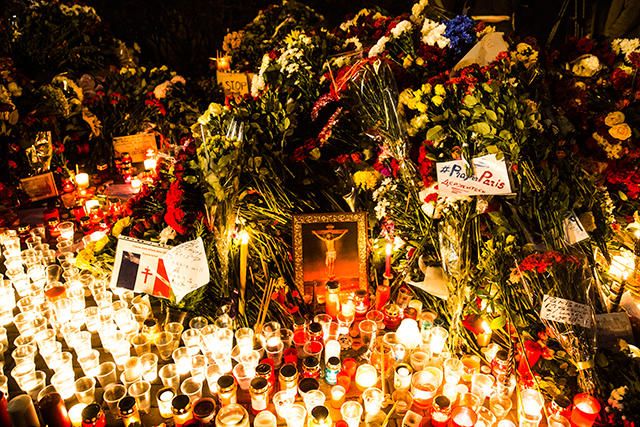
The first flowers started appearing outside France's embassy in Moscow before the sun had even risen on November 14, when the city was only waking up to news about a horrific terrorist attack 1,800 miles to the west in Paris. All day long on Saturday, the line of sympathizers and mourners outside the embassy stretched a hundred yards or more down Bolshaya Yakimanka Street. Outside, beside a book in which visitors inscribed their condolences, a sign from the embassy soon appeared, reading, "France extends its gratitude to the Russian authorities and the Russian people for their expressions of sympathy and solidarity in connection with the terrorist attacks in Paris." Meduza was present at the scene and spoke to several ordinary citizens who came to show their support.
Alexander Shmurov, soccer commentator for the television network *Match-TV*
It's terrifying what's happened in Paris, where there is a wonderful, huge mosque. In the film, "Paris Je t'aime," there's an unbearably touching bit about an Arab girl and a French boy. And it's in this place that innocent people are being blown up!
The modern world today is composed almost entirely of countries where the only men sent to fight are the ones who volunteer. And there's nothing more despicable than volunteering to take the war to a stadium or theater, where people are only there for the most peaceful reasons.
Generally speaking, we've got no weapons in this fight but how we raise our kids. It's stupid to say that there's a direct connection, if someone is carrying out a military operation in one place, and kids are being killed in another. No. It's just that the world is so closely intertwined now and things are so tense that someone is bound to blow up, if not in one place, then in another.
We came here today because we have a great deal in common with France. This [tragedy] is especially hard and painful for us, but it also affects everyone. There's nothing we can do—nothing I can do—but show kindness to our children. But it's terrifying, as humanity changes, it's terrifying how people allowed themselves to joke after the events in Paris.
Lots of people have talked about Charlie Hebdo, but satire isn't mockery—it's a way to get people to see the world differently, so they see it through someone else's eyes. I hope that the people who spent the night cracking jokes will see these flowers and think it over. Maybe they'll see differently all the trash that's running through their heads.
There's no connection whatsoever between the migrants and what happened in Paris. This is a terrible misconception—it's nonsense. I have many friends in Paris, including several migrants, and they moved their to live—not to carrying out terrorist attacks.
Anna, manager
It's terrible what happened. And it's incredible how many people came out [to the French embassy] today. It's very surprising, and it shows that things aren't so bad, that not everything is lost—because coming here is important purely as a human being. After the Charlie Hebdo attack, not as many people came, though these things are one in the same.
We need badly to get out of Syria, so what happened in Paris doesn't happen in Russia. What we're doing in Syria and the way we're doing it is wrong, and it doesn't help the fight against terrorism; it only makes the danger of a terrorist attack here even greater. Something could happen here at any moment now.
It's hard to say what the world needs to do, but this is a terrible threat that must be defeated. To find a solution, everyone needs to work together, which isn't how it's been happening, up to now. This is a matter of survival.
Kirill Goncharov, member of the regional council of the opposition political party Yabloko
We need to express our solidarity with the French people. It's obvious to everyone that this is a shared tragedy for all European civilization. And it's great that so many people came out today, including young people who understand very well that these attacks target the integrity of all Europe, not just the French people.
It goes without saying that Russia should be worried about something similar occurring here, and that's just another reason I think so many people have come [to the French embassy] to help carry some of the grief today. Right now we need to unite with Europe—not act locally and independently. I think it's obvious to everyone in the Russian establishment that Russia's participation in this conflict is escalating, and Russia needs either to unite with Europe against ISIL or act locally in support of Assad, but then [in the latter scenario] we'll see the same terrorist attacks on Russian soil [as we've seen in Paris].
Nikita, student
This isn't a blow to the French, but to the whole civilized world. It hits all European civilization. Right now, though, everyone needs to support the French specifically, and that's why we've all come out today [to the embassy]. We need to show that we stand with them, and we won't abandon them, and that we're together. This is absolutely necessary. And we must work together not just on this issue, but generally. So that nothing like this every happens again, we need to intensify the fight against ISIL and will all radical Islamists—not just in Syria, but everywhere. How we fight this war is a big question. But now we know that, for every Russian or Western Coalition airstrike there, they'll answer with strikes here at us.
Anatoly Karpalov, advertising agency head
When people die, there's nothing but sorrow to feel, and so I came here to express mine. Terrorism is everywhere and nobody is safe from it—not in Moscow, not in Paris, not in Kiev. I have friends living in Paris and colleagues who work there, and they're all alive and well, but there's no way I could not come here [to the embassy] today.
On the one hand, France—when it comes specifically to Syria—isn't the main player in the fight against terrorism, but on the other hand I think this provocation by ISIL is because of ground forces in the region. I don't think this is because of Charlie Hebdo, otherwise they would have blown them up again, but here the attack was much more. I don't know what exactly our army is doing in Syria, but it's an absolute fact that this global force of evil—ISIL—must be destroyed.
I don't feel safe in Moscow. We've already had a plane targeted. Now we've got to be more cautious and careful. There's no sense of security. After all, we've experienced our share of terrorist attacks here in Russia. There's even a sense of routine about it all.
Artem, a student
You know, the worst thing is that once again it feels like it did in the 1990s. I was hardly an adult at the time, but I remember how I was always scared on a subconscious level. I don't want to be scared. I can imagine how scared the people of Paris are now. It shouldn't have to be this way.
Georgy Pereborshchikov, civic activist
The main thing right now is that we in Russia don't turn to demagoguery amidst all this bloodshed and terrorism. We mustn't return to everything we said about Charlie Hebdo and try to tie this tragedy to the confrontation with the West, which our leaders have led us into. The main thing is that we demonstrate our solidarity with the French people. We need to remain unafraid of terrorism and demonstrate that we are not afraid.
I'm almost certain that Russia is even more exposed to the dangers of such attacks because we have a much higher level of corruption, and there are just a couple of countries between our borders and the conflict zone. Russia is more vulnerable. Just what form future terrorist attacks will take, I don't know. But there's already been the catastrophe in Egypt.
And I hope governments, both in Russia and in Europe, don't decide to crack down at home in the guise of fighting terrorism.
Olga, pensioner
My daughter studies in Paris, so it was important for me to come here [to the embassy]. Everything that's happening is very close to me. My daughter called me right away and said that she is okay. I'm by no means a specialist in politics, but we all need to think together about how to keep this from happening again. It's all an absolute nightmare. Lots of people say we need to sit down and talk to these terrorists, but how is it possible to talk to such people? They're terrorists. I'm afraid to judge our campaign in Syria, and probably there's a logic to it all, but I've also heard the view that what we're doing in Syria could trigger retaliatory strikes against us.
Konstantin Yankauskas, Moscow municipal deputy in Zyuzino
It's terrible that rivers of blood have suddenly spilled through one of the most beautiful, lively, and vibrant cities in the world. We all have an inner moral duty to come [to the embassy] and express our solidarity. Here in Moscow we know how this is—and that's why we have to be here.
I think we can expect the same [type of attack] to take place here in Russia. Unfortunately, it's very frightening knowing how unprepared, I think, our security agencies are for a similar situation. They're busy with commercial activities, racketeering, and raiding. All this puts me at unease.
First, policies in the Middle East have failed, where ISIL has had two years to expand its activities, gain popularity, recruit new supporters, and carry out terrorist attacks. This is the first reason for the failure; it's not because of [Europe's] multiculturalism. The fact that Western leaders couldn't solve the Syrian problem is the main reason for the terrorist attacks. Russia's political leadership also bears some responsibility. After all, we've prolonged the violence as a frozen conflict by supporting Assad. If the crash of our plane and these terrorist attacks aren't a wakeup call to governments and if they don't instill them with some new resolve, then we can expect more of the same.
Ilya Azar
Moscow