
Оригинал материала
Four years of state-sponsored homophobia
A sad anniversary for the persecution, humiliation, torture, and murder of people in Russia's LGBT community
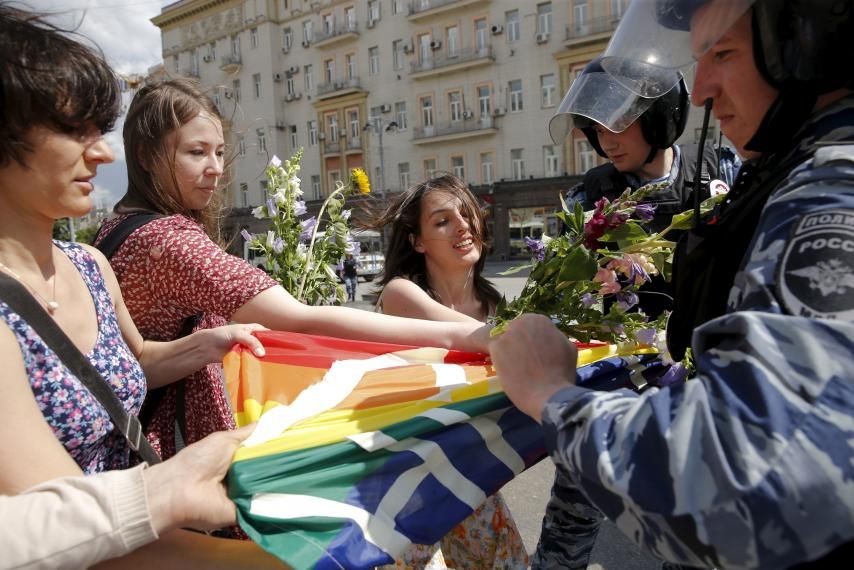
Four years ago today, on June 30, 2013, Russia enacted its ban on so-called “gay propaganda,” prohibiting the “promotion of nontraditional sexual orientations” in the presence of minors. State officials insist that the law has a narrow scope, but in reality the legislation has served two broad functions: first, it formally establishes the federal government’s position on LGBT persons, making them second-class citizens (the law forbids people from presenting children with “misconceptions about the social equality of traditional and nontraditional sexual orientations”); and second it creates a situation where people are afraid to speak openly about same-sex relationships, given the growing levels of homophobia in society and the threat of criminal liability. Members of Russia’s LGBT community have told human rights activists that they’ve encountered more harassment since the ban on “gay propaganda” went into effect. Meanwhile, Russian state officials have argued that society disapproves of gay people, but that doesn’t mean the LGBT community is persecuted in Russia, the authorities say. Meduza presents a few obvious counterarguments to this claim.
Members of Russia’s LGBT community are tortured and killed.
Earlier this spring, the newspaper Novaya Gazeta revealed a mass police crackdown on gay men in Chechnya, where more than 100 individuals have reportedly been locked up in secret detention centers and tortured into giving up the names of other gay men. So far, at least three of these prisoners have died in custody, journalists say.
This story, in turn, has unearthed new reports on the North Caucasus’ system of “honor killings,” where people murder their own relatives for so-called “immoral behavior,” including being lesbian, gay, bisexual, or transgender. For example, Leila, who calls herself “Chechnya’s first transgender woman,” says her own uncle hired a hitman, who later tracked her down in Moscow and stabbed her twice in the chest. She survived and immigrated illegally to the United States.
Russia’s hate crimes against gay people aren’t isolated to Chechens, however. A month and a half before the “gay propaganda” ban went into effect, a 23-year-old man in Volgograd named Vladislav Tornovoy was brutally murdered when he came out as gay. His attackers raped him with several glass bottles before killing him.
Members of Russia’s LGBT community are beaten and humiliated on camera, while being robbed.
Human rights activists have encountered dozens of gay and transgender Russians who say they’ve been the victims of both planned and spontaneous attacks targeting the LGBT community. Russian police, moreover, refuse to keep exact statistics on such crimes, arguing that there’s no need for a separate category.
What human rights workers are able to record is clearly just a small percentage of all the hate crimes committed in Russia against members of the LGBT community, if only because victims in such assaults rarely turn to the police.
In several regions throughout the country, attackers have used online dating services to lure gay men on dates, in order to entrap them, humiliate them, and force them to declare their sexual orientation on camera. This footage is then used to blackmail the gay men into paying money to keep their videos a secret. Some of these fake dates have ended in murders. In most of these incidents, victims never filed a police report, fearing that people would find out that they’re gay. Others say they never bothered with the police because they doubted it would lead anywhere.
In May 2016, Meduza special correspondent Daniil Turovsky wrote about a group of “gay hunters” in St. Petersburg. Two of the criminal group’s members have since been convicted of robbery.
Members of Russia’s LGBT community aren’t allowed to defend their own rights.
The Russian authorities consistently refuse to allow activists to stage public rallies in support of gay rights, and even small attempts to picket buildings usually end with attacks on demonstrators. When this happens, the police don’t always rush to the defense of gay rights activists.
LGBT teenagers in Russia have nowhere to turn.
There are almost no organizations in Russia designed to help teenagers cope with being LGBT in Russia. These people have almost nowhere to turn for answers. Elena Klimova founded the online group “Children-404,” one of the few portals in Russia where LGBT teens can talk about their experiences, support one another, and consult psychologists. In January 2015, however, a court in Nizhny Tagil convicted Klimova of spreading “gay propaganda” and fined her 50,000 rubles ($850). Consequently, Vkontakte also blocked the original “Children-404” page, though community members launched a replacement group that’s still online.
Teachers are fired from their jobs at schools and universities for being gay.
In 2014, Human Rights Watch recorded seven instances where Russian teachers and lecturers were pressured to leave their jobs at schools and universities. In Russia, anti-gay activists monitor the social media accounts of educators, filing complaints with school administrators and law enforcement agencies when they find evidence of gay teachers, arguing that being LGBT and instructing children constitutes a violation of Russia’s federal ban on “gay propaganda.” Human rights activists say LGBT teachers also encounter discrimination at the hiring stage.
In January 2015, Meduza’s Daniil Turovsky wrote about one woman in St. Petersburg who lost her job teaching disabled children after she was outed as a lesbian.
Homophobia has become a marketing tool in Russia.
Herman Sterligov recently opened a bakery chain in Moscow, St. Petersburg, and Kirov, publicly refusing to serve members of the LGBT community. Hanging above the doors to all the stores are signs reading, “No faggots allowed.” A bar opened in Blagoveshchensk, in Russia’s Far East, that also denies service to gay men, telling them that “there are plenty of beautiful women around” and “a man’s caboose wasn’t created for that.” The owner of St. Petersburg’s “Central Barbershop” chain says his hair salons will turn away gay customers. “There are too many gays and lesbians,” he stated publicly. The television network Tsargrad, meanwhile, announced a promotion called “Happy Trails, Perverts!” The channel said it would buy “sodomites and perverts” one-way tickets out of Russia, if they present “certificates of homosexualism.”
Same-sex couples are directly forbidden from adopting children.
Just a few days after he signed Russia’s ban on “gay propaganda,” President Putin enacted another law explicitly forbidding same-sex couples from adopting children. Less than a year later, in February 2014, Prime Minister Dmitry Medvedev signed a decree prohibiting the adoption of Russian children by persons residing in countries that allow same-sex marriage.