
Оригинал материала
The Real Russia. Today.
Appreciating Oleg Sentsov, Trump wants the G8 back, and Gulag records are destroyed
Friday, June 8, 2018
- Meduza explains why Oleg Sentsov's hunger strike matters
- Donald Trump wants Russia back in a reconstituted G8
- Putin is reportedly still working behind closed doors to arrange a summit with Trump
- Russian authorities are secretly destroying Soviet Gulag records
- Ukraine's prime minister pooh poohs big bonuses at Naftogaz
- Ukrainian officials find a load of cash in a lock box registered to a Russian journalist accused of treason
- Novosibirsk's mayor saves the city's direct mayoral elections by promising not to challenge the incumbent governor this September
- Russia inches closer to raising its retirement age
- Moscow denies any role in an airstrike that reportedly killed dozens at a market in Syria
- Russian journalist loses job for granting interview to independent TV station
- Russian Jehovah’s Witnesses say they've been harassed more than ever by the police, since their organization was banned
- An artist in St. Petersburg is hit with a hefty fine for marching on May Day with an anti-Putin banner
- Oleg Navalny goes free at the end of the month, and prison staff are taking their last chance to give him hell
Understanding Oleg Sentsov's significance 🧠
June 8 marks the 26th day of Oleg Sentsov’s hunger strike. The Ukrainian filmmaker is currently serving a 20-year sentence in a Russian prison for planning a terrorist act and setting fire to the Crimea office of the ruling political party United Russia. On May 14, the director (who denies the charges against him) demanded the release of all Ukrainian political prisoners now being held at Russian penitentiaries, vowing to refuse compulsory feedings. Sentsov says he is ready to die for this cause. Many prominent cultural figures — both in Russia and abroad — have publicly come to the filmmaker’s defense. Meduza film critic Anton Dolin offers ten reasons why Oleg Sentsov’s hunger strike is something you shouldn’t ignore.
- Read Dolin’s text here: “Ten reasons you should give a damn: Why Oleg Sentsov's hunger strike matters”
Trump flips the script 😮
Already set to fight with other Group of Seven leaders at this weekend’s meeting in Canada over new steel and aluminum sanctions, Donald Trump called on Friday for the restoration of the G8, saying that Russia should be invited back. (It was kicked out of the group in 2014, after Moscow annexed Crimea.) The U.S. president is scheduled to leave the conference early on Saturday for Singapore, where he’ll meet with North Korean leader Kim Jong-un on Tuesday.
Commenting on Trump’s proposal, Kremlin spokesman Dmitry Peskov said essentially: thanks, but no thanks. “We’re putting our focus on other [diplomatic] formats,” Peskov explained.
Putin still wants his Trump summit 💝
Vladimir Putin has asked Austria’s chancellor to organize a meeting with Donald Trump in Vienna this summer and the White House is pondering the offer, a senior European official told The Wall Street Journal. Read the (paywalled) story here.
Let the past die. Kill it, if you have to. ⌛
Executing a secret government order from 2014, the Russian authorities have reportedly started destroying archival records documenting the imprisonment of people during the Soviet era, according to a letter from Roman Romanov, the director of the Gulag History Museum, addressed to Vladimir Putin and Mikhail Fedotov, the head of Russia’s Presidential Human Rights Council.
A researcher working with the museum says he discovered a confidential interdepartmental order issued on February 12, 2014 — signed by Russia’s Interior Ministry, Justice Ministry, Emergency Management Agency, Defense Ministry, Federal Security Service, Federal Drug Control Service, Federal Customs Service, Federal Protective Service, Foreign Intelligence Service, Attorney General’s Office, and State Courier Service — mandating the destruction of special Gulag registration cards after former convicts turn 80.
What are these records? The USSR indefinitely archived the records of Gulag inmates who died as prisoners, but these case files were destroyed if inmates survived their incarceration. Upon release, prisoners were issue a special registration card that recorded their information and Gulag record. The Russian government has reportedly started destroying archives containing these “card” records, jeopardizing the work of professional historians and making it far more difficult for ordinary people to find out what happened to relatives who were sent to the Gulag.
Speaking to the newspaper Kommersant, Mikhail Fedotov promised to address the issue, saying, “This is fundamentally important, as we’re talking about a means of countering the falsification of history. When you’ve got the document, it’s nearly impossible to falsify it. When there’s no document, you can make up whatever you want.”
Historians don’t know exactly how many people were imprisoned in the Soviet repressions, but the human rights group “Memorial” says it was at least 13 million.
Russia and Ukraine
⛽ You're not out of the woods yet, Naftogaz
Ukrainian Prime Minister Volodymyr Groysman is asking Naftogaz to reconsider the large bonuses it says it will award to staff for its victory over Gazprom in a February Stockholm Arbitration ruling, where the Ukrainian national oil and gas company was awarded $4.6 billion in compensation for unpaid gas transit fees. Naftogaz plans to pay $46.3 million (one percent of its total award) to 41 different employees (not all of whom are top managers, the company says).
Groysman says the massive bonuses are “poorly timed” and “over the top,” though he congratulates Naftogaz and its management on winning “a serious victory for Ukraine’s interests.”
In December 2017, in a separate case, the Stockholm Arbitration Court ordered Naftogaz to buy 5 billion cubic meters of gas from Gazprom between 2018 and 2019, and required it to pay the Russian company $2 billion. With the February 28 ruling, Naftogaz is now owed $2.6 billion from Gazprom, which is challenging the second verdict and withholding the $2.6-billion payment on the grounds that Ukraine is unlikely to return the money, if the ruling is reversed on appeal.
💵 Opening up Vyshinsky's box
Ukrainian national security agents raided the safety deposit box of RIA Novosti Ukraine chief editor Kirill Vyshinsky, who’s currently under arrest in Kiev on treason charges. Officials reportedly found $200,000 in cash, an object “resembling a Browning 1906 pistol,” and Vyshinsky’s labor contract with the Rossiya Segodnya media holding company.
Vyshinsky, who denies the charges against him and has dual Russian-Ukrainian citizenship, has asked Vladimir Putin to help him renounce his Ukrainian citizenship. Russian federal officials are treating his arrest as the obstruction of a journalist’s lawful activities and the knowing prosecution of an innocent person.
One hell of a political deal 🗳
Anatoly Lokot, the mayor of Novosibirsk, stuck a deal with the region’s acting governor not to run against him in September, in exchange for preserving direct mayoral elections in his city. The governor even says he’ll endorse Lokot for re-election, now that Lokot has agreed not to challenge him at the polls. “We have many tasks ahead, and we’ll work together on solutions,” acting Governor Andrey Travnikov told reports on Friday.
In May, Lokot’s political party, KPRF, announced that he would seek the governorship in the September elections, where he was expected to be Travnikov’s main rival.
Don't quit your day jobs, oldies 🧓
The Russian government is reportedly close to approving a plan to raise Russia’s retirement age. Three sources told the magazine RBC that federal officials plan to raise the pension age for men from 60 to 65 and for women from 55 to either 60 or 63. The government has apparently settled on the five-year hike for men, but the Finance and Labor ministries are still duking it out over how much to raise women’s retirement age. (Finance wants it hiked to 63, and Labor says 60 will be good enough.)
In early May, Prime Minister Dmitry Medvedev announced that the government would present a plan to raise Russia’s retirement age in the near future. Officials have discussed the controversial reform for several years, but the government has postponed a change of policy until now.
Russia denies another Syria catastrophe ☠
Monitors from the White Helmets and the Syrian Observatory for Human Rights say the Russian military bombed a market near a mosque outside Idlib in Syria on June 7, injuring 66 people and killing at least 44, including 11 women and six children. The death toll is expected to rise, as many victims are still in critical condition. Moscow denies that it carried out the airstrike.
In the fall of 2015, Russia intervened militarily in Syria, officially in order to fight terrorists from ISIS. Several Western countries have accused Moscow of using the war against ISIS to conceal its real goal: rescuing the Assad regime. In a live call-in show on Thursday, Vladimir Putin defended the military intervention as an invaluable opportunity for Russia’s armed forces to gain experience on the ground. The president also reasoned that “it’s better to fight them over there, than here in Russia.”
It's Russia's private press, not the free press, Buster Brown 📺
The Nizhnevartovsk television station N1 fired journalist Alexandra Terikova and her program producer on Friday, after she granted an interview to the independent TV channel *Dozhd. On June 6, Dozhd* aired a segment about a concert at a kindergarten in Nizhnevartovsk, where children performed Vyacheslav Antonov’s song, “Uncle Vova, We’re With You.” Terikova’s daughter took part in the show.
The station’s general director said Terikova was let go because of her “political ambitions.” On Instagram, Terikova shared a photograph of her resignation letter, where she wrote: “I ask to be dismissed for my excessively active civil position and for political disagreements with the TV station’s editors.”
N1 director Rinat Karimov was a bit prickly when the website URA.ru asked him to comment on Terikova’s ouster. “You know, we’re a private TV channel and this is none of your business,” Karimov said.
Law and order à la russe
✝ Have you heard the appellate news?
Representatives for Jehovah’s Witnesses in Russia have sent a letter to the Presidential Human Rights Council, saying their group is facing widespread harassment across the country. The appeal bears the signatures of the wives of dozens of Jehovah’s Witnesses members now jailed or under house arrest or travel restrictions. “Law enforcement agencies are trying to make us live in fear and wince every time there’s a knock on the door or a siren wails, expecting to be arrested just for our faith,” the letter states.
In April 2017, Russia’s Supreme Court banned the “Jehovah’s Witnesses’ Administrative Center” as an extremist organization, outlawing its activities nationwide. In late May, the European Court of Human Rights agreed to hear an appeal brought by 395 Jehovah’s Witnesses communities in Russia, who say the Supreme Court’s designation violates their religious freedoms.
✊ Unpermitted anti-Putinism
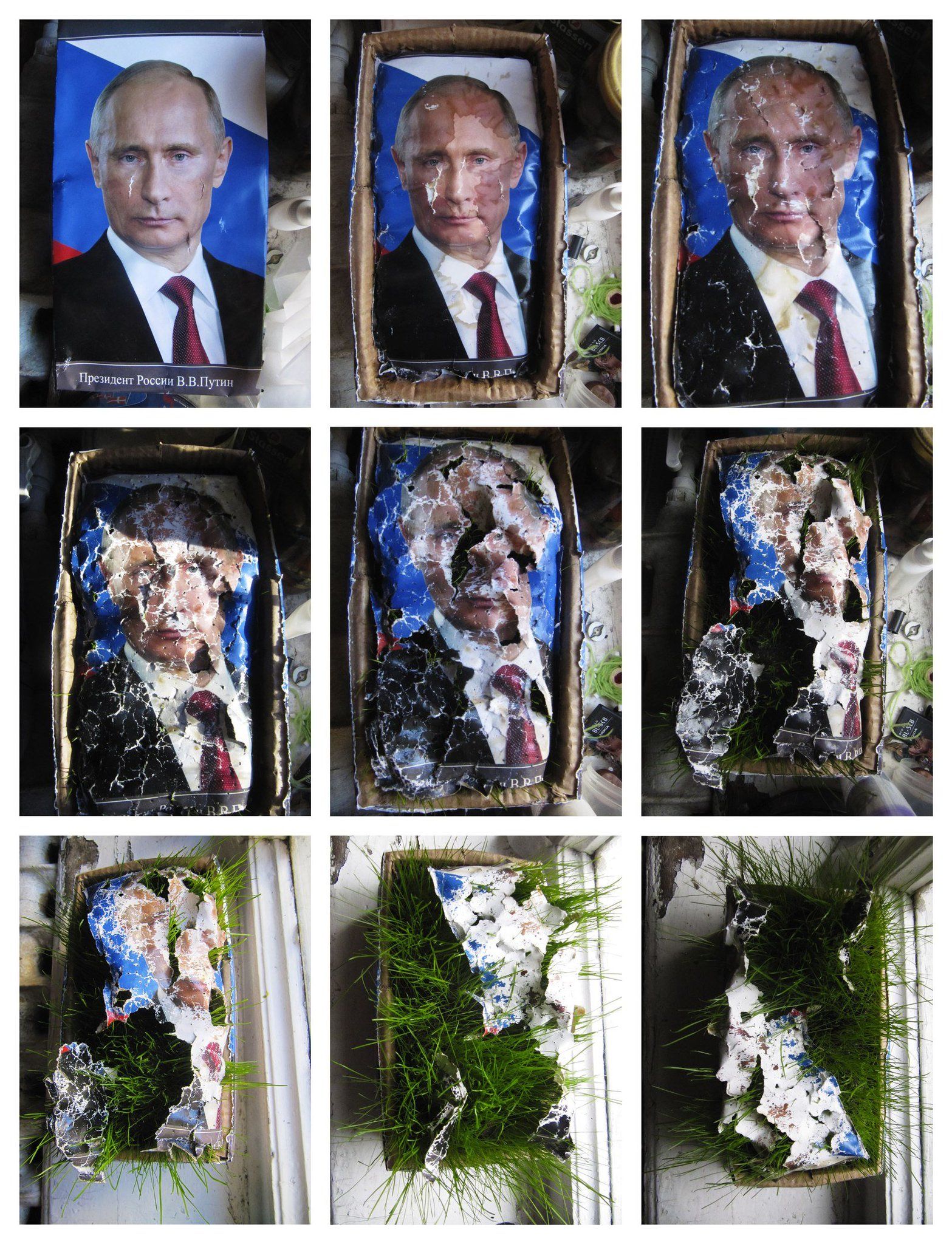
A court in St. Petersburg has fined an artist 160,000 rubles ($2,560) for marching with an anti-Putin banner in the city’s May Day parade. Varvara Mikhailova’s sign featured a series of time-lapse photos showing grass breaking through a portrait of Putin. Known as “The Nine Stages of a Leader’s Decomposition,” the image was created in 2015 by the artist-protest group “Vesna.”
The court convicted Mikhailova of repeatedly violating Russia’s laws on public assemblies. (She was last detained at a rally on June 12, 2017.) Mikhailova says the court also ordered her to destroy the banner. When police officers detained her on May 1, they reportedly asked her if the banner had been approved by city officials.
Police detained 15 people at St. Petersburg’s May Day parade this year, including several anti-war demonstrators who marched with foreign flags and three LGBT rights activists carrying rainbow flags.
🧘♂️ It's never too late to screw with a Navalny
Oleg Navalny, the brother of opposition politician Alexey, is due to go free from prison at the end of the month, but his fast-approaching release hasn’t discouraged the prison staff from locking him up in a “special punishment cell” for the remainder of his sentence. Alexey Navalny’s website reported on Friday that Oleg has been moved to a pomeshchenie kamernogo tipa. In late May, Oleg Navalny was moved to “punitive confinement” for the seventh time in his 3.5-year prison sentence. He will go free on June 30.
In April, the Presidium of the Russian Supreme Court refused to overturn the December 2014 verdict in the so-called “Yves Rocher” case that sent Oleg Navalny to prison for supposedly embezzling several million rubles from an Eastern European subsidiary of the cosmetics company Yves Rocher.
Alexey Navalny demanded his brother’s immediate release in accordance with the European Court of Human Rights’ October 2017 ruling that the Navalnys’ right to a free trial had been violated. (The ECHR refused, however, to say that the Yves Rocher case was politically motivated.)
The Russian Supreme Court also concluded that the Yves Rocher case should be reopened to consider the “new facts.” Navalny’s lawyer didn’t want the investigation reopened, pointing out that the last ECHR ruling to force a retrial of a case against Alexey Navalny (the “Kirovles” case) resulted in a verdict that was identical to the first.
Yours, Meduza