
Оригинал материала
The Real Russia. Today.
How Soviet invasion changed the Czechs forever, Russia's new retro-futuristic electric car, and a push to ban Kadyrov from Moscow
Friday, August 24, 2018
This day in history. On August 24, 1991, the Ukrainian parliament declared its independence from the Soviet Union.
- Meduza reports from Prague, 50 years after the end of ‘socialism with a human face’
- Explaining Russia's new retro-futuristic electric car
- Russia's metallurgical and chemical industry tells Kremlin adviser to buzz off after he proposes higher taxes to fund Putin's new social spending
- Investigators begin reviewing new torture allegations at a prison in Kemerovo
- Independent newspaper wants Moscow to ban Chechnya's ruler from visiting the city
- A publicist in Yekaterinburg faces administrative charges because he called a local city councilman a ‘condom’ on Facebook
- Police in Kazan press charges against a local environmentalist for disguising a protest as an outdoor yoga class
- Russian officials ban another U.S. nonprofit as a national security threat
- A mobster tombstone turns up at a Russian playground
- The American Journal of Public Health says Russian trolls tried to make the U.S. vaccination debate even dumber
- John Bolton meets with Russian counterpart and demands an end to election meddling
How Soviet invasion changed the Czechs forever 💔
Before dawn on August 21, 1968, Warsaw Pact armies invaded Czechoslovakia and shut down the Prague Spring, ending the nation’s attempt to put a “human face” on socialism. In 36 hours, as many as 406 people were killed. Afterwards, many more were arrested, fired from their jobs, or forced to leave the country. The subsequent effort to “normalize” Czechoslovak stagnation would continue until the collapse of the Communist regime in 1989. Meduza special correspondent Konstantin Benyumov went to Prague and learned how the Soviet invasion 50 years ago still affects the Czech Republic and shapes attitudes about Russians today. Read his report here.
This story is almost 5,000 words. What’s the gist?
You won’t get the rich character development in CliffsNotes, but a general summary of this article would tell you that the USSR squandered Czechoslovaks’ World-War-II-era goodwill by rolling their tanks into Prague in August 1968. For many in the country, the invasion transformed Moscow from a liberator into an occupier, though a political coup and Stalinization program already offered grounds for hard feelings. The Czech Republic’s modern-day politics are messy, too, with populists not all that unfriendly to Russia leading the government.
Back to the future 🚗
On August 23, presenting at the “Army-2018” forum, the Kalashnikov Concern arms manufacturer unveiled its CV-1 electric automobile prototype, whose outward appearance is modeled on the IZh 2125 “Kombi” compact car. The vehicle’s design team thinks it can become a competitor to Tesla. Russian Internet users responded immediately with the meme “How do you like it, Elon Musk?” repeating a phrase used to mock Russia’s most absurd and unimpressive home creations. Meduza asked industrial designer and former Marussia Motors chief designer Yaroslav Rassadin to share his thoughts about the CV-1, and to explain why Kalashnikov decided to give its car of the future a look from the past.
What’s the main takeaway from this interview?
It’s pretty short, but if you want to skip it, the gist is that Rassadin says the “retro-futuristic” design is a publicity gimmick that cuts straight to Russians’ Space Race soul. It’s an interstellar rocket strapped to a bucket.
Find the money somewhere else, Kremlin 💸
Kremlin adviser Andrey Belousov met this week with representatives from the metallurgical and chemical companies he recently proposed taxing extra to raise 500 billion rubles ($7.4 billion) needed to implement Vladimir Putin’s new social spending program. Shockingly, the companies haven’t embraced the opportunity to hand over their profits, and they’ve proposed an alternative plan where they voluntarily invest some of their money in social projects selected by a special working group. Belousov says he hopes the industry will invest between 200 and 300 billion rubles. “That would be pretty good,” he told the newspaper Vedomosti on August 24.
Were these taxes ever going to happen for real?
The stock market certainly worried about it. In mid-August, within 24 hours of Belousov’s suggestion, Russia’s super-rich metal and mining tycoons saw $3.1 billion “wiped off their fortunes,” as Bloomberg put it. The government has been kicking over every rock, trying to find the money to pay for Putin’s latest “May Orders,” which call for boosting Russian life expectancy and reducing poverty. Raising the country’s value-added tax was part of this hunt for cash. Economists believe the project’s total price tag is at least 8 trillion rubles ($118.7 billion). If the money doesn’t come together, however, officials can always fudge their numbers to fake better demographic statistics. According to Vedomosti, that’s at least partly how Russia implemented Putin’s 2012 platform.
Prison torture continued 👊
Russian investigators have opened a preliminary review of allegations that guards at a penitentiary in Kemerovo beat and abuse the inmates. Officials say they learned of the situation through “news media monitoring.” On August 23, Meduza reported torture allegations at Correctional Facility No. 37 in Kemerovo, where inmates say they’re beaten regularly, while state inspectors mysteriously fail to uncover any regulatory violations.
How did Meduza find out about the torture in Kemerovo?
Earlier this month, we published a chart cataloging the year’s reported cases of torture by Russian prison guards, federal agents, and police officers. With more than four months left in the year, the number of reported cases was already well above fifty. Meduza also solicited readers for information about under-reported prisoner-abuse cases, and that’s how we heard from Bashkiria resident Oksana Khattarova, whose husband was tortured at Correctional Facility No. 37. The recent explosion of news coverage about prison torture in Russia owes largely to a video published by Novaya Gazeta in mid-July showing more than a dozen guards in Yaroslavl taking turns beating up inmate Evgeny Makarov. On August 23, the newspaper shared a second video from the same prison that showed guards punching and kicking prisoners as they are herded through a hallway.
Ban Ramzan ⛔
Responding to Chechen ruler Ramzan Kadyrov’s recent statement that human rights activists aren’t welcome in his republic, editors from the newspaper Novaya Gazeta have made a public appeal to Sergey Sobyanin, asking Moscow’s mayor to ban Kadyrov from the city. A letter from the newspaper says Muscovites will be safer without his “gun-toting retinue.” The text also calls Chechnya a “heavily subsidized region,” taking a page from the “Enough Feeding the Caucasus!” protest movement that generated some buzz earlier in the decade.
Why is Novaya Gazeta doing this now?
Kadyrov made his latest “no human rights activists!” speech at a meeting with Chechen law enforcement agencies on August 22, saying that Oyub Titiev would be the last of these troublemakers allowed in Chechnya. Kadyrov even compared human rights activists to “terrorists and extremists,” saying they “interfere with Chechen life.” Activists and independent journalists rallied to Titiev’s defense after his January arrest on suspicious drug-possession charges. Novaya Gazeta and Ramzan Kadyrov have a long and antagonistic relationship. The newspaper has repeatedly reported human rights violations by Chechen security officials, including the mass arrest and torture of gay men between February and March 2017 and a mass execution of suspected extremists in January 2017. In April 2017, Islamic theologians convened at Grozny’s central mosque and allegedly called for the “massacre of journalists” responsible for insulting “the dignity of Chechen men” by suggesting that gay people live in the republic. Kadyrov is fond of denying the existence of a Chechen LGBT community.
Social (media) unrest 🔥
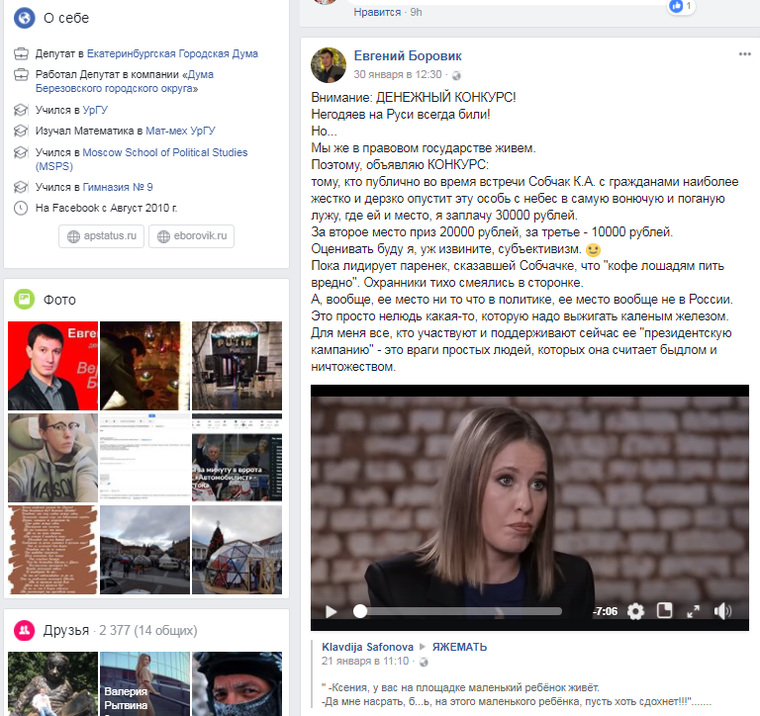
Prosecutors in Yekaterinburg have opened a criminal caseagainst publicist Platon Mamatov, in response to a police report filed by City Councilman Evgeny Borovik over an argument in late June that took place on Facebook. Mamatov is charged with violating Article 5.61 of Russia’s Administrative Code — the misdemeanor offense of “insulting someone in a public speech or speech shown in the mass media.” In a heated exchange of Facebook comments, Borovik implied that he would beat up Mamatov, who responded, “You’re such a boring, predictable scumbag.” (Literally, Mamatov called him a “condom” — a colorful invective in Russian slang.)
Who cares about two loudmouths bickering on social media?
Evgeny Borovik isn’t just any loudmouth. Having changed his party affiliation at least eight times, he entered Yekaterinburg’s City Council in 2013. In February 2018, he offered a cash reward to the person who could sling the most mud at presidential candidate Ksenia Sobchak. A month later, Borovik fled to Paris, after his Sobchak-defamation contest triggered a hate-speech criminal investigation. In April, the case against him was closed, and Borovik returned to Yekaterinburg. In June, Borovik and another city councilman were accused of failing to report their income for the previous year.
Let's give 'em a peace of our mind 🧘
Police in Kazan have charged a local environmentalist with the misdemeanor offense for staging an unpermitted protest disguised as an outdoor yoga session. On August 17, Vera Kerpel led a small crowd gathered in the public square outside the building that houses the Tatarstan Government. The participants wore matching shirts stamped with slogans against the planned construction of a new trash incineration plant. The next “public exercise” was scheduled for August 24, but police summoned Kerpel and informed her of the administrative charges against her. She reportedly refused to go to court for her arraignment, saying she felt unwell, and her hearing was moved to next week.
Is yoga the future of Russian street activism?
Perhaps not, but it’s no surprise that Russian activists feel the need to get creative when it comes to political demonstrations, where getting a permit is often an impossible feat. On August 24, Moscow city officials yet again denied a permit to Alexey Navalny, who wants to stage a mass protest on September 9 (Election Day) against proposed pension reforms. Navalny says he’s nevertheless going ahead with the rally at Tverskaya Street, where he’s called supporters out for unpermitted demonstrations before. (Read Meduza’s report from one such event on June 12, 2017.) Theoretically, things should be easier for activists in Kazan, where Tatarstan’s Supreme Court recently ruled that local officials illegally denied a permit to environmentalists wishing to protest the same incineration plant opposed by Vera Kerpel.
Another one bites the dust 🛢️
The Russian Attorney General’s Office has banned the U.S.-based Pacific Environment and Resources Center as an “undesirable” organization, saying the group “represents a threat to the Russian Federation’s constitutional system and state security.” Next, the Justice Ministry is supposed to add the center to its formal registry of “unwanted NGOs” — a list that currently names 14 groups, including the National Endowment for Democracy, the Open Society Foundation, the Institute of Modern Russia, the German Marshall Fund, and others.
What does this organization do in Russia?
According to its own website, the Pacific Environment group works with local and indigenous partners in the Russian Far East, Siberia, and the Altai Territory to “defend the region’s natural and cultural treasures against fossil fuel extraction, reckless gold mining, and illegal logging.” Being blacklisted as an undesirable organization is bad news in Russia. Cooperating in any way with one of these groups carries stiff criminal penalties, and the organizations themselves are prohibited from disseminating information inside Russia, including on the Internet.
Mobster ghosts 👻
Internet users in Samara have discovered a mobster tombstone at a local children’s playground. According to Alexander Khinshtein, a former State Duma deputy from the area and a current adviser to the director of Russia’s National Guard, the stone tablet will be removed by August 27.
The tombstone reportedly appeared sometime at least three years ago, honoring crime lord Konstantin Berkut’s younger brother, Vladimir, who was shot not far from the playground in April 1994. (Konstantin was killed five years later.) Khinshtein says the gravestone was installed illegally, tweeting that “obelisks to criminal authorities in the center of the city are unacceptable.”
Meanwhile, in 'Murica
💉 More trolls
A study, published in the American Journal of Public Health on August 23, suggests that Russian bots and trolls posing as social media users disseminated both pro- and anti-vaccine messages between 2014 and 2017, in an apparent effort to “legitimize” the vaccine debate and “promote social discord.” Read CNN’s summary of the report here.
🕊️ More talks
At a Thursday meeting in Geneva with his Russian counterpart, National Security Adviser John Bolton says he warned Moscow against meddling in this November’s U.S. midterm elections. “I made it clear we wouldn’t tolerate [election] meddling in 2018 and that we were prepared to take necessary steps to prevent it from happening,” Bolton told a news conference after more than five hours of talks. Read the story at Reuters.
Yours, Meduza