
Оригинал материала
‘A naked man is always more submissive than one wearing clothes’
Journal entries from life in the USSR’s drunk tanks
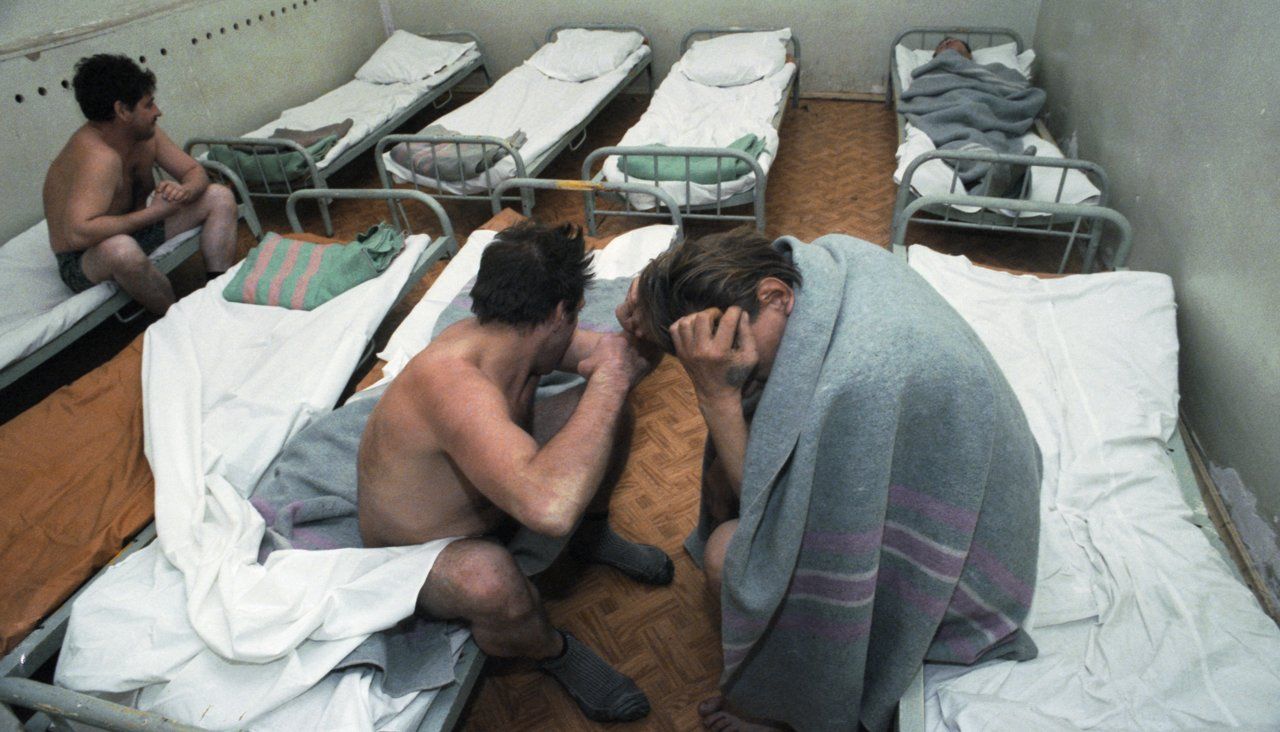
Russian senators are entertaining the idea of resurrecting the country’s vytrezviteli (sobering-up centers, or drunk tanks) and empowering the police to lock up people caught intoxicated in public. Under the new proposal, those who spend a night in the tank would be forced to pay for their stay, though lawmakers have yet to draft a mechanism for extracting these payments. Russia’s first “haven for the inebriated” appeared in 1902, but drunk tanks weren’t common until the Soviet era, when the standard procedure involved a medical exam, a cold shower, and a few hours of sleep in a shared room, for which residents were charged a fee. Police guards often allowed violence, and anti-government demonstrators were sometimes locked up here during the USSR’s “Era of Stagnation,” from the early 1970s to the mid-1980s. As the Federation Council moves forward with its initiative, Meduza translates journal entries published by the project Prozhito, written by people who had brushes with the drunk tanks of the Soviet Union.
Alexander Dreitser, health worker, 51 years old
August 13, 1941
On Orlikov Pereulok [in Moscow], there’s a drunk tank situated inside a small building. The streets are dark, but the driver knows the exact place, and he stops the car right outside. With some difficulty, we carry out the patient, who digs in his heels, swears, and tries to fight us. The police officers and nurse on duty are experienced, and they restrain him quickly, dragging him to the floor, and shoving a rag, stuffed inside his own hat, soaked in ammonia inhalants [smelling salts] into his face. He screams wildly, but he’s already half subdued. Then they hand him over to two large women who will undress him. They throw him on a sofa and strip him naked within a minute. His clothes are removed over his head from behind, with a few buttons coming loose and rolling away, before he’s dragged into a cool bath, where he’s scrubbed with soap and a washcloth, dried off, and — now thoroughly humbled — led to a cot. A naked man is always more submissive than one wearing clothes, which can’t be said for women. I assess him and find no visible injuries, and a few minutes later he’s fast asleep beside other men who enjoyed similar exploits that night. In another room, his belongings and cash are cataloged and carefully placed in a numbered bag. The next morning, everything will be returned, minus 25–40 rubles, depending on the severity of his mischief. When he pays the fee, he’ll get a receipt that reads “for medical care.”
Yuliya Nelskaya-Sidur, teacher and writer, 32 years old
September 27, 1972
Eddy told Dima that Borya Khazanov joined a demonstration at the Lebanese embassy, and [the police] took him and everyone else to a drunk tank, where he met [physicist and Soviet human rights icon] Andrei Dmitrievich Sakharov. They didn’t even ask anyone for their documents — they just detained everyone and released them. An unprecedented display of liberalism. Nevertheless, Borya took a stand, and demanded to know why they’d been detained. When they were finally released, Sakharov waited up for him specifically and commended him.
Georgy Elin, journalist, 25 years old
August 30, 1976
Graveyard shift with Yuri Selenov, an emergency physician in Hospital Number 36’s surgery unit […] It turned out to be a quiet night. At dawn, while losing another hand of cards, Selenov shouted, “I’m dying here!” and suggested heading down to “Auschwitz,” in other words, where they bring in the injured drunks (amusingly, they call this place “Buchenwald” [another infamous Nazi concentration camp] at the Sklifosovsky Institute). But the features desk at Molodaya Gvardiya doesn’t want anything that grim.
Mark Kharitonov, writer, poet, and translator, 43 years old
March 26, 1981
Kozelsk [a town in Russia’s Kaluga region]. This is the story of how a group of gas industry workers came to the “Ogonek” restaurant to celebrate finishing their job. They’d laid a gas pipe and been paid more than 1,000 [rubles]. Outside the restaurant, there was already a “meat wagon” waiting for them. The officers took them all to the drunk tank, and they woke up penniless. The police threatened that they wouldn’t leave Kozelsk, if they complained.
Anatoly Chernyayev, international affairs adviser to Mikhail Gorbachev, 63 years old
May 18, 1985
On Thursday, Ligachyov gathered all the staff chiefs and deputy chiefs, and warned that the executive orders and decrees against alcoholism and drunkenness would be published the next day (it seems we’ll soon be celebrating the 400th anniversary of Russia’s war against drunkenness, begun by Boris Gudunov) [...] He listed the following figures: 107,000 Communist Party members land in the drunk tank every year, plus another 370,000 Communist Youth members.
Translations by Dilshat Zhussupova and Kevin Rothrock