
Оригинал материала
The Real Russia. Today.
On the ground in Ingushetia, Putin belittles the Mueller report, and a Petersburg court sides with a trans woman in a labor-discrimination lawsuit
Tuesday, April 9, 2019
This day in history: Viktor Chernomyrdin would have been 81 years old today. Born on April 9, 1938, Chernomyrdin was the first chairman of Gazprom and a long-serving prime minister, coining several idioms, most famously: “We wanted the best, but it turned out like always.” He died in November 2010 at the age of 72.
- Meduza reports from the ground on Ingushetia's remarkable months-long protest movement
- Activist Olga Romanova says the ‘Seventh Studio’ case could be part of some intrigue we'll never know
- Political analyst Alexey Makarkin says the Putin administration is stuck in 1984, looking backwards
- Vladimir Putin says Mueller's Russia report is a ‘mouse’ not a ‘mountain’
- Two former ‘United Russia’ lawmakers in Astrakhan are sentenced to decades in prison for sex crimes against minors
- Shortlist announced for Russia's prestigious National Bestseller literary prize
- For first time ever, Russian court sides with trans woman who sued employer for labor discrimination
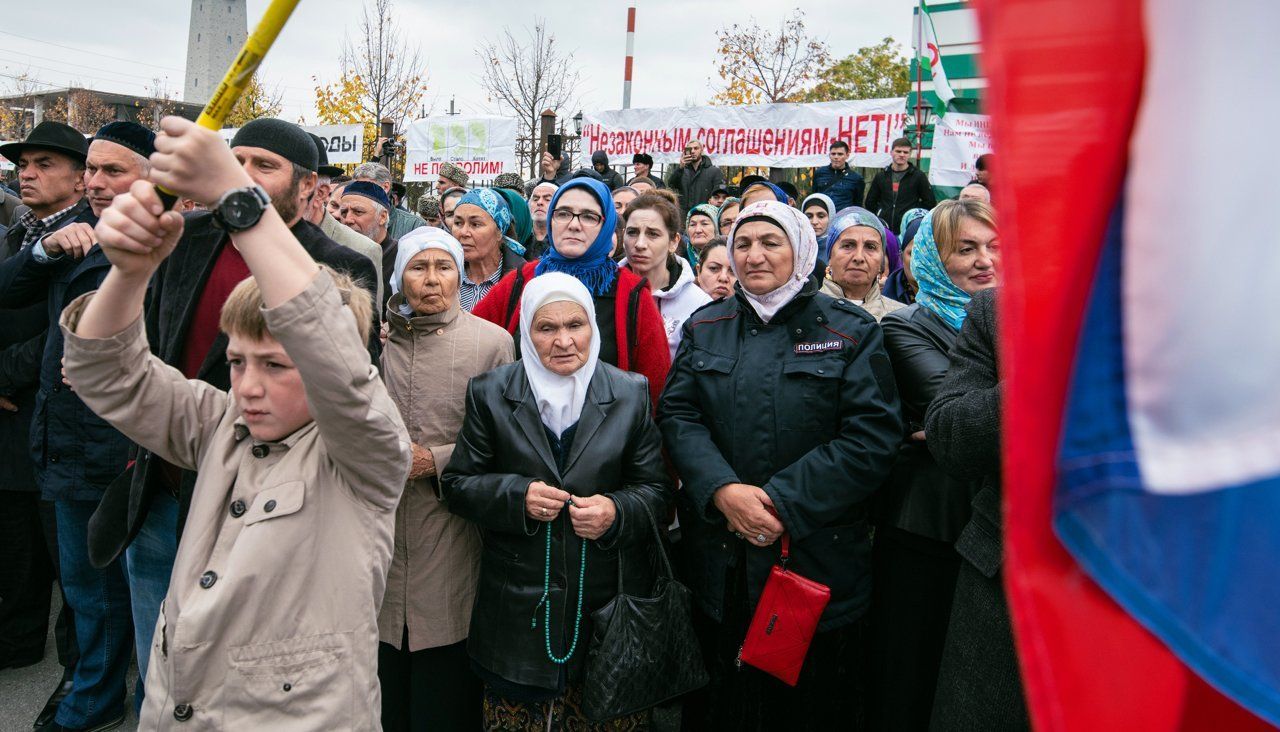
Since the fall of 2018, residents of Ingushetia have held ongoing protests against a newly proposed border with Chechnya. On paper, there has been no formal border since the Chechen-Ingush ASSR split into two Russian federal subjects in 1991. On an objective level, a legal demarcation is necessary, but the border bill that the governments of both republics approved in the fall gave Chechnya more than seven percent of Ingushetia’s territory. As Ingush citizens protested, first against the deal itself and then against the government’s attempt to eliminate the need for a popular vote on it, both the region’s intelligentsia and Islamic fundamentalists took part. By April, that struggle against municipal, regional, and federal government forces had become a war of entrenchment: law enforcement agencies began searching and arresting opposition activists en masse. Meduza asked journalist Vladimir Sevrinovsky to speak with members of the Ingush protest movement in Magas and Nazran.
Read Meduza's special report: “On the ground at Ingushetia's remarkable months-long protest movement”
Opinion
⚖️ Romanova: The ‘Seventh Studio’ case could be part of some intrigue we'll never know
In an op-ed for Republic, oppositionist and prisoners’ rights activist Olga Romanova speculates about why Moscow’s City Court suddenly freed three defendants in the “Seventh Studio” case (notably stage director Kirill Serebrennikov) from house arrest this week. Romanova says Serebrennikov enjoys much of the same public support at home and internationally as other prisoners like Oleg Sentsov, Yuri Dmitriev, Oyub Titiev, and even Soviet refusenik Natan Sharansky, but somehow he’s managed a temporary reprieve.
Romanova says the “Seventh Studio” case is unusual because it isn’t clear who stands to benefit from the investigation. In past trials against governors, “especially bankers,” and human rights activists, the shadowy figures presumably pulling the strings have been apparent: Ramzan Kadyrov was behind the Titiev case, the Memorial Museum Society that wants to “correct” the history of the Sandarmokh mass grave is behind the Dmitriev case, Igor Sechin was behind the Ulyukaev case, and Transneft and its president, Nikolai Tokarev, are behind the case against the Magomedov brothers, according to Romanova.
Vladimir Putin likely decided directly to release the “Seventh Studio” suspects, Romanova says, given that pro-Kremlin television pundit Dmitry Kiselyov declared a week earlier on his program that the president was calling for a purge of the “little Stalin” inside every citizen that’s supposedly to blame for the country’s oppressive criminal justice system.
Romanova says she has a feeling that a “counterattack” is coming, however. She summarizes but ultimately dismisses rumors that Serebrennikov was romantically involved with the wrong top official’s daughter or spouse, before arguing that the entire “Seventh Studio” case could be a side attraction connected to a larger deal between “higher contracting parties.” (Romanova says groups sometimes double cross their own people in cut-throat settlements that are never revealed to the public.) Whatever the backroom reasons for the investigation, Romanova says she expects this counterattack to target people associated with the figures who “favorably influenced” the recent decision to end the “Seventh Studio” suspects’ house arrest. She points out that she would have listed Kirill Serebrennikov as one likely “associate,” before his case began.
👮 Makarkin: Russia finds itself back in 1984, but the Kremlin is looking to 1984, not 1985
In an op-ed for Republic, political analyst Alexey Makarkin says Russia has found itself at a crossroads similar to 1984, when oil prices were low, tensions with the West were high, the economy was stagnating, public discontent was rising, and society’s most modern segment was increasingly eager to emigrate. Rather than turn to rapprochement with the West and cautious liberalization at home, like the USSR began to do in 1985, Makarkin says today’s Putin administration has taken a page from Yuri Andropov and looked to 1983 as a better example.
Makarkin says the recent arrests don’t obey theories about unified clans within the state, like “siloviki” or “liberals,” battling for hegemony, which he says haven’t worked since the early 2000s, after Nikolai Patrushev’s FSB went to war against Viktor Cherkesov’s Federal Drug Control Service. Makarkin points out several other “institutional competitions,” as well: the Attorney General’s Office versus the Federal Investigative Committee, the “Sugrobov” case that pitted the FSB against the Interior Ministry, and last year’s “attack” on National Guard head Viktor Zolotov. There are divisions among the liberals, too, but they lack the same “brutality,” Makarkin explains.
Of all Russia’s state agencies, the FSB has clearly gained the most influence in the arrests of Michael Calvey, Evgeny Pokushalov (an electrophysiologist arrested in February 2019 for fraud and money laundering), Senator Rauf Arashukov, Mikhail Abyzov, and Viktor Ishaev. Commercial interests have also played an important role in some of these cases, but they are insufficient to explain the larger chain of events, given that business conflicts exist in many other, unprosecuted cases.
Makarkin says the “logic” behind today’s crackdown rests on Andropov’s approach in 1983: improve the state’s quality of management (which is why the Kremlin has adopted a technocratic approach to training new governors) and roll out a major anti-corruption campaign with several high-profile arrests. The arrests lift numerous taboos on certain figures’ untouchability and demonstrate an attempt to add “mobilization elements” to the Russian authorities’ relationship with the country’s elites.
As an anti-corruption campaign, however, the arrests have questionable merit in terms of managerial and political effectiveness, Makarkin says, arguing that the authorities are no more accountable than before, and both civil society and the news media are no better engaged.
News briefs
- ⛰️ President Vladimir Putin has finally weighed in on the finished U.S. Justice Department investigation into Russian election meddling and collusion in America’s 2016 presidential race, telling reporters on Tuesday, “The mountain gave birth to a mouse,” referring to one of Aesop's Fables. Read the full story here.
- ⚖️ A court in Astrakhan has sentenced Vitaly Kurskov and Igor Poplevko, two former regional lawmakers from United Russia, to 24 years and 16 years in prison, respectively, for sexual crimes against minors. The two ex regional Duma deputies were convicted of committing rape and sexual abuse against minors and producing child pornography. Read the full story here.
- 🏆 The shortlist for the National Bestseller award, one of Russia’s most prestigious literary prizes, was announced today in a TASSpress conference. The list, which spans a range of genres from fantasy to experimental horror, is as follows: Finist — The Clear Falcon by Andrey Rubanov, The Twentieth Century Presents: Cameras and Cadavers by Mikhail Trofimenkov, Kalechina-Malechina by Yevgenia Nekrasova, Slavic Otaku by Upyr Likhoi, I will always be with you by Alexander Yetoyev, and The Foursome by Alexander Pelevin. Read the full story here.
- 🏳️🌈 For the first time ever in Russia, a court has acknowledged workplace discrimination against a transgender woman. On April 9, a judge in St. Petersburg ruled that a printing press violated Anastasia Vasilyeva’s civil rights when it fired her after she re-registered her identification documents as a woman. The employer cited a federal provision that makes it illegal for women to hold certain jobs, including printing press work. According to the LGBTQ-rights group “Vykhod” (Exit), Vasilyeva has been reinstated at her job and awarded 10,000 rubles ($155) for emotional distress and 1.85 million rubles ($28,500) for lost income. Read the full story here.
Yours, Meduza