Дата
Автор
Maxim Ivanov, Kevin Rothrock, Alexey Kovalev
Источник

Сохранённая копия
Оригинал материала
‘Illiterate, stupid, uninquiring idiots’
HBO’s ‘Chernobyl’ miniseries has enraged Russia’s state media and pro-Kremlin reporters. Here’s why they hate it.
HBO has finished airing its critically acclaimed miniseries about the April 1986 Chernobyl nuclear disaster. On the website IMDb, “Chernobyl” is currently the highest rated television program of all time, surpassing even other hits from the same network, including “Game of Thrones” and “The Wire.” In Russia, many journalists and film critics have praised the miniseries as a haunting and beautiful, albeit not entirely historically accurate, retelling of the 1986 accident. But HBO’s “Chernobyl” also has many critics in Russia, especially in the state media and various “patriotic” news outlets, where commentators have accused the show’s American filmmakers of trying to “reprogram” viewers and blacken the USSR’s historical memory. Meduza looks at some the the angriest reviews.
Ekspress Gazeta
“The Truth About the ‘Chernobyl’ miniseries”
Problems with the show
Journalist Yuri Tkachev calls the miniseries “a historical fake” and a “propaganda victory” for the Americans. He argues that the show was designed to “reprogram the brains of the younger generation.”
Tkachev praises “Chernobyl” for its attention to detail, but says showrunners presented the events of the nuclear disaster “as darkly as possible.” He also has issues with specific episodes. For example, Tkachev claims that Valery Legasov never hid tape recordings from the KGB in a garbage can outside his apartment. He also criticizes a scene where Pripyat’s city committee meets at the power station’s underground bunker. “That never could have happened, even theoretically,” he says.
Quotes
- “Those dirty Americans really did a masterful job here. Colossal, painstaking attention to detail.”
- “The plant workers didn’t wander around the facility after the accident like stoned lemurs, crying burning, hysterical tears.”
- “What the fuck? The creators probably think their audience is a bunch of illiterate, stupid, uninquiring idiots. And based on the storm of excitement, they know who they’re dealing with.”
- “They’re trying to make Legasov into this hero whistle-blower. Nice try. Except he hanged himself because his fellow scientists wouldn’t stop hounding him, because he was too supportive of the official line.”
- “If anybody in the show radiates superhero qualities, it’s Mikhail Gorbachev, who’s traditionally revered in the West as the great reformer who put an end to the communist ideology. What a shock.”
Rossiyskaya Gazeta
“Brain Splitting: We Need Films About the Chernobyl Catastrophe, But What Kind?”
Problems with the show
In the text, Rossiyskaya Gazeta identifies Nikolai Dolgopolov as a Chernobyl liquidator (one of the people who helped clean up the nuclear disaster), but Dolgopolov, by his own account, traveled to Pripyat in May 1986 as a special correspondent. In his review, he says he binge-watched the first four episodes, and hadn’t yet seen the finale.
Dolgopolov says the heroic feats of Ukrainian and Russian characters in the show are depicted fairly reliably. He also liked the acting — especially Jared Harris’s portrayal of Soviet chemist Valery Legasov. Dolgopolov says he was outraged, however, by how the show’s creators “paint us with the blackest colors.”
Quotes
- “But the Americans wouldn’t be Americans without cramming the show with a complete bundle of all their favorite Russophobia. Somewhere in the third episode, the main character transforms into vodka that’s devoured by the glass.”
- “The people are depicted as drunken lowlifes, to the extent that you find in some Hollywood movies, where Slavs show up as these disgusting, repulsive characters.”
- “Back in 1990, Dovzhenko Film Studios in Kyiv released ‘Decay,’ starring Sergey Shakurov. In 2011, there was Alexander Mindadze’s ‘Innocent Saturday.’ I find it hard to maintain my objectivity here: my friend Sasha Mindadze’s film about the first day of the tragedy is magnificent.”
- “We still know and we still remember, but we’re forgetting, and for our descendants everything that happened in April 1986 will be represented by this foreign American TV show.”
Bonus
In addition to Dolgopolov’s column, Rossiyskaya Gazeta also published a rave review of the show’s first episode, which stated: “Early critics (not in Russia, but abroad) have already found elements of propaganda [in HBO’s miniseries], but they’re wrong. Situations can arise in any country where the leadership and the authorities try to silence the truth. That’s exactly this new show’s strength.”
Argumenty i Fakty
“A Wall of Lies: The ‘Chernobyl’ Miniseries Is an Excellent Propaganda Weapon”
Problems with the show
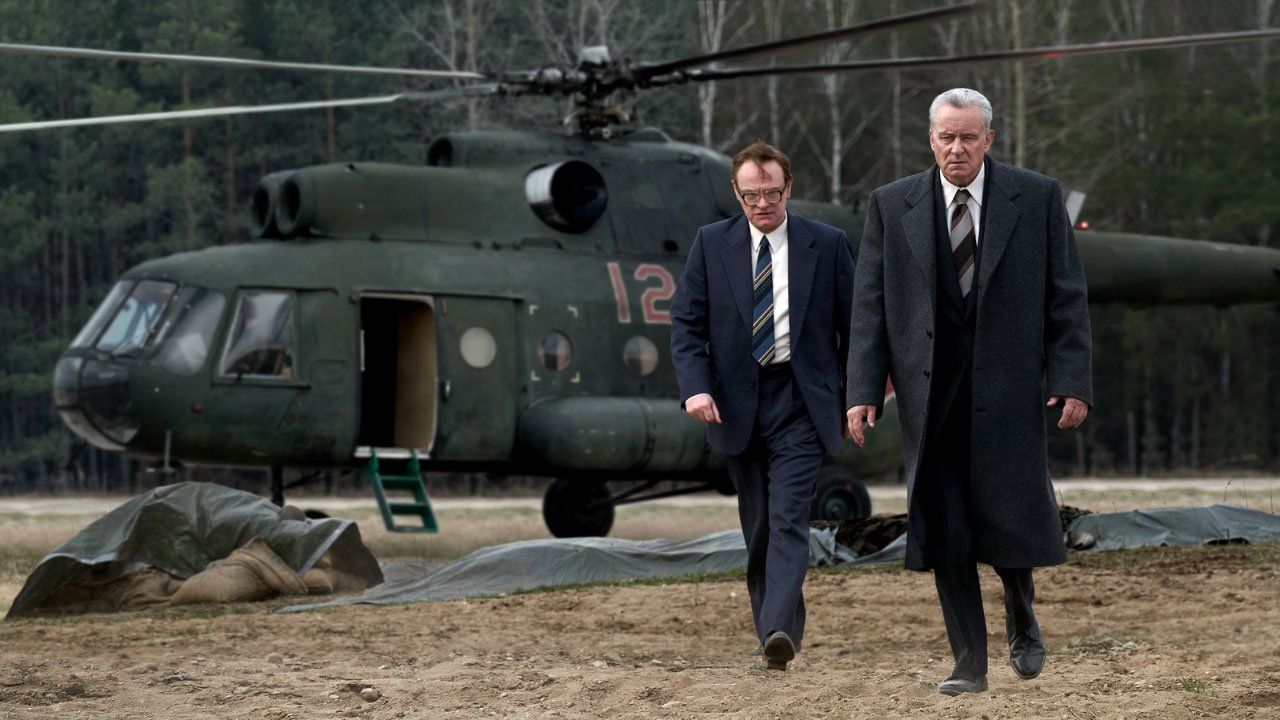
Editor Andrey Sidorchik says the show’s creators deliberately distort history. For example, he points out that the helicopter crash depicted in episode two actually occurred under completely different circumstances.
Sidorchik also compares the depiction of firefighter Vasily Ignatenko’s hospitalization in Moscow to his wife’s recollections, which are available online. “In this scene, a gray wall was added, with the caring hand of the screenwriters. What for? To show viewers that Soviet people aren’t really people.”
In his conclusion, Sidorchik accuses HBO’s miniseries of the same “sneaky tricks” as the Russian movie “Going Vertical,” a 2017 sports drama about the USSR’s 1972 Olympic basketball team.
Quotes
- “The feats of ‘the Soviet’ were all completed at gunpoint, and after finishing their work these heroes were hidden far away, behind gray walls.”
- “Just look at the reviews. People are thrilled. And then, as the plot develops, they casually feed viewers something about the Holodomor, and Stalin’s terror, and they equate Soviet soldiers with Hitler’s.”
- “A lot of people simply don’t bother to compare the real historical records and memoirs with what they see on the screen. Why? They have a seat, spend an hour watching, and know that they’ve seen ‘the truth.’”
- “Our country has had great victories and great tragedies, but our people has never been a herd of silent cattle marched off for slaughter. And if this idea is served to you in a pretty wrapper, that doesn’t make it any less vile.”
Komsomolskaya Pravda
“‘Chernobyl’ Is a Miniseries About Saving Your Own Skin, Not Your Soul”
Problems with the show
In an editorial for Komsomolskaya Pravda, special correspondent Alexander Kots shares his thoughts about why he thinks HBO’s “Chernobyl” miniseries is American propaganda. To establish his authority on the subject, Kots starts by reminiscing about a few days he spent squatting in abandoned apartments in Pripyat in 2006 for a report about the nuclear accident’s 20th anniversary.
What’s Kots’s beef with the HBO show? He offers a few specific quibbles: there were no glassed-in balconies or dual-pane windows in Pripyat, he says, and the helicopter crash at the power plant actually happened in early October, not in the immediate firefighting effort. Also, based on what Lyudmila Ignatenko told Svetlana Alexievich, Vasily Ignatenko’s hospital room actually had a pretty good view of Moscow. “Chernobyl” also embraces certain gruff ethnic stereotypes about Russians, Kots says, citing two invented events: the confrontation between the coal minister and the miners, and the miners stripping nude in the summer heat while tunneling under the power plant. These scenes are “on the creators’ consciences,” he says.
Kots also claims that HBO’s miniseries fails to capture the love story between Vasily and Lyudmila Ignatenko. Despite the fact that the show gives significant screen time to Lyudmila’s devotion to her husband and the tragic final days they spent together at a hospital in Moscow, Kots says “Chernobyl” is really about soulless KGB operatives, noble scientists, “captive nations,” and Politburo careerists “saving their own skin at the expense of their enslaved people.” He says the show focuses on these political points, while ignoring the “heroism of Russians who saved the world from catastrophe.”
Kots finishes with an somewhat unexpected parting salvo, criticizing Russian filmmakers for failing to produce their own quality content about the Chernobyl disaster.
Quotes
- “Regarding the details… I don’t remember any glassed-in balconies in Pripyat. And nobody even dreamed of insulated dual-pane windows in 1986.”
- “The helicopter crashed near the reactor not in the first few days, but on October 2.”
- “This is a show about careerists from the Politburo saving their own skin at the expense of a humiliated and enslaved people, driven by the idea of their own mission’s importance.”
- “From a propaganda point of view, it’s a perfect film, but it lacks the human nerve that makes the heart ache.”
“Is the ‘Chernobyl’ Miniseries a Gift to Rosatom’s Competitors?”
Problems with the show
Special correspondent Dmitry Steshin says HBO’s new miniseries “Chernobyl” is a vast conspiracy to undermine global public support for Russian nuclear power. Steshin starts by making it clear that he doesn’t like the show because he believes it misrepresents history. He says he knows the disaster personally, having visited Pripyat in 2006 as a reporter, when he interviewed former power plant staff and “liquidators,” ate locally sourced food (it’s harmless, he implies), and read survivors’ memoirs.
Specifically, Steshin faults HBO's miniseries for exaggerating how long it took the plant’s management to realize that the reactor exploded. He also mocks responders’ search for higher-powered dosimeters and radiometers, and ridicules the idea of a supervisor threatening his subordinate with execution (he’s apparently referring to assistant chief engineer Anatoly Dyatlov threatening to “make things worse” for shift supervisor Alexander Akimov, when Akimov hesitates to obey his orders).
Ignoring the positive reviews “Chernobyl” has received in Russia, Steshin says the show’s “inaccuracies” and “lies” are obvious to Russian viewers, but he believes the intended audience is everyone else.
Steshin thinks HBO is trying to weaken global confidence in Russian nuclear power — specifically Rosatom. Why now? Steshin credits Western sanctions against Russia with forcing the U.S., France, Great Britain, and China to fight over access to deposits in “Namibia, Niger, Kazakhstan, South Africa, and Brazil,” while Rosatom has utilized its “full autonomy.” Steshin points out that Rosatom has grown rapidly and cornered more than half the world's nuclear plant construction market (though he omits that fact that the company still has just 17 percent of the global nuclear fuel market). “According to analysts,” Steshin says, the European Union will be the next epicenter of “competition between the nuclear giants.” The stakes of HBO’s show, he warns, are a “very profitable business on a global scale.”
Quotes
- “Rostaom’s main advantage emerged during the 2014 sanctions, with our full autonomy in obtaining and processing our own fuel for nuclear power plants.”
- “Right now, for example, fickle Bulgaria can’t decide: should it eat the berry from Rosatom or climb the Christmas tree of Westinghouse?”
- “Suddenly they’re showing the whole world this chilling, terrifying ‘Chernobyl’ miniseries, about how the wild, clueless, and careless Russians inflicted an unprecedented environmental disaster on Europe, using their nuclear reactors.”
- “The ‘Chernobyl’ miniseries is for the general public, for the same people who go to protests with banners reading, ‘We won’t allow a second Chernobyl!’ And later they look in horror at their electricity bills. That’s how it was in Lithuania, where according to EU regulations the Japanese closed down and dismantled a nuclear power plant. Or in Ukraine, where there are more than 100 nuclear facilities, but their fate is in jeopardy.”
Rossiya 24
Problems with the show, quotes, problems with the problems, and problems with the problems of the show’s problems
Stanislav Natanzon, the host of the “Vesti” news program on the state television network Rossiya 24, criticizes HBO’s “Chernobyl” for various anachronisms, such as glassed-in balconies and insulated dual-pane windows featured in scenes of Pripyat that couldn’t have existed there in 1986.
Natanzon also objects to the presentation of Valery Legasov’s character, arguing, “In reality, it wasn’t like that at all.” Natanzon says the Soviet chemist never made secret recordings detailing the accident, and never hid them “from any KGB.” In fact, Natanzon says, Legasov published several articles in the newspaper Pravda, and his broadcast even showed an excerpt from one of these publications with a quote reading, “It is my duty to talk about this.” Natanzon adds that Legasov hanged himself during the day, not at night, as the miniseries depicts.
The TV presenter dislikes how the power plant engineers on the show “run around like zombies,” and that deputy chief engineer Anatoly Dyatlov is made out to be a “dictator.”
The Rossiya 24 broadcast also featured an interview with Chernobyl liquidator Vladimir Asmolov, who spent more than 10 minutes identifying various inaccuracies in HBO’s miniseries. (See below for more from Asmolov.)
Writing on Facebook, Dozhd journalist Ilya Shepelin argued that Pravda initially refused to publish Legasov’s memoirs, explaining that the chemist repeatedly called a correspondent he knew at the newspaper, to find out if there’d been a response. “There was no response,” Shepelin says. ”Meanwhile, Legasov’s findings were being dismissed at the Academy of Sciences. And Gorbachev decided not to award him, a true hero of Chernobyl, the Hero of Socialist Labor honorary title (even though he’s given the award to Legasov’s colleagues).” In the end, Shepelin says, Pravda published Legasov’s notes only two weeks after his suicide in 1988.
Stanislav Natanzon later commented on Shepelin’s Facebook post, admitting his mistake, and saying that he’d “heard about the article in some old report about Legasov and didn’t double check.” Natanzon also promised to apologize and acknowledge the error in a future televised segment about the “Chernobyl” miniseries, though he insists that “this doesn’t change the general story.”
In an op-ed for The Moscow Times, Ilya Shepelin addressed this broadcast and how “Putin’s media” is “struggling” with the HBO miniseries.
In reality, as noted by the Twitter user “Russia_calls” (and supported by scans of the newspaper itself), Valery Legasov’s article, titled “From Today to Tomorrow,” was actually published in Pravda on October 5, 1987 — six months before his death.
This article, however, doesn’t say a word about the Chernobyl nuclear accident, and merely contains the chemist’s thoughts about the problems of the transition from an industrial to a technological society: “We are now getting an abundance of contrasting pictures of magnificent technical and organizational achievements and economic and organizational actions that are completely unacceptable and contrary to common sense.”
Then, on May 20, 1988, after Legasov’s suicide, Pravda published the article where he wrote, “It is my duty to talk about this,” which was in fact an abridged transcript of the tape recordings Legasov made shortly before killing himself (this is depicted in the first scene of HBO’s “Chernobyl”). The journalist who wrote the preface to this publication, who was then working as the editor of Pravda’s science section, told Novaya Gazeta in an interview that the audio tapes Legasov hides in a trash can on HBO’s miniseries were actually meant for him.
Who else is writing about this show?
Tsargrad
- “The bare backsides of those miners is the pure invention of a studio that’s long gone down in history thanks to the meme: ‘It’s not porn… it’s HBO.’”
- “The show’s creators are constantly trying not only to minimize the team of liquidators (instead of thousands of scientists and leaders at different levels, they just show you Shcherbyna, Legasov, and this made-up Khomyuk), but they also make the entire system working to solve this problem look stupid.”
- “‘And yet we have to humiliate the Russians,’ is how the creators of ‘Chernobyl’ think — to humiliate them with the truth or with something that imitates it, like this show.”
Forbes
These quotes are from an article by Vladimir Asmolov, the Chernobyl liquidator who appeared on Stanislav Natanzon’s Rossiya 24 show:
- “Let us remind the younger generation of viewers that in those years in the USSR the ‘Ligachev’ campaign against alcoholism was just rolling out, and sometimes there wasn’t even alcohol at weddings.”
- “We won’t even address the fact that the term ‘biorobot’ didn’t exist at that time, and a lot more didn’t exist: there was no chaos or doomed soldiers wandering the roof among graphite fragments.”
- “The helicopter, of course, didn’t fall because of the radiation. The accident didn’t happen immediately after the explosion, but in November [sic]. The helicopter crashed after colliding with one of the three 120-meter [394-foot] cranes that were used to build the sarcophagus.”
Text by Maxim Ivanov, with assistance from Alexey Kovalev and Kevin Rothrock