
Оригинал материала
Negligible and largely useless
Why women’s rights advocates in Russia have turned against the draft version of their law against domestic violence
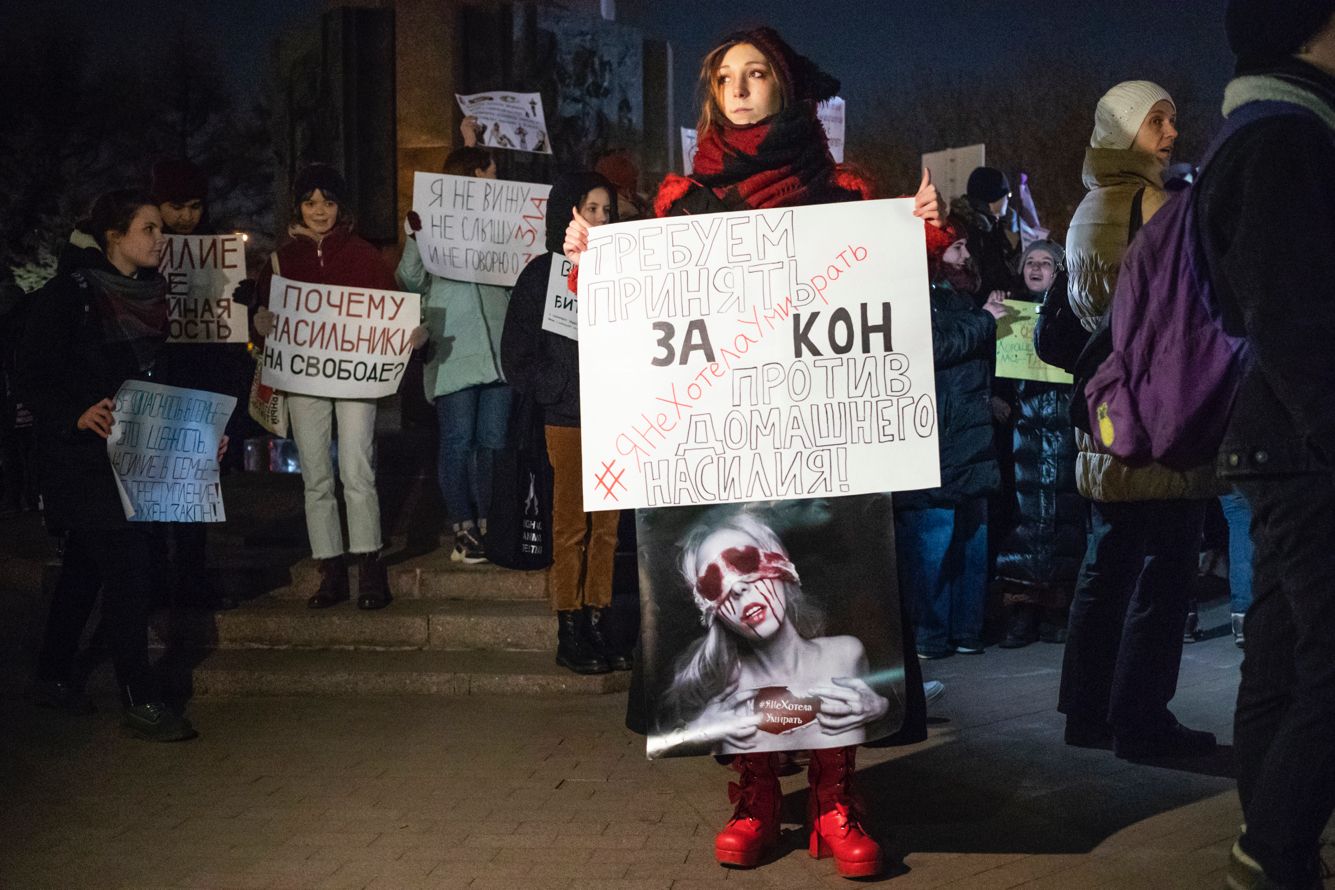
On November 29, Russia’s Federation Council published the draft text of new legislation that would impose additional penalties on domestic violence. Lawmakers have introduced similar bills in the past, but not a single initiative has survived the parliament’s revisions process. The new legislation was co-authored by State Duma deputy Oksana Pushkina and has support from Federation Council Chairwoman Valentina Matviyenko, State Duma Speaker Vyacheslav Volodin (Pushkina has even called him the draft law’s “protective charm”), and Human Rights Commissioner Tatyana Moskalkova. Several women’s rights organizations also helped develop the legislation. The campaign to impose stricter punishments on violence in the home has provoked opposition from Vladimir Zhirinovsky (the leader of the right-wing political party LDPR) and some conservative movements, like the Christian Orthodox group “Forty Times Forty.” After lawmakers finally submitted the bill to the upper house of Russia’s parliament, women’s rights advocates who helped develop the legislation reported that the text omits several key components they supported. The version ultimately introduced to Russia’s Federation Assembly is largely useless, activists say, and panders to “radical conservative groups.”
Why did the legislation’s draft text surprise its coauthors?
Russia’s bill against domestic violence is the result of many collective efforts. The legislation’s first draft appeared in 2016, but it was rejected and sent back for revisions. In early 2019, lawmakers renewed their efforts to draft a version that could win adoption in the parliament.
The new draft legislation draws on contributions from working groups at three different institutions: the Federation Council, the State Duma, and the Presidential Human Rights Council (before President Putin recently dismissed many of its more independent-minded members). Besides deputy Oksana Pushkina, it remains unclear which lawmakers will formally cosponsor the initiative (the published draft text doesn’t list any names). Senator Galina Karelova chaired the Federation Council’s working group. In the State Duma (the Russian Parliament’s lower house), the working group includes Pushkina and deputies Tatyana Kasaeva and Valentina Kulieva, as well as Constitutional Court judges, representatives of the Federal Investigative Committee, and a handful of human rights activists. Mari Davtyan, who heads the Center for the Defense of Domestic Violence Victims, and “Project W” co-founder Alyona Popova were among the experts and public figures recruited to advise lawmakers.
After reading the legislation’s published text, Popova wrote on Facebook that she was “horrified,” and accused Russia’s senators of “bowing to the fundamentalists” and the patriarchy (apparently referring to the Moscow Patriarchate). Davtyan also expressed disappointment, saying that she, as a member of the legislation’s working group, never agreed to the new language. “This version isn’t just stripped down and cut back — it’s also legally illiterate in large part. It’s the result of the Federation Council’s pandering to various kinds of radical conservative groups. And this is bad! They should have been thinking about how to protect those whose lives and safety are in danger, not how to respect people who see spiritual bonds in violence,” Davtyan argued.
There are people who oppose new legislation against domestic violence?
Yes. The law’s opponents recently staged a protest in Moscow. Oksana Pushkina has also stated that she and several of the women’s rights advocates who helped draft the law have received violent threats online. On November 25, Pushkina asked Interior Minister Vladimir Kolokolstev to investigate the Christian fundamentalist group “Forty Times Forty” for involvement in the threats. Pushkina told Meduza that members of this right-wing movement provide the “muscle” for opposition to the new legislation. She says the campaign to stop her initiative is sophisticated and orchestrated: “There are movements, foundations, and public groups. They’re not just a few troublemakers. [...] This is a well-organized, well-financed structure.”
Why have activists like Popova and Davtyan turned against the legislation?
Popova and Davtyan object to the definition of domestic violence in the published version of the legislation, which doesn’t include types of violence that are punishable by Russia’s criminal and administrative offense codes (like assault and battery, for example). “If you’re beaten up, this version of the law would be of no use,” says Davtyan, who believes this key omission renders the legislation meaningless.
Alyona Popova has identified a whole list of recommendations she and her colleagues made to lawmakers. “Legislators in the upper house considered some things, and ignored other things entirely,” she wrote on Facebook. Here’s what Popova highlighted:
- The definition of violence. Like Davtyan, Popova objects to the wording in the published draft legislation, noting that assault and battery and other bodily harm in domestic situations are treated as misdemeanor offenses, verification of which can take between 10 and 30 days. Popova says this deprives survivors of “protective measures and social support at the most heated and dangerous stage of a domestic conflict.” Additionally, the legislation provides no grounds for jailing aggressors who threaten or mildly injure victims, leaving survivors without any protection.
- A lack of protection for unmarried partners. The legislation limits its definition of domestic-violence victims to former and current spouses and all cohabitating relatives (including non-blood relatives). “Meanwhile,” Popova says, “up to 12 percent of families [in Russia] spend years without officially marrying, and almost 30 percent of families lived together and had joint households before they formally married.”
- Victims are required to report threats themselves. The published version of the legislation says individuals threatened by their spouses or relatives must themselves bring the matter to law enforcement. Concerned neighbors and family can report these threats only if the victim is in a helpless or dependent state. Popova says anyone should be able to report domestic violence, whether it’s happening or is being threatened.
- Weak penalties for violating restraining orders. The bill empowers both the police and the courts to issue restraining orders, but they can be issued only with the consent of the victim or the victim’s legal representative. Popova says restraining orders should be possible even without this consent, if there is reason to believe the victim “is dependent on the offender or living in fear.” Also, the legislation imposes only a fine or brief arrest on those who violate restraining orders. Popova says the proposed penalties are “so negligible” that they won’t deter offenders. She argues that repeated violations of restraining orders should be prosecuted as a felony.
Will lawmakers adopt this version of the legislation?
We don’t know, but it’s probably safe to assume that the answer is no. One indication is that the Federation Council has invited further discussion of the draft bill, and senators say they intend to share the text with public organizations, “including those that categorically oppose its adoption,” to learn why. Chairwoman Valentina Matviyenko has already said that the parliament will take into account the views of the legislation’s opponents. She has also said the Russian Orthodox Church has expressed interest in discussing the initiative.
After the draft law was published, Alyona Popova called on her colleagues and supporters to write letters to the Federation Council, State Duma, and presidential administration. “Let’s unite now even more, and let’s not play by the rules of war zealously imposed on us by the fundamentalists,” Popova wrote online. “Let’s be strong in our arguments and confident in our victory in discussions for an ideal version of this legislation.” Mari Davtyan says she and other public figures who have helped develop the legislation will seek the adoption of an “effective law.” “The working group will meet, and I am a part of this working group. So we’ll continue to work,” Davtyan wrote online.
According to Senator Galina Karelova, the “active discussion about the bill” “testifies to the great public interest in this issue.” Because of the controversy, lawmakers will delay the legislation’s introduction in the State Duma, where it was supposed to arrive for consideration in early December. Public discussions in the Federation Council will continue until December 15.
Text by Vladislav Gorin
Translation by Kevin Rothrock