
Оригинал материала
The lost architect
He designed Moscow's legendary first skyscraper, sold it, and disappeared. Now, we finally know how Ernst-Richard Nirnzee died.
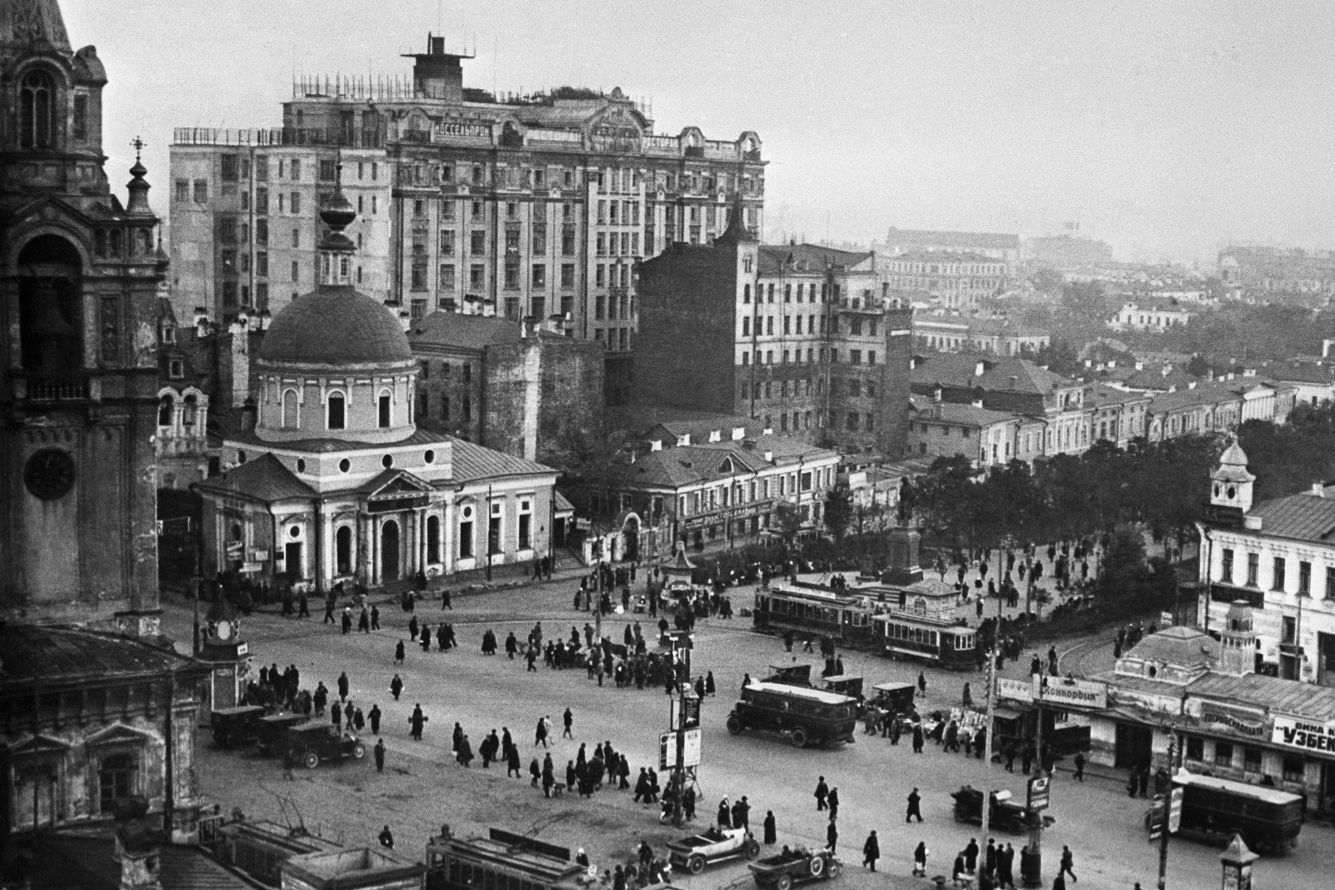
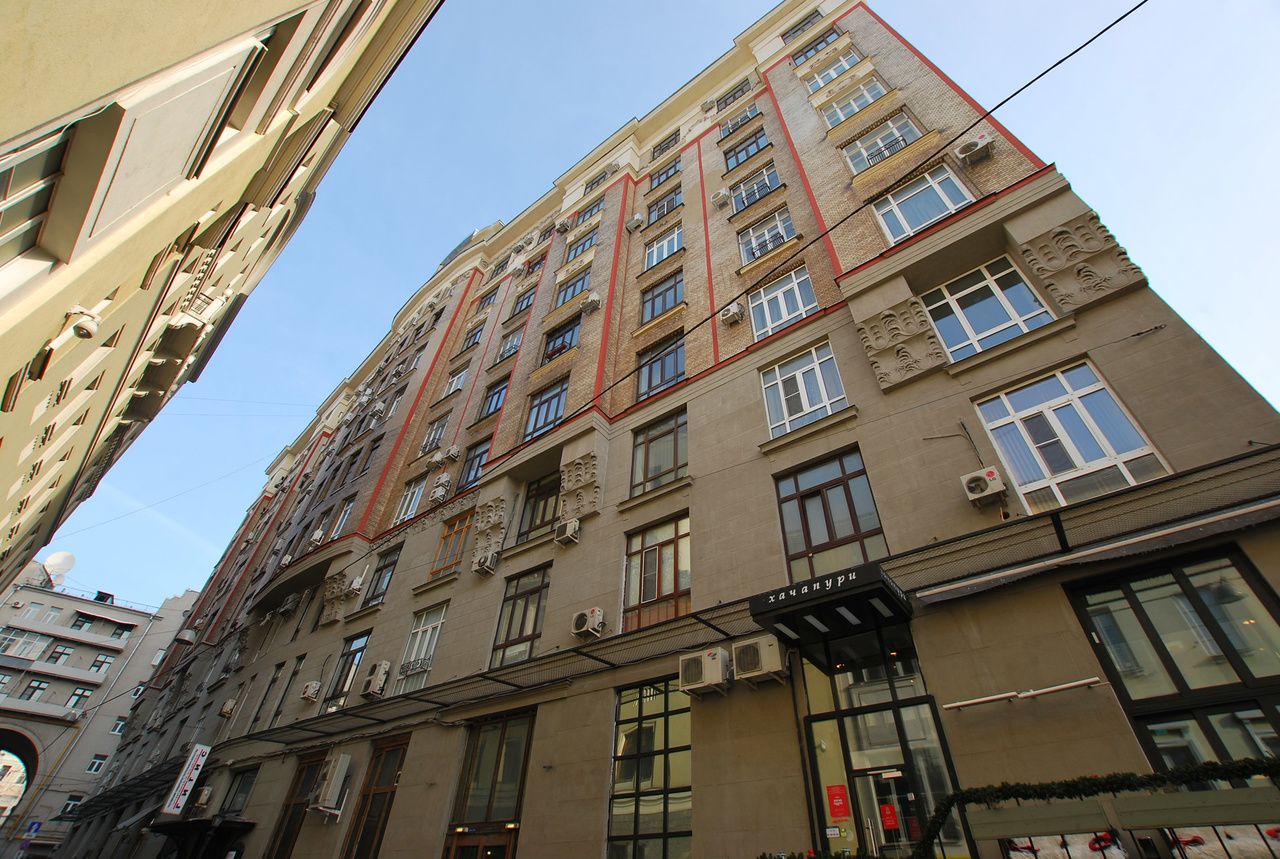
The Nirnzee House was Moscow’s very first skyscraper — or, as early twentieth-century journalists called it, “cloudslicer” (tucherez). The legendary building is still standing: You can find it on Bolshoi Gnezdnikovsky Alley at the intersection of Tverskoy Boulevard and Tverskaya Street. The building has played host to numerous well-known historical figures: Mikhail Bulgakov, the author of The Master and Margarita, met his future wife Yelena Shilovskaya within its walls; The Bat, a cabaret theater housed in the basement, was frequented by director Konstantin Stanislavsky, opera singer Fyodor Shalyapin, and writer Maxim Gorky; the poet Vladimir Mayakovsky even lived in the building, and one of his lovers hid notes to him in the furniture. The architect of the skyscraper, Ernst-Richard Nirnzee, sold his creation in 1915 and largely disappeared from history thereafter. Some researchers wrote that he had emigrated from Russia to escape rising anti-German sentiment in the capital; others believed he had jumped down a stairwell and died. A century after Nirnzee’s disappearance, the Moscow travel blogger and TV host Vladimir Rayevsky teamed up with Polish Studies scholar Nikolai Misko to find the architect’s grave.
Man, myth, legend
The beautiful pre-revolutionary building that stands at 10 Bolshoi Gnezdnikovsky is still called the Nirnzee House even though its architect and owner, the famed Moscow real estate developer Ernst-Richard Nirnzee, left Russia more than 100 years ago. In 1915, he sold the house to the banker Dmitry Rubinshtein for 2.1 million rubles and fled Moscow, where anti-German sentiment was on the rise as World War I raged. After his exit from the Russian capital, Nirnzee’s trail goes cold. Generations of scholars researching Moscow’s history have been unable to discover what happened to him after he left the city, and some, like the writer Vsevolod Garshin, even wrote that the architect had thrown himself down a stairwell.
Four years ago, we made a film about the Nirnzee House and found a good deal of interesting new information in the process. However, even Vladimir Bessonov, the author of an extremely detailed biography of the building, didn’t know what had really happened to Nirnzee himself.
10 facts about the Nirnzee House
- The Nirnzee House was the tallest building in Moscow from 1912 through 1931, when it was surpassed by the ill-fated House on the Embankment. As the first 12-story building in the city, the Nirnzee House was an immediate sensation: Locals dubbed it “the skyscraper,” “the cloudslicer,” and “the belfry-building.” The apartments in the building were small enough to earn the nickname “little cavaliers”; some called the building “the house of bachelors” for its inability to house large families.
- The elaborate mosaic underneath the building’s roof was created by the artist Alexander Golovin. It is an exact copy of the mermaid depicted on the façade of the Metropol hotel.
- A company called Kinochaika built a film studio on the roof of the building. It was large enough to hold soccer matches; Konstantin Yesenin, the son of the poet Sergey Yesenin and the actress Zinaida Reich, played there in 1932. A famous scene from the classic film Office Romance (Sluzhebny roman) was also filmed on the roof of the Nirnzee House.
- The Soviet newspaper The Night Before, which was distributed in Berlin, had its newsroom in the Nirnzee House. Mikhail Bulgakov was one of the paper’s writers. One day, when he was visiting family friends, the Moiseenkos, in another part of the building, he met Yelena Shilovskaya, an officer’s wife who would soon become his own spouse.
- Before the 1917 revolutions, a cabaret theater called The Bat operated out of the building’s basement. It was run by the impresario Nikita Balieff and staffed by energetic vaudevillians from the Moscow Art Theater. The Romen theater later took over the space, which is now occupied by the Russian Academy of Theater Arts.
- In the 1990s, a group of workers repairing the skyscraper’s foyer found a note behind a mirror that read, “I love mirrors. I want to be beautiful today. I love you very much, Vladimir Mayakovsky. Your poetry and yourself.” The note was written to Mayakovsky, who lived in the building, by Sofya Shamardina, a contemporary who was famous for her beauty. By the time Shamardina left the note for Mayakovsky, however, he had already met Lilya Brik, who would become the most important woman in his life and his legacy. The poet would only remember the Nirnzee House in his verse as a testament to the taller buildings that would spring up around it.
- After the Bolshevik Revolution, the Nirnzee House was renamed in the classic Soviet style as an abbreviation of an abbreviation: Chedomos stood for chetvyorty dom Mossoveta (the fourth Mossovet building), and Mossovet stood for Moskovsky gorodskoi sovet (Moscow City Council). Andrey Vyshinsky, a notorious Stalinist prosecutor, lived in the building, where his personalized elevator can still be found.
- During World War II, an anti-aircraft battery was installed on top of the building. Following the war, it was replaced with a set of equipment used for ceremonial military salutes.
- Until the 1970s, The Soviet Writer, a state publishing house, was located directly underneath the building’s roof. In an attempt to prevent the publication of Doctor Zhivago in the West, The Soviet Writer signed a contract for the rights to the book with author Boris Pasternak. Therefore, it could easily be the case that the manuscript for the novel made a stop in the Nirnzee House on its way to global fame.
- The current monthly rental cost of an apartment in the Nirnzee House ranges from 55,000 ($657) to 400,000 rubles ($6,233).
That’s when I found a distant relative named Pyotr Nirnzee in Germany — his great-grandfather was Ernst-Richard’s father’s brother. Pyotr told me that, as far as he knew, Ernst-Richard was the descendant of Viennese émigrés who had moved to Warsaw. This meant, as Pyotr explained to me, that Nirnzee was more Polish than German despite his name. Nonetheless, upon the architect and developer’s move to Moscow, he was invariably taken for a German and treated accordingly. Pyotr said his cousin twice removed died in Warsaw in 1934, but only after he had managed to build another house near the lower Mokotów neighborhood.
Searching through Poland
From there, I searched stubbornly for any details I could find about Nirnzee’s life in Poland, but I had difficulty finding a Polish ally in that quest. Looking for clues while based in Moscow and without knowing any Polish proved to be no easy task.
In 2019, however, I struck up a conversation with Nikolai Misko, who studies Polish history at the State Historical Museum. Although Nikolai specializes in the 17th century, he agreed to help me. Just a week later, Nikolai wrote that he had found a certain Zuzanna Nirnzecel in a Warsaw homeowner’s registry from 1939.
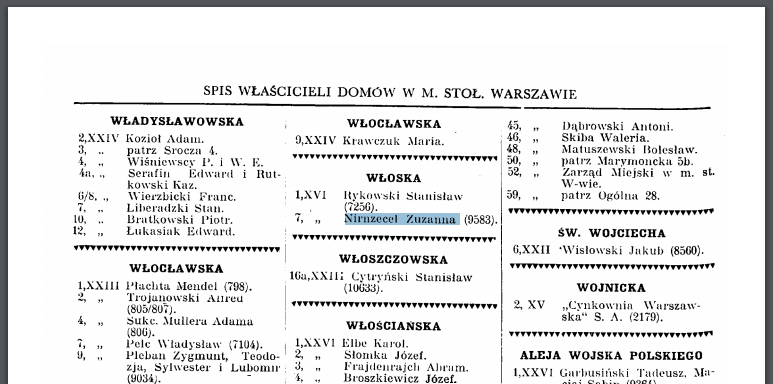
The name was obviously misspelled, but because we knew “our” Nirnzee’s wife was named Suzanna and that he had died a few years before this list was published, we also knew that we were on the right track. The neighborhood listed was also a match — it was in lower Mokotów. The house that stands there at 7 Włoska today is clearly new: Like much of the city, this area was largely destroyed in the Nazi razing that followed the Warsaw Uprising of 1944. Only ten or so buildings are on the street in total, which means that Nirnzee’s house in Warsaw has clearly been lost.
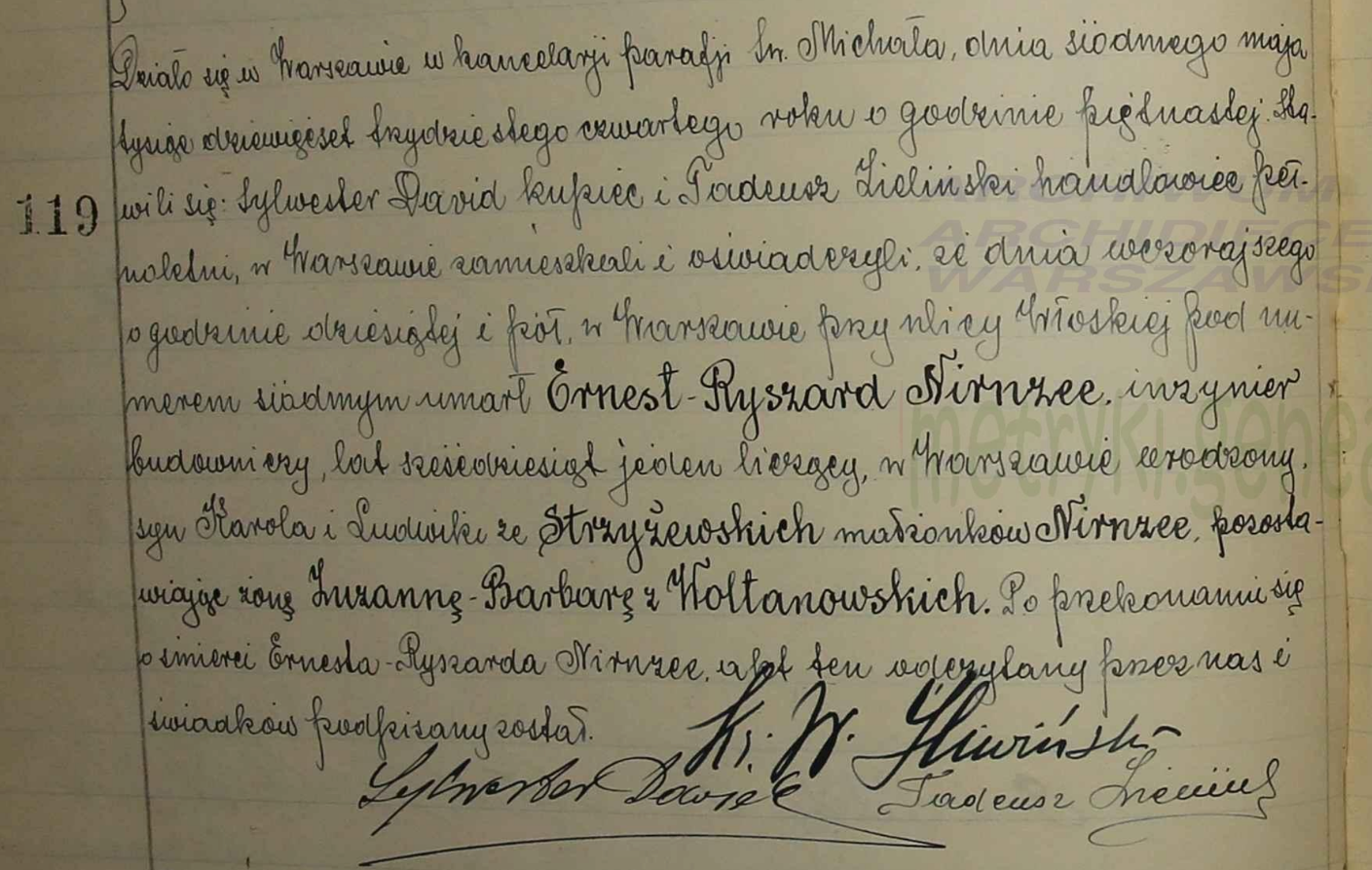
Before long, Nikolai found a 1943 death notice for Suzanna Nirnzee in a parish register, and a death notice for Ernst-Richard himself soon followed. The following is a translation of that document based on Nikolai’s literal translation from the Polish:
The affair has occasion to take place in Warsaw in the chancellery of the parish of St. Michael. On the date of the seventh of May of the year one thousand nine hundred thirty-four at three o’clock in the afternoon, the following were present: Sylvester David, merchant, and Tadeusz Lislinski, salesman. These adults resident in Warsaw testify that midday yesterday, at half past ten in the morning, on Vloski (Italian) Street in Warsaw, house number seven, there died Ernest-Ryszard Nirnzee, an engineer and construction specialist who had lived a full sixty-one years, born in Warsaw, the son of Karol and Ludwika of the Strzyzewski family and the Nirnzee family. He left a wife, Suzanna Barbara of the Woltanowski family. Following the confirmation of the fact of Ernest-Richard Nirnzee’s death, this act has been read and signed by ourselves and the witnesses.
The church where Nirnzee’s funeral took place was also destroyed during the war — the fact that some of its records had been preserved is a miracle in itself. We had no hope of finding an undamaged cemetery outside the place where the church had formerly stood. Letters sent to the church and its diocese met with no response. We thought we would have to make do with what we had — and that was already quite a bit.
Then, suddenly, Nikolai went through the lists of indexed graves on Warsaw City Hall’s website and found Nirnzee’s grave. It was in the Old Powązki, the oldest, most respectable, and best-known necropolis in the city. Nikolai’s friends, Warsaw natives Mateusz and Aleksandra Bajek, visited the cemetery one weekend and took a photograph of the grave.
Nikolai wrote of the find that, “finally, Nirnzee has gained a persona — we now know where he was born, where he died, and the state of his family and his grave.” I completely agree with him. There are dozens of buildings in Moscow that have the phrase “architect unknown” listed in their reference entries; that is primarily a result of Stalin’s Great Terror. However, the fact that the fate of Moscow’s most famous pre-revolutionary developer remained a mystery for so long was entirely without cause.
Text by Vladimir Rayevsky
Translation by Hilah Kohen