
Оригинал материала
Coronavirus as pretext. Luxury cab service Wheely argues with Moscow Mayor’s office about privacy amid COVID quarantine
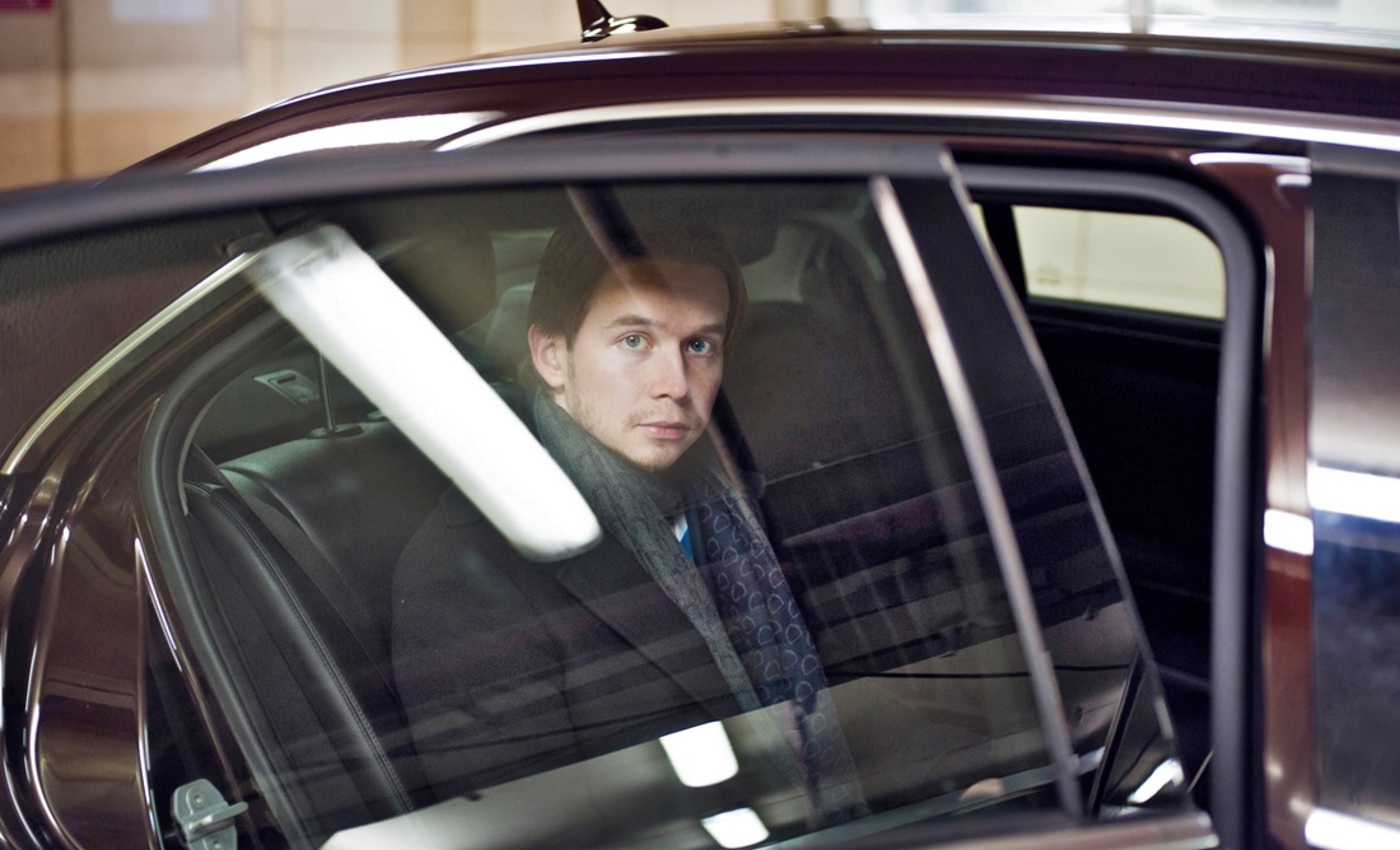
Since mid-April 2020, operation of all ride hailing apps not registered as taxi services have been suspended in Moscow. So far, only one company, Wheely, has publicly objected to the officials’ request. Alexander Borodikhin tells a story in which Moscow Department of Transportation, under the pretext of coronavirus quarantine, closes the last remaining gaps in control over city transport, and the young son of the ex-governor unexpectedly turns out to be a defender of digital rights and freedoms.
During a court session a year ago, Judge Elena Abramova of the Presnensky District Court questioned Russian soccer star Pavel Mamaev about a specific phrase uttered by Alexandra Pozdnyakoviene when she entered Vitaly Solovchuk’s car.
The incident unfolded near the Moscow club Egoist on the morning of October 8, 2018, sparking a conflict involving FC Zenit St Petersburg striker Alexander Kokorin, Mamaev and their companions. The altercation began when Pozdnyakoviene mistakenly entered Solovchuk’s white Mercedes, leading to a confrontation and subsequent physical altercation.
As Mamaev recounted, Pozdnyakoviene’s response to the driver’s reprimand was: “You must be Alexander’s driver or one of the guys’?” “Could there even be a driver there?” he was asked. “Of course, 90% of my friends have drivers.”
Mamaev explained that his friends used the Wheely service to order cars, which mostly has a fleet of Mercedes business and executive class vehicles (E and S). The app, through which residents of London, Paris, Moscow and several other Russian cities can call a personal driver, has been operating in Russia since 2012. In Moscow, St Petersburg, Sochi and Yekaterinburg, Mercedes sedans are available for order, while in Kazan, Perm and Krasnodar, more affordable brands are offered.
Wheely employs around 150 people in its offices. In Moscow, Wheely has 2,800 drivers and 87,000 customers—such data is provided by its founder Anton Chirkunov in an open letter to Moscow Mayor Sergei Sobyanin. The businessman was forced to buy an advertising strip in Kommersant for this appeal due to the Moscow coronavirus quarantine: since mid-April, the capital has banned passenger transportation in cars without a taxi licence.
“This is due to the fact that the permit for passenger transportation required under the new decree is issued only to drivers of yellow and white taxi vehicles,” explained Gett CEO in Russia Anatoly Smorgonsky. “Black premium taxis operate under charter agreements. The new regulations do not take into account this class of taxi transportation.”
The mass services Yandex.Taxi, Uber and Gett did not argue with the mayor’s office decision: they simply made premium options unavailable in their apps; however, Gett later returned the “updated business class.” “In order to provide our customers with higher-class cars during the regime of hightened readiness, we fulfil all the necessary requirements prescribed by the regulatory documents of the Moscow government,” the press service of another aggregator, Citymobil, told Kommersant, without specifying when orders for the “Business” tariff would resume.
For Wheely, which does not offer a budget segment at all, the ban meant a complete suspension of work; the company was only able to add a “Personal Assistant” tier for ordering groceries or medicines and transporting documents.
“Why were we left without work? Because in Moscow, a taxi licence is issued not to the driver, but to the vehicle: to get it, it’s enough to paint the car yellow, buy a taximeter and an orange ‘checker’,” Chirkunov fumed in his letter to Sobyanin.
The mayor’s office, represented by Deputy Mayor for Economic Policy and Property and Land Relations Vladimir Efimov, responded to the young businessman the very next day: “Following the recent meeting of the economy team, we discussed with colleagues from the transport complex the mechanisms for admitting premium taxis and personal driver services to work. Such requirements are adapted to carriers and do not concern the colour of the vehicle; they have already been prepared, and if they are met, these services will be able to return to work.”
Wheely was not pleased with the decision of the Moscow authorities: the company was required to transmit live location of all cars to the Moscow Unified Regional Navigation and Information System (ERNIS), as well as data on drivers and reports on sanitary measures. Deputy Head of the Department of Transport Dmitry Pronin, arguing with Chirkunov, stopped just short of admitting that the mayor’s office used the coronavirus pandemic as a pretext to include the premium taxi segment in the general system of transportation control. He said that officials had been trying to get companies to cooperate since 2018, but “never received their consent, although tens of thousands of professional taxi drivers in Moscow and the Moscow region fulfil them every day.”
Moscow taxi services were required to provide information about drivers and their vehicles to the ERNIA system back in 2017. At that time, it was about the location of the vehicle with an indication of its status (free/busy). In September 2019, the Moscow Mayor’s Office significantly expanded the list of data to be transmitted to ERNIS, and now companies are obliged to provide not only detailed status data (free, accepting orders/free, not accepting orders/busy without a passenger/busy with a passenger), but also the driver’s personal data: full name, driving experience, car number, driver’s licence and insurance data.
The Moscow Mayor’s Office adopted the new resolution without discussing it with industry representatives, Kommersant wrote. A source from one of the companies told the newspaper that fulfilling the requirements would entail significant costs and require changes to the software, which “will ultimately be borne by consumers.”
On May 8, Anton Chirkunov had to make another public appeal—this time to Wheely customers. In it, the businessman took on the role of a defender of digital rights and freedoms, calling the ERNIS system a “God mode” for the Moscow Department of Transport and referring to Apple and Google’s privacy decisions. “As far as we know, the department insists on transmitting the geolocation of all drivers in real time. Wheely will challenge such a requirement,” Chirkunov stressed. “The requirement to transfer data is not related to the pandemic and the current restrictions—it appeared back in 2017. For us, this is a matter of principle.”
The head of Wheely specifically noted that the data required by the Mayor’s Office allows for direct tracking of the driver and indirect tracking of the passenger: “If the passenger’s address is known—and this could be a lawyer, a journalist, or a politician—it’s not difficult to track all trips from this point and establish when and where they went, who they met with.” Moreover, the data is proposed to be transmitted in unencrypted form, Chirkunov emphasised.
“We work in different countries of the world and everywhere we comply with the law, whether we like it or not. At the moment, no law of the Russian Federation establishes the obligation to transmit the geolocation of vehicles engaged in passenger transportation—especially in real time,” the businessman concluded.
“I support and am proud!” his father, former governor of the Perm region Oleg Chirkunov, reposted the appeal.
On May 12, the Moscow Department of Transport reported the resumption of premium transportation services under chartering agreements: they will transmit “tracks for all their vehicles and driver data online.” Today’s Kommersant publications on this topic are contradictory: first, there was a report about Wheely resuming work, having conducted “integration with the Department of Information Technologies” to check digital passes before ordering a car, although the company still does not intend to transfer geolocation data to ERNIS. Just a few hours later, news appeared about the continuation of trips only in the format of the “Personal Assistant” service (delivery of groceries and orders).
After the publication of this article, former Wheely Vice President for Communications Maria Glazkova contacted Mediazona and confirmed that passenger transportation had not resumed. “On May 7, a Decree was issued in which, in order to resume transportation, on-demand transportation services are required to comply with sanitary standards and transfer data to the Moscow Department of Transport,” she conveyed the company’s position. “Wheely reported on sanitary standards to Rospotrebnadzor in March. Regarding data transfer, the service’s position is indicated in the open letter on the company’s website. At the moment, Wheely is awaiting a regulatory act from the Department of Transport with further clarification.”
The company stressed that together with the Moscow Department of Information Technologies, they launched a pass check before ordering trips through the app: “Thus, the requirement to transport only those passengers who have a valid pass, as part of countering the spread of coronavirus infection, has been fulfilled.”
“Anton graduated from the University of St. Gallen in Switzerland,” the company provides a biography of its founder on the official website. “In 2010, Anton created Wheely as an online platform for ordering taxis and minicabs. Two years later, he decided to switch to the premium market. Since then, the company has been growing and developing.”
“Almost all articles about Wheely and about you mention that you are the son of the former governor of the Perm region,” a correspondent from the Zima Magazine for Russians living in Great Britain asked Anton Chirkunov. “I really don’t know why,” the young man replied. “For some reason, journalists consider this important. Why—I don’t understand. It seems to me that even when I’m 60 years old and I’ve built a company with a capitalisation of several billion dollars, everyone will still write in articles: ‘The son of the ex-governor’.”
Oleg Chirkunov, who headed the Perm region until 2012, is remembered primarily for his experiments on the cultural transformation of the region: under him, gallery owner Marat Guelman launched the PERMM Museum of Contemporary Art, and conductor Teodor Currentzis launched the Diaghilev Festival. With Chirkunov’s resignation, the Perm cultural project disappeared from the news, and the ex-governor himself settled in the foothills of the Pyrenees: “A real French province, one of the main wine regions. There are no Russians here”; the coronavirus pandemic caught him in London.
Anton, who grew up in Switzerland, meanwhile made a journey in the opposite direction, from Europe to Russia: in 2009, reports appeared about the appointment of the 23-year-old young man as an advisor to the vice-premier of the region on industrial and business issues. “Previously, I was reproached for [my son] living and studying abroad. Rightly reproached—he studied and lived abroad,” Chirkunov-senior commented on the publications. “Last Saturday, he received his bachelor’s degree, came to Russia, and told me that he wants to take a break from his studies in order to start working.” The vice-premier himself explained that Chirkunov-junior would work “on a voluntary basis.”
According to Kommersant, the Wheely service is owned by Wheely Holding LLC, in which 59.6% of the shares belong to Anton Chirkunov. According to him, the first investments in the project amounted to $2.5 million, “borrowed from relatives and friends.” In 2018, Kommersant estimated the total amount of attracted investments at $13 million, including the “personal funds of the founder,” as well as grants from Yuri Milner and Pavel Durov ($25,000) and the Innovation Assistance Fund (5.9 million roubles). Vedomosti wrote that in 2019, the service attracted $15 million in investments from the British venture fund Concentric and private investors; Concentric partner Denis Shafranik is the son of former Energy Minister Yuri Shafranik.
Editor: Dmitry Tkachev