
Оригинал материала
‘One day was enough for God’
Russia’s authorities are set to introduce multi-day voting in all elections, but not everyone is on board
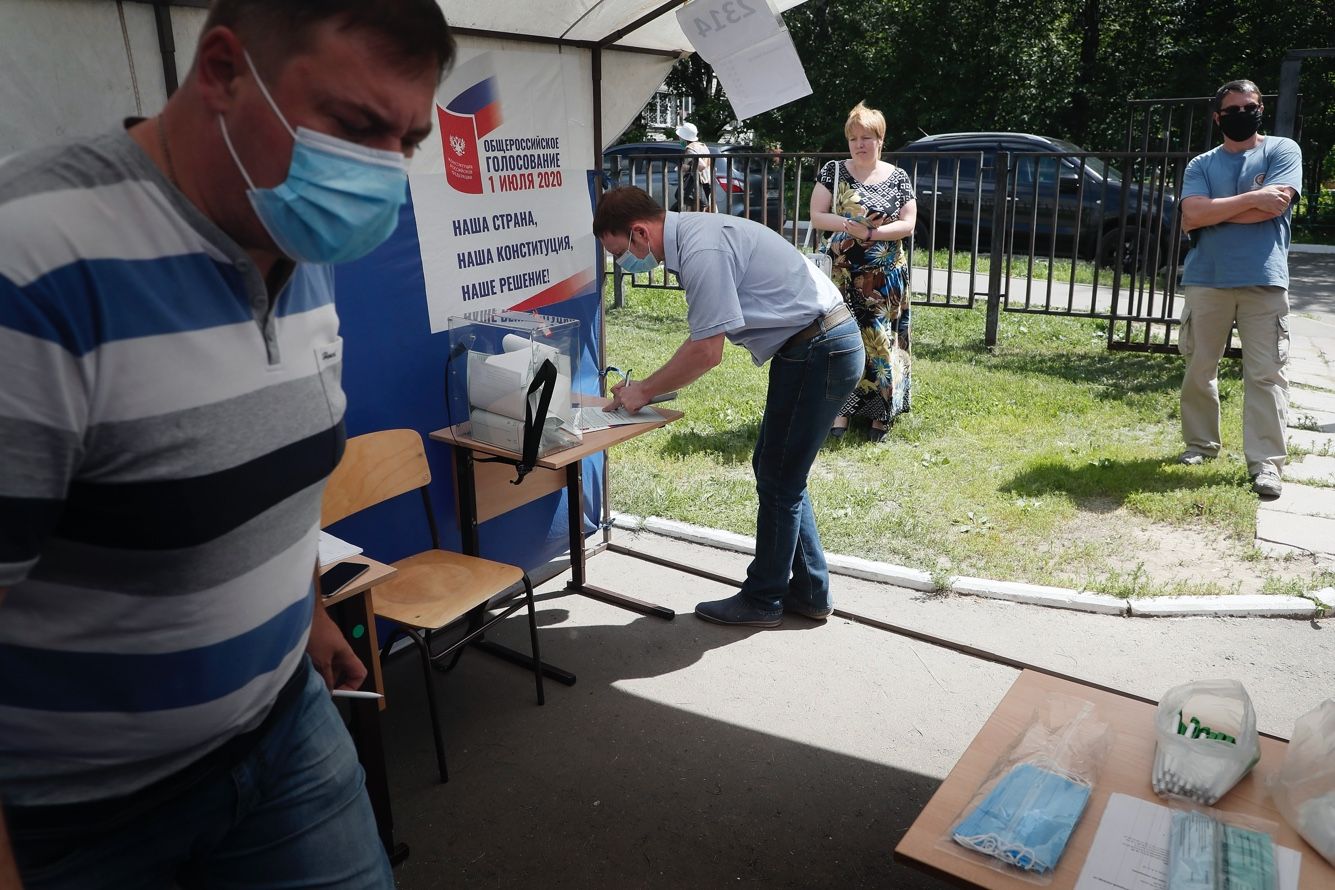
Voting in Russia’s recent plebiscite on constitutional amendments went on for a week, and according to experts it was the most fraudulent vote in the country’s recent history. Nevertheless, the Central Election Commission and the State Duma have deemed the process a success and are hurrying to introduce multi-day voting for all elections. Deputies from the ruling party, United Russia, are rapidly amending the country’s election legislation, regardless of protests from other parties and rank-and-file electoral officials. Meduza breaks down how United Russia is pushing through these changes and who is trying to stop them.
The day after Russia’s nationwide vote on constitutional amendments ended, Federation Council speaker Valentina Matviyenko stated that going forward, it would be better to hold all elections over a two or three day period, since “it was much more convenient for citizens.” The head of Russia’s Central Election Commission, Ella Pamfilova, made similar claims during a video conference with President Vladimir Putin, calling the vote “a concentrated expression of direct democracy.” Pamfilova cited a survey from the state pollster VTsIOM, in which the majority of Russian citizens said they liked the constitutional plebiscite’s voting procedures. Senator Andrey Klishas stated that three-day-long elections needed to be introduced as soon as possible, without explaining what for. Meanwhile, presidential spokesman Dmitry Peskov maintained that the Kremlin “had no clear position” on holding elections over the course of several days.
The authorities didn’t waste any time: last week they made the necessary legal changes and adopted them in their second reading, simultaneously limiting the rights of election observers and expanding the Central Election Commission’s powers. This provoked protest from the nominally opposition factions in the State Duma, as well as local election officials and election experts.
What are the legal changes?
Three key blocks of changes have been introduced:
- Any elections, including State Duma elections, can take place over the course of one to three days, if the election commission organizing the vote decides as such. In this case, early voting and absentee voting will be cancelled. The counting of the ballots in multi-day elections will take place the day after the end of voting.
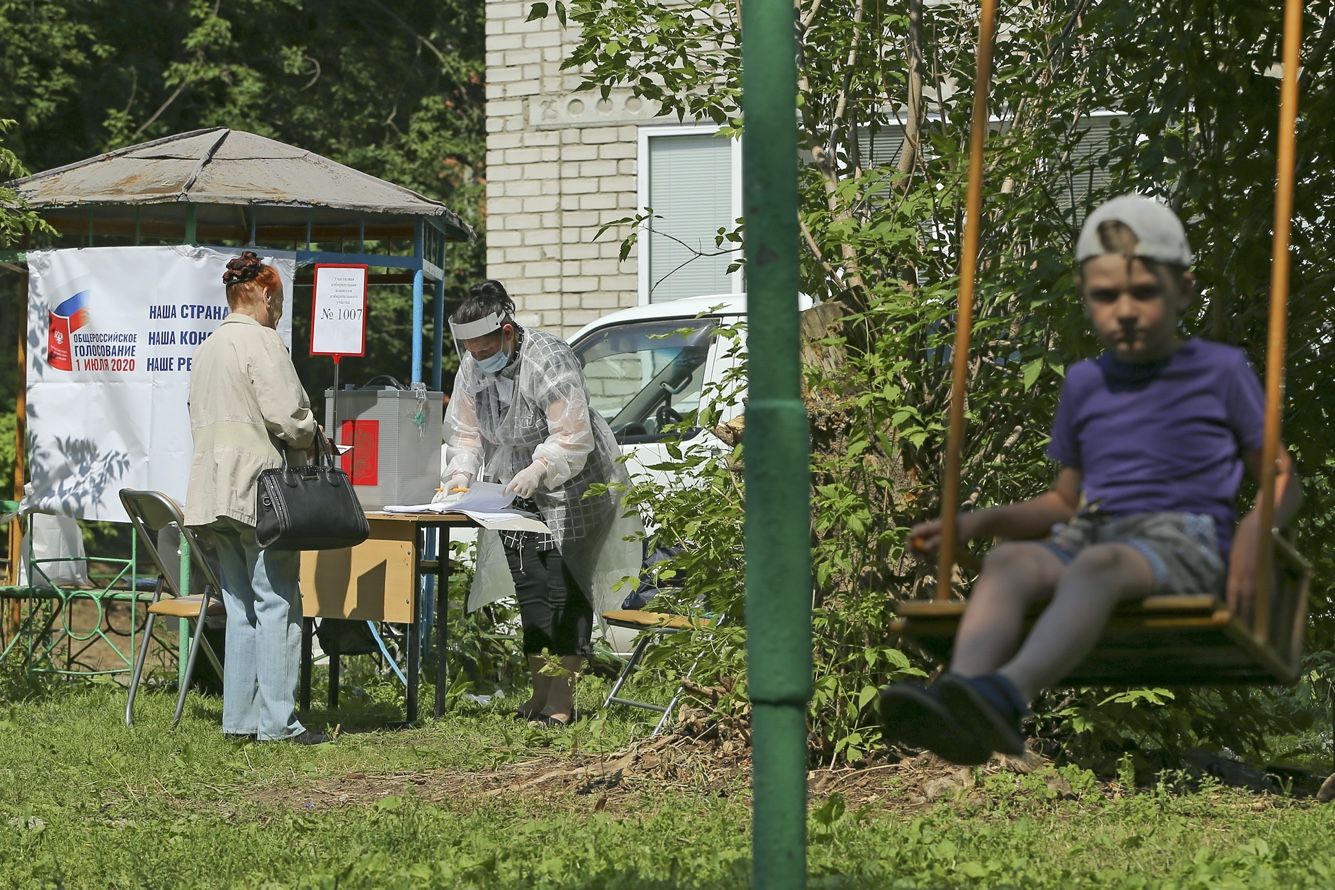
- Voting in so-called “adjacent locations” has been legitimized — a practice widely criticized during the constitutional plebiscite (because of the coronavirus, voters were able to cast their ballots outside of polling stations — in some cases, the ballot boxes were literally set up on tree stumps or in the trunks of cars ). The changes also include what are referred to as “additional opportunities for the implementation of electoral rights,” such as offering “group voting” for voters who live in places without voting facilities or with limited access to transportation.
- The political parties that provide a segment of election commission members (the proportion depends on the level of the commission) will be allowed to withdraw them at any time. Furthemore, election observers will only be allowed to monitor the vote in their own region, depending on their residential registration (previously, a Russian citizen could act as an election observer in any part of the country).
What’s more, the law authorizes the Central Election Commission to set the “other particularities” of conducting elections and establishing the outcome of the vote at its own discretion — the amendments don’t include any specifications.
Pushing the changes through
Russia’s deputies introduced the changes to the electoral law incredibly quickly — the State Duma’s Control and Regulation Committee received the document on July 13 and approved it the next day. On July 15, the Duma considered it not as a new bill but as the second reading of the amendments to a draft law on election commissions that had languished since its first reading in 2012.
Members of the Control and Regulation Committee from United Russia introduced the new changes to the bill. Deputies from the opposition parties pointed out that they were violating the regulations that they themselves were meant to be monitoring: a bill approved in its first reading isn’t supposed to be changed beyond recognition at a later date (that said, this often occurs due to a lack of accountability).
The way the changes were pushed through provoked protests from the nominally opposition parties in the State Duma — the Communist Party of the Russian Federation (KPRF), the Liberal Democratic Party (LDPR), and A Just Russia (Spravedlivaya Rossiya).
On Twitter, Communist Party leader Gennady Zyuganov said his faction was “strongly against turning elections into a circus.” A Just Russia deputy Valery Gartung said that making significant changes to the draft law in its second reading “set a bad precedent” and predicted that adopting the amendments would lead to an increase in street protests.
“How can one amendment introduce changes to 18 articles? This is a gross violation of the regulations regarding the second reading of a law. We will be forced to leave [parliament] if you ignore the opinion of the faction,” threatened KPRF Deputy Chairman Nikolai Kolomeytsev.
A Just Russia deputy Oleg Nilov was outraged at the rejection of his amendment, which suggested the introduction of constant video surveillance in the event of a multi-day voting period, to prevent electoral fraud from taking place overnight.
Deputy Speaker Igor Lebedev (LDPR) also appealed to United Russia’s representatives: “Three out of four parties don’t support the draft law at hand. There’s no need to push through by force, dear colleagues! Why such a rush?”
Regardless of the fact that the Communist Party and A Just Russia voted against the draft law, and the LDPR abstained from voting, it was approved in its second reading thanks to United Russia’s votes. The opposition made one concession: the third reading was postponed until July 21, so the deputies could discuss the amendments. However, this is of little consequence since no more changes can be made to the contents of a bill after it’s adopted in its second reading.
‘One day was enough for God’
“We just need to learn how to conduct fair elections. One day was enough for God to separate the light from the dark. And one day should be enough for us to separate the honest votes from the stuffed and spoiled ballots. We don’t need anymore [time],” said Yegor Shatov, a territorial election committee official for Moscow’s Severnoye Tushino District, during an expert discussion on the introduction of multi-day voting last Thursday.
Shatov opposes the amendments to the electoral law — and he’s not the only election official who has come out against the changes. At the time of writing, an open letter from electoral committee members calling for maintaining a one-day voting period had gained 1,455 signatures. The letter’s main argument is that a single day has always been sufficient for conducting a vote; running the elections already requires officials and observers to work long hours, which don’t need to be extended.
Local election officials see the prospect of a three-day voting period as “exhausting and pointless,” Konstantyn Bogatyrev, one of the letter’s authors and a territorial election commission member for Moscow’s Severnoye Medvedkovo District, told Meduza. He feels that prolonging the vote “kills the principles of transparency and public oversight.” According to Bogatyrev, he and his colleagues planned to send the letter to the Central Election Commission, the State Duma, and the Federation Council.
During a discussion at the Central Election Commission, Ekho Moskvy chief editor Alexey Venediktov said that multi-day voting would be ineffective for the same reasons. He also added that prolonging the vote would require a larger number of observers, and there’s nowhere to get so many qualified people. As Venediktov pointed out, many polling stations lacked election monitors during the recent nationwide vote, and the observers that monitored the plebiscite were exhausted after working seven days straight.
Central Election Commission Chairman Ella Pamfilova retorted that voting would now take place over the course of two or three days, not seven, and pointed to other countries with multi-day election periods, offering Italy, the Czech Republic, and Lichtenstein as examples, among others.
“[In places] where votes are considered honest, you can [have] flexibilities, innovations, and experiments. In western countries ‘multi-day’ [voting] is primarily through early mail-in voting or voting at polling stations, and not in a courtyard, like in the recent plebiscite on amending the constitution. Voting on benches in entryways and on playgrounds is a mockery of voters and the institution of elections itself,” said Ivan Bolshakov, the deputy chairman of the Yabloko party, during the discussion at the Central Election Commission. Bolshakov called multi-day voting “a gift for forgers.”
“I have never heard of a single case where something was changed at night,” Pamfilova said in response.
Extremely dangerous amendments
The voter rights movement “Golos” also spoke out against the new amendments, issuing a special statement, which says that approving these changes will further alienate Russian elections from their constitutional purpose — to be the highest expression of the people’s will.
According to experts from Golos, in the context of Russia’s current voting practices and in the absence of public oversight, multi-day voting is “extremely dangerous.” The recent plebiscite demonstrated that an extended voting period stimulates forced voting, which “is contrary to the principle of the voluntary nature” of voter participation, the statement says.
Golos gave the possibility of political parties recalling election commission members a negative assessment, as well. According to their experts, this will make it easier for party officials to pressure and control these commissions.
Finally, Golos maintains that Russian citizens being denied the right to monitor the vote in any region constitutes a deliberate restriction of public oversight. In their experience, observers monitoring elections in regions where they don’t live “is the most important factor in improving the quality of the elections,” the statement says.
As it turns out, it looks like the changes to Russia’s voting processes won’t be limited to the aforementioned amendments. Last Thursday, Central Election Commission head Ella Pamfilova said that if elections were to take place over the course of several days, then the country’s unified day of voting (now scheduled for the second Sunday in September by law) will have to be postponed. “The worst month that could be subject to these conditions in September,” she said. Pamfilova suggested that the elections be moved to the summer; according to her logic, a multi-day voting period would require election officials to run polling stations on weekdays, and since many of them are set up in schools, the elections would disrupt education.
Text by Farida Rustamova
Summary by Eilish Hart