
Оригинал материала
Political science in practice
‘Meduza’ examines different scenarios for the opposition movement that’s swept Belarus
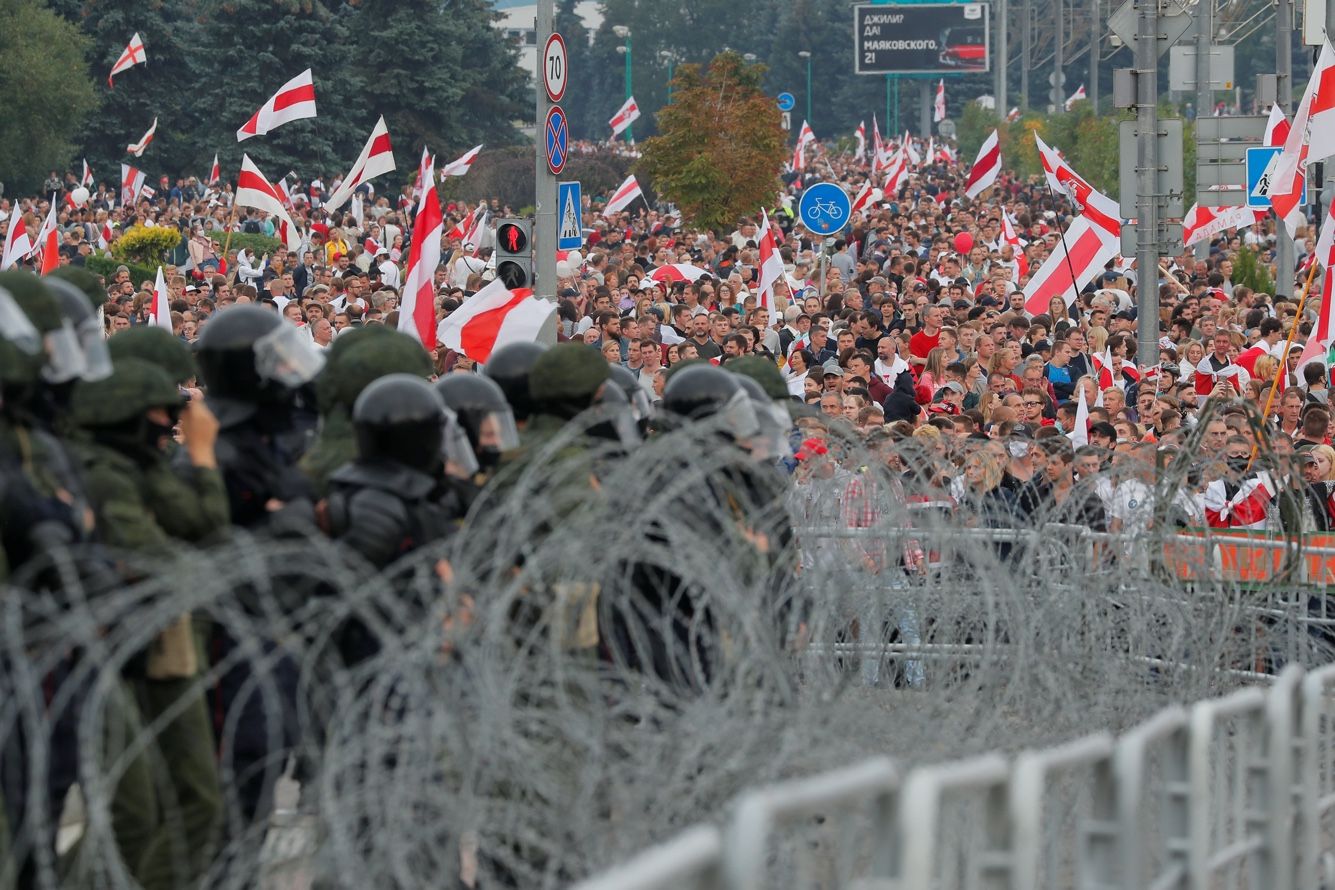
The protests in Belarus have entered a new stage, and it looks a lot like a stalemate. As demonstrated last Sunday, the scale of the opposition protests hasn’t decreased significantly. Alexander Lukashenko’s regime, which initially responded to the unrest with violence, has changed tactics and is now relying on a mixture of ignoring the size of the protests, persecuting the organizers (if they can find them), and putting on theatrical performances featuring Lukashenko in an effort to mobilize his supporters. Meanwhile, the regime’s power base — the security apparatus — isn’t showing any outward signs of breaking down. In this context, where compromise isn’t an option and neither side has a clear advantage, it seems impossible to predict the outcome of the standoff. However, according to researchers studying protests, who have analyzed hundreds of movements around the world over the past few decades, even in such difficult cases it’s possible to assess the likelihood of different possible outcomes, if not the exact results of the protests. Meduza applies this theory to the ongoing events in Belarus.
Why did the Lukashenko regime reach a point of crisis?
For a long time, the events in Belarus have resembled a classic case of “democracy by mistake,” as described by the political scientist who coined the term — UCLA professor Daniel Treisman. He explains that the transition from autocracy (most often, from a personalistic autocracy) to democracy usually takes place not because of the will, death, or resignation of the dictator in question, but because of their mistakes. The leaders of personalistic autocracies — liked modern day Russia or Belarus — seek to personally control too many aspects of public life; sooner or later they miscalculate, catastrophically undermining their own popularity, which, in turn, deprives them of legitimacy.
Where did Luka go wrong?
Lukashenko has made a critical number of mistakes in the past five years. In 2015, the last time he was re-elected as president, his popularity was relatively high — this was against the backdrop of the Euromaidan protests in Kyiv, the annexation of Crimea, and the outbreak of war in Ukraine’s Donbas region, which he used as evidence of external danger and the urgent need to defend state sovereignty. His legitimacy, even in spite of traditional election rigging, wasn’t in doubt at that time.
Then came the economic crisis linked to the collapse of the Russian economy and the price of oil. This caused a crisis at Belarusian state enterprises, which account for 80 percent of the country’s economy and employ the people who have formed Lukashenko’s core electoral base for the past two decades. Many large enterprises were consistently unprofitable and received subsidies from the state budget, which, in turn, was critically dependent on subsidies from Russia (through the supply of cheap oil and gas). During the crisis, these subsidies began to plummet. To consolidate the sagging budget, the Belarusian government tried to raise taxes on private businesses. In 2017, they introduced the so-called “parasite tax,” which effectively taxed self-employed workers. This resulted in protests, which the authorities responded to by yielding, rather that using violence — the tax was quietly removed.
In the spring of 2020, Lukashenko made what some believe to be a fatal mistake: he banned government agencies from taking the coronavirus pandemic seriously. The authorities hid morbidity and mortality statistics, and the president suggested that the population take precautionary measures like steam baths, drinking vodka, and working in the fields. At the same time, the government’s refusal to introduce quarantine restrictions didn’t do anything for the economy — it plunged into a serious crisis, much like the economies of neighboring countries that opted to impose strict lockdown restrictions. The population’s incomes fell due to the pandemic and a record drop in oil prices; Russia’s enterprises and population stopped buying Belarusian products, and border closures interrupted the traditional flow of labor migration.
That said, how exactly these mistakes affected Lukashenko’s popularity remains unknown: the country has virtually banned independent sociology for several years. According to a leak from the state sociological service, in April 2020 — the start of the coronavirus epidemic, — only 24 percent of Belarusian citizens living in Minsk supported the president. Therefore, the scale of the protests in response to the rigged elections, which saw election officials “issue” more than 80 percent of the ballots to Lukashenko, shouldn’t come as a surprise.
Does that mean Lukashenko’s overthrow is inevitable?
Not necessarily. The concept of “democracy by mistake” doesn’t explain the differing results of protests in different countries with similar initial conditions.
In the last few decades alone, revolutions in different countries have taken a variety of different forms and led to differing results:
- In Ukraine, peaceful protests initially provoked violence from the authorities, then this violence became mutual. Finally, several months after the start of the revolution, and following a short but bloody period of the suppression of protests in Kyiv, Viktor Yanukovych’s regime collapsed over the course of a few days as his political supporters and the security forces deserted en masse. In the end, Moscow annexed Crimea and a war broke out in eastern Ukraine, in which separatist forces, thanks to Russia’s not-so-secret support, have been relatively successful.
- The uprisings in the Middle East and North Africa during the Arab Spring differed greatly from country to country. In Tunisia, which witnessed its first revolution at the end of 2010, the population persisted for several weeks, after which then-president, Zine El Abidine Ben Ali, fled the country. In similar situations, Libya and Syria saw the outbreak of civil wars that drew in world powers. Libya’s Muammar al-Gaddafi was overthrown and killed with the help of the United States and EU countries, while Syria’s Bashar al-Assad has held on to power with the help of Russia and Iran. Morocco saw only peaceful demonstrations, and in Jordan, the king conceded to some of the protesters’ demands, including the dismissal of the government.
- After six months of protests in Thailand in 2014, the military staged a coup. Venezuela has had de facto dual powers in place since the start of 2019: President Nicolás Maduro control over part of the country’s territory rests mainly on the loyalty of a large segment of the army, which has suppressed several attempted military rebellions. Even a catastrophic economic crisis, US sanctions, and oil production hitting a 75-year low haven’t been able to impede the Maduro regime.
The situation in Belarus vaguely resembles that of Venezuela: it’s close to a stalemate. Despite its loss of legitimacy — from the point of view of a significant portion of the population, as well as many foreign governments that don’t recognize the results of the elections, — the regime can still rely on the loyalty of the security forces and hope for external assistance — primarily, from Russia. However, there’s clearly some holes in this analogy. The security forces supporting Lukashenko and the stubbornness of the opposition (which mobilizes tens and even hundreds of thousands of people to demonstrate in protest, but can’t offer them an effective mechanism for overthrowing the regime), doesn’t mean that the confrontation in Belarus will be dragged out for years.
How can you predict the course of a revolution?
Political science models, built on the basis of studying thousands of protests in dozens of countries over the last 25 years, offer assessments of the likelihood of different scenarios based on the “cost” the opposition puts forward for the authorities to “pay.”
There’s the cost of an “agreement,” which depends on the opposition’s demands and the perseverance with which it defends these demands. Obviously, a higher price means the regime or the members of the “coalition” that supports it will be less likely to compromise.
Then there’s the cost of the “damage” that the opposition can inflict on the authorities with its actions. The higher the cost, the more incentives the regime (or its allies) have to negotiate. “Damage” can mean very different things — from economic damage that occurs when the protests interrupt the normal functioning of enterprises, the financial system, and transportation, to social damage, which can include violent actions. However, in the latter case, the authorities are often inclined towards repression, rather than an agreement.
Here’s how different combinations of these factors can play out:
- When both costs are low — that is, when there are a few, separate, non-violent protests driven by minor demands, — then the authorities, as a rule, generally prefer to ignore the demonstrations. This is the most common scenario, as well as the most common outcome of protests. For example, this is exactly what appears to be happening in Russia’s Far Eastern city of Khabarovsk.
- In the event that the protesters’ demands are relatively mild, but the demonstrations themselves could inflict great damage, the authorities are inclined to compromise. Such cases also occur in Russia: for example in Bashkiria, where local residents were protesting against plans to extract limestone from a natural landmark — the Kushtau mountain. The protesters were prepared to take violent action against riot police to protect the site, but the regional authorities decided not to bring about “political destruction” and stopped the extraction plans.
- If the price of the agreement is high — such as the protesters demanding regime change, significant modernization, or an in-depth reform of the security agencies, — but the cost of the “damage” is comparatively low (the damage being the inconvenience the protesters can cause the regime), then the authorities will often resort to suppressing the protests. This partly resembles the outcome of the “Bolotnaya” protests in Moscow in late 2011 and 2012.
- The excessive use of force can increase the scale of the protests and raise the “cost” of reaching a compromise, in the event that the protesters demand punishment for those responsible or resort to violence themselves. This was the case in Minsk and other Belarusian cities from August 9–12, when the opposition immediately came out with slogans about a change of power, which appeared as a threat to the regime’s survival (in particular, calls for new — fair — elections). After the opposition was met with violence carried out by the security forces, the scale of the protests increased.
- Obviously, Lukashenko miscalculated the amount of “inconvenience” the opposition could cause him. The scale of the protests grew to a point where suppressing them with force becomes difficult, and this was paired with economic leverage in the form of strikes, albeit without work stoppages at many of the country’s largest enterprises, and expressions of collective discontent among the leadership of IT companies, which were previously the showcase of modern, private business in Belarus. Both of these factors increased the cost of the “damage” and forced the authorities to minimize the use of violence.
- Finally, there are complex and less obvious combinations of factors — such as what happened in Belarus after August 12. Obviously, both the cost of a compromise and the cost of the “damage” are considered equally high. Researchers have found that as a rule, in cases like these, the regime tends to return to violence once again.
But what does this mean in practice?
The regime is left with a difficult task — to try and reduce the scale of the protests, as well as the costs, which would allow them to move on to the “targeted” persecution of the opposition’s coordinators and the organizers of the strikes. The alternative — to try and soften the protesters’ demands, for example, by offering them a compromise in the form of new elections without a preliminary change of power — no longer seems achievable. However, no one can say with certainty that the regime is absolutely monolithic and that there’s no one within the government who could do their own calculation of the “costs.”
If the protesters really want to achieve their goals, they need to increase the difference between the two “costs” — to make sure that the cost of an agreement is lower for at least some of the members of the regime than the scale of the “damages” that threaten them. The opposition has two options for its response: 1) prepare for counter-violence, in other words, increase the “damages” (the Euromaidan option), or 2) ease their demands for at least part of the “ruling coalition” (that is, the security forces).
The opposition doesn’t seem to be on board with the violent confrontation option: this idea is unacceptable to a significant segment of the protesters. In addition, the protesters taking violent action can partially legitimize the violence of the regime — if not within the country, then among some foreign sympathizers, for example, in Moscow and Beijing.
The “easing demands” option assumes that the opposition (it’s not yet clear on whose behalf) will abandon the idea of total lustration and stop ridiculing Lukashenko as “The Riot Police’s President.” This option worked in Bolivia in 2019, for example, when the police refused to support then-president Evo Morales, and he was forced to flee the country. There was no such option in Venezuela, where in all other respects — from the economy to electoral support — the regime was much weaker than in Bolivia. In order to negotiate with the security forces, the opposition needs an effective political structure that can speak on behalf of the protesters. The opposition leaders failed to create such a body — both before the elections and after, once the protests began.
That said, abandoning lustration poses a greater problem. According to economist Konstantin Sonin, a professor at the University of Chicago, the main issue is that lustration would form the basis of the opposition’s most reasonable economic program in the event that it comes to power. Without changes to law enforcement agencies, which have thus far interfered in private business, neither foreign, nor domestic investment is possible.
However, time is still working in opposition’s favor: according to researchers studying protests around the world, the longer the protests go on, the higher the cost of the damages inflicted upon the regime. In Belarus, this means the authorities’ financial situation is systematically deteriorating: the state budget was already running a deficit, while the country, after the start of the protests, effectively lost the opportunity to borrow from abroad. An increase in the deficit could (in quite some time) lead to Lukashenko simply having no money to pay the security officials for their “work.”
That said, Lukashenko can still hope for external support (as in the case of Venezuela’s President Maduro): Russia can always cover some of the losses the regime incurs from the protesters’ actions. It’s possible that, in theory, Moscow could refuse to support Lukashenko (political scientists close to the Kremlin have hinted at this), but this would require an alternative — a political structure in Belarus with which the Russian authorities could discuss a common future.
Text by Dmitry Kuznets
Translation by Eilish Hart