
Оригинал материала
Bucha atrocities look set to stymie peace talks
| | | | --- | --- | |
| | | --- | | 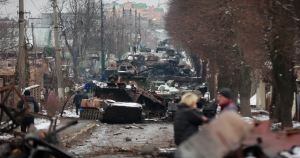
As Russian troops retreated from areas around the Ukrainian cities of Kyiv and Chernihiv over the weekend, photos and videos emerged of the summary execution of civilians and mass graves. The most shocking images were from the town of Bucha, just outside Kyiv, that Ukrainian forces retook Saturday. Corpses were found lying in Bucha’s main street — some of which had their hands tied behind their backs. Ukrainian President Volodymyr Zelenskyy quickly accused Russian troops of war crimes and genocide. Russia denies the allegations, and the Russian Ministry of Defense said Sunday that the video and photo evidence was a “provocation”. State-owned news agency RIA Novosti claimed that the West was trying to fabricate a “Ukrainian Srebrenica”. On a visit to Bucha on Monday, Zelenskyy warned that the behavior of Russian troops could make peace negotiations much harder. "It's very difficult to talk when you see what they've done here," Zelenskyy told journalists. "The longer the Russian Federation drags out the negotiating process, the worse it is for them and for this situation and for this war." Prior to the Russian retreat, a meeting in Istanbul last week between the two sides had generated some guarded optimism that a ceasefire might be possible. The Ukrainian delegation unveiled a proposal for a future ceasefire deal which, according to The Bell’s sources, largely met with Moscow’s approval. However, significant disagreement remains on several fundamental issues. For Ukraine, it’s important to appear as the initiator, a source close to the negotiations told The Bell. The same source believes Russia is moving toward an agreement because any further military action would mean combat in cities and a repeat of the carnage in Mariupol. The Ukrainian proposals boiled down to: An agreement on Ukraine’s neutral, nuclear-free status backed by third-party security guarantees. An agreement on mutual respect for language and culture (Kyiv suggests that other neighboring states such as Poland, Hungary and Romania should join this pact). * A delay in discussions about the status of Donbas until a summit meeting between Putin and Ukrainian President Volodymyr Zelenskyy. Everything is up for grabs: from the re-establishment of pre-war borders of the so-called People’s Republics of Donetsk and Lugansk to full recognition of their independence. A compromise could reflect the borders of the territory held by Russia at the moment of any agreement.
At the same time, it’s important to point out major sticking points: The status of land under Russian control of the Russian army in northern and southern Ukraine (including the Crimean peninsula annexed by Russia in 2014) was not discussed. The content and wording of a collective security agreement for Ukraine is a complex issue. It’s important to keep in mind that the wording suggested Tuesday is the Ukrainian proposal, according to The Bell’s source. Russia is highly unlikely to agree to a final agreement that reflects the phrasing of Article Five of the North Atlantic Treaty Organization (NATO). Genuine security guarantees must be given to Ukraine, but there needs to be a clear mechanism to prevent NATO states from manipulating the agreement to the detriment of Russia’s interests, our source said. * Any easing of Western sanctions against Russia is not part of the negotiations. Officially, the Russians have not raised this issue, The Bell’s source said.
Russia confirmed that a meeting between Putin and Zelenskyy was possible, but refused to commit to a time frame. On Friday, Turkish President Recep Erdogan - who has emerged as a key intermediary in the negotiations - mentioned the possibility of a summit. However, the previous day, Italian Prime Minister Mario Draghi, who took a phone call from Putin to discuss the possibility of paying for Russian gas in rubles, said the Russian president had told him that talk of a ceasefire was “premature”. 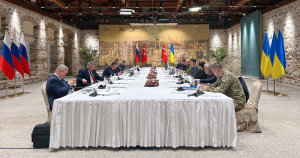
|
|
| | | --- | | |