
Оригинал материала
Russia’s long shot in the Donbas
Even with a potential full mobilization, the Kremlin’s war could sputter to defeat in eastern Ukraine
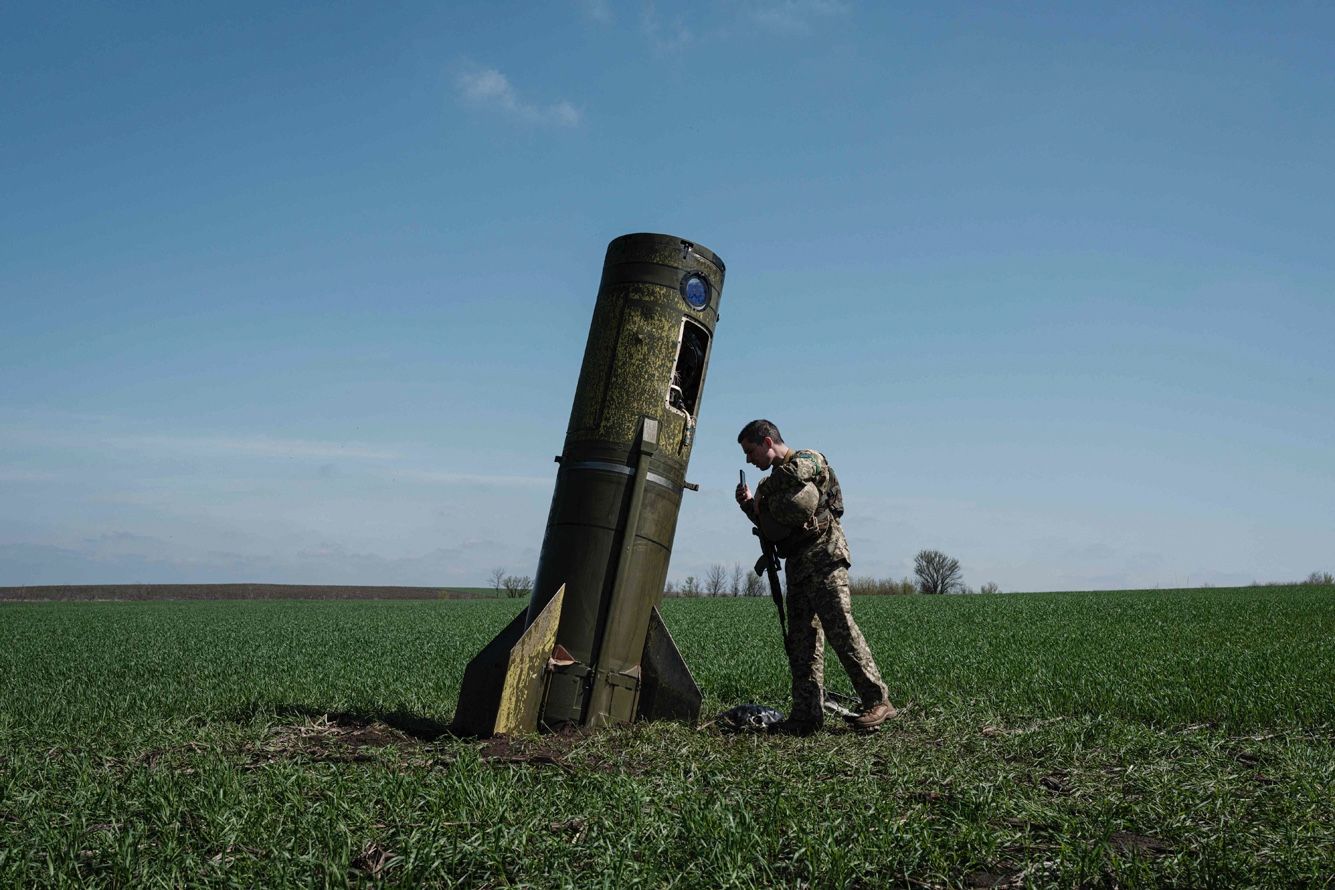
Western intelligence “does not rule out” that Vladimir Putin could declare a full military mobilization. Though the Kremlin denies any such plans, and it’s uncertain whether officials in Europe and America have any real data on Putin’s plans, mobilization has long been a hot topic in Russia, where the army plainly lacks the numbers needed to continue its offensive in Ukraine. In early April, the Russian military reduced its frontline by almost half, in order to surround and smother the greater part of Ukrainian troops in the Donbas region. Still, for more than a month now, complete encirclement or any breakthrough has eluded Moscow’s fighters. Eventually, the Russian authorities might try to shift the balance by mobilizing the country’s full military might.
In this editorial, we try to assess the combat situation in Ukraine on the basis of available data. Meduza opposes the war and advocates the immediate return of Russian troops to their homeland. Meduza thanks Anna Razumnaya, author of the newsletter The Foreign Agent, for the following translation. The original text in Russian was published on May 6, 2022.
What’s happening at the front? Why might Russia need additional soldiers?
In April and early May, the main line of combat followed the river Siverskyi Donets, which happens to be a significant obstacle to moving military equipment. Each day of combat has left fewer fixed bridges connecting the two sides of the river, since both sides have bombed and destroyed the bridges in place.
In general, the Russian and Ukrainian armies control areas on “their” respective banks of Siverskyi Donets. The Russians control the left bank closest to the border. The Ukrainian forces maintain their positions on the bank opposite, but they also have three bridgeheads on the left bank closest to Russia. Likewise, the Russian army has a bridgehead on the right bank south of Izium. (This does not account for the older strategic footholds around Donetsk and Luhansk, where trench warfare has long been underway without much success on either side). The main forces of the two sides are concentrated around these positions. Reserves are being deployed to these areas, as well.
In more detail:
- Over the past two weeks, Russian troops have managed to advance by several dozen kilometers in one direction. The goal of their offensive is to eliminate the Ukrainian bridgehead near Lyman (formerly Krasnyi Lyman). If successful, the troops will reach the main Ukrainian stronghold near Sloviansk and Kramatorsk not only from the north (the Izium direction), but also from the east. A strike from the east would let the Russian army cover one of the flanks of its offensive from the Izium bridgehead. Otherwise, advancing deep into the Donbas with two open flanks would be far too dangerous. This is complicated by the fact that the Russian military itself has destroyed the bridge near Lyman (so as to hamper the Ukrainian army’s access to reinforcements). Even if otherwise successful, Russia will still have to solve the problem of crossing.
- In April, Russian troops encountered little resistance when advancing in this direction. As they approached Siverskyi Donets, however, that resistance intensified. Now there is fighting around Lyman (controlled by Ukrainian forces), Yampil (recently occupied by the Russian army), and on the outskirts of Sviatohirsk, the home of the famous Sviatohirsk Cave Monastery. The wooded terrain makes combat operations difficult for the Russian troops, who otherwise have an air and artillery advantage.
- Across the river, in the Izium direction, persistent fighting continues for the same villages that were being contested in early April. The main forces on both sides appear to be engaged here, on the frontline from Balakliia to Sviatohirsk. North of Balakliia, Ukrainian troops are trying to penetrate the Russian positions near Izium. To this end, they built a crossing over Siverskyi Donets near Protopopivka, but satellite images show that it was destroyed on either May 4 or May 5.
- All along the front formed by Siverskyi Donets, firefights are intensifying. Judging by NASA’s FIRMS fire map, forests have been burning over a large area spanning from Protopopivka to Yampil in recent days. Fires have also been noted in areas long occupied by Russian troops. This may be due to the fact that Ukrainian batteries armed with Western long-range artillery equipment (including a certain number of laser-guided high-precision missiles) have reportedly been deployed to the area. Combined with Ukrainian drones, these weapons pose a serious threat to Russia’s troops. Still, there is no reliable information yet about the use of Western artillery in the Donbas.
- The self-proclaimed LNR’s forces continue to advance along the southern flank of the action near Lyman. After weeks of fighting, they managed to occupy the industrial town of Rubizhne completely. The town, however, is only one part of a large agglomeration that includes Sievierodonetsk and Lysychansk, straddling both banks of Siverskyi Donets. Unless the situation changes elsewhere along the frontline (that is, if the entire Donbas grouping is surrounded), weeks of fighting still lie ahead.
- On the other hand, Ukrainian troops are making progress north of Protopopivka — all the way to the Russian border. Just 30 kilometers (about 20 miles) outside of Kharkiv, the Ukrainian army has occupied Staryi Saltiv, which was deep in the rear of the Russian positions until only recently. Near Kharkiv, the Russian positions appear to be weak. Men mobilized from Donetsk have been spotted in the area, which implies that the Russian army is facing staffing problems. Still, the Ukrainian army’s offensive in the area suffers from the natural obstacle of Siverskyi Donets.
- The Ukrainian army has another left-bank bridgehead near Chuhuiv, whence it threatens to penetrate the Russian positions. This threat, however remote, pressures the Russian command to disperse its forces, thwarting efforts to concentrate troops outside Izium.
- To the south, in the Zaporizhzhia region — from where Russian forces are believed to be advancing towards Izium — the front line has not moved since the first Russian attacks, more than two weeks ago. Ukrainian forces are defending four footholds: Kamianske (south of Zaporizhzhia), Orikhiv, Hulyaipole, and Velyka Novosilka on the border with the Donetsk region. This appears to be another area where the Russian army lacks the necessary numbers for an ambitious offensive.
What about the Ukrainian army?
The Ukrainian command is trying to “patch holes” by redeploying troops between different sections of the Donbas front. For instance, units previously seen near Lyman have appeared near Velyka Novosilka, where local defenders found themselves in a vulnerable position about a week ago. Units that had previously fought north of Donetsk have been similarly redeployed in Lyman. No new brigades seem to be transferring to the Donbas front from the western and central regions. Still, there are resources for doing this in the future: sending new defense brigades to the Donbas from western Ukraine is currently under discussion.
We do not know how effective the Ukrainian offensive near Kharkiv will continue to be, whether it is only a temporary success due to the weakness of the Russian defense, or if it will gain even further momentum.
In any modern conflict, photos and videos published on social networks by eyewitnesses make it possible to compile at least a partial objective record of the events. We have created a map that reflects a significant part of available “documentary evidence” of the war.
Is the Russian army hopelessly stuck?
This is difficult to judge. We do not know what reserves might yet be available to the Russian army. It’s possible that the resources needed for a major offensive have not been exhausted. Currently, the locations of up to a third of Russia’s military formations (based on the pre-war tallies) remain unknown. This includes the locations of formations sent toward Kyiv in February and March, and to Mariupol in April.
What might this mean?
- It’s possible that motorized rifle and tank battalions from these “missing” formations suffered such heavy losses in the first phase of the war that they are no longer combat-ready.
- Another possibility is that they will be replenished with personnel and equipment in order to return them to the front.
- It’s also quite possible that some of these forces are in reserve and will be deployed for added impact, should the Ukrainian resistance weaken on one of the strategic directions.
- All three possibilities are likely to be true at once: some of the formations absent from the front have been lost, some are being replenished, and some are still in reserve.
Still, even the possible availability of large reserves does not significantly increase the chances of success for Russia.
We can assume that Russian forces will occupy Lyman, where Ukrainian defenders have virtually no means of crossing over Siverskyi Donets to organize a supply of reinforcements. A new (and more effective) offensive from the Izium bridgehead is also quite possible (if the Russian command can address the open flank at Balakliia and Protopopivka). Less likely, but still possible, is a major offensive in Zaporizhzhia, which would nevertheless require a large infusion of reinforcements.
On the other hand, it’s difficult to believe in the success of the larger plan to surround the Ukrainian grouping in Donbas, even with full deployment of available reserves. The frontline that stretches from Staryi Saltiv near Kharkiv to Kamianske near Zaporizhzhia is close to 600 kilometers (approximately 400 miles) in length. If the Russian forces succeed in surrounding the Ukrainian fighters (and they would have to advance by about 120 kilometers, or roughly 75 miles, in order to accomplish this), the two encirclement fronts — the internal and the external one — would add more than 200 kilometers, or over 125 miles, to the frontline’s total length.
According to the theory taught in Russian military schools, a motorized infantry battalion’s offensive strip should not comprise more than two kilometers, or just over a mile (assuming that there is direct contact with neighbors on the flanks). It follows that an operation on the scale just discussed would require at least 400 such battalions. Meanwhile, each Russian battalion tactical group (the battalion with its support units: communications, electronics, and artillery) consists of 700–900 servicemen. In other words, a successful offensive in the Donbas alone would require at least 300,000 Russian soldiers.
Meanwhile, experts estimate that no more than 70–80 battalion tactical groups — that is, no more than 60,000 Russian servicemen — are operational in all of Ukraine. In early March, the overall grouping numbered no more than 100,000 combatants, albeit without considering the additional forces of the LNR, DNR, and Russia’s National Guard.
We have seen attempts to compensate for personnel shortages by making efficient use of artillery, but this has not been effective in recent weeks.
Making up for personnel shortages with more aviation also does not seem to be working; aviation’s role remains limited. These developments make apparent that no grandiose Russian offensive in the Donbas is possible without an expeditious replenishment of the available personnel. This brings us back to the subject of mobilization.
If Putin announces a mobilization, will Russian troops win the Donbas?
Not necessarily. Ukraine will answer the influx of fresh Russian forces with its own mobilization and with a supply of weapons (and probably intelligence, too) from the West. This scenario could even lead to Russia’s retreat from most of the Donbas region.
Additionally, Russia and Ukraine may embroil themselves in a perpetual war of attrition, where the Russian army’s only advantage will be its potential numerical superiority (due to Russia’s larger population and the proportional numbers of conscripts).
Still, Russia’s possibilities for mobilization are limited by at least two factors:
- First, mobilization is politically dangerous because the inevitably high casualties among those mobilized would just as inevitably reduce the public’s support for the government and for the war.
- Second, most of Russia’s experienced officers and contract servicemen are already in Ukraine. This means these soldiers cannot train the new recruits in Russia. Apart from the difficulties of motivation, any freshly recruited new troops could prove to be undertrained.
Another option for mobilization already has a legislative basis: urgently filling Russia’s Combat Army Reserve. Designated by the Russian acronym “BARS” (“snow leopard”), this reserve formation was created by presidential decree in early 2021 and intended to take at least 100,000 Russian men who had already fulfilled their army service. (Judging by the few available reports, Russia never actually achieved this enrollment goal.) BARS reservists are supposed to train for several months a year and to serve continuously in wartime. Even in their free months, they are paid a monthly stipend: officers receive 5,000 rubles ($70), and soldiers and sergeants up to 3,500 rubles ($50). It is unclear if it would be possible to replenish this fighting force in wartime. Given the immediate risk, evident to any new recruit, of being killed in action (and given that recruitment goals could not be met in peacetime), this remains an open question.
Text by the Meduza analytical team
Translation by Anna Razumnaya, author of the newsletter The Foreign Agent