
Once upon a diplomacy
The NATO-Russia Founding Act is dead and buried. The North Atlantic Alliance rushes to increase its presence in the East
Increased assistance to Ukraine that is currently defending its territory was the main topic discussed at the meeting of Defence Ministers on Wednesday and Thursday in the Brussels NATO Headquarters. The discussions did not only touch upon the weapons and ammunition supply for the military needs of Kyiv but also the need for a change in policy and military structure of the Alliance in the light of the new world order.
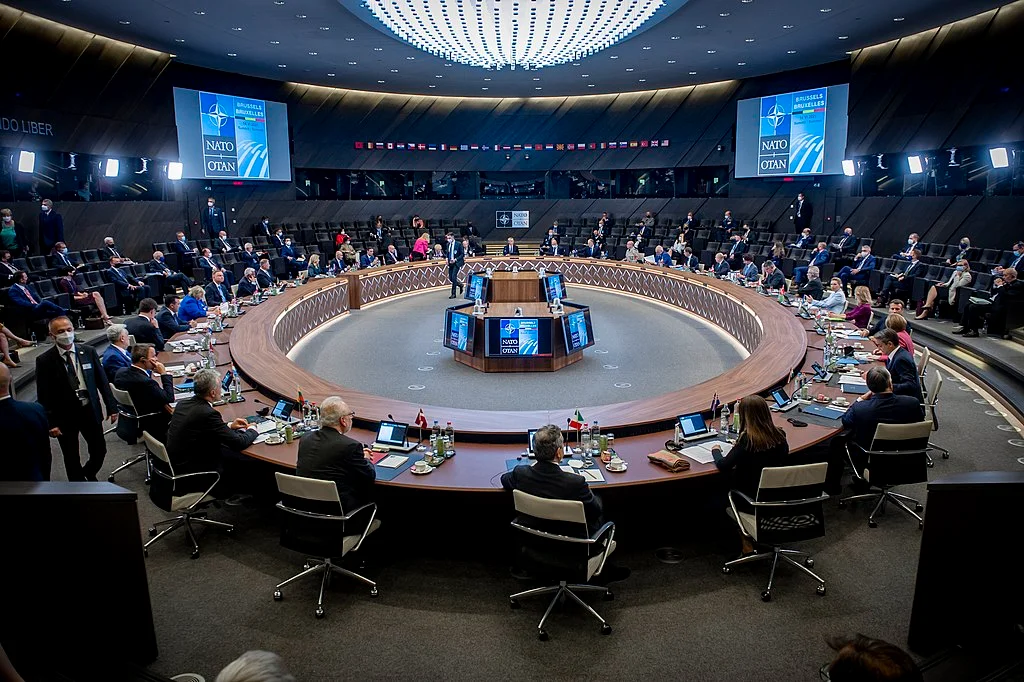
The volume of supplies, deadlines and methods of delivery as well as the need to train Ukrainian soldiers to use modern equipment — these were the topics discussed by the Defence Ministers of about 50 countries during the third meeting of the US-led Ukraine Defence Contact Group. Also known as the Ramstein Group due to the first meeting having taken place at the American Ramstein Air Base in Germany back on 26 April. This is one example of the new “coalition of the willing” format: it does not concern itself with its members being a part of NATO.
“We can’t afford to let up and we can’t lose steam. The stakes are too high,” US Defence Secretary Lloyd Austin said at the meeting in Brussels. “Ukraine is facing a pivotal moment on the battlefield... Russia is using its long-range fires to try to overwhelm Ukrainian positions.”
According to him, the US will provide Ukraine with a $1 billion military aid package. It will include 18 M777 howitzers and 46 thousand NATO-standard 155 mm shells. Ukraine will also receive programmable projectiles for multiple rocket launchers (MRL). The Ukrainian military will additionally be supplied with two anti-ship missiles Harpoon as well as thousands of protected radio transceivers, night vision devices, thermal imagers, and telescopic sights. Hundreds of pieces of heavy artillery and other weapons will be provided by other members of the Ramstein Group. Austin vowed that the Group members will continue to send weapons to Ukraine for as long as is necessary.
The deployment of the promised NATO weapons will take time, and Ukraine will need constant Western support to start using them. Meanwhile Ukrainians need them here and now because the Soviet era reserves of weapons and ammunition are being exhausted.
The numbers of the to-be-delivered weapons promised at the meeting are no match to the current huge advantage that Russia possesses when it comes to military equipment on the Ukrainian front, journalists noted. General Mark Milley, chairman of Joint Chiefs of Staff, who was present together with Austin at the press conference after the meeting, admitted that Russia outnumbered Ukraine in terms of artillery, even though he kept their assessments in the classified realm (five, ten or even twenty to one?). However, he also said that during a war other factors matter too. In particular, such things as logistics, morale, and leadership. Meanwhile the Russians, according to him, “have run into a lot of problems” there.
At the NATO meeting, in which Ukrainian Defence Minister Oleksii Reznikov also took part, the Alliance countries approved a comprehensive aid package to the partner country, which Ukraine had become at the beginning of the 1990s (and so had Russia). This package is intended to help Ukraine, in the long term, make the transition from the Soviet era weapons to modern NATO weaponry and increase the Ukrainian interoperability.
After the start of the Russian “special operation” the NATO countries began to provide Kyiv with better air defence systems and artillery as well as supplying Ukraine with more heavy weaponry and modern NATO-standard weapons. They are also helping Ukraine with such important non-lethal resources as fuel, medication, and protection equipment.
During a separate press conference after the meeting NATO Secretary General Jens Stoltenberg noted that the qualitative change in deliveries requires some time to train soldiers as well as establishing due maintenance and technical support of the aforementioned systems. The training takes place in NATO member-countries.
Dutch Prime Minister Mark Rutte outlined the ongoing process of supplying Ukraine with howitzers at the meeting. The process also involves training of the Ukrainian soldiers who will later be using these modern weapon systems.
In practice, Ukraine, with NATO’s help, is starting to move away from Soviet era weaponry towards better NATO equipment. Ukraine and NATO having the same technical standards is connected with interoperability and compatibility of command and control procedures, which will allow for operational cooperation between Ukraine and NATO’s troops.
But Ukraine being able to defend itself is not the only problem. Ukraine is not a NATO member, so it does not fall under Article 5 of its Treaty, Collective defence (“All for one. One for all.”). The West is ready to defend Ukraine with everything it has, except for “boots on the ground”, its soldiers, who will not be participating directly in the war.
The date of 24 February became a pivotal moment for NATO too. The relations between the Alliance and Russia dramatically worsened back in 2014 after the annexation of Crimea and the beginning of the conflict in Donbas. The word “partnership” was excluded from the rhetoric, and practical cooperation was suspended. But there was still a small hope that things could go back to normal. Now there is no more doubt that the democratic West and authoritarian Russia parted their ways for a long time.
The Founding Act between NATO and the Russian Federation, signed in 1997 in Paris after a long, agonising negotiation process between Russian Foreign Minister Eugeniy Primakov and NATO Secretary General Javier Solana, is dead and buried. That era came to an end. NATO thinks that Russia betrayed the Founding Act and its main principles, above all the one about the respect for the territorial integrity and sovereignty of all countries in Europe.
Stoltenberg, replying to journalists’ questions during the press conference, declared that the Funding Act no longer limits NATO’s ability to increase its presence in the eastern part of the Alliance and strengthen its posture in general across the whole Alliance. Let us remember that, according to the Act, NATO pledged not to permanently place any NATO military infrastructure or deploy significant contingents of foreign troops to the west of its 1997 borders. Which is to say in the countries that became NATO members in 1999 and later. Even before, since 1990, this rule was applied to the territory of the former GDR. NATO adhered to it until 2014.
Stoltenberg added that Putin’s goals go beyond Ukraine. That was clear in “the so-called security treaties” that Moscow proposed to the United States and NATO in December 2021. There was a meeting held in the NATO Headquarters in January that saw the Russian delegation led by Vice Foreign Minister Alexander Grushko and the NATO delegation try to find a diplomatic solution. In those “proposals” they threatened not only Ukraine but also NATO. Russia demanded NATO to stop its enlargement by removing all troops and all NATO infrastructure from the Allies that had joined after 1997.
The Alliance, as expected, refused these demands. First of all, they violated the fundamental “open doors” NATO principle. Secondly, NATO’s Collective Defence does not support any kind of “first- and second-class NATO membership”. Thirdly, past history played its role: Russia had undermined territorial integrity of Georgia and Ukraine.
The beginning of the “special operation”, its devastating consequences, deaths of tens of thousands of people, cruel images of war and suffering, Europe-wide refugee crisis, global economic and food crises only made NATO more certain of its views on modern Russia. Now, NATO members are closer than ever.
There is a bigger chance that the Alliance will accept new members. Not only the ones that wanted to become a part of NATO for a long time. Even Finland and Sweden, which previously only thought about it, ended up applying for membership.
NATO’s eastern flank, previously Russia’s calmest neighbour, is increasing its military power.
The goals Putin had announced back in December’s ultimatum via “proposals” were not achieved, the opposite happened. Maybe that was the secret goal all along?
“The Finnish president had said that it was actually when Russia wanted to close the door to NATO, that they realised that they had to move into NATO,” shared Stoltenberg.
In response to the Russian “special operation”, in the last three months NATO doubled the number of NATO battle groups to eight, and extended them from the Baltic to the Black Sea.
Members of the Alliance placed over 40,000 troops under direct NATO command, mainly on the eastern flank. These measures were backed by major air and naval power. NATO increased its troops’ readiness and the number of exercises.
On 16 June, Defence Ministers made decisions that will define the troops’ size and structure long-term. In short, NATO will increase its presence, military capacity and readiness. Some other changes were also proposed.
First of all, there will be a further increase in the NATO presence in Poland, Romania, and the Baltic states. The same can be arranged for Finland and Sweden, if they so wish. France, Belgium, and other Allies increased their contingents in Romania. The US significantly increased their presence in Europe: from 70 thousand to over 100 thousand. The majority of these forces are not permanently based, most often they are located in Germany and Poland but they change locations, notably they are rotating around in the eastern part of the Alliance.
Secondly, there will be pre-positioned heavy equipment and other supplies in the eastern NATO territories. Weapons and ammunition stockpiles. It is easier to reinforce if there are already pre-positioned materials present. There also will be headquarter elements, which is important for operating commanding and controlling any reinforcement. All that is left is to send the troops there in case they are needed.
Thirdly, for the first time since the Cold War NATO will have pre-assigned forces to specific countries in the East, linked to its defence plans. They are quartered at home, but they will regularly train in the country they are assigned to. The UK is discussing what kind of increased presence they can have in Estonia. It is expected to be significant. Germany will strengthen its engagement in Lithuania.
There is talk of a combination of more forward presence and more pre-assigned forces. Not all pre-assigned German troops will be based in Lithuania or other eastern parts of the Alliance. But the assignment means they will rotate in and out, they will train and interoperability work with the home defence, they will know the country, the territory. Some Allies have more air and naval presence than the countries located near the war zone. Spain is currently helping with more air defences in the Baltic region.
To sum up, not all of the NATO forces will be deployed on the front lines. A part of them will stay there permanently while another part will remain in their own countries ready for rapid deployment if necessary. The same ideas apply when it comes to cyber-space, naval and air defence. All in all, there will be a big increase in NATO’s deterrence and defence.
All these proposed steps will be definitively determined in the new NATO Strategic Concept that is likely to be approved at the end of June at the Madrid summit and will reflect the new security reality.
I distinctly remember the Lisbon summit of 2010 during which the current Strategic Concept was agreed on. There Russia was referred to as a “strategic partner”. Back then NATO summits were graced by the presence of Russian presidents; Dmitry Medvedev, who at the time was the face of pro-Western reforms and modernisation of Russia, went to the Lisbon summit. Just how fast times and people change!
Of course, according to Stoltenberg, Russia will not be referred to as a “strategic partner” in the new Strategic Concept. It will more likely be mentioned as a problem or even a threat. In the old Concept they kindly state that the Euro-Atlantic region lives in peace (even after South Ossetia). Today Europe is in the middle of a real war.
In the 2010 document there is not a word about China. The next Strategic Concept will see the inclusion of China as a possible threat to the security of NATO countries. But they will not call China its enemy. At the same time, NATO will be expanding its definition of partnership at the next summit in Madrid. For the first time in NATO’s history the leaders of New Zealand, Australia, Japan, and South Korea were invited. These countries are considered to be “like-minded” by NATO in the Asia Pacific region.
Ukrainian President Volodymyr Zelensky was invited too and he accepted the invitation to the summit. As expected, there was no room for Russia at this time.