
Оригинал материала
Roskomnadzor briefly blocks Telegram domain t.me
Update: the t.me domain has disappeared from Roskomnadzor’s list of blocked sites.
Roskomnadzor, Russia’s federal censorship agency, at the request of the Prosecutor General’s office, has started blocking the domain t.me, which is used to create shortened links in the Telegram messenger app. A service on the Roskomnadzor website for checking access restrictions for Internet pages confirms this information.
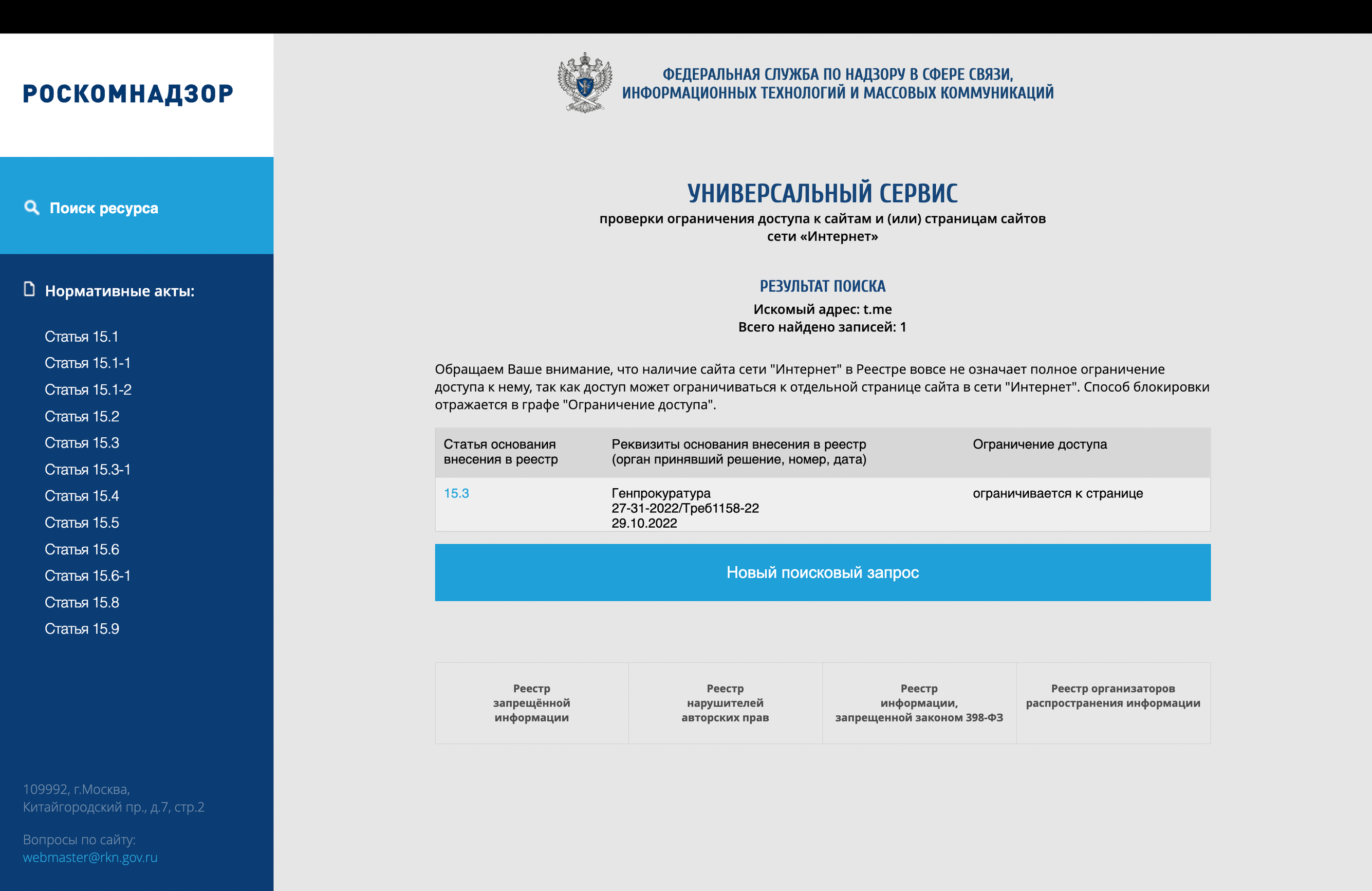
The agency’s reasons for blocking the t.me domain are unknown. According to Roskomnadzor, access to t.me is limited by the Prosecutor General’s office on the basis of Article 15.3 of the law on information (Procedure for Restricting Access to Unlawfully Distributed Information).
The project Network Freedoms notes that Article 15.3 provides grounds for blocking the dissemination of extremist material, fake news, calls to protest, and discrediting the Russian armed forces. The project thinks that “given current practices, this is almost certainly about military fakes.”
Publication Astra writes that project Roskomsvoboda’s [Russian Communications Freedom] monitoring of the list of banned sites shows three pages with the t.me domain were blocked by the General Prosecutor on October 29. They were posts from Ukrainian Telegram channels calling for Russian soldiers to surrender.
The Prosecutor General’s request is mandatory for all Internet service providers. “This means that in the near future, they will start trying to block Telegram’s traffic,” says the Network Freedoms post. Publication Baza writes the first consequence will be that external links to Telegram channels will stop working.
Telegram itself currently still works in Russia, says BBC’s Russian service. Roskomnadzor wrote on its own Telegram channel that “blocking this social network on Russian territory is currently precluded.”
- Roskomnadzor blocked Telegram in 2018 after the messenger refused to provide the FSB with encryption keys for user correspondence.
- Roskomnadzor then blocked several million IP addresses which, according to the agency, Telegram was using to circumvent restrictions. This led to operational failures on other sites and services.
- Despite the attempts to block it, Telegram continues to operate mostly stably in Russia. In 2020, Roskomnadzor abandoned its attempts to restrict the messaging app.