
Оригинал материала
US leadership forced to drag Germany along on issue of supplying tanks to Ukraine, says defense expert Rafael Loss
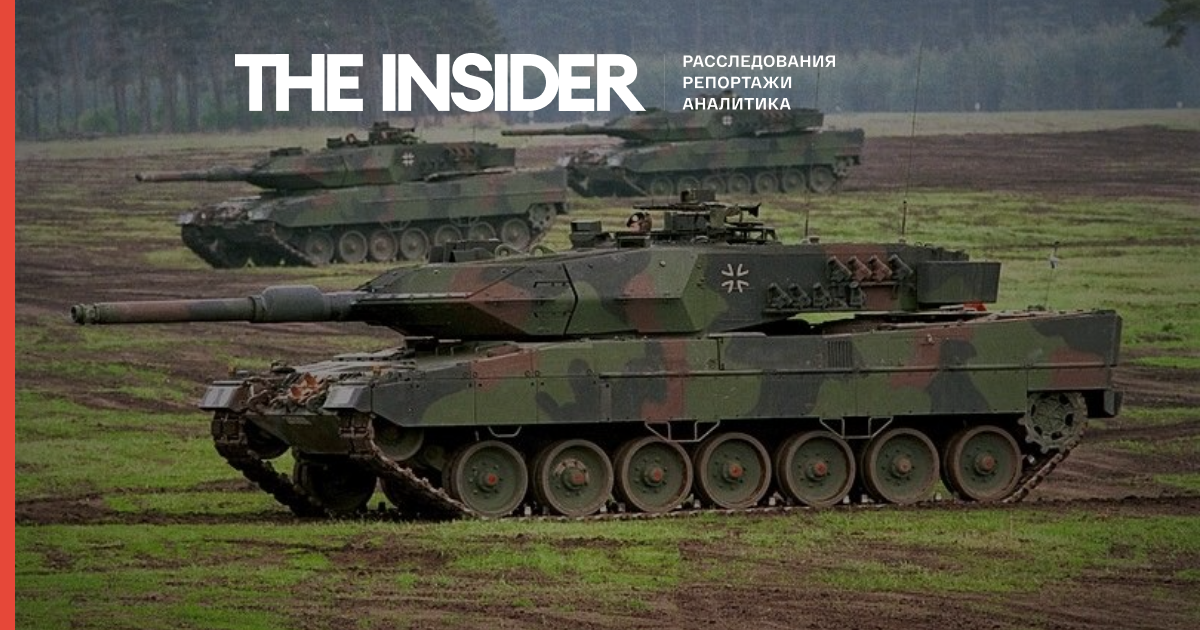
Chancellor Olaf Scholz has said that he will allow NATO allies to send German Leopard tanks to Ukraine only if Washington also provides Kyiv with American Abrams tanks. According to a report by The Wall Street Journal citing high-ranking German officials, Scholz is pressuring US President Joe Biden to make a decision on the issue. Earlier, several countries, including Poland, Finland and Denmark, had promised to send Leopard tanks to Kyiv if Berlin did not object.
Rafael Loss, coordinator for pan-European data projects at the European Council on Foreign Relations' (ECFR) Re:shape Global Europe project, explained the position of the German authorities in a conversation with The Insider.
Why is it a matter of principle for Germany that the US must participate?
The past months have shown that decisions about what military aid to send to Ukraine when are being made in the chancellery. Political factors are the main cause for the chancellor’s refusal to move without the United States: he seems to believe that his party and the public would oppose German leadership on this question – at least on the latter he is wrong, I believe.
Why is Germany demanding that Abrams tanks be sent ahead of the Leopards?
As proof that Germany and the United States are seemingly in lockstep – when on most metrics, they are not. US military aid to Ukraine far exceeds Germany’s. The US is also carrying the greatest burden for deterrence and reassurance within the NATO alliance. Olaf Scholz might believe that the relationship between Berlin and Washington is the basis for the West’s support of Ukraine, but I doubt that the White House would agree.
Which version of Leopards is most likely to be supplied?
The 2A4 and 2A5 variants of the Leopard tank are the most widely available in Europe, but there are some technical differences between the two versions. 2A5 and 2A6 are more alike, which would reduce the training and sustainment burdens, but there few European countries use the 2A6 variant. An additional challenge will be to standardise user interfaces and such across national origins of donated Leopard tanks – the differences between two 2A4 coming from two different countries can be quite significant. Logistically all of this will be a monumental challenge, but that means that it should be done – it has to be done, and the sooner Ukraine’s supporters start the sooner these tanks can have an effect on the battlefield.
Is Germany ready to become the coordinator of the process of delivering Leopards?
Not of its own conviction, no. As the last days have shown – including a recent DoD statement – US leadership has to drag Germany along on this question. But simply by the fact that Germany needs to approve other countries’ re-exports of Leopard 2 tanks to Ukraine and because German industry produces these tanks as well as ammunition and spare parts for them, Berlin finds itself at the centre of this effort.
How does the “tank issue” influence the internal political struggles in Germany (or is it those struggles that influence the tank problem)?
For months, the question of whether or not to send German-produced Leopard 2 tanks to Ukraine has dominated debates over Germany’s support for Ukraine. Leaders from Olaf Scholz’s two coalition partners – the Greens and the liberal FDP – and opposition politicians have called for such deliveries, as have some members of Scholz’s own SPD. When Olaf Scholz now claims a leadership role for Germany in European security, this rings increasingly hollow.
Why is Germany, not willing to supply tanks itself, also reluctant to authorize other operators (Poland, Finland) to hand over tanks?
It seems that this would still be a step too far for Germany’s chancellor to take, politically, in the relationship with the United States. But this attitude has certainly prevented Europe from adopting a more pro-active and strategic attitude towards supporting Ukraine against Russian aggression, and in doing so helping to rebalance the transatlantic relationship towards a true partnership in leadership.
An interview with the CEO of Rheinmetall said that there are 22 Leopard 2 tanks and 88 Leopard 1 tanks, but no contract to prepare them for delivery to Ukraine. Why couldn't such a contract be concluded? In the same interview, the CEO of Rheinmetall said that preparing and delivering tanks to Ukraine would require one year, is that really so, according to your estimates?
More recent reporting suggests that German industry would be able to supply more vehicles along a somewhat shorter timeline, and I think there are reasons to believe that to be accurate. No one expects industry to make hundreds of tanks appear out of nowhere. That is why pro-active leadership and coordination with allies and industry are so important in supplying Ukraine with an initial Leopard 2 capability – 80-100 vehicles is a realistic target for a first tranche, I believe – and then to draw on industry stocks to replace vehicles that were donated and to ramp up production of new hulls. This is what sets the Leopard 2 apart from all other European tanks: an active production line, which can serve as a basis to rebuild capacity. Because clearly demand will grow for new tanks among European NATO allies and in Ukraine.