
Оригинал материала
A tax that isn’t a tax
Hello! This is Alexandra Prokopenko with your weekly guide to the Russian economy — brought to you by The Bell. In today’s newsletter, we’ll look in depth at the state of Russia’s budget and the Kremlin’s linked attempt to impose a special levy of up to $3.5 billion on Russian companies. We also analyze household income figures from last year.
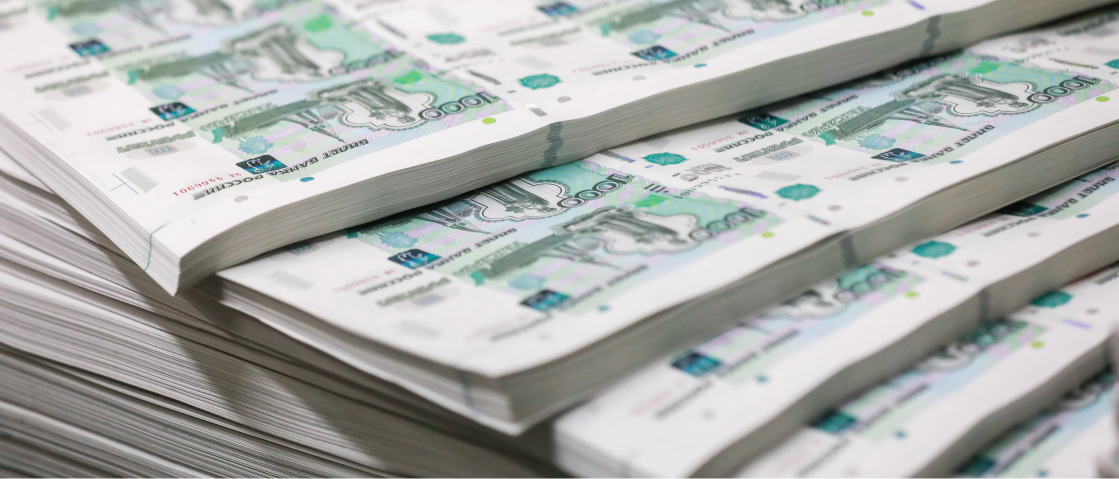
Ballooning budget deficit and ‘backdoor’ tax proposals
The Russian authorities are turning to businesses for money to top up the budget. As The Bell reported this week, the government is demanding large companies make a one-time budget contribution of up to 250 billion rubles ($3.5 billion). This comes on top of December’s tax recalculation that is expected to take a further 1.8 trillion rubles ($25 billion) out of the economy. Businesses are trying to resist, but the government is not budging – and has good reasons for its position: January statistics released this week showed a rapid rise in spending against a background of falling incomes.
What’s happening?
At the end of last year, the government grew concerned about the increasing budget deficit and Prime Minister Mikhail Mishustin proposed a “revenue mobilization.” Among the measures under discussion were increased dividends for state-owned companies and one-off payments from large private companies, Bloomberg reported.
The government acted quickly. Back in mid-December, the Russian Union of Industrialists and Entrepreneurs (RSPP), which unites Russia’s biggest companies, was invited to contribute about 200 billion rubles (the first proposal had been a sum that was twice as much, a source close to the discussions told The Bell). This was the brainchild of Finance Minister Anton Siluanov, the source claimed. Another source said that behind-closed-doors meetings with business leaders were led by Deputy Prime Minister Andrei Belousov.
After The Bell published its article, Belousov confirmed our information.
“A voluntary contribution from businesses is under discussion,” he said. “The fact is that last year’s financial results were very good.”
The government has invited businesses to come up with their own proposals on how exactly to levy additional payments. However, there is not much time: Maxim Oreshkin, Russian President Vladimir Putin’s advisor on economics, is apparently eager to offer a "gift” to his boss at RSPP’s spring congress.
The Bell has seen RSPP documents suggesting the association will resist any form of new payment. The documents point out that, in December, the Finance Ministry ordered a retroactive tax on profits generated by companies whose assets were revalued due to the strengthening ruble. And they stated that the mooted one-off payments will cost the Russian economy 1.8 trillion rubles — of which just 270 billion rubles will go to the budget.
The RSPP documents suggest that the government should either treat the December tax recalculation as a “contribution,” or cancel the tax recalculation and generate the required money by raising corporate income tax by 0.5 percentage points to 20.5%.
The Finance Ministry has already stated it is “categorically opposed” to any tax increases.
Could Russia get more money from business without raising taxes?
The current situation is nothing new. The government always talks about the need for predictable tax rates — however, whenever it needs money, it has a habit of trying to impose sudden surcharges on businesses (allowing them to claim taxes remain the same):
- Gazprom paid 1.24 trillion rubles into the budget as an additional Mineral Extraction Tax payment in 2022. This sum was sufficient to compensate the state for the sharp fall in oil-and-gas revenues in the second half of the year. For example, in November Gazprom’s MET payment of 466 billion rubles represented almost half of the total oil-and-gas income – without it, revenues would have been down 48%. In January 2023, Gazprom’s MET payments reverted to their usual 44 billion rubles.
- Belousov in 2021 said that metal companies had “ransacked” the state for 100 billion rubles during the pandemic, and insisted that this money should be returned either through taxation or a one-off payment.
- In 2018, when he was working in the presidential administration, Belousov calculated windfall profits of metal companies, fertilizer and chemical gas companies at more than 500 billion rubles. He proposed collecting this money and spending it on the president’s initiatives. Nothing came of the proposal.
- During the 2016 oil price slump, the Russian budget was saved by a deal to sell 19.5% of the state’s shares in oil giant Rosneft, which generated more than 700 billion rubles. The deal was extremely opaque.
What’s making the government nervous?
This week saw the release of the first budget statistics of the year, which showed the budget recorded a deficit in January of 1.8 trillion rubles ($25 billion). This compared to the surplus of 125 billion ($1.9 billion) that was recorded in January, 2022.
Budget revenues in January fell 35%, mostly due to a 46% reduction in oil-and-gas income to 426 billion rubles. The reasons for that decline are related to falling prices for Russian oil (Urals blend was selling for $49 per barrel in January —much lower than the $70 a barrel that was expected in Russia’s budget calculations) and reduced gas exports.
Non-oil and gas revenues fell 28% to 931 billion rubles ($13 billion). The most serious slump was in revenues from domestic VAT and income tax. However, that is largely a result of changes in the way these taxes are administered. In April, Russia switched to an accelerated payment of VAT refunds —- and from Jan. 1 almost all taxes and fees have been transferred to a single payment that is made on the 28th of each month.
Expenditure went up by a record 58.7% in January to 3.1 trillion rubles. Again, much of this can be explained away as a one-off — for example, the government paying up front for state contracts. The volume of public procurement increased fivefold in January compared with the same month last year (from 249 billion rubles to 1.3 trillion rubles).
At the same time, some of this points to different dynamics — before the war, the Finance Ministry’s peak expenditure was in the fourth quarter. However, it’s not clear which expenses are being brought forward – after war broke out, the Finance Ministry stopped publishing a detailed breakdown of government expenditure.
It is still far too early to make any predictions about the state of the budget by the end of the year. But the dynamic is an important confirmation that things won’t be easy — and that revenue will fall. Under these conditions, the Kremlin and the government usually embark on so-called “resource mobilization” — i.e. going in search of hidden reserves they can tap.
Where is this leading?
The Russian government’s attitude toward business is only adding to heightened levels of uncertainty. Taxing profits after the fact is the complete opposite stable taxation. But the entire history of relations between business and the state suggests that the government will find a way to acquire what it wants — while maintaining the fiction of unchanging tax rates.
Dear readers,
The Bell is now listed as “a foreign agent” in Russia: we can no longer raise money through advertising, and our business model is in ruins. Journalists in Russia face greater risks than ever before. Repressive new laws threaten up to 15 years in jail for objective reporting.
However, we are not about to give up. This newsletter is our newest project. It presents an in-depth analysis of the Russian economy, which has survived the first year of the war but is becoming ever more secretive. We will try and shed some light on what’s going on. Each edition will tackle a part of the big question: how long can the Russian economy endure under sanctions and when will the Kremlin run out of money for its war?
We don’t want to have to charge a fee for our newsletters. However, if The Bell is to continue its work, we need your support.
You can make a donation here. It will help our journalists continue investigating stories, breaking news and publishing newsletters.

Household incomes in Russia fell just 1% in 2022
Russians’ real disposable incomes fell 1% in 2022, Russia’s State Statistics Service (Rosstat) reported this week. That is significantly less than forecast – the Ministry of Economic Development expected a slump of 2.2%. Incomes for Russians (following record growth of 2.2% in 2021) declined for three quarters in a row in 2022 and rebounded only in the final months of the year. The fourth quarter saw incomes jump 0.9%.
The late growth was due to falling inflation and increasing salaries. That was, in turn, fueled by the country’s sudden need for labor after the September mobilization and the related mass exodus abroad. In its report on the regional economy, the Central Bank indicated that, in December, half of Russia’s businesses suffered staff shortages. Firms said that they plan to keep increasing salaries in 2023 as a way of overcoming staffing problems.
According to calculations by the “Hard Figures” Telegram channel, car manufacturers were among the leaders for salary growth in November: pay was up 30% year-on-year. This coincided with a gradual resumption in output after a collapse in the months after the invasion. Salaries in passenger rail transportation were up 27% last year, in pipeline transport 23%, electronics 21% and 20% in metal products.
Entrepreneurship saw a 0.7% rise in its share of household incomes. “The changes in the structures of income favor funds from entrepreneurial activity,” said Lilia Ovcharova, an economist at the Higher School of Economics. “This is an effect of sanctions — as a result we saw a number of small and medium enterprises trying to develop imports for a range of products.” The role of “other cash income” also seems to be growing. In Rosstat’s methodology, this can include shadow incomes and remittances from abroad.
Russians spent less and saved more last year. In particular, the increase in saving (+7.3%) was noticeable. This indicates uncertainty – both about the present and the near future.
Figures of the week
- The Central Bank kept its key interest rate at 7.5% at a Friday meeting, but indicated future rate increases were possible because of inflation risks.
- Russia’s current account balance continued to decline in January, according to a Central Bank report. Despite deteriorating market conditions and the balance falling to $8 million from $19 million a year ago, it remains relatively high.
- From Jan. 31 to Feb. 6, weekly inflation accelerated to 0.26%. That’s compared to 0.21% and 0.14% for the preceding two weeks. Prices are up 1% since the start of the year and the annual inflation rate climbed to 11.7% year-on-year.
- As many as 67% of Russian businesses have switched to Chinese companies for machinery and equipment, according to a survey by the Gaidar Institute for Economic Policy. Just 39% of firms were able to find Russian substitutes for parts no longer being supplied by the West. At the same time, 15% of respondents said sanctions had not prevented them from sourcing restricted items. The survey also found that investment plans continue to recover.
Essential reading
- “China Aids Russia’s War in Ukraine, Trade Data Shows” — the Wall Street Journal documents how Russia’s war machine gets critical components and equipment from China
- “Russia’s Second, Silent War Against Its Human Capital” — Andrei Kolesnikov argues that one of Russia’s major socio-economic problems is that 70-year-olds decide how young people should live their lives
- According to Pew, the share of Americans who say the U.S. is providing too much support to Ukraine has grown from 7% in March 2022 to 26% in Jan. 2023
- “‘I Will Not Go Back’: Anti-War Russians Stuck in EU Asylum Limbo” — The Moscow Times reports on Russians facing an uncertain future in Europe
- What Russia Got Wrong RAND Corporation's Dara Massicot discusses what Russia can learn from it’s failures in Ukraine