
Stolen washing machines as sign of Russian withdrawal and an arrest warrant for Vladimir Putin. What happened on the front line on March 17?
The front line
Russian forces are making little headway in Bakhmut and are unlikely to resume their offensive on Vuhledar, the US-based Institute for the Study of War (ISW) said in its latest report. The ISW quoted Ukrainian army spokesman Serhiy Cherevaty as saying that the Russian military has made 42 ground attacks near Bakhmut over the last day.
“The relatively slower pace of Russian attacks on and around Bakhmut on March 16, coupled with relatively fewer Russian claims on advances in this area, supports ISW’s March 15 assessment that the Wagner Group offensive on Bakhmut is likely nearing culmination.” the institute's experts said.
The briefing also noted that Russian forces continue limited operations in the western part of the Donetsk region near the town of Vuhledar, located 30 km from Donetsk.
The daily British military intelligence update said that in recent days, Russian military and Wagner PMC mercenaries had managed to gain a foothold on the western bank of the Bakhmutka river, which runs through the city centre. During the previous week, the river had marked the front line. The Armed Forces of Ukraine (AFU) are continuing to defend the western part of the city.
Overall, along the front line, the level of local advances is now at its lowest since early January 2023, according to the report. Apparently, Russian troops have temporarily depleted the combat capabilities of their units, which are now insufficient even for small offensive operations.
British military intelligence believes that the Russian command will seek to restore offensive capabilities as soon as personnel and ammunition are replenished. Until then, commanders will have to choose between conducting offensive operations and providing a credible defense along the front line.
The pro-Russian Telegram channel Dva Maiora (“Two Majors”) wrote that northwest of Bakhmut the Wagner PMC is “building on its success after taking Zaliznianske.”
Meanwhile, Estonian intelligence reported that the Wagner PMC cannot recruit enough new mercenaries, which has led to the Russian military leadership having begun to replace them with regular units on the southern flank of its grouping near Bakhmut. Estonian intelligence also noted a decrease in the intensity of Russian assault activity in this direction compared to the winter period due to weather conditions and the rotation of units, but warned that their activity may increase again by April.
A report from the AFU said that the Russian army had unsuccessfully attacked in the direction of Kamianka, Nevelske, Avdiivka and Marinka in the Donetsk region. The Russians also unsuccessfully tried to break the defenses of the Ukrainian army in the Kupiansk and Lyman directions, according to a report from the Ukrainian General Staff.
The situation remains unchanged in the Volyn, Poliske, Siversk and Slobozhansk directions. The Russians continue to engineer the terrain in the border areas of the Bryansk and Kursk regions, the Ukrainian General Staff said in its most recent report. The Russian army is on the defensive in the Zaporizhzhia and Kherson directions, according to reports from the AFU.
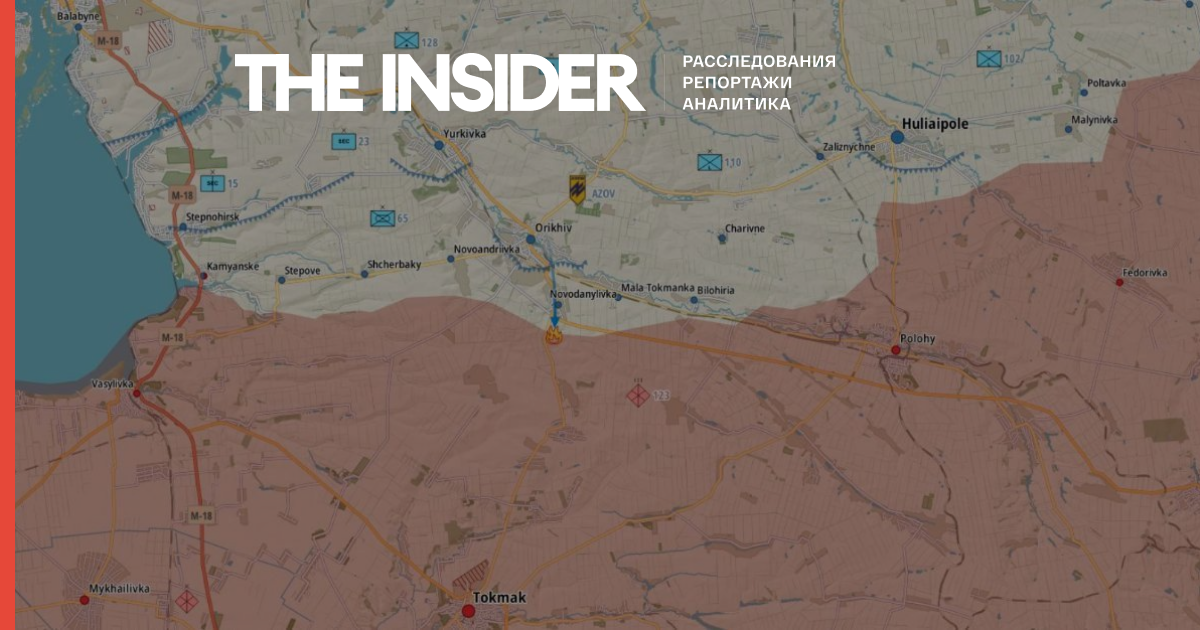
Earlier, the Russian-appointed “interim governor” of the Zaporizhzhia region, Yevgeny Balitskiy, said that Kyiv was preparing its troops to step up combat operations in the Zaporizhzhia section of the front. In an interview with The Insider, defense expert Roman Svitan commented that preparations in this direction were indeed under way, but it was too early to talk about an offensive. However, there are also signs of Russian retreat from this direction, according to Svitan:
“In the Zaporizhzhia section of the front, as in other sections, there is a rotation of troops, meaning there’s a changeover, one part leaves to be re-staffed and another goes in. After the troops come in, that’s followed by so-called ‘reconnaissance-in-force’ to determine the boundaries of the enemy fortifications.
What we are seeing now is post-rotation warfare conducted by our troops entering the front line. This could be considered trivial reconnaissance-in-force, but any offensive action begins with it. Everything here will depend on the command.
New units entering the front line are being prepared for offensive action. When will they be? That's another question, but preparations are going on all the time. It's commonplace for any recently deployed unit. This is not the offensive they’re talking about, but the preparations may be taking place.
On March 16, the Ukrainian General Staff gave information that Russian trucks carrying ammunition to the Kherson and Zaporizhzhia directions are coming back loaded with washing machines from the left bank [of the Dnipro river]. This suggests that the Russians are preparing to withdraw from the left bank and from the Zaporizhzhia front. Such preparations are always noticeable when the rats from the rear know how the events are going to unfold and prepare to leave: they steal and begin removing the loot.
This is a good signal, when there are lines of trucks coming back, laden with [electric] appliances from abandoned homes, [on their way] to Crimea. They are preparing for our offensive and their retreat. All armies do this, that's the way this world works. This is not the case in Donbas and Luhansk, empty cars go back there, but from Zaporizhzhia and Kherson directions, the cars are full.”
Shelling
Two people died as a result of Russian shelling in the Donetsk region. According to the regional administration, 19 residential buildings, a prison, a school and a business were also damaged. The morning rocket attack on Avdiivka did not cause any casualties. The image below shows the aftermath of the strike on Avdiivka: