
Оригинал материала
How Russia is losing scientists and destroying science

The Story of Scientists Leaving Russia Again
Yulia Balakhonova
March 27, 2023
After launching the attack on Ukraine, the Russian leadership decided to attack a variety of spheres within its own country as well. In addition to independent journalists and human rights activists, who have been practically eradicated, science has also been targeted. In the spirit of the Soviet tradition, scientists are getting fired, their books are getting confiscated, and money is only provided to those who are loyal to the regime.
The Fugitives
Three years ago, prominent astrophysicist and corresponding member of the Russian Academy of Sciences Yury Kovalev along with other Russian specialists made a breakthrough in the study of black holes 
, — that is how this story was reported by the Interfax news agency. A group of astrophysicists proved that ultra-high energy neutrinos originate near black holes ×
. The scientist was then full of optimism and talked to the media a lot about other discoveries that may be made. As it turns out now, should these discoveries be actually made, it would be in another country.
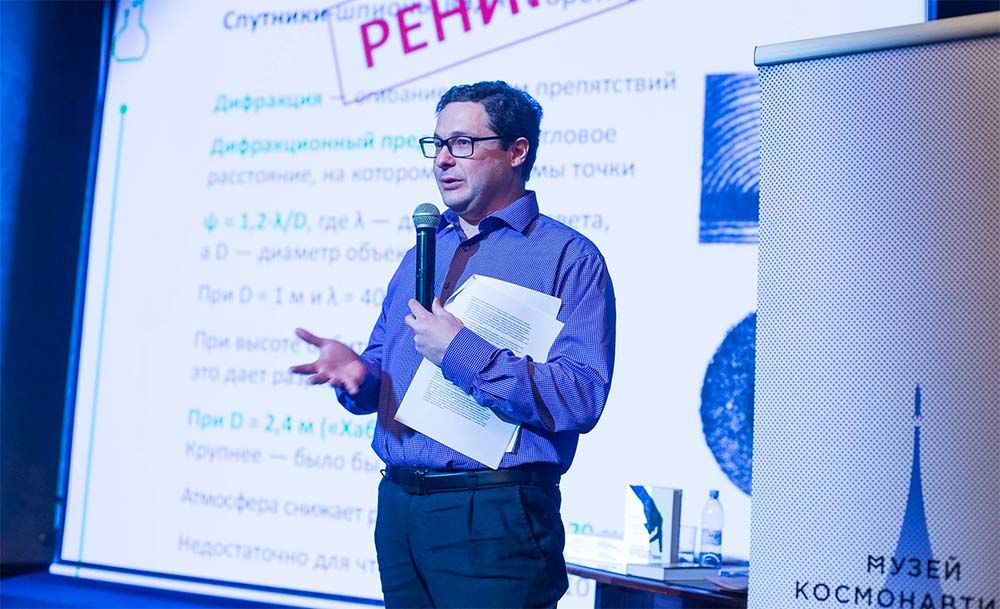
After the war began, Kovalev, like many other scientists, signed a letter condemning the Russian aggression and left for Germany in the fall , as he told The Project ×
. He is now engaged in helping other scientists: some need to relocate, while others need to overcome certain difficulties in their new place of residence , Kovalev says ×
.
What did the open letter signed by 8489 scientists say about the war?
“This fatal step leads to enormous loss of life and undermines the foundations of the established system of international security. The responsibility for unleashing a new war in Europe lies entirely with Russia.
There is no reasonable justification for this war. Attempts to use the situation in Donbas as a pretext for launching a military operation are not credible. It is clear that Ukraine does not pose a threat to the security of our country. The war against it is unjust and outright pointless.”.
Many scientists need such assistance. “After February 24, we were so stressed and shocked that we could not eat anything, we were terrified, we panicked, we bought a ticket to Istanbul and just ran away,” recalls Alexander Markov, professor of the Russian Academy of Sciences and head of the Department of Biological Evolution at Moscow State University. He left for Turkey with his wife, Elena Naimark, a leading researcher at the Paleontological Institute of the Russian Academy of Sciences, but the couple briefly returned a month and a half later. “There was a feeling that this horror had to end soon, because it just couldn’t go any further,” he says. “The horror” did not end though, and since December Markov, one of Russia’s most prominent biologists and science popularizers, has been living in Israel. Academician Viktor Vasilyev, president of the Moscow Mathematical Society, has now also settled there.
In total, The Project has identified 28 prominent scientists and professors from leading universities who left Russia after the beginning of the war. Among them are specialists of international renown and laureates of numerous scientific prizes.
Scientists who have left Russia
However, the total number of scientists who have left Russia is much larger. Scholars at Risk alone, an organization dedicated to helping scientists from around the world, has moved 200 people out of Russia 
, its representative Prachi Patel told the Project ×
. Another 62 scientists were assisted in leaving Russia by the German Alexander Humboldt Foundation
, its spokeswoman Christina Guroff told the Project. The foundation had been helping Russian scientists even before the war ×
. Over six thousand people are now members of Telegram chats for scientists in need of relocation
, as sociologist Dmitry Rudenkin points out. The chats in question are those of Kovcheg, an organization that has been helping emigrants from Russia since March 2022 ×
.
Where have the Shaninka employees gone from Russia?
The scientists who left Russia have already begun to create new educational organizations abroad: for instance, in Montenegro, former employees of the Moscow School of Social and Economic Sciences (also known as Shaninka) have created the Liberal Arts & Science educational program. The management is already recruiting students for short courses and expects to turn the program into a full-fledged university , say Ksenia Luchenko and Andrei Fetisov ×
. According to Ksenia Luchenko, program director and former dean of the Media Communications Department at Shaninka, they have already received more than 30 applications from Russian educators. “To be honest, we have fewer vacancies than applicants so far,” Ksenia says.
“Entire scientific branches have come to a halt; no research is being conducted. We were set back by years,” laments astrophysicist and professor of the Russian Academy of Sciences Sergey Popov. His biography is similar to that of many notable scientists. In 2016, he received the state prize “For Fidelity to Science,” in February 2022 he signed an open letter against the war, and a few months later he left Russia.
There were no attempts to persuade Popov or any of his other colleagues to stay. On the contrary — scientific and educational organizations themselves were expelling high-class specialists. And in line with the traditions of the 1930s USSR, there were denunciations and spy hysteria.
The Dismissed and the Traitors
The Russian Academy of National Economy and Public Administration (RANEPA) is not an ordinary university; it calls itself the “presidential academy,” which runs an important project for the Kremlin: the so-called “school of governors”
. In 2017, the university launched a program for the development of the managerial talent pool (the Higher School of Public Administration ×
. It includes some rather extravagant activities, such as asking students to lie under a moving tank to test their stress tolerance. 41 graduates of this “school of governors” have become heads of Russian regions, said Alexei Komissarov, then director of RANEPA Higher School of Public Administration, in 2021). After the start of the war, this academy dealt with the disgruntled without much ceremony.
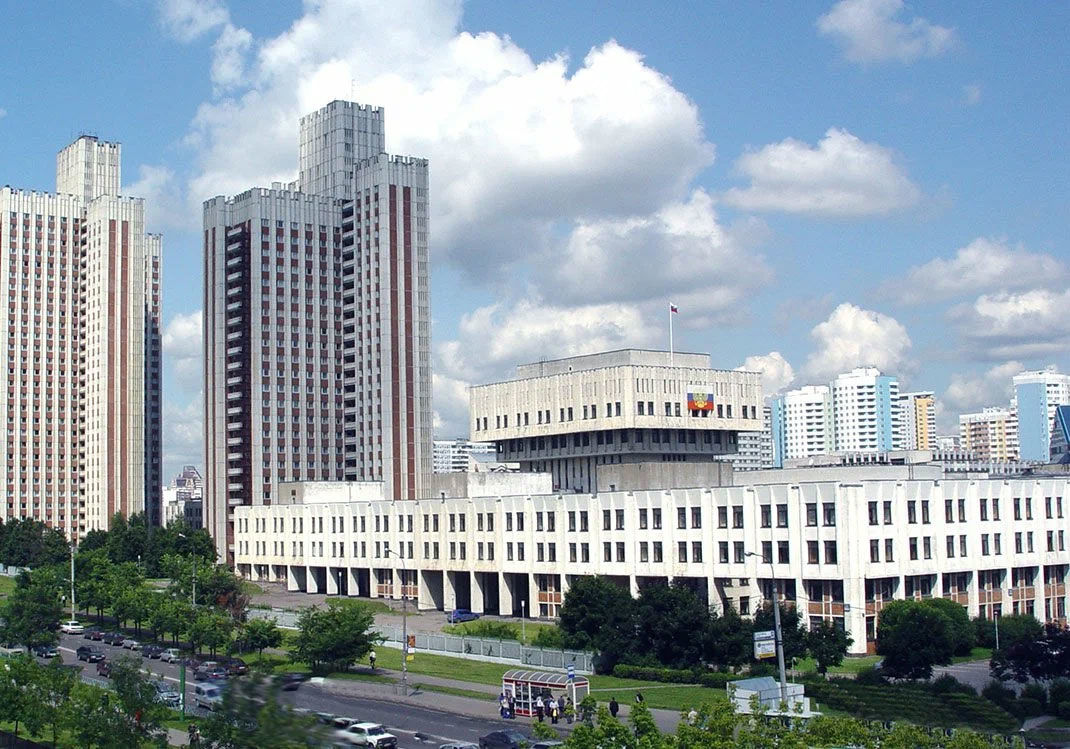
“All the components of the myths about May 9 and the Great Victory have been definitively nullified by reality,” Denis Grekov, lecturer in the course “Critical Thinking” at RANEPA, wrote in his Facebook on May 8 last year. Shortly thereafter, professor Natalia Tanshina of the same institution complained publicly in her Telegram channel ×
about his critical reflections, and Grekov was immediately summoned to the dean’s office and offered to resign. Another lecturer, Tatiana Kamoza, who also condemned the war in her social networks, was dealt with differently. After a student denounced her, two observers from the dean’s office were assigned to her lectures, to make sure she did not say too much , says Kamoza. Her lectures were also recorded — she was only allowed to teach remotely ×
. Moreover, one of the university administrators met with student group supervisors and urged them to denounce lecturers who said anything “unpatriotic” in class , Grekov adds. Kamoza confirms the same. RANEPA did not respond to The Project’s inquiry ×
. Grekov now lives in Poland.
The former deputy director of the department of science at the Russian Military Historical Society (! — the RMHS is headed by presidential aide Vladimir Medinsky — **) and associate professor at the Moscow State Institute of International Relations Konstantin Pakhalyuk was denounced twice: over a Facebook dispute on whether Ukraine can be called a fascist state, and over an interview with TV Rain. However, the accusations that actually forced him to resign from the RHMS were more ridiculous than those.
In mid-March, the scientist, who made no secret of his anti-war stance, received a phone call from the presidential administration, inviting him to Staryaya Square , the Presidential Administration of Russia is located there ×
. The Administration did not reply to The Project’s inquiry.) There, one of the officials , Pakhalyuk does not name him for security reasons ×
told him, “We have received information that there are Mossad agents in your contacts. Pahalyuk adds that he had never dealt with representatives of the Israeli secret services. In addition, the interlocutor reminded him of his opposition to the currently implemented concept of genocide of the Soviet people , this is handled by the ‘No Limitations Period’ project overseen by Deputy Director of the Department of Public Projects of the Presidential Administration Elena Malysheva, says Konstantin ×
, which ‘contradicts state policy’. The official then asked Pakhalyuk to write a letter of resignation.
The lecturers at the once-liberal Higher School of Economics also come under pressure — after the war began, university officials began to phone them up, asking if they had left for abroad
, as several lecturers from the Higher School of Economics told The Project. The press service of the university did not respond to The Project’s inquiry ×
. As a result, dozens of employees have been fired or made independent contractors. According to the estimates of former professor Konstantin Sonin, the university has lost at least 150 lecturers since the war began. For example, the Poletaev Institute for Humanitarian Historical and Theoretical Studies has lost 60 percent of its staff
, says Alexei Pleshkov, former director of the Institute. This is confirmed by comparing the current list of employees with the archived page from January 2022 ×
, and the Institute itself lost its status as an international laboratory at the beginning of 2023
, this will have a negative impact on the financing of the unit ×
.
One of those fired was Professor Oleg Lekmanov, a specialist in 20th-century Russian poetry. He left Russia shortly after he attended an anti-war rally in Moscow, and was not allowed to continue working at the Higher School of Economics. The university was in such a hurry to fire him that his personal page was removed from its website while he was still reading his lecture course remotely.
Assistant professor Dinara Gagarina made the following post on her Facebook in September:
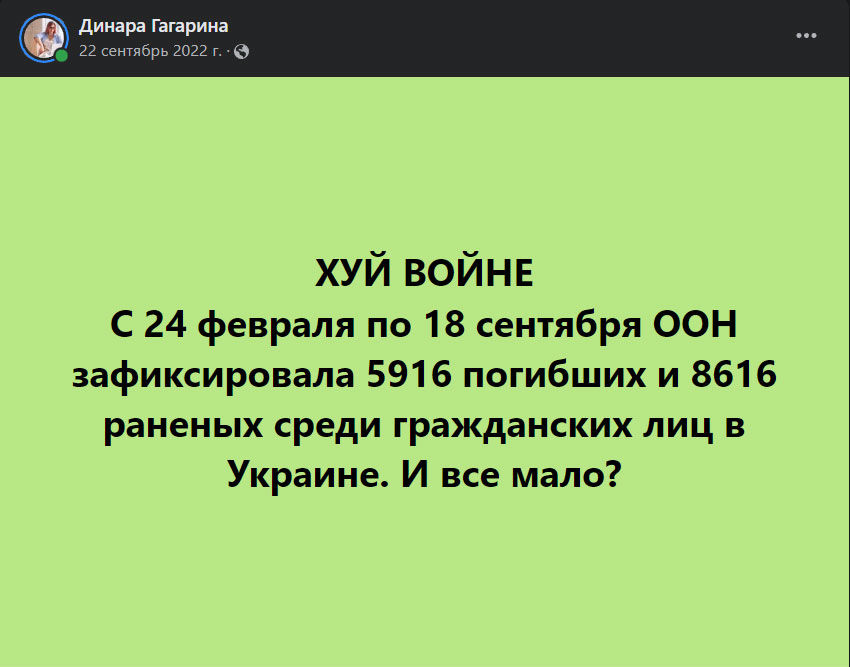
After that, she was consecutively fired from three positions: in the summer Dinara was supposed to become head of the Center for Digital Humanities Research at the Higher School of Economics in Moscow, but she was dismissed right on the day of the center’s opening. In October, she was fired from her position as the head of a master’s program at the Perm branch of the Higher School of Economics , she had founded a master’s program in digital methods for the humanities ×
and, at the end of the year, she was also fired from her post as the head of the Historical Research Department at the same university.
The staff of the Journalism Department of Moscow State University was also laid off: lecturers with oppositional views were simply stripped of their teaching loads while maintaining their minimal pay and removed from the teaching schedule , as former Moscow State University lecturer Mikhail Edelstein told us ×
. In total, The Project has established the names of 20 professors at leading universities who spoke out against the war and were subsequently fired.
Which educators were left out of work after the war began?
Universities frequently not only lay off staff, but also shut down entire divisions and university programs.
What programs were shut down in universities in 2022
Political Journalism module at the Faculty of Journalism at MSU, which had existed at the faculty since 2013. It was merged with the Social Journalism module.
Liberal Arts program at the Russian Academy of National Economy and Public Administration. The faculty offered students the opportunity to combine two study profiles — for example, political science and history.
Human Rights and Democratic Governance specialization within the Master’s program “Political Analysis and Public Policy” at the Higher School of Economics. Students of this program interned at foreign universities and worked at international government agencies and human rights organizations.
Sociologist Anna Kuleshova and anthropologist Alexandra Arkhipova say they have encountered cases in which editors of scientific journals would remove the names of scientists who had left Russia from scientific articles , the scientists in question requested to remain anonymous for security reasons ×
. “The same practice existed in the 1980s USSR — and now it’s being repeated,” says Kuleshova.
This is true, censorship has indeed returned to Russian science in full force.
The Forbidden Topics
In the 1980s, Soviet scholar Igor Kon wrote a new textbook for the Soviet public of the time, titled Introduction to Sexology. But at the end of last year, they stopped issuing this textbook to visitors of some of Moscow’s libraries. The reason was the authorities’ crusade against the LGBT community.
The new law on LGBT propaganda
Signed by Vladimir Putin at the end of last year, the law on the complete ban on propaganda of non-traditional sexual relations, sex reassignment and pedophilia introduces heavy fines for such “violations”. LGBT “propaganda” can result in fines of up to 400,000 rubles for individuals and up to 5 million for companies. Websites on which such “propaganda” is found are to be blocked by Roskomnadzor.
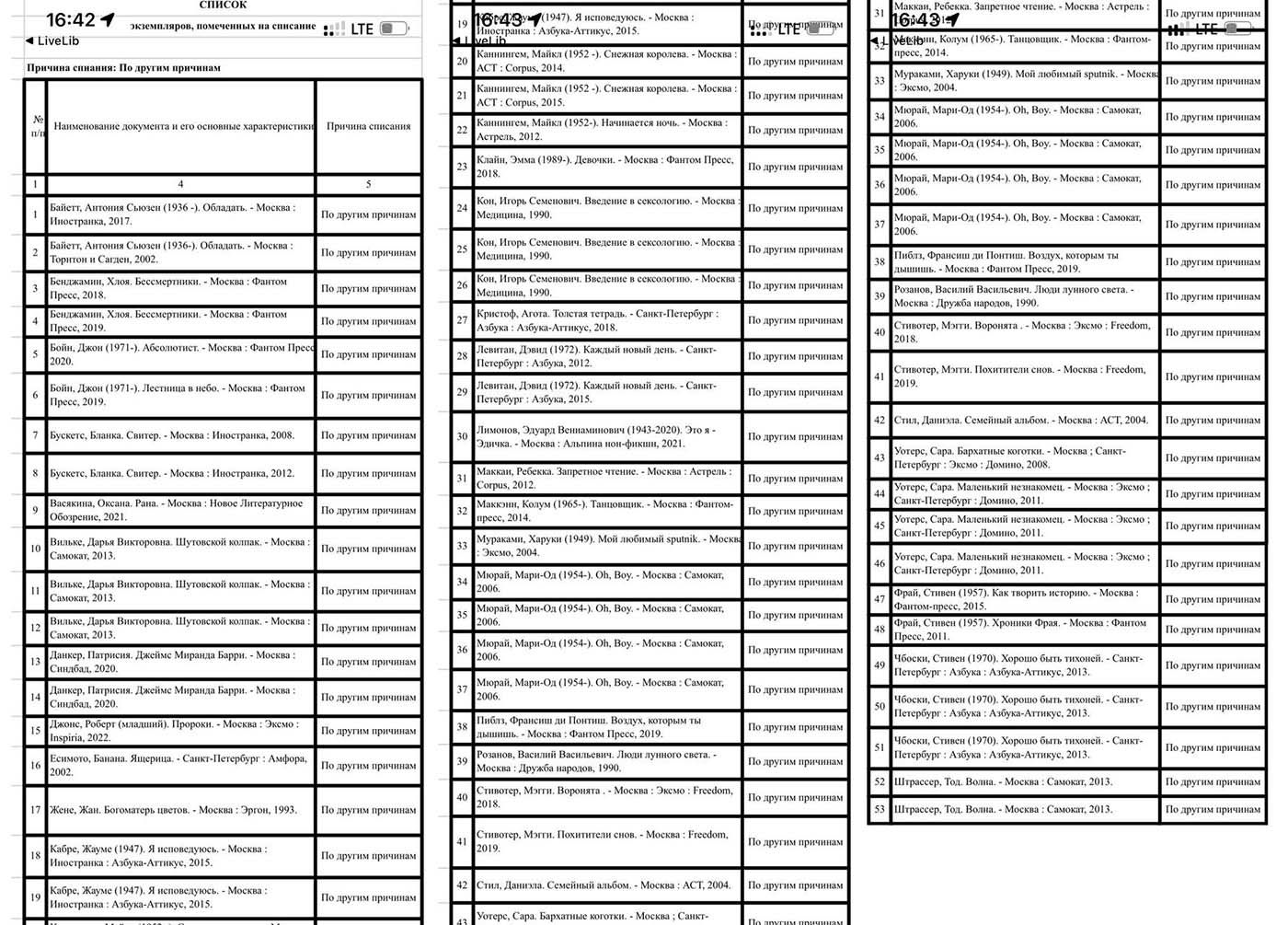
After the adoption of a new law on the “propaganda of non-traditional sexual relationships,” librarians receive lists containing dozens of books that were to be confiscated as illegal. , Sergei Lebedenko, a journalist for Novaya Gazeta, was the first to tell the public about this; the information about the ban was later confirmed by the head of the Akhmatova SMART Library in Krylatskoye Vladimir Kosarevsky. He did not specify who sent him the list ×
. Among others there was Kon’s work, as well as books by many other famous authors, including Haruki Murakami.
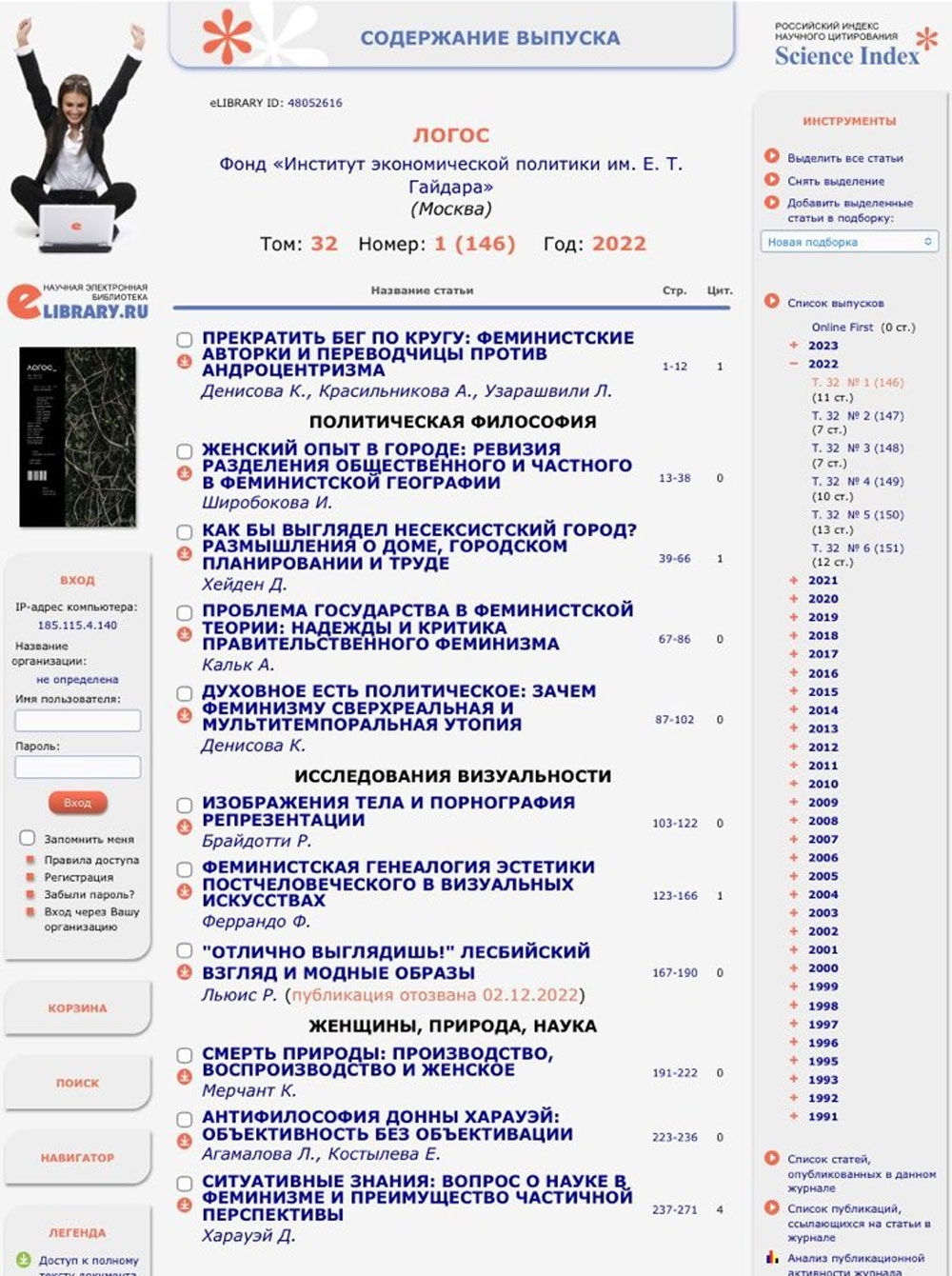
The fear of the new law is so great that the philosophical-literary journal Logos — this is one of the scientific journals of the Higher Attestation Commission, published by the Gaidar Institute ×
first prepared and then removed from its website an entire issue devoted to feminist studies, which could also allegedly fall under the new law , says Anna Kuleshova, who works at the Council for the Ethics of Scientific Publications. The journal did not respond to The Project’s inquiry ×
. The Sociology of Power journal did much the same, taking the last issue off its website in order to have every article checked by lawyers for any “blasphemy” , Kuleshova says ×
. This issue has now been returned to the site , the journal did not respond to The Project’s inquiry ×
. “In total, about two dozen articles have been withdrawn from publication in various journals. I can’t even imagine how many articles about LGBT issues will never be written,” Kuleshova laments.
The Higher School of Economics is also getting rid of “banned” books and publications. As The Project discovered, the university’s Directorate of Legal Affairs compiled and sent out a memo to various departments on how to deal with “forbidden” information. Its essence was that it was best to remove practically any content related to LGBT issues. They even give a specific example — the book Summer in a Pioneer Tie, a bestseller from the first half of 2022 , it was the second best-selling book of that time according to the All-Russian Book Rating. It was published in over 250,000 copies ×
needs to be withdrawn.
What should we do if a book mentions same-sex relationships, but we’re not sure if it’s propaganda?
There are books with a clear propaganda focus that are widely discussed by the public (e.g., Summer in a Pioneer Tie). Such books should be withdrawn.
In case of doubt, the book can be left in the 18+ section.
Recommendations for the university library
Moreover, the authors of the memo are so reassured that they even include BDSM and swingers among the forbidden non-traditional relationships, noting, however, that “as a rule, such practices are not propagated”.
Are non-traditional sexual relationships restricted to LGBT?
Broadly speaking, the term can also encompass other taboo practices and relationships (e.g., BDSM, swingers, etc.). However, as a rule, such practices are not propagated.
An excerpt from the sent “memo”
The authors of the “memo” had no remorse for “foreign agents” either. They pointed out that “any information materials by foreign agents, if there were any on the portal, must be removed” . The law on foreign agents states that only adults are allowed to access the materials authored by them. Obviously, it is impossible to restrict access to the university’s website for teenagers, so “eliminating” such materials is much simpler ×
. The Project could not establish whether the university implemented all the orders — the press service of the Higher School of Economics did not respond to the inquiry.
Just as in any time of persecution, researchers from all social-humanitarian spheres are suffering in 2023 Russia. Last year, a student at one of the regional divisions of the Higher School of Economics was preparing a diploma on Hannah Arendt, the founder of the theory of totalitarianism. The topic was deemed inappropriate and he was told to change it, with a recommendation that he “write about the pernicious influence of social networks,” says one of the professors, speaking on condition of anonymity.
The most problematic topics, however, were Ukraine and the Great Patriotic War. Dozens of scholars have been banned from doing research that is in some way related to Ukraine, says anthropologist Alexandra Arkhipova
, citing stories from people who have turned to her for help — Arkhipova runs the “Persecuted Scholars” Telegram channel, where she posts about foreign vacancies and scholarships at foreign universities ×
. Pakhalyuk says that the central archive of the Defense Ministry does not provide documents about the failures of the battles near Moscow or the interaction of the Soviet army with the people of Europe. Another St. Petersburg historian was unable to obtain documents about the partisan movement from the archives
, as he told The Project on condition of anonymity. At the time of publication, The Project was unable to obtain any comment from the archives ×
.
What is allowed now?
New topics have already begun to appear in the curricula — for example, the following has been added to the general history curriculum for non-specialized majors:
— Refusal of the USA, NATO and the EU to discuss threats to Russia’s national security,
— Armed provocations in the Donbass,
— Armed provocations and preparations by the Ukrainian regime to seize the Donbass republics by force,
— Official recognition of the LPR and the DPR by Russia,
— Launch of the special military operation in Ukraine,
— Sanctions pressure from Western countries on Russia and attempts to isolate it from the rest of the world,
— Objectives of the special military operation,
— Accession of Donetsk People’s Republic, Luhansk People’s Republic, Zaporizhzhia Oblast, and Kherson Oblast to Russia
The concept was adopted in February 2023.
In fact, scientists with “wrong” views are now not allowed to publish anything at all, even if they write on permitted topics. The poetry of Joseph Brodsky has not yet been put on the list of banned topics, but the once liberal publisher Novyi Mir refused to publish an article about the poet by Oleg Lekmanov, a former professor at the Higher School of Economics , Lekmanov opposed the war and left Russia after the invasion ×
. Before the war, his articles appeared in the magazine many times , the magazine did not respond to The Project’s inquiry ×
.
Censorship of topics that are sensitive to the authorities is not the only problem of scientists remaining in Russia. If they want to receive money from the government, they need to fit into the general line.
Only Patriots Get the Money
“Here (on the site of the Memorial to the Victims of Political Repressions near Yekaterinburg) more than 21,000 residents of the region were shot in 1937-1938. While more than 21,000 names are inscribed on the pylons, nothing is known about the vast majority of these people”. So begins the application from the Volunteer Society of the Sverdlovsk Region, which tried to obtain funds from the Presidential Grants Fund to collect stories of Yekaterinburg residents who suffered from Stalinist repressions. The government did not respond to this request, however. Instead, the two key foundations to which researchers apply for funds . After the outbreak of war, many countries in Europe and the USA officially severed scientific ties with Russia. This also affected the ability of Russian scientists to receive foreign grants — for example, the EU suspended Russia’s participation in its Horizon Europe science grant programs ×
— the Russian Science Foundation and the same Presidential Grant Fund — gave millions of rubles to those who promised to teach children patriotism and train fighters to replenish the ranks of the armed forces.
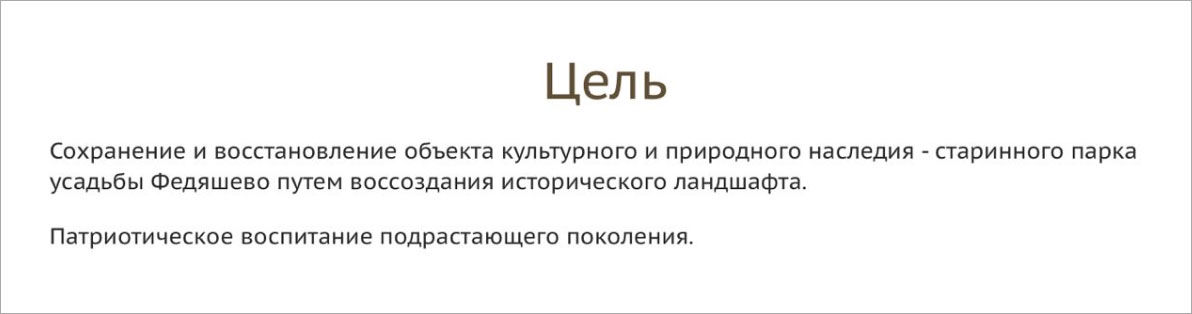
“If the team does not work in the field of ‘patriotism, ‘ there is essentially no chance of receiving funding from state funds,” says a university professor who works with grant applications. Other people interviewed by The Project agree with her: grant applicants are advised to mention “patriotism” or “patriotic education,” even if their application has nothing to do with this topic. This leads to ridiculous stories. Russian Manor, an organization dedicated to the preservation of cultural heritage sites, wanted to restore the manor park of Maria Gartung, Alexander Pushkin’s eldest daughter, in the village of Fedyashevo in the Tula Oblast. However, the great poet’s daughter was mentioned only once in the grant application. Instead, they placed an emphasis on the “pressing issue”: the fate of the estate during World War II. To be safe, they also listed “patriotic education” among project goals. And they were right: 3.5 million rubles will now be allocated for the restoration.
The Project was able to verify that using patriotic rhetoric substantially increases the chances of receiving money by analyzing the list of winners of grants from the Presidential Grants Fund , those who filed their applications between January 1, 2022 and February 15, 2023 ×
in the categories in which scientific and educational organizations usually submit their applications. For example, last year, 13% , 64 of 504 ×
of the winners in the “Support for Projects in Science, Education, and Outreach” category included “patriotism” or “patriotic education” in their applications. In another field, “Preservation of Historical Memory” , Synergy University and the European University of St. Petersburg submitted their applications for this field among others, but their projects were not supported ×
, 71% of the winners 358 out of 503 ×
emphasized “patriotism”. In total, the state allocated 781 million rubles for “patriotic” projects in these two categories.
Some organizations tried particularly hard: The Project found a grant “Interregional youth military-patriotic project ‘Siberian regiments’”, the applicant was the “Patriot” Association of Patriotic Organizations of Novosibirsk Oblast ×
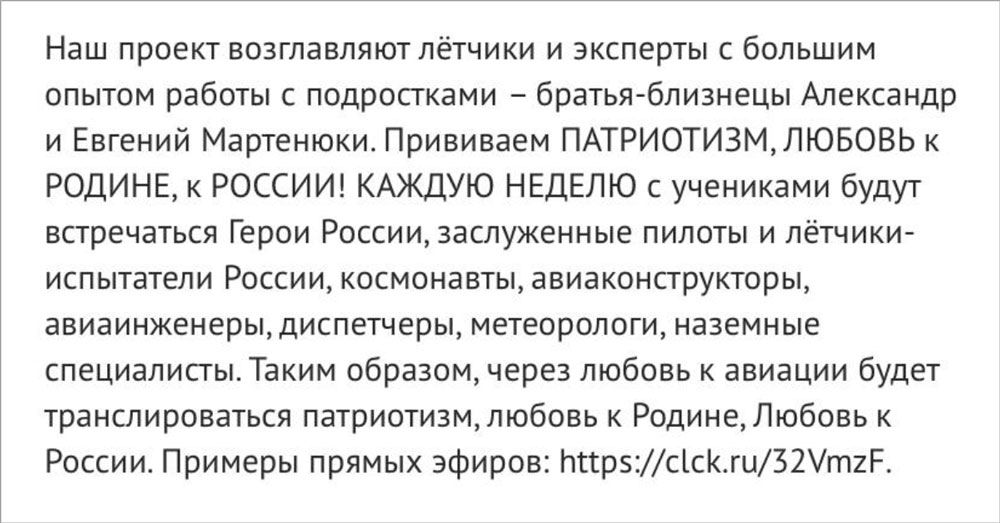
in which the word “patriotism” is mentioned 52 times. The “Federation of Gliding Sport of Russia” which became one of the winners in the category “Support of projects in the field of science, education, education” , their project was an offline and online course of aviation training for children and teenagers and received 2.8 million rubles ×
, drew attention to “love for the Motherland” in their application in the following manner:
Those who asked for money for military training and education also received funding. Such topics as firearms and tactical training of schoolchildren and students, as well as “formation of an attractive image of military service” were mentioned one way or another in the applications of 34 winners (they received a total of 44 million rubles) — we are talking about the aforementioned categories “Support for projects in the field of science, education, and enlightenment” and “Preservation of historical memory”. There were about 1000 winners in total in these categories during this period ×
.
What did the Presidential Fund award grants for?
Examples of how winners of grant applications related to military-patriotic education explain the social significance of their projects
— “The name of our project (‘Patriotism Mobilization’) was not chosen accidentally, as it is related to one of the reasons for the problem of evading partial mobilization in Russia caused by the special military operation — the low levels of patriotism.
— “The introduction of systematic military-patriotic activities into the agenda of activities of pre-conscription age teenagers will contribute to a stable replenishment of the Russian Armed Forces with healthy, physically developed and motivated soldiers trained in modern technology.”
— “Today, when the aggressive policy of the collective West against Russia, powered by the neo-Nazi ideology of the Kyiv regime, has escalated into an armed conflict, the lack of understanding by a significant portion of young people of the causes of the situation has exposed the extreme severity of the serious shortcomings in patriotic education in post-Soviet Russia. Numerous videos on the Web about the frenzied departure from the country of men subject to reserve conscription, following the President’s announcement of partial military mobilization, are a clear and convincing evidence of this.”
— “We believe there is currently a societal demand for young people who are physically strong, who love their homeland, and who are ready to serve their country in the armed forces of the Russian Federation.”
None of the applicants explain how pre-conscription training, teaching young people how to use rifles, and raising the prestige of military service are related to science and “preservation of historical memory”.
Another grantmaker, the Russian Science Foundation, started awarding money for projects that outright support Russia’s attack on Ukraine. The four winners of the 2023 competition in the category “Humanities and Social Sciences” received at least 16 million rubles , the grants of the Russian Science Foundation can range from 4 to 6 million rubles ×
for projects in which the applicants, for example, prepare a “transit of power in post-Ukraine” or promise a “new legal system” for the DPR and the LPR.
Researchers started receiving money from the Russian Science Foundation for topics related to the war in Ukraine
Peculiarities of the perception of state transit in the regions of post-Ukraine. “The expected final results of the study are: an effective method of assessing social tension and protest potential associated with the situation of statehood transit in the post-Ukrainian territories; establishment of patterns occurring in the political-geographical spaces of state transit, which in this case is understood as the change of statehood of the territory”
Factors of Crimea and Sevastopol in Russian-Turkish relations: the influence of external and internal actors on the conflictogenicity of the Black Sea region against the background of the special military operation in Ukraine. “After the reunification of Crimea with Russia, the West and its allies, including or excluding Turkey depending on national interests, implement a logic that would lead to a historical analogy of the Crimean War of 1853-56… The closure of the Black Sea straits by Ankara during the special military operation shows the subjectivity and role of the Turkish state in the regional conflict… As before, the problem of the Black Sea straits is becoming more and more relevant for both the West and Russia.”
The legal systems of the recognized Donbass republics: problems of transition and ways to achieve self-sufficiency. “The legal system of the DPR and LPR generally meets the challenges of the present, which are typical for the transitional period in the development of the legal system. However, as the political situation stabilizes, significant rulemaking work will be required for the long term”
Competing memories of Prince Sviatoslav and the dynamics of nationalism in Russia and Ukraine. “In the current situation it is obvious that several concepts of national identity, models of citizenship, and approaches to the past will be implemented in Ukraine and among the Ukrainian diaspora in the Russian Federation and other countries. These interpretative frameworks will be formed around their own pantheons of national heroes, one prominent place among which is traditionally occupied by Prince Sviatoslav.”
* * *
In the spring, Vladimir Putin’s alma mater, St. Petersburg State University, hosted the “Slovo-2022” international contest of scholarly and journalistic works. Students Anastasia Polosina and Varvara Rudich became winners in the “Research Paper” category with their report “Z and V: From Semantic Ambiguity to Variation of Meanings,” and they decided to enhance their presentation by wearing traditional Russian clothes and headdresses , as one of the students said ×
. In the category “Publicistic Essay” the winners were the reports “Russian World. These words have so much in them…” and “Those who left the country in the period of the special military operation”. Full loyalty is now required not only from current scholars, but also from future ones.
Editing by Mikhail Rubin
Fact checking by Katya Arenina