
Spartacus revolts in the Russian army, AFU battles in the Zaporizhzhia direction. What happened on the front line on July 13?
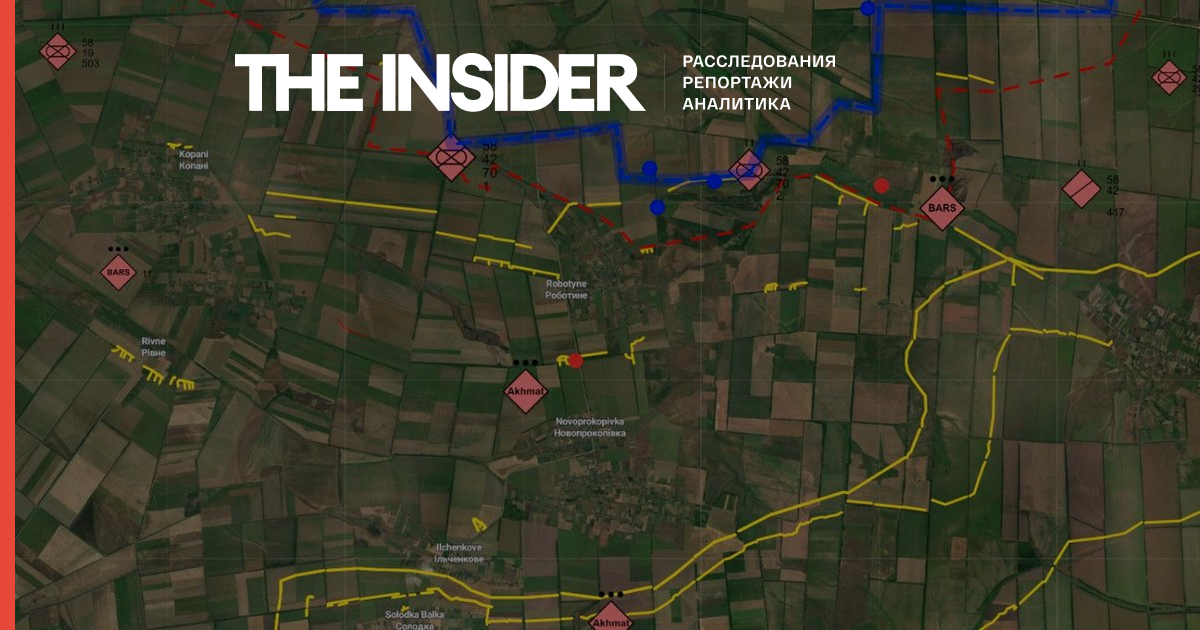
Sladkov was echoed by another VGTRK “military correspondent,” Yevgeny Poddubny, who is sure that “attempts to organize public discussion” of personnel decisions in the Russian Armed Forces are “a harmful practice.”
Fighterbomber, a Telegram channel reportedly linked to the Russian Aerospace Forces, was outraged by the very fact that the appeal was recorded, but notes that the problems voiced “exist in reality in 90% of cases.” It is worth recalling that pro-war channels have previously reported problems with rotation (1, 2, 3) and with the organization of counter-battery fire (1, 2).
One of the separatist field commanders in Donbas in 2014, and now a well-known pro-war commentator, convicted war criminal Igor Girkin (aka Strelkov, Runov) described the current situation as “almost a mutiny”:
“The retired commander's appeal to the public – this (in the regular army) is nonsense, a scandal, a most dangerous precedent. Almost a mutiny. Especially since this time it was created not by some criminal, who by the will of fortune made his way ‘from rags to riches’ [Yevgeny Prigozhin – The Insider], but by an actual career general. (And a decent one at that.)
What’s next, as many commentators rightly point out – are only mutinies and the uncontrolled disintegration of the army. And that, in fact, it's ‘just a stone's throw away.’ Only a new major military defeat separates us from a new ‘march on Moscow’ by the regular army.”
However, Girkin also shares the opinion of alleged “front-line officers” that General Popov was “provoked and framed,” by individuals that wanted to “take the report up the chain.”
Girkin's associate in the radical “Club of Angry Patriots,” retired Air Force Colonel Viktor Alksnis, regarded General Popov's appeal as a “political statement” and believes it is unacceptable for a high-ranking officer to voice problems without submitting his resignation in protest.
“War correspondent” Roman Saponkov wrote that “Popov's dismissal is a monstrous attack against morale in the army” and “simply an act of sabotage,” directly linking it to the Wagner rebellion:
“The Wagner march was against [General Staff head] Gerasimov and against [Defense Minister] Shoigu. Personally against them [both]. And it united a huge part of the army. Entire units refused to shoot or use force.
But then the army was outweighed by the opinion that the Wagners were a private army, mercenaries, and the army should not go along with the mercenaries.
After Wagner’s failure, sudden purges began.
And then faceless people with fishy eyes took down a combat general who demanded rotation for the fighters, normal counter-battery [warfare] and support. A general who did not publicize these problems, but reported to his superiors in a private meeting.”
Komsomolskaya Pravda “war correspondent” Alexander Kotz suggested [following 1.5 years of the “special military operation” – The Insider] the authorities consider “a system of encouragement for reports that correspond to reality. And about punishment for the opposite.”
Propagandist Anastasiya Kashevarova also published an outcry on her Telegram channel:
«How do you convey information so that it will be heard? Publicity doesn't work. Rebellion doesn't work. Truthful reporting doesn't work.
The system tries to preserve itself no matter what. It always has. It hardened itself against all attacks. And it's not so much the Ministry of Defense and the General Staff, it's the civilian leadership too. It's about the general approach to the [special military operation].
The problem is in the entire state apparatus.
[...]
We're coming apart at the seams, men. Self-destruction is in full swing. Nobody's stopping it. So the system must be rebuilt, the military must be helped, bureaucratic officials must be held accountable.”
The well-known pro-war channel Military Informer (“Voenny Osvedomitel”) accused Russia’s military leadership of being stuck in a “la-la-land of repeatedly twisted reports and neat PowerPoint presentations,” which it cited as one of the reasons for Prigozhin's mutiny.
The authors of the channel highlighted the gravity of the issues raised by Popov. They emphasized that counter-battery warfare is hindered by a convoluted decision-making process and delays in information transmission from intelligence to the fire units. Consequently, strikes are often carried out in areas where the enemy is no longer present. Military Informer also criticized Roscosmos' satellite constellation, describing it as “miserable” and far from the capabilities of Western satellite intelligence systems.
In response to the series of accusations, Russian authorities were compelled to react – so far, however, only Andrei Kartapolov, Chairman of the State Duma Defense Committee, has spoken out publicly. Kartapolov promptly reassured that the issues raised by Ivan Popov were already being addressed. While the statement suggests some acknowledgment of the concerns, it is important to note that a high-ranking Russian officer validated at least a portion of the assessments made by Western experts (1, 2) concerning the weaknesses of the Russian army.
In relation to General Popov's removal from command of the 58th Army, “war correspondent” and pro-war activist Alexei Zhivov shared a story about the conflict surrounding the Storm Shadow missile. As shared by former Roscosmos chief Dmitry Rogozin, the Russians were able to bring the missile wreckage back to Russia in order to study and develop countermeasures against this type of weapon. Zhivov claimed that those responsible for retrieving the wreckage “under enemy fire” will face punishment for delivering it to a specialized design bureau, as Defense Minister Sergei Shoigu allegedly intended to display the Storm Shadow missile in the military-themed Patriot Park near Moscow.