
Оригинал материала
Live updates: Alexey Navalny is dead
Russia’s most famous opposition figure has died in prison
What happened: Russian politician Alexey Navalny has died, according to the local administration of Russia’s Federal Penitentiary Service (FSIN).
What we know so far:
- According to the FSIN’s statement, Navalny “felt unwell after a walk and almost immediately lost consciousness.” “All necessary resuscitation measures were carried out, which did not yield positive results. Emergency medical personnel confirmed the death of the convict. The cause of death is being established.”
- Navalny’s team has not yet confirmed the news but announced on YouTube that his death appears to be likely.
- Vladimir Putin is aware of Navalny’s death, but the president did not comment on the matter during a visit on Friday to Chelyabinsk. His spokesman has criticized Western responses as premature and “inappropriate.”
Alleged cause of death: Sources told Russian state propaganda network RT that Navalny died from a detached blood clot.
16 февраля 2024 г. 12:05:12
Russian opposition politician Alexey Navalny has died
Russian opposition politician Alexey Navalny has died. This was reported by the local administration of Russia’s Federal Penitentiary Service (FSIN).
According to the FSIN’s statement, Navalny “felt unwell after a walk and almost immediately lost consciousness.” “All necessary resuscitation measures were carried out, which did not yield positive results. Emergency medical personnel confirmed the death of the convict. The cause of death is being established.”
Sources told Russian state propaganda network RT that Navalny died from a detached blood clot.
Navalny was being held in Correctional Facility No. 3 in Russia’s Yamalo-Nenets Autonomous Okrug.
The politician was 47 years old.
16 февраля 2024 г. 12:05:56
Kremlin spokesman Dmitry Peskov comments on Navalny’s death
Kremlin spokesman Dmitry Peskov, commenting on reports that Russian opposition politician Alexey Navalny has died, said that Russia’s Federal Penitentiary Service is conducting all necessary investigations.
Peskov said that Russian President Vladimir Putin had been informed of Navalny’s death.
According to Peskov, he has no further information on the cause of death, adding that “doctors should determine” it.
16 февраля 2024 г. 12:12:13
Telegram channel Baza reports that Navalny became ill around 13:00 Moscow time. An ambulance was called. Medical workers declared him dead at 2:17 p.m. Moscow time.
16 февраля 2024 г. 12:17:14
Latvian President Edgars Rinkēvičs was the first foreign leader to comment on Navalny’s death.
16 февраля 2024 г. 12:17:54
Navalny’s team has not yet confirmed the news, saying that the politician’s lawyer is en route to the prison colony.
“Alexey’s lawyer is now flying to Kharp. As soon as we have some information, we will share it,” reads a Telegram post on Team Navalny’s channel.
16 февраля 2024 г. 12:25:53
Human rights defender Eva Merkacheva told the news outlet Msk1 that Navalny’s death may have been a result of the fact that he was put in solitary punitive isolation (ShIZO) cells 27 times over the course of his incarceration.
I believe this could undoubtedly be a result of his endless trips to the ShIZO. He was there once, then twice, then three times — the count of his stints in the ShIZO was already in the dozens. Detention conditions in ShIZO cells are very harsh. A person there usually freezes, usually starves, essentially. That’s why they’ve put in place strict requirements that a person cannot be sent there for more than a certain number of days. But there were no limitations on the number of times he could be sent to the ShIZO.
16 февраля 2024 г. 12:29:05
Ukrainian President Volodymyr Zelensky, commenting on Navalny’s death, said: “Clearly, he was killed by Putin.”
16 февраля 2024 г. 12:39:55
Alexey Navalny’s lawyer, Leonid Solovyov, said that he last visited Navalny on February 14, and everything was fine with the politician.
“By the request of Alexey Navalny’s family, I’m not commenting on anything at all. We’re currently investigating,” he added.
16 февраля 2024 г. 12:46:02
European Council President Charles Michel wrote that the responsibility for Navalny’s death lies with the Russian authorities:
[Alexey Navalny] fought for the values of freedom and democracy. For his ideals, he made the ultimate sacrifice.
The E.U. holds the Russian regime for sole responsible for this tragic death.
I extend my deepest condolences to his family. And to those who fight for democracy around the world in the darkest conditions.
16 февраля 2024 г. 12:52:40
German Chancellor Olaf Scholz has commented on Navalny’s death:
There is no final confirmation yet, but we are assuming that it is highly likely that Navalny has died in a Russian prison. This is very depressing for us. I met him in Berlin when he was being treated in Germany for the effects of his poisoning, I talked to him about the courage his decision to return to Russia required. Now he has paid for it with his life. We know very well what kind of regime this is. Anyone who criticizes, anyone who advocates for democracy must fear for their life and their safety. So we are shocked. Our thoughts are with his wife, his children, his friends, his followers. It’s just awful. And it’s a sign of how Russia has changed. Unfortunately, this process started a long time ago, it has long ago moved away from democracy, it hasn’t been a democracy for a long time.
16 февраля 2024 г. 12:57:52
Mikhail Khodorkovsky has urged every Russian to write in Alexey Navalny’s name on their ballots in the presidential election on March 17
“If you didn’t know or doubted how to act on that day, here is your answer,” Khodorkovsky said.
16 февраля 2024 г. 12:59:35
Russian political scientist Ekaterina Schulmann on Navalny’s death:
“Russian society will be horrified. And evidently, that’s the intention.”
16 февраля 2024 г. 13:00:02
In response to the news, opposition figure Garry Kasparov wrote:
Putin tried and failed to murder Navalny quickly and secretly with poison, and now he has murdered him slowly and publicly in prison. He was killed for exposing Putin and his mafia as the crooks and thieves they are. My thoughts are with the brave man's wife and children.
Putin is Navalny's killer, make no mistake, but there is blame enough to share. First, the Russians who failed to match Alexei's courage to end Putin's dictatorship and war. Some of us tried, and he marched with us in numbers that seem a fantasy now. But it wasn't enough.
16 февраля 2024 г. 13:00:03
Russia’s ruling party, United Russia, has asked State Duma deputies not to comment on Navalny’s death
A source told Agenstvo that the party’s apparatus asked politicians to “strictly adhere to the interpretations of the Federal Penitentiary Service, […] or better yet, refrain from comments altogether.”
16 февраля 2024 г. 13:04:33
Navalny associate Leonid Volkov: “Don’t rush to bury Alexey”
We have no reason to believe state propaganda. They have lied, are lying, and will continue to lie. If it’s true, then it’s not “Navalny is dead,” but “Putin killed Navalny,” and only that way. But I don’t believe them at all. Don’t rush to bury Alexey.
16 февраля 2024 г. 13:17:44
On the medical response to Navalny’s death
It took the ambulance crew seven minutes to reach the prison where Alexey Navalny was located and another two minutes to get to the patient, Labytnangi City Hospital representatives told Interfax.
“The medics who arrived at the scene continued resuscitation efforts already begun by the prison’s medical staff. They continued for over half an hour. However, the patient passed away,” said the hospital.
The Telegram channel Mestami notes that the distance between Labytnangi and the village of Kharp, where the prison is located, is approximately 34 kilometers (21 miles).
16 февраля 2024 г. 13:30:04
European Commission President Ursula von der Leyen commented on the death of Navalny:
Deeply disturbed and saddened by news of the death of [Alexey] Navalny. Putin fears nothing more than dissent from his own people. A grim reminder of what Putin and his regime are all about. Let’s unite in our fight to safeguard the freedom and safety of those who dare to stand up against autocracy.
16 февраля 2024 г. 13:36:42
Sergey Mironov, the chairman of the party A Just Russia — For Truth on investigating Navalny’s death
Sergey Mironov, the chairman of the party A Just Russia — For Truth, stated that the circumstances surrounding Navalny’s death need to be carefully investigated in order to counteract Western “disinformation”:
The death of Alexey Navalny, who was previously convicted of extremism, is advantageous to many enemies of Russia, including those who attempted to poison him earlier. Therefore, it is necessary to thoroughly investigate the circumstances of his death and take measures to counteract the inevitable information attack from the West.
Certainly, health problems could have been the cause. However, in any case, the sudden death of the notorious ‘opposition figure,’ especially a month before the presidential elections, is primarily advantageous to Russia’s enemies. They will undoubtedly attempt to exploit it to the maximum to put pressure on us from abroad and to destabilize the situation within the country.
16 февраля 2024 г. 13:46:54
Alexey Venediktov, the former editor-in-chief of the radio station Ekho Moskvy, commented on the news of Alexey Navalny’s death:
This is a monstrous catastrophe for Alexey Navalny’s family, it's a monstrous loss for Alexey’s associates, for those who knew him and for those who believed in him. In my opinion, it's also a monstrous loss for all of Russia because Alexey represented a competitive, alternative path for our country. We will all miss Alexey Navalny, whether we supported him or not.
16 февраля 2024 г. 14:02:34
In front of the Monument to the Victims of Political Repression in Vilnius, Lithuania
16 февраля 2024 г. 14:04:23
People in Russia need us more than ever now. Help us to continue our work.
16 февраля 2024 г. 14:06:22
A former Russian Federal Penitentiary Service analyst and former employee of the Public Monitoring Commission on the potential cause of Navalny’s death
Anna Karetnikova, a former Russian Federal Penitentiary Service (FSIN) analyst and former employee of the Public Monitoring Commission (ONK), an organization tasked with overseeing the observance of prisoners’ rights, writes that thromboembolism (which Russian propaganda outlet RT has named as the cause of Navalny’s death) is a “universally complex and difficult-to-prove diagnosis.”
‘Pulmonary thromboembolism’ is the name of a disease which, at least by prison doctors, is used in somewhat of a… figurative, slightly expanded sense. Something like this: ‘Why did the patient die?’ ’Forget it, they’ll just write thromboembolism anyway, who’s going to investigate.’
According to her, medical staff within the department said that thromboembolism is “something that can explain everything.” “Such a universal diagnosis, difficult to prove, and in that sense, convenient. Was the patient in pain from kidney or liver problems? And who said they didn’t provide medical help? Come on, they did. Thrombus [means] sudden death. Was he not in pain from anything? Was he healthy yesterday? Well, we’ll wait, of course, but you know there’s a high probability it’s thromboembolism again… And after saying this, the doctor might look away, or throw up his hands, or give a heavy sigh,” Karetnikova wrote.
16 февраля 2024 г. 14:22:10
Sources in Russia’s Federal Penitentiary Service told Novaya Gazeta Europe that the department is currently discussing the issue of an autopsy
One source said that the morgue at the prison where Navalny was being held is “equipped with all the necessary, but outdated equipment.” He assumes that the authorities will wish to establish the actual cause of death because “accusations of their involvement in Navalny’s death are not beneficial to the Kremlin right now.” For this reason, he thinks the autopsy will be conducted in Moscow.
Another source believes that doing the autopsy locally could make it seem like “the Federal Penitentiary Service (FSIN) has something to hide.” He said if staff members were not involved, then “it’s more advantageous for them to carry out all possible examinations,” in which case the body would likely be taken to Moscow. However, if the FSIN needs to “cover their tracks” then, in his opinion, the body may be taken to Salekhard, where there is a crematorium, and destroyed immediately after the autopsy.
16 февраля 2024 г. 14:28:55
16 февраля 2024 г. 14:34:49
State media employees have received instructions to limit themselves to “event-based news” about Alexey Navalny’s death, reports the Telegram channel Ostorozhno, Novosti.
New publications should be tied to specific events, and journalists have been asked not to write any more about statements from public figures regarding the politician’s death.
16 февраля 2024 г. 14:41:03
Navalny’s widow speaks
Speaking today at the Munich Security Conference, Alexey Navalny’s wife, Yulia, delivered the following brief remarks:
We’ve probably all seen today’s horrible news. I asked myself if I should come here or get on a plane to go to my children. And then I asked what Alexey would do in my place. And I’m certain that he would be here. He’d be on this stage. I don’t know whether to believe this terrible news we’re getting only from Russia’s state media sources. Because for many years, as you all know, it’s been impossible to trust Putin and Putin’s state. They lie constantly.
But, if the news is true, I want Putin and everyone around him — all Putin’s friends, his government — to know that they will be held responsible for what they’ve done to our country, to my family, and to my husband. And that day is coming very soon. And I’d like to call on all the international community, on everyone present in this room, and on people around the world to rally together to defeat this evil. To defeat this horrific regime in Russia today. Both this regime and Vladimir Putin personally should be held responsible for all the atrocities they’ve committed against our country over the years.
16 февраля 2024 г. 14:45:38
Former Navalny headquarters coordinators have commented to 7x7 on reports of the politician’s death:
Elena Lekiashvili, former coordinator of Navalny’s Yaroslavl headquarters:
Forgive me if I cry, I'm at a loss. [...] Navalny turned political life in [Russian] regions upside down. In 2016, it was impossible to imagine this — branches of an unregistered political party [Navalny's headquarters] in every region. He came and said that we could do it. He gave us the feeling that anything was possible.
Yevgeny Karpov, former coordinator of Navalny’s Voronezh headquarters:
I’m waiting for a statement from Navalny’s team. I still can’t believe it. I’m still reflecting. […] If Putin remains, I don’t know if I’ll have the strength to continue working. But Navalny’s team will continue.
16 февраля 2024 г. 14:58:37
Actions in memory of Navalny in Russia
Moscow
Tomsk
Belgorod
Perm
16 февраля 2024 г. 14:59:09
Russian police officers have arrived at memorials set up in Navalny’s memory, reports 7x7.
- In Ulyanovsk, people are taking flowers to a memorial to victims of political repression. People in plain clothes immediately remove the flowers and take photos of those who brought them.
- In Novosibirsk, the police cordoned off the local memorial to the victims of political repression. Police officers say they received a bomb threat.
- In Tomsk, police officers arrived at the Stone of Sorrow. So far, no one has been detained.
- In Nizhny Novgorod, people brought flowers to a memorial in memory of journalist Irina Slavina, which is located near the Internal Affairs Ministry building.
- People also brought flowers to memorials in Belgorod, Barnaul, and Kazan.
- In the Komi Republic, people brought flowers to a chapel in memory of victims of political repression.
- Leaflets are being spread in Tver.
16 февраля 2024 г. 15:04:51
On Lubyanka Street
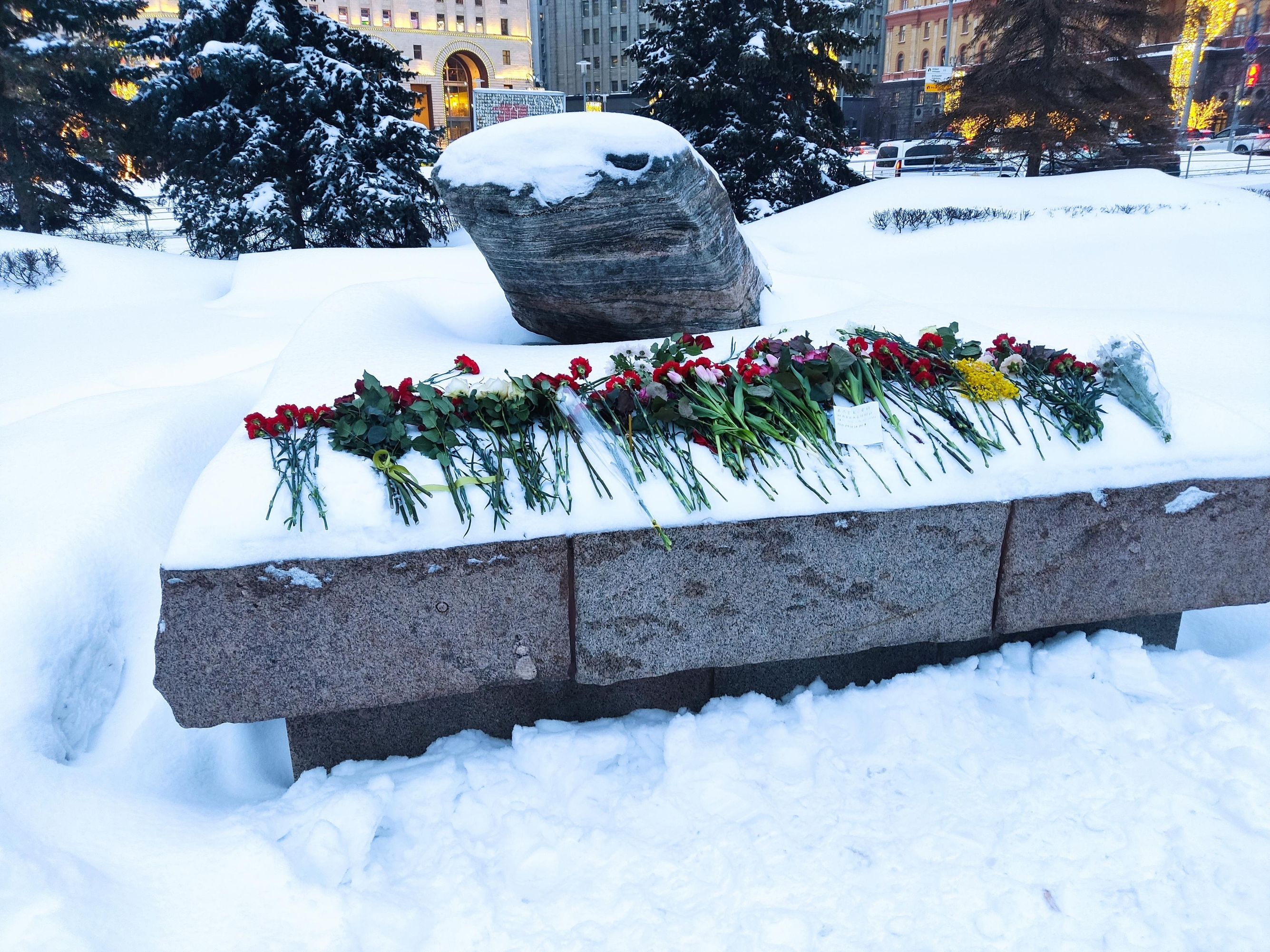
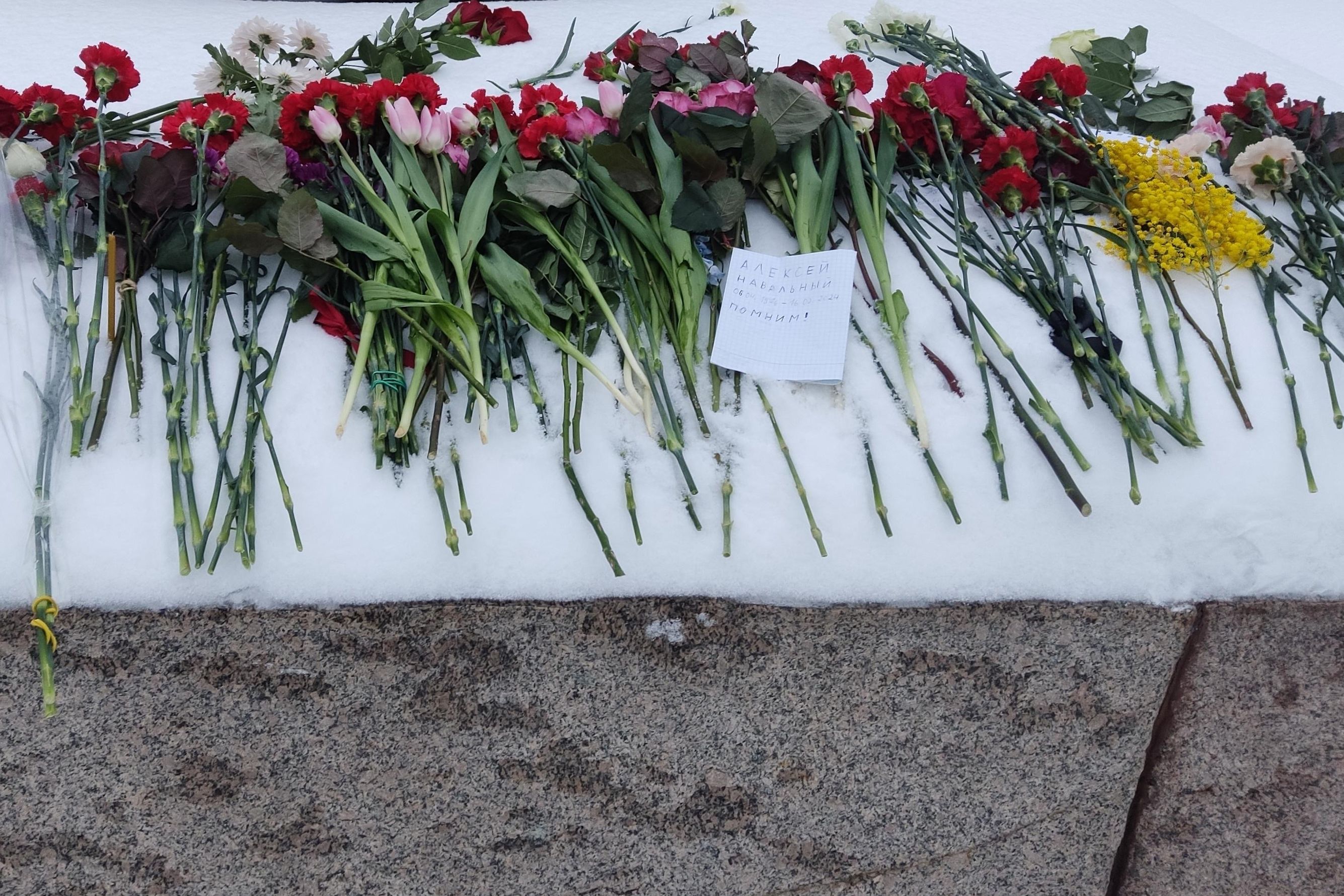
In Moscow, residents are placing flowers to the Solovetsky Stone on Lubyanka Street, a monument to victims of political repression that was put up in 1990.
16 февраля 2024 г. 15:06:19
Maia Sandu, president of Moldova, wrote:
The death of Alexei Navalny in a Russian prison is a stark reminder of the regime’s appalling oppression of dissent. My heartfelt thoughts go out to his family, all democratically-minded Russians, and those bravely fighting for freedom and democracy within Russia and abroad.
16 февраля 2024 г. 15:10:01
Russia’s Foreign Affairs Ministry accused the United States of “extreme cynicism” after the State Department blamed Russia for Navalny’s death:
The death of a person is always a tragedy. It’s interesting why for the White House and the State Department, the death of a Russian citizen in a Russian correctional facility turned out to be much more important and seem more horrible than the death of an American citizen, journalist Gonzalo Lira, tortured in a Ukrainian prison. Instead of sweeping accusations, it would be appropriate to show restraint and wait for the official results of the forensic examination.
16 февраля 2024 г. 15:10:17
Speaker of Russia’s State Duma blames the West
Reasoning that the West has the most to gain, State Duma Speaker Vyacheslav Volodin declared on his Telegram channel, “Washington and Brussels are to blame for Navalny’s death.” Volodin argued that the Kremlin’s various critics in “unfriendly countries” (politicians and leaders who impose sanctions on Russia, root for its defeat in Ukraine, and so on) are “culprits” in Navalny’s death because they oppose the Putin administration’s various initiatives. Volodin did not elaborate on the logic of his accusation.
16 февраля 2024 г. 15:25:19
A bot network is already boosting the Kremlin’s narrative on Navalny’s death
Journalists at Agenstsvo report that a bot network operating to boost the Kremlin’s media narratives on Vkontakte and 𝕏 has started publishing comments on posts about Alexey Navalny, arguing that the Russian authorities don’t benefit from his death and claiming that the blood clot that allegedly killed Navalny (as reported by Russia Today) could have been caused by his hunger strike in early 2021. Numerous accounts have repeated claims already voiced openly by State Duma Speaker Vyacheslav Volodin that the West is responsible for Navalny’s death because they stand to “gain” the most. Others complain that Navalny and even his death have received too much media attention.
16 февраля 2024 г. 15:46:54
Latest updates as of 6:50 p.m. Moscow time (3:50 p.m. London, 10:50 a.m. New York)
- Alexey Navalny’s wife, Yulia, commented on the news of her husband’s death. She said she doesn’t know whether or not to believe the reports: “But, if the news is true, I want Putin and everyone around him — all Putin’s friends, his government — to know that they will be held responsible for what they’ve done to our country, to my family, and to my husband. And that day is coming very soon.”
- Russian President Vladimir Putin spoke with factory workers and students in Chelyabinsk but said nothing about the news of Navalny’s death. At the time, according to Putin’s press secretary, he had been informed of the news.
- People in Russia and abroad have been paying their respects to Navalny. In Russia, people are bringing flowers to memorials for victims of political repression. In some cities, the police are already on duty at the memorials.
- Journalists noted that during the filming of a documentary about himself (Navalny, released in 2022), Navalny was asked what to do if he was killed. “Don’t give up,” he replied.
- Meduza’s sources said that the Kremlin’s political bloc views Navalny’s death as a “very negative event” for Putin's election campaign. At the same time, the Kremlin does not believe that it will seriously affect the election results. They think that within Russia, his death “will be discussed for a few days, and then [the topic] will fade away on its own.”
- Yabloko party leader Nikolai Rybakov tried to speak about Navalny’s death on live television but was quickly interrupted. Additionally, state media employees have reportedly received instructions to limit themselves to “event-based news” about Alexey Navalny’s death.
16 февраля 2024 г. 16:18:02
Director of Alexey Navalny’s Anti-Corruption Foundation says Navalny was likely killed
“Alexey Navalny has been murdered. And he was killed by Vladimir Putin,” said Ivan Zhdanov, the director of Alexey Navalny’s Anti-Corruption Foundation (FBK).
According to Zhdanov, “officially the hospital, officially the morgues, officially the prison colony, are now not answering calls, they are on the defensive because they understand that some kind of event has happened.”
The politician’s associates noted that they do not yet have official confirmation of his death.
Navalny’s press secretary, Kira Yarmysh, encouraged people to pay their respects and to join demonstrations in memory of the politician.
16 февраля 2024 г. 16:24:35
What we know about conditions in the Arctic prison where Alexey Navalny died
Navalny was serving a 19-year sentence at Correctional Facility No. 3 (IK-3) in Russia’s Yamalo-Nenets Autonomous Okrug (a prison also known as “Polar Wolf”) when he “felt unwell after a walk and almost immediately lost consciousness,” according to Russia’s Federal Penitentiary Service. The authorities say emergency medical workers carried out “all of the necessary resuscitation measures” but that they “did not yield positive results.” Meduza explains what we know about the living conditions, prisoner treatment, and medical resources at IK-3.
16 февраля 2024 г. 16:50:41
The Kremlin called the E.U.’s decision to blame Russia for Navalny’s death ‘reckless’
When asked to comment on the accusations leveled against Russian authorities by E.U. officials regarding Navalny's death, Kremlin spokesman Dmitry Peskov said the following:
The remarks of Western leaders are abundantly clear. Look, there is no statement from doctors, no information from forensic experts, no final information from the Federal Penitentiary Service; that is, there’s no information on the cause of death. And such statements are being made. Obviously, they’re absolutely reckless. We consider such statements absolutely unacceptable.
“I have nothing more to say on this topic,” added Peskov.
16 февраля 2024 г. 17:48:59
Joe Biden lays blame for Navalny’s death with Vladimir Putin:
Make no mistake: Putin is responsible for Navalny’s death. Putin is responsible. What has happened to Navalny is yet more proof of Putin’s brutality.
16 февраля 2024 г. 18:05:22
What do officials in the Kremlin think about Alexey Navalny’s death? Meduza’s Andrey Pertsev spoke to sources on the inside.
16 февраля 2024 г. 18:25:21
Navalny’s team posted a image with the words: “Not death, but murder.”
16 февраля 2024 г. 19:00:14
Latest updates as of 10:00 p.m. Moscow time (7:00 p.m. London, 2:00 p.m. New York)
- There are memorials and demonstrations for Navalny in cities across Russia and the world. In Russia, people are bringing flowers, posters, candles, and portraits of Alexey Navalny to memorials for victims of political repression. Abroad, there are gatherings at Russian embassies and consulates.
- Police have begun arresting people in Moscow, St. Petersburg, and Nizhny Novgorod. The Moscow Prosecutor’s Office has warned against mass demonstrations.
- Ivan Zhdanov, the director of Alexey Navalny’s Anti-Corruption Foundation (FBK), said that Navalny was “most likely killed.” According to Zhdanov, Navalny’s family has not yet been officially notified of his death.
- A bot network is operating on social media to spread the Kremlin’s narrative that Navalny’s death “doesn’t benefit” the Russian authorities.
- U.S. President Joe Biden said that Vladimir Putin bears responsibility for Navalny’s death. “What has happened to Navalny is yet more proof of Putin’s brutality,” Biden said.
- Putin himself has not commented on Navalny’s death. According to Putin’s press secretary, the Russian president has been informed about the incident.
16 февраля 2024 г. 19:16:07
Russian state television channels devoted less than a minute to Navalny’s death
NTV: Reported the politician’s death on the 4:00 p.m. news broadcast. An anchor read the Federal Penitentiary Service’s (FSIN) press release at the 13th minute.
Channel One: Reported Navalny’s death on the 6:00 p.m. news broadcast. An anchor read the FSIN press release at the 26th minute.
Russia 1: Made no mention of Navalny's death.
16 февраля 2024 г. 19:33:16
In St. Petersburg, police are dispersing a rally in memory of Alexey Navalny
The rally is taking place at a monument honoring the victims of political repressions on the Voskresenskaya Embankment. More than 20 people have been arrested, according to Novaya Gazeta, including journalists from Novaya Gazeta and RusNews.
16 февраля 2024 г. 19:56:56
Former U.S. Ambassador to Russia Michael McFaul:
16 февраля 2024 г. 20:04:06
Police near the Solovetsky Stone on Moscow’s Lubyanka Square began saying that the “square is closed” but continued allowing people to lay flowers
The pile of flowers on the stone is already taller than a person, reports Kommersant correspondent Alexander Chernykh.
16 февраля 2024 г. 20:07:53
Another protester arrested
An activist has been arrested at Moscow’s Solovetsky Stone — a monument to victims of political repression — after holding a sign that read “Murderer.” He’s reportedly being charged with disobeying police.
According to the human rights project OVD-Info, the man’s name is Matvey Klestov. Lawyer Alan Kibizov said Klestov is also being charged with violating the rules governing public events.
16 февраля 2024 г. 20:08:26
Police are arresting people near Moscow’s Solovetsky Stone
Police officers beat Moscow resident Maxim Sokolov while arresting him near Moscow’s Solovetsky Stone, Sokolov’s girlfriend told OVD-Info. According to OVD-Info, at least eight people have been arrested near the Solovetsky Stone.
16 февраля 2024 г. 20:30:02
Russian writer Dmitry Glukhovsky on how Western countries should respond to Navalny’s death:
The goal of Navalny’s murder is to show the Russian people and the West that there’s no alternative to Putin, that this is forever, that the people need to come to terms with it, and that the West must accept that they have no choice but to talk with Putin and only with Putin — and that all of the people they might wish to talk with instead will be eliminated. But that’s not true. The Russian people will be happy with any alternative: they welcomed [Yevgeny] Prigozhin with flowers and stood in the cold to show their support [for Boris] Nadezhdin. And the last thing the West should do is start a conversation with Vladimir Putin. Because the goal of this conversation will be deception, blackmail, and degradation.
16 февраля 2024 г. 20:35:59
Over 70 people have been arrested at memorials for Navalny across Russia
16 февраля 2024 г. 20:41:58
Memorial for Navalny in Moscow
16 февраля 2024 г. 21:13:59
Dear readers, we’re bringing this live blog to a close, but that doesn’t mean we’re done covering the news of Navalny’s death, the world’s reaction, and the consequences for Russian and global politics. Keep an eye on our site for the latest updates and expert analysis as details continue to emerge. In the meantime, we’ll leave you with some of our more in-depth reporting on Alexey Navalny’s death: