
“My Young Admirers of Imperialism”. Brotherhood of Academists cells emerge in universities across Russia at the behest of Konstantin Malofeev. We explain what they are and why the head of Tsargrad is interested in educating the “future elite of Russia”
Привет, это редакция «Грозы». Извините, что прерываем, мы хотим попросить о помощи — пожалуйста, поддержите нас донатом.
Hello! Sorry for interrupting, we’d like to ask for your support — please consider donating to us.
Cells of the student community “Brotherhood of Academists” are opening in Russian universities; furthermore, university administrations are registering them as official student organizations. But this is no ordinary student club. The Brotherhood is sponsored by Konstantin Malofeev, the founder of the “first Russian TV channel” Tsargrad, a platform known for its far-right, nationalist views.
Members of the Brotherhood, who call themselves “Academists,” meet with lawmakers and regional governors. They “quietly” land jobs in state and state-adjacent institutions. They collect humanitarian aid for the war in Ukraine, and some even join Russian troops on the front lines.
Reporting for Groza and Holod, journalist Filipp Smirnov infiltrated the Brotherhood and spoke with its leader to share with readers what this organization is, how it operates, and what purpose it serves to Konstantin Malofeev.
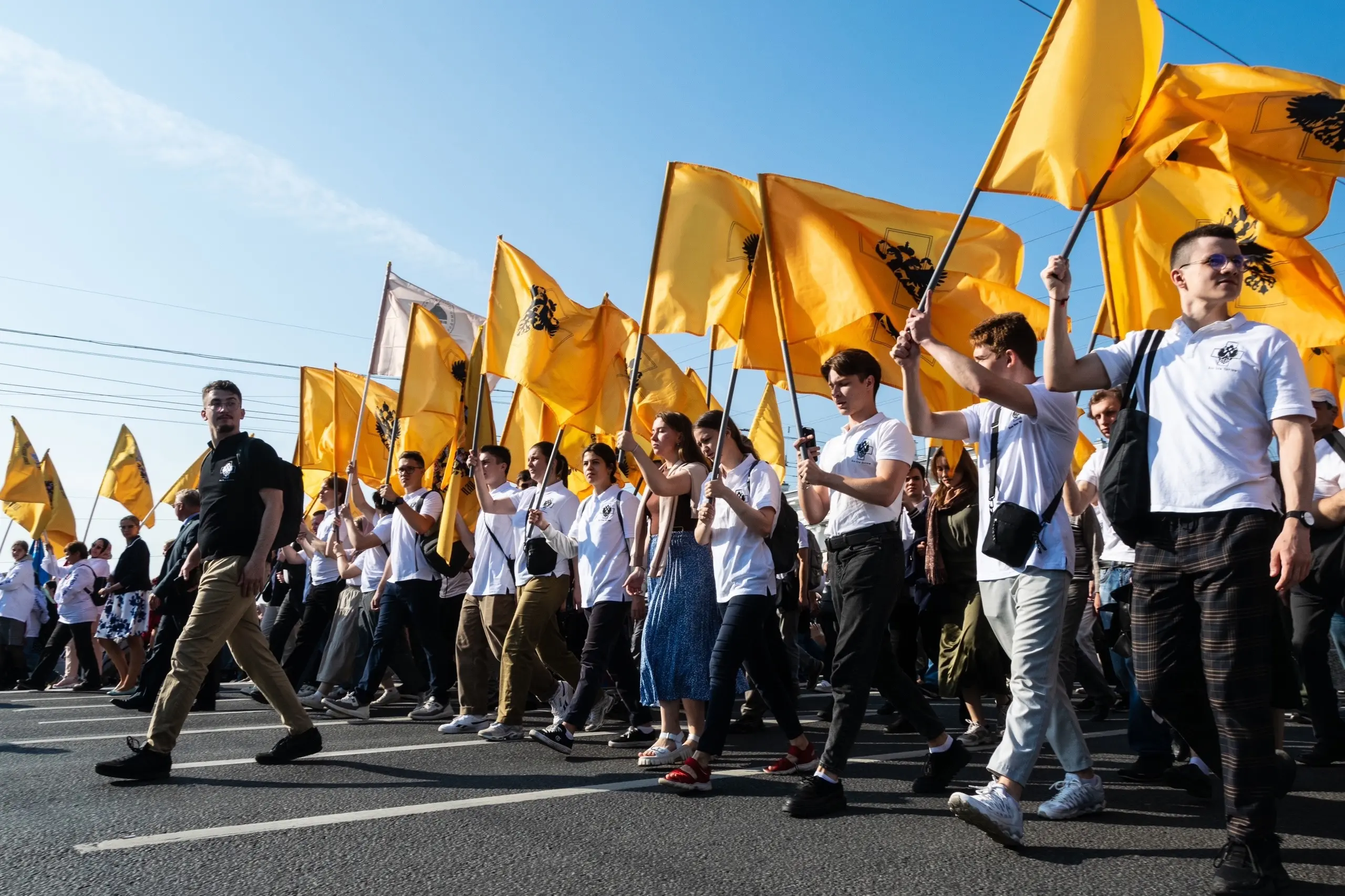
“Defend the country with weapons left, right, and center”: who are the Academists, and what do they want?
The Brotherhood of Academists was founded in 2020 under the umbrella of the Tsargrad Society. According to the newspaper Vedomosti, this society is a nonpartisan structure, established by far-right politician Konstantin Malofeev to funnel his supporters into the State Duma during the 2021 elections.
The Brotherhood’s stated goals, according to their introduction post on the social networking platform VK, include “fostering skills of self-organisation, as well as national solidarity and mutual assistance in Russian students” and “hosting student discussion platforms and Young Politician Schools”.
For its members, the Brotherhood organizes lectures on Russian nationalism and arranges meetings with regional politicians and right-wing conservative speakers, like Darya Dugina, daughter of the philosopher Alexander Dugin, and Pyotr Tolstoy, a “Russian politician” and State Duma member for the ruling United Russia party. The Brotherhood’s online presence echoes the style of “Sputnik and Pogrom”, a now-defunct online publication that used to promote Russian nationalism in the 2010s.
Darya Dugina was a pro-Russian journalist and political commentator. In 2022, she was killed in a car bombing — an explosive device had been planted in the vehicle she was driving.
Philosopher Alexander Dugin is known for his support of Putin’s policies. Dugin has long called for the killing of Ukrainians, the invasion of Ukraine, and it’s annexation.
“Sputnik and Pogrom” was a socio-political media with a Russian nationalist orientation, founded by publicist and nationalist Yegor Prosvirnin in 2012. He described the publication as a magazine for the “rebellious Orthodox rabble”.
Shortly before the full-scale invasion of Ukraine, the Brotherhood of Academists underwent a structural overhaul. From a local group within the Tsargrad Society, it expanded into an organization with cells in numerous major Russian universities. Judging by the Academists’ VK pages, cells have been established in at least 20 cities across Russia, as well as in occupied territories of Ukraine, including Kherson and Crimea.
The cells are active at prestigious universities like Moscow State Institute of International Relations, The Russian Presidential Academy of National Economy and Public Administration, St. Petersburg State University, St. Petersburg Mining University, Kuban State University, Ural Federal University, Novosibirsk State University, and Kazan Federal University. Crucially, some of these cells are registered as official student societies – meaning they operate with the explicit permission and support of university administrations.
Tsargrad continues to openly back the Academists. In January 2023, Konstantin Malofeev, the channel’s director general, hailed the Brotherhood as “the true guards of Saint Tatiana” and on Student’s Day extended his special congratulations to those of its members who were “fighting on the front lines of Donbas and Novorossiya as volunteer soldiers”. In May 2024, Malofeev personally presided over the induction ceremony for the new Brotherhood members.
From the Moscow State University website: “Saint Tatiana, a Roman martyr of the 4th century, has been venerated in Russia since the 18th century as the heavenly patron saint of Moscow University, Russian students, and all those who strive for education”.
In 2014, Russian President Vladimir Putin introduced the term “Novorossiya” (“New Russia”) to describe a proposed pro-Russian state entity in southern and eastern Ukraine.
Shortly after the formation of the self-proclaimed Donetsk People’s Republic (DPR) and Luhansk People’s Republic (LPR), they announced plans to unite into a “Novorossiya” confederation. Both Donetsk and Luhansk oblasts are now annexed.
“Over the past years, the Academists have shown that they are not just promising young people but already accomplished individuals ready to perform complex tasks. And there have been quite a few of those, including humanitarian missions to Donbas and Novorossiya, academic conferences, assistance to our compatriots abroad, and much more. And some of our members are defending our Motherland with weapons in hand”. Malofeev wrote on his VK page.
Even before the war broke out, Malofeev had launched the Empire of the Future’ show on the Tsargrad TV channel, where he had been talking with the Academists — these “successors to the pre-revolutionary traditions of the patriotic student movement” — and narrate them the contents of the first volume of Empire, a “historiosophy” book of his own authorship. The show was intended to become “The ABCs of Russian imperialism” explaining the nature and the essence of the Empire and its importance for the future of Russia”. The show was last aired on April 16, 2022.
“Pre-revolutionary” here means the mores that existed before the February revolution of 1917 that resulted in emperor Nicholas II abdicating the throne and the Soviet rule taking power.
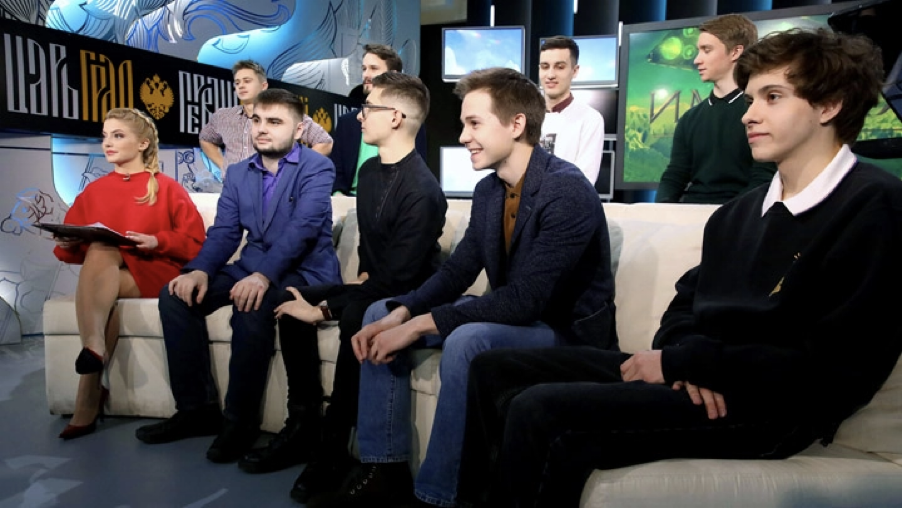
Brotherhood’s ideology
According to the Brotherhood’s brand book that the Groza reporter acquired upon infiltrating the group, it is founded on the belief that “the world order transformations and massive shock waves” are to come soon, and “the Russian Federation will be reborn a new political superpower under the banner and the ideals of the Russian Empire”.
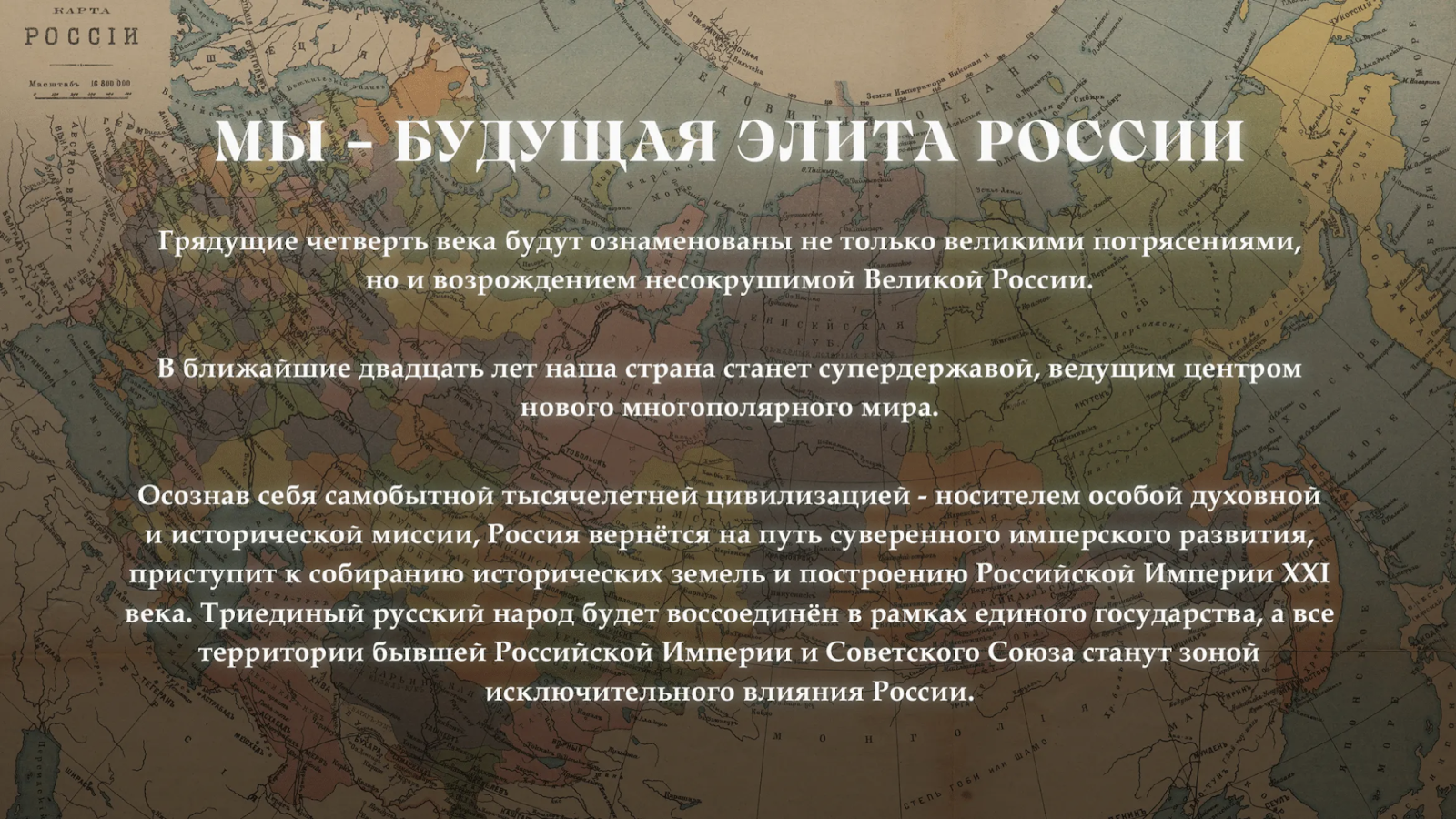
The Brotherhood members see Russia’s mission as a truly global one: the Russian Federation is to defeat “global evil” and to “hold down the fort of the Christian Faith and traditional values”, while the Russian Orthodox Church is to “gain universal status and become the foremost authority in the global Orthodoxy”.
According to the Academists, in twenty years Russia could become “the world leader in scientific and technological progress, and the 21st century will become the golden age for Russian culture; an era of ideological and cultural domination of Russia in the world”.
Academists themselves, as mentioned in the brandbook, are the Russian “national elites” and “the future builders of the Russian Empire”.
To be accepted into the Brotherhood, one should live up to four ideals, or pillars, of the organization, that are reflected in its logo: a cross with a two-headed eagle and the capital Cyrillic “A”.
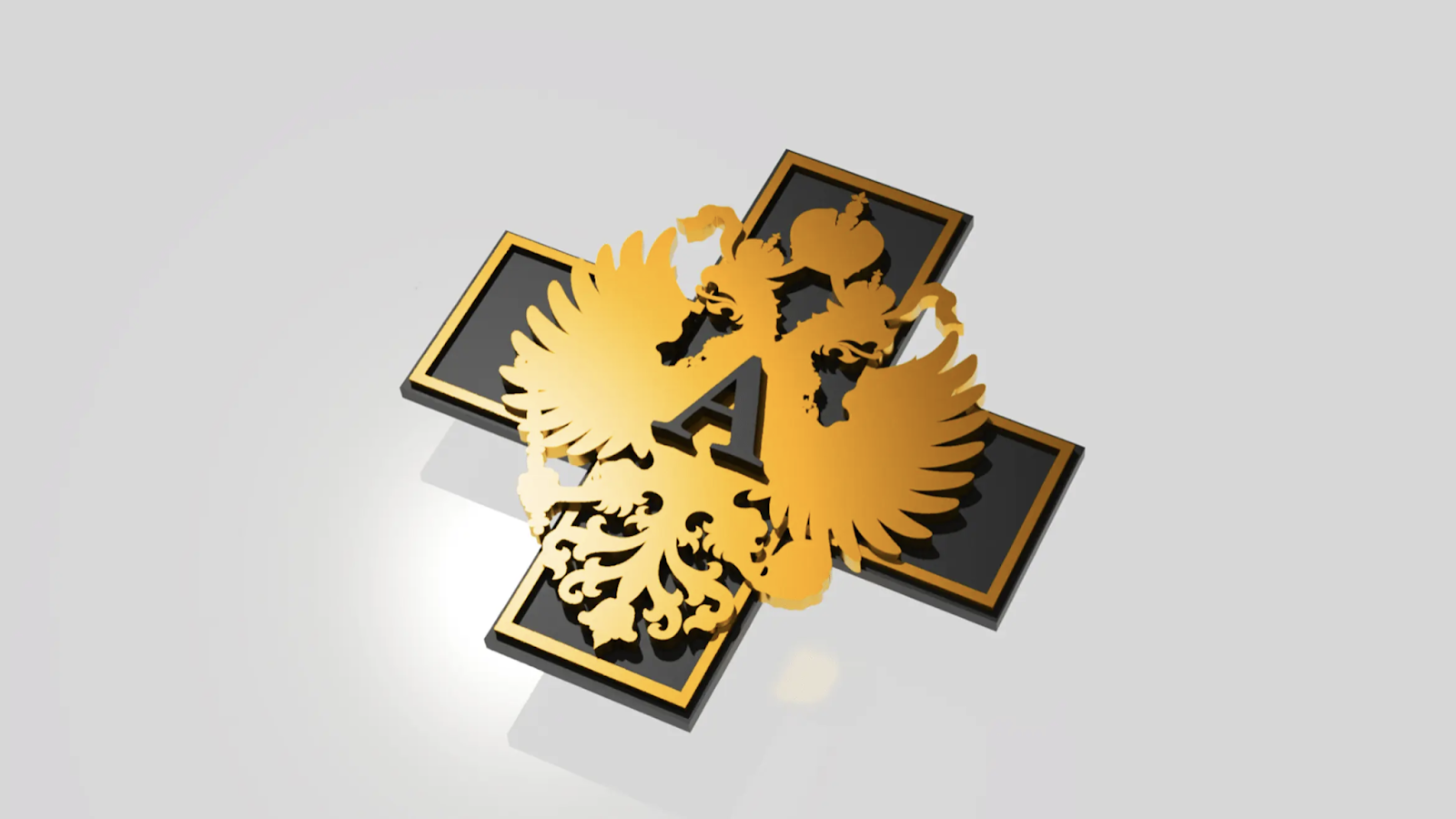
Each end of the cross symbolizes, as cited from the source,
- The upper end of the cross represents the idea of the Third Rome — the Katechon. The idea of the Empire as the Third Rome constitutes the highest meaning of Russia’s existence, its spiritual mission, which is to be the universal Katechon, restraining the world from evil.
- The lower end of the cross symbolizes the Future. The Brotherhood in its entirety serves the future of Russia. The club is raising the new elite. Membership in the club opens the door to the future for the Academists.
- The right end of the cross symbolizes Holy Russia. For the Aсademists, Holy Russia is the indivisible unity of Russia as above, so below, sanctified by the feats of Russian saints and heroes. It is a spiritual space of the sacred ideals and the centuries-old memories of Russian people.
- The left end of the cross symbolizes the Fatherland. The fate of the Aсademists is inseparable from the fate of the Fatherland. Devotion to the Fatherland and its historical mission is the main goal of the Academists’ activities.
From Greek — "the one who restrains". A theological concept associated with the coming of the Antichrist and the end of the world. This concept has multiple interpretations in both Catholic and Orthodox traditions, but the main one describes it as the last stronghold of humanity in the struggle against universal evil. It is only after the fall of Katechon that the antichrist will present itself.
Many Russian monarchist philosophers have spoken about the Katechon. The term was reintroduced into popular Russian nationalist discourse in 1997 by Alexander Dugin, who interpreted it as Russia being the Third Rome and a "geopolitical ark".
There exists a theological, historiosophical, and political concept that claims Moscow is the Third Rome, meaning the successor to the Roman Empire and Byzantium.
The Academists also believe that the four ends of the cross symbolize the four cardinal directions, to which the cultural, economic, political, and military expansion of the “reviving Russian Empire” extends. The Brotherhood states that all of its members “must be ready to serve in the Army, as well as to defend the Fatherland and the Orthodox Faith”.
The Academists emphasize their connection to and “historical continuity” with the right-wing nationalist movements of the early 20th century and sometimes use pre-revolutionary Russian orthography. The central figure of the Academists is the Chairman of the Council of Ministers of the Russian Empire, Pyotr Stolypin. His birthday is celebrated with wreath-laying ceremonies. The Academists write articles and essays about Stolypin, attempting to apply his methods and reforms to modern Russia; the Brotherhood is also in charge of the Stolypin Readings conferences.
Pyotr Stolypin is primarily known as a reformer and statesman of the early 20th century who played a key role in suppressing the revolution of 1905-1907.
Historical materials on reforms are accompanied by articles like the one titled “The Genealogy of the Triumphant Pig”—written by an Academist and presented at a forum in annexed Luhansk. The article argues that the “neo-Banderite regime of [Ukrainian President Volodymyr] Zelensky can be fairly considered yet another tool of the West, created to weaken the main anti-globalist force of Eurasia — Russia”.
Stepan Bandera (1909–1959) was a Ukrainian nationalist leader and head of the Organization of Ukrainian Nationalists (OUN). He fought for Ukrainian independence during World War II, initially collaborating with Nazi Germany but later opposing them. He was assassinated by the KGB in 1959.
A Real Estate Agent and an Angelika Varum Hater. Who is the Leader of the Academists?
Nikita Izyumov, a 34-year-old Brotherhood’s coordinator, runs a personal video blog “for young lovers of imperialism”, where he regularly criticizes the authorities and their lax migration policy. He also advocates for the complete elimination of Ukraine as a state and cautiously defends the former “Minister of Defense” of the self-proclaimed DPR and present political prisoner Igor Strelkov.
In Alexey Navalny’s opinion.
Izyumov was born in Krasnodar. As stated on his website, he used to work as a real estate agent, serve in the army where he achieved the rank of junior sergeant (however, he avoided mobilization), and unsuccessfully run for the State Duma as a candidate from the “New People” party.
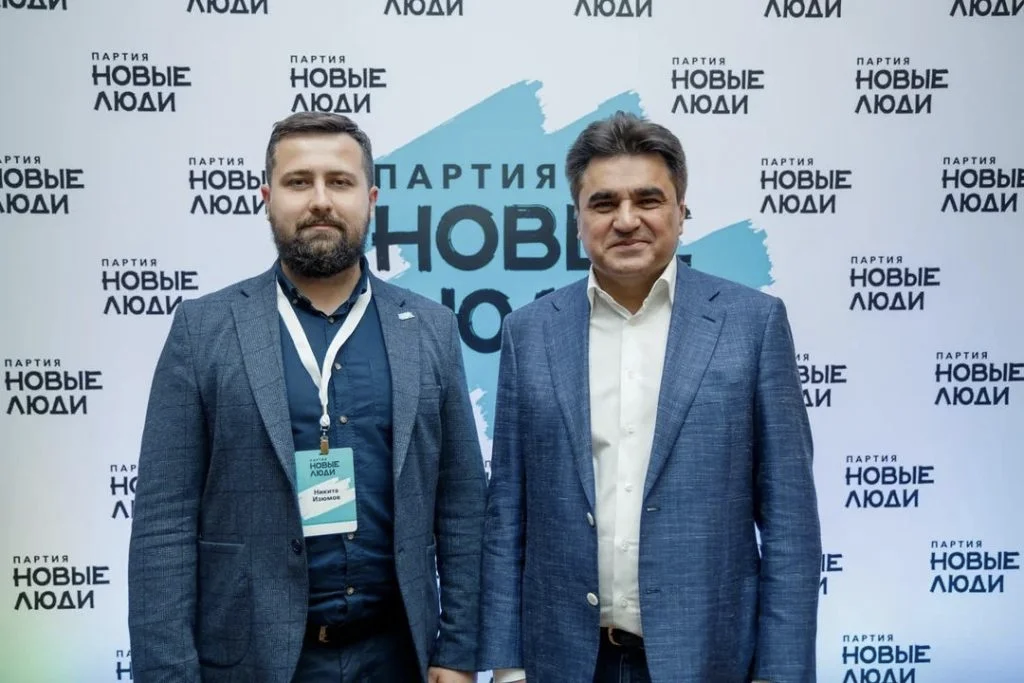
Since the beginning of the war against Ukraine, Izyumov has been using his social media accounts — frequently reposted by Academist communities — to call for the cancellation of concerts by the artists Shortparis, Leonid Agutin, and Angelika Varum, and to urge Russian soldiers to “use strength, toughness, and even violence [on the battlefield]”. He dubs Ukraine a “threat to Russian civilization”,
“The very existence of a hostile Ukrainian project is a constant threat to Russian civilization. It is absolutely irrelevant who governs Ukraine — whether it is a Nazi government, a fascist government, a communist government, or a liberal-democratic one”, Izyumov stated in 2023 in an interview with the “Bloknot Krasnodar” media outlet.
As Izyumov told the author of the article, he was not the Brotherhood’s original leader. However, he had already been working with Tsargrad; he heads the Yekaterinodar branches of the Tsargrad society and the Federation of Traditional Sports “Double-Headed Eagle”. According to Izyumov, it was precisely because of his experience in ultra-right organizations that the leadership of Tsargrad found it “perfectly natural” to make him lead the future “Russian elite”.
Until 1920, the Russian city of Krasnodar was called Yekaterinodar.
Federation “Double-Headed Eagle”
It engages in the development of “traditional sports” — particularly wall-to-wall fighting and MMA training.
The organisation’s founding executive director was former General of the Russian Foreign Intelligence Service (SVR) Leonid Reshetnikov. The creation of this organisation may have been an attempt to co-opt nationalist football fan movements of the 2000s and 2010s into the sphere of influence of the Tsargrad society.
In 2019, according to sources cited by The Bell, Double-Headed Eagle was considered a potential platform for a new conservative party in Russia.
When asked how much control he has over the Brotherhood, Izyumov responded that he is “not an absolute leader”,
“Essentially, they [Brotherhood cells] are the university-based horizontal communities of new Russian people. At first, we worked quite closely with sports collectives under Double-Headed Eagle, but collaborations with Russia’s intellectual youth were lacking. That is exactly why the Academists tradition was revived and is now developing. I am not its absolute leader, though. There is a higher management. I only coordinate the Brotherhood’s development across the country.There are two approaches available. Obviously, we cannot fully control the regional cells. We only try to set boundaries: we have such positions, such symbols, and such statements that we subscribe to. Within these limits, everyone is free to act as they please.Of course, there are situations when someone crosses the line, and we have to step in. But since the Brotherhood has centralized funding, we have management and enforcement tools. If people do not comply, then of course, we stop working with them. These are normal work processes — building and structuring ideology.”
Denunciations, “Wine Symposia”, and War: What Is Russia’s “Future Elite” Up To?
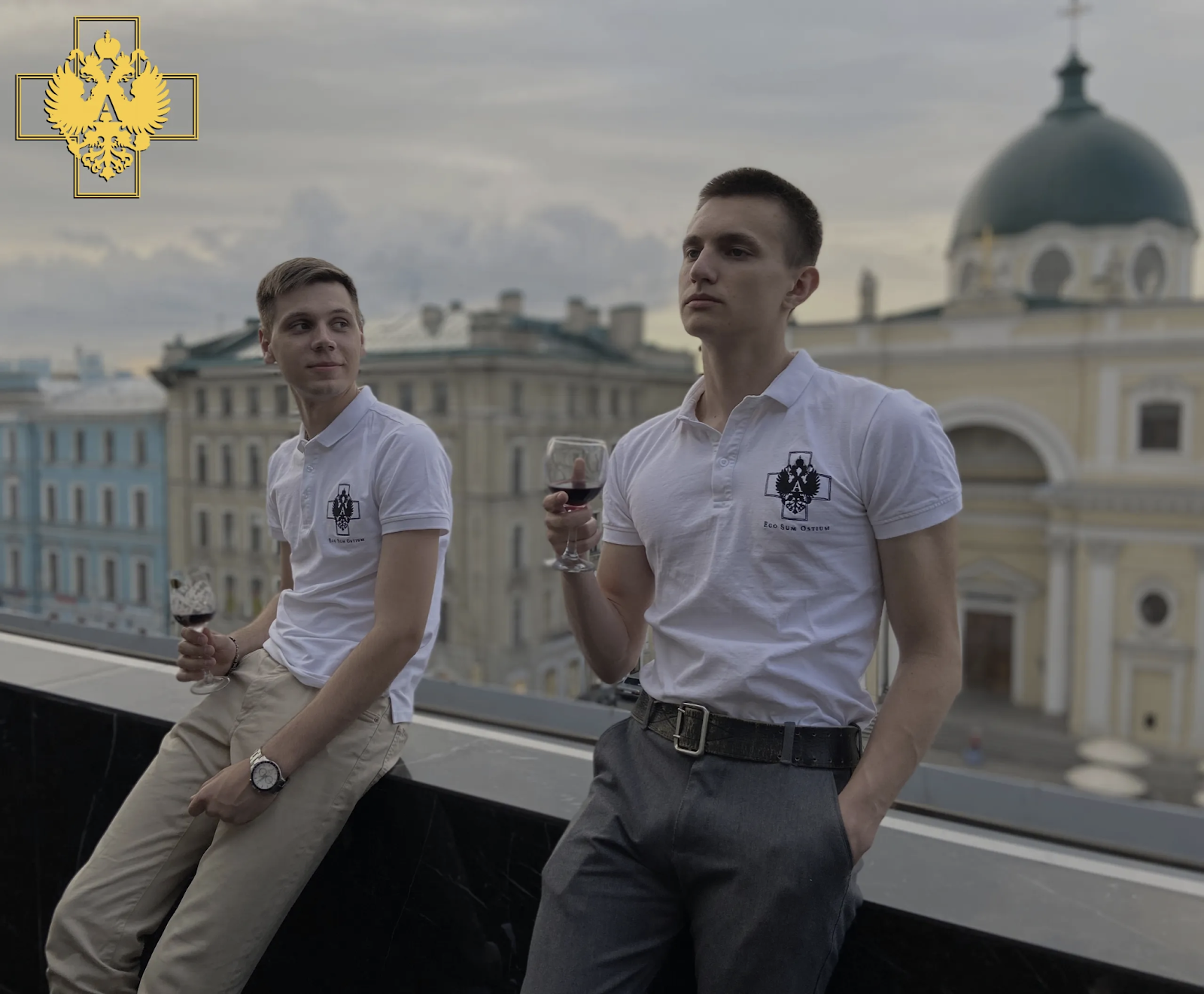
The Brotherhood's work “with intellectual youth” currently manifests in the form of reading clubs, intellectual competitions in annexed Crimea, teleconferences with “war correspondents”, and gatherings for “studying the culture of drinking”, which participants refer to as “symposium”. Additionally, the Brotherhood holds balls — for example, in St. Petersburg.
Among the recurring events of the Moscow Brotherhood, there are lectures at the “Russian Mansion”, on the topics like faith during the “SMO”, migration policy, the feats of World War I, and “Conversations with a Priest” — “cordial discussions” for Orthodox youth.
The "Special Military Operation" (or SMO) is how Russian authorities refer to the war against Ukraine — and demand everyone else refer to it the same way.
The Academists also have a list of recommended books. First and foremost, they are advised to study the works of Konstantin Malofeev himself, for example, his three-volume study “Empire”. Additionally, you can find there writings of Philotheus of Pskov, “Ivan the Terrible: The Sovereign”, “Domostroy”, as well as “Geopolitics: A Textbook” and “Genesis and Empire: Ontology and Eschatology of the Universal Kingdom” by Aleksandr Dugin.
What else do the Academists read? ↓From the literature of the 19th and 20th centuries: “The Ideology of Conservatism” by the Slavophile Mikhail Katkov, “National Russia” by Putin’s favorite philosopher Ivan Ilyin, Oswald Spengler (author of “The Decline of the West”), and authors convenient for explaining “geopolitics” in the understanding of Russian authorities — Samuel Huntington, Egor Kholmogorov, and Klaus Schwab.
Military Training
As stated on the Brotherhood’s website, military training sessions are being held in Moscow and St. Petersburg for Academists who want to join the war against Ukraine. Academists are taught tactical combat casualty care, drone (UAV) operation skills; they also undergo firearm and tactical training. Military training is available in other regions, such as Voronezh, Krasnodar, and Yekaterinburg.
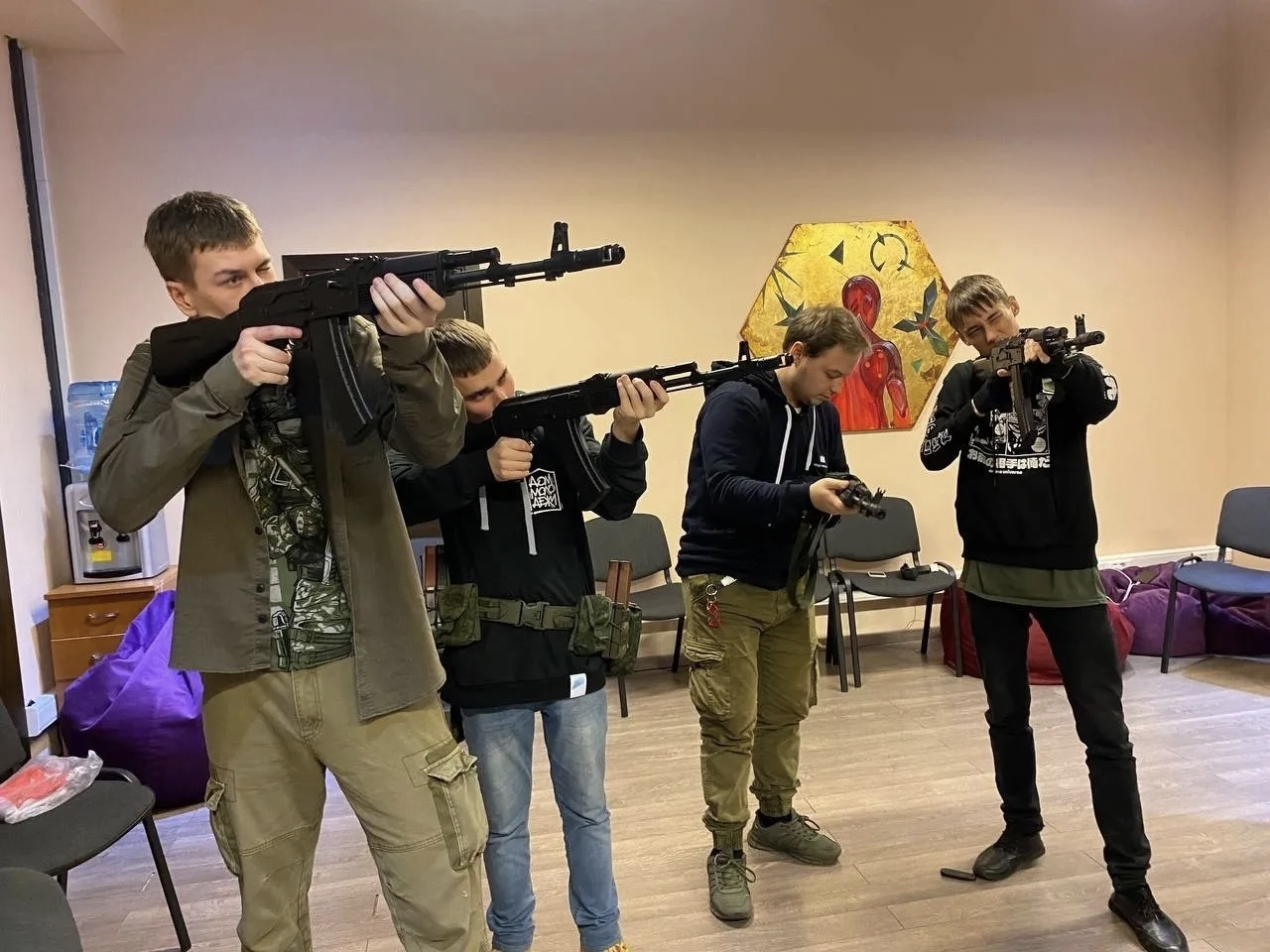
St. Petersburg Brotherhood is the most militarized group: they teach how to operate BTR-80 armored vehicles and BMP-1 infantry fighting vehicles in pre-revolutionary Russian. The World Russian People’s Council — another organization under Konstantin Malofeev’s control until late March 2024 — holds military training outings for local Academists.
The BTR-80 is a Soviet armored personnel carrier; the BMP-1 is an amphibious infantry fighting vehicle.
World Russian People's Council
Another organization that supported the creation of the Academists Brotherhood. The Council was established back in 1993. It is an international organization dedicated to spreading Orthodox ideas, headed by Patriarch Kirill.
Training sessions on how to handle anti-tank guns are filmed by Brotherhood cameramen and posted on social media with upbeat music in the background. Before Yevgeny Prigozhin’s rebellion, the Academists had been planning to involve former Wagner Group mercenaries in their military training sessions.
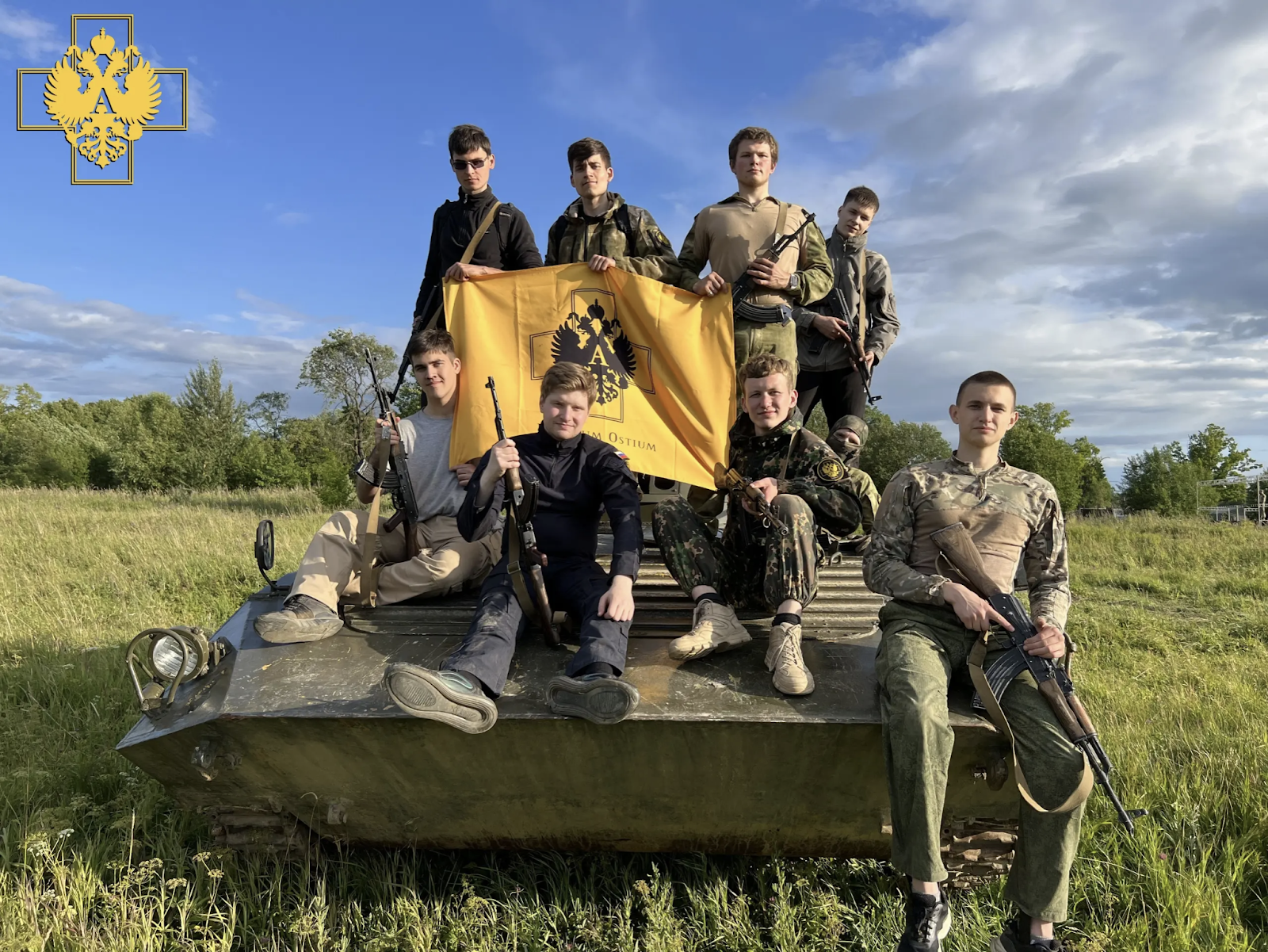
The Voronezh Brotherhood focuses on firearms training, frontline training, and combat. Their social media content reflects strong anti-immigrant views, echoing Tsargrad's materials on migration policy. In addition to parroting the TV channel content, Academists have recently been reposting ultra-conservative rap artist Misha Mavashi and the “Russian Nationalist” VK group.
The official community page of Academists, as well as St. Petersburg, Krasnodar, and Chelyabinsk cells — all publish posts with anti-immigrant sentiment. In Moscow, Academists held a lecture on “uncontrolled migration”.
In addition to military training, members of the Brotherhood organise fundraisers for battalions fighting against Ukraine, like the VDV (the Russian Airborne Forces) reconnaissance unit “Moscow”, which was created by “volunteers — professional athletes and supporters of Russia’s flagship football clubs from “Two-Headed Eagle” society”.
Denunciation
Since the beginning of the war against Ukraine, Academists have opposed anti-war student initiatives. For example, they planned to push for the dissolution of the student council of the Faculty of History at St Petersburg State University (SPBSU) in case of an “anti-war demonstration”.
The SPBSU Academists are notoriously ruthless in their persecution of students who oppose the policies of the Russian authorities.
The most notable instance of repression was the denunciation by the Academists against Mikhail Belousov, a lecturer at the Institute of History at SPBSU.
SPBSU dismissed the lecturer and subsequently expelled seven students who had sympathised with him. The Academists even received a letter from the Vice-Rector for Human Resources, expressing gratitude “for the demonstration of their firm civic stance”.
School Lectures
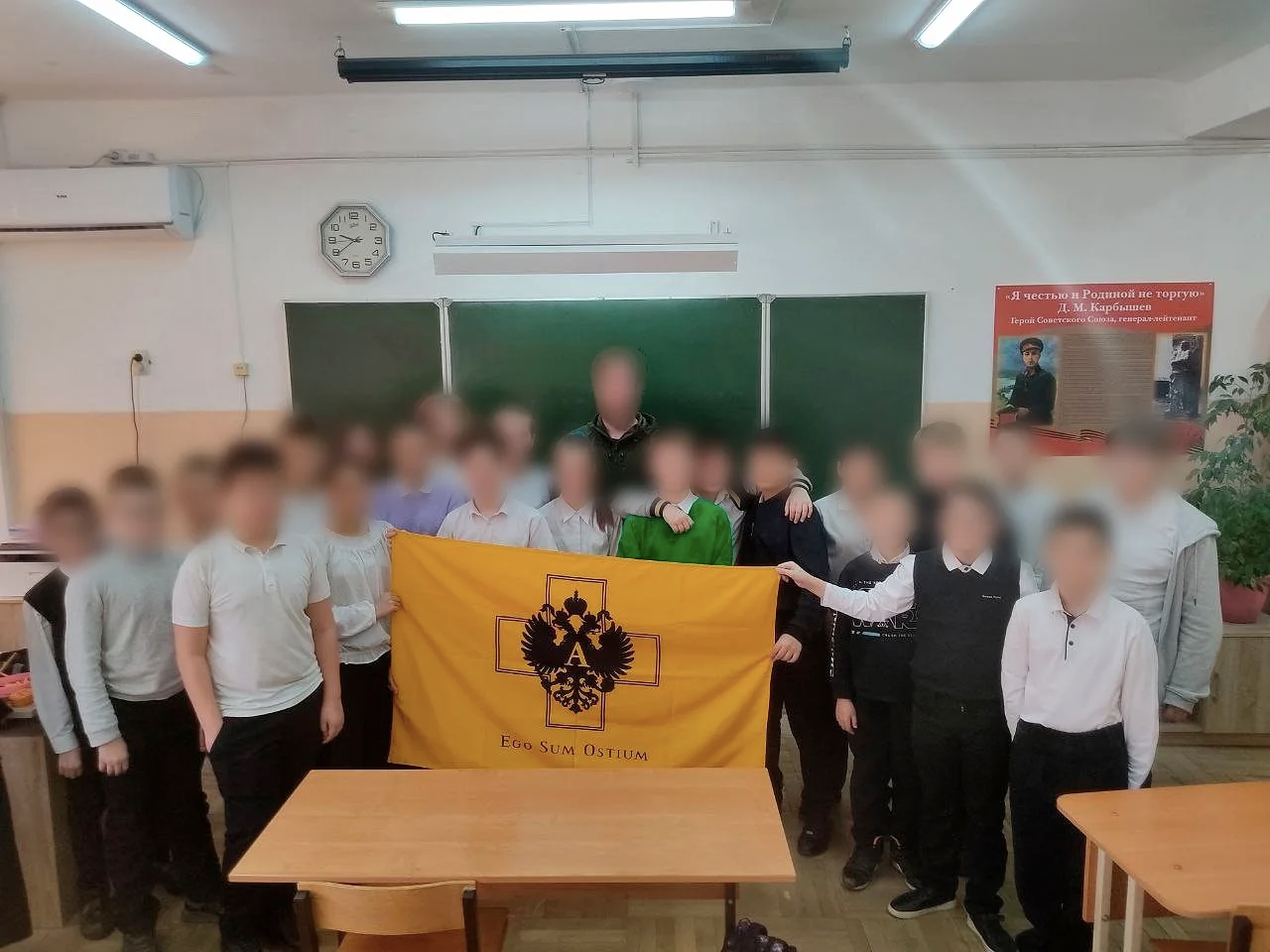
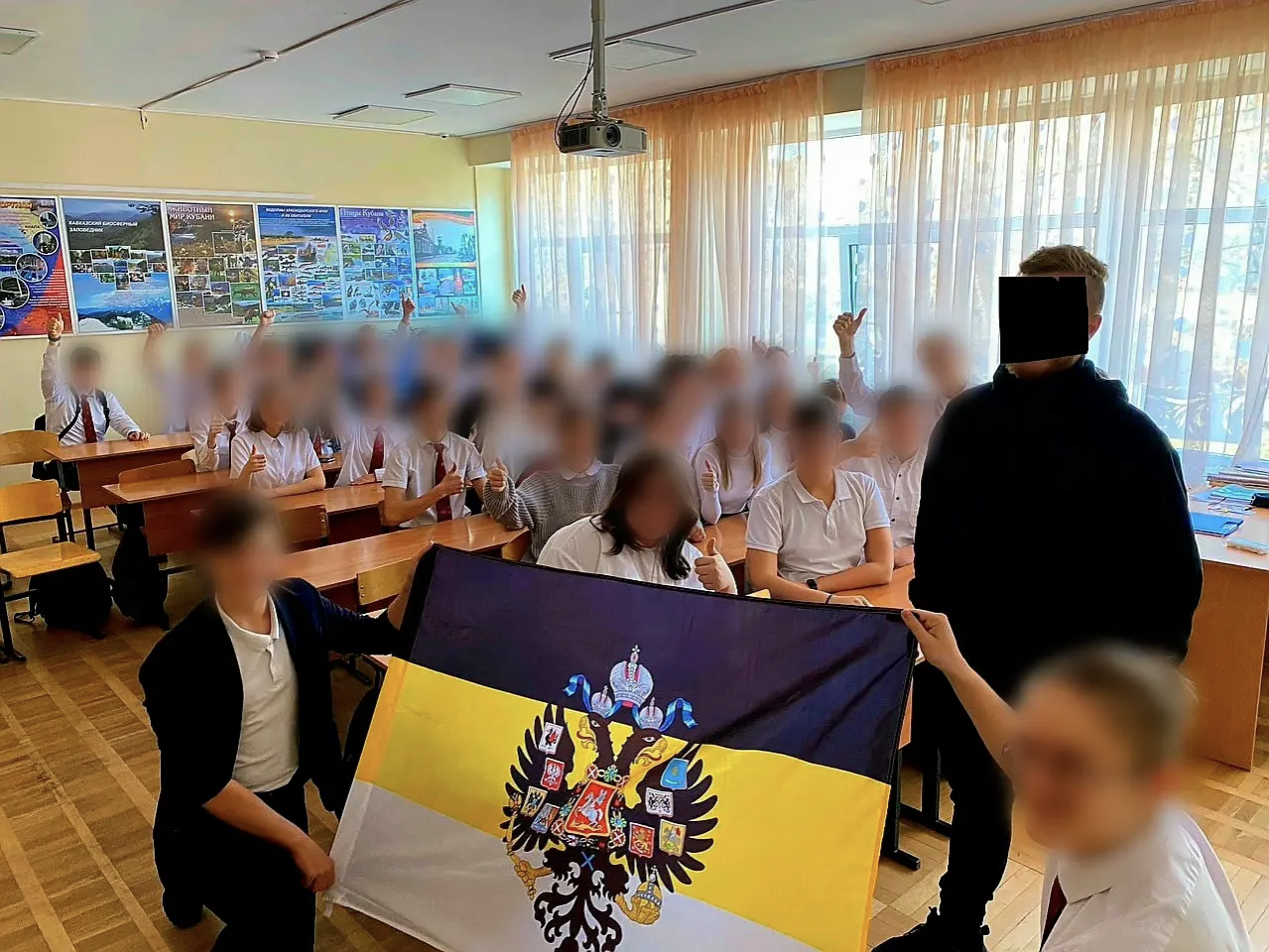
The Yekaterinodar Academists (the pre-1920 name of Krasnodar, a major city in southern Russia), for example, delivered a lecture to schoolchildren titled “Heroes of the Past. Heroes of the Present”. For the Academists of Kuban State University, this is part of a broader initiative,
“Tradition is about passing the torch, not worshipping ashes. That is precisely why we decided to name our project “Plamya” (“flame”, “torch”) — a program for visiting schools with educational lectures,” write the Academists.
Voronezh Academists told schoolchildren about “the heroes of Novorossiya and the ideals they fought for”.
International Cooperation
Through its connections with the Tsargrad Society and the World Russian People’s Council (WRPC), the Brotherhood has established ties with European far-right organizations. In April 2024, the “International Club of Moscow Academists” held a teleconference with “Brazilian friends from Nova Resistência” [Portuguese for “New Resistance”], a “patriotic Brazilian organisation advocating for a just and multipolar world order”.
Later, the Academists congratulated the Brazilian people on the anniversary of dictator Getúlio Vargas, who had been ruling Brazil for 15 years. According to them, Vargas was “the greatest political figure in modern Brazilian history”.
Furthermore, in February 2024, the SPBGU Academists presented their club at the Union State Youth Forum at Belarusian State University (BSU). During a roundtable discussion, they and the BSU representatives “discussed further cooperation”.
Active support for the war against Ukraine
Since the start of mobilization, some Academist cells have been spreading information about legal consultations offered at a so-called human rights centre affiliated with the Tsargrad Society, while others have been actively encouraging volunteers to enlist. An article in Komsomolskaya Pravda claimed that Moscow Academists were among those who visited military recruitment offices to assist the Russian army.
In the Stavropol Brotherhood, members hand-wove camouflage nets for “SMO soldiers”. This activity was hosted at the local Liberal Democratic Party of Russia (LDPR) headquarters. The party activist Konstantin Chasovnikov (real surname Pavlov, allegedly) is the leader of the Stavropol cell.
The Liberal Democratic Party of Russia (LDPR) is a nationalist political party in the Russian Federation that has presented itself as an opposition force since its founding, while remaining part of the government.
Expansion into Occupied Ukrainian Territories
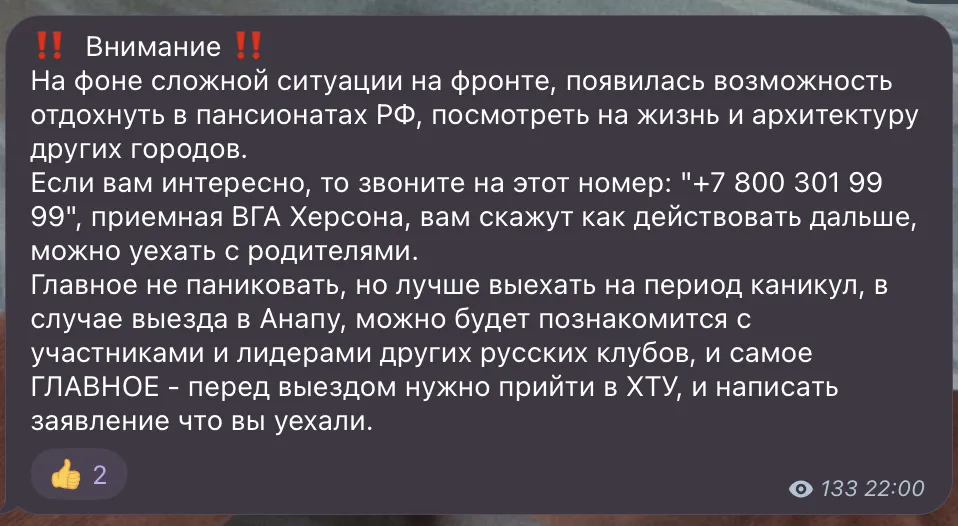
The Academists also set up cells in occupied Ukrainian territories. However, following Ukraine’s counteroffensive in autumn 2022, these cells had to evacuate. The Brotherhood’s Telegram channel described the evacuation of the Kherson “Russian Club” as a “vacation trip to Russia”.
When asked about new cells, Nikita Izyumov responded,
“Most of our new cells were established from scratch, however, some existing communities joined us [the Brotherhood]. We are building a living organization — not a top-down state-run youth movement, but an organic structure. The first step is to find leaders who can bring people together in different regions and universities, then support them in working with university administrations to ensure there are no obstacles from those in power.So generally, we seek out such groups in universities and then start supporting them. Sometimes we publish announcements and they respond, sometimes we reach out through professors of these universities who know active students with similar views.”
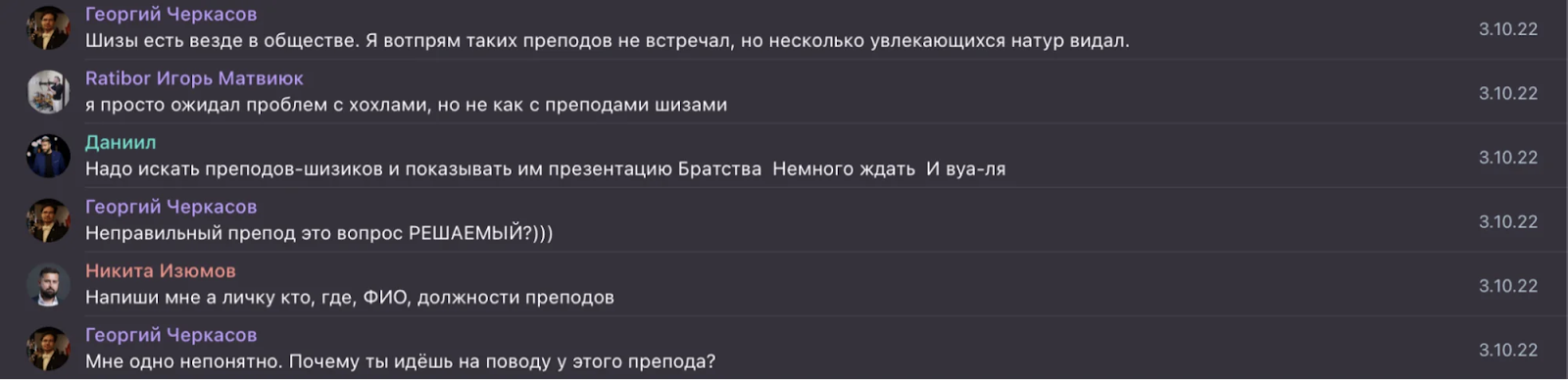
If the teachers do not agree or are not ready to support such groups, the Brotherhood leadership may try other negotiation tactics. This screenshot, for example, shows members of the Brotherhood discussing the ‘resolvable’ issue posed by an unnamed ‘uncooperative’ professor during their effort to establish a club in Kherson which at the time was occupied by the Russian army.
Publicly, however, Izyumov presents the opening of the Kherson club in a positive light.
“We had established a club in Kherson during the beautiful period of liberation of the city. It did not last long though, the city was abandoned by our forces, and our boys had to leave… These people were born and raised in the Ukrainian state, all but young students, yet they retained their Russian identity, the ideals of the Russian Empire. That is why we are actively working and engaging with students. But for now, those club members were relocated here, to the region of Kuban.As for Zaporozhye, after we left Kherson the people there have become more apprehensive. In Donetsk and Lugansk, however, the process of creating new cells and holding more negotiations is still active.In Mariupol, funnily enough, there are still several institutes with lots of young people. We posted photos of meetings with them. Our volunteers commute there a lot. It is a good-natured, reciprocal exchange, a dialogue; maybe we will establish a cell in Mariupol as well. There are people there who receive scholarship money from our benefactor, they would make a good core for a local branch.”
The Academists themselves are fighting against Ukraine
Tasting wine and reading Malofeev’s works are not the only activities Academists engage in; they also die in the war. Their website has an entire “Our Heroes” page of black-and-white photos and life descriptions of Ilya Gamanin and Ivan Bulakhov, two Academists who died on the battlefield. The page refers to the war against Ukraine as the “war of Russian national liberation”.
Both young men died in September 2022. Ivan Bulakhov was from Kuban and Ilya Gamanin from Kharkov. The latter was 19 years old and received a shrapnel to his heart during the occupation of Bakhmut. Several months before Ilya Gamanin's death, the Voronezh cell of the Brotherhood collected money for sleeping bags and medicines for him. After Gamanin's death, the Botherhood promised to organize an annual award in his name. Judging from the community's social networks, the award has been forgotten about least in 2023.
Almost every cell of the Brotherhood collects humanitarian and medical aid for the Russian military; the head of the Brotherhood also encourages collecting funds for military drones. St. Petersburg and Omsk Academists delivered “paramilitary cargo” for the “people’s militia of the LPR (Lugansk People's Republic)”.
Vladislav Yevpatyev, the current press secretary of the Brotherhood, explains, “Academists are builders of the Empire. It is essential for us to be on the forefront of its formulation not in word but in deed.”
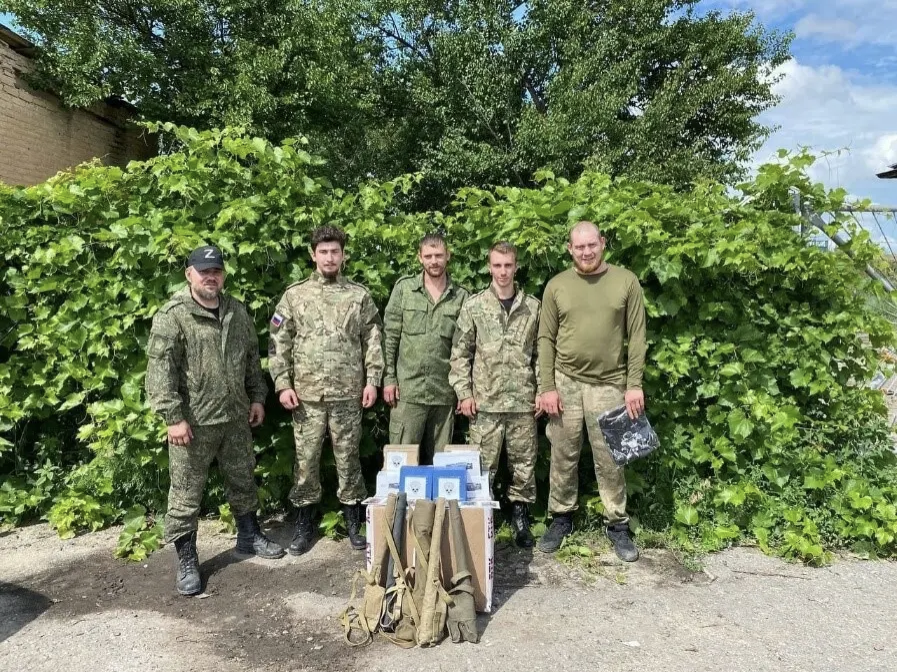
Here is what Izyumov has to say about Academists who joined the Russian army,
“Since there is a war going on, we must give up everything we have for the war effort, for our victory. There has been a large number of volunteers amongst the Brotherhood who properly joined the military action. Some of them are still fighting, others, unfortunately, have died. At the same time, we have a volunteer mission in Mariupol; every two weeks, another group goes there. They engage in the usual volunteer stuff such as clearing out debris, repairing, etc. It is a great thing for universities, because none of the universities do it. And when we do it, everyone is thrilled. Therefore, military training solves many problems: attracting new soldiers, teaching combat skills, preparing for war, for defense of the homeland, not by word, but by deed with weapons in their hands, which some of our brothers have already done and, unfortunately, may they rest in peace, have already sacrificed their lives for our homeland.”none of the universities do it. And when we do it, everyone is thrilled. Therefore, military training solves many problems: attracting new soldiers, teaching combat skills, preparing for war, for defense of the homeland, not by word, but by deed with weapons in their hands, which some of our brothers have already done and, unfortunately, may they rest in peace, have already sacrificed their lives for our homeland.”
Do they really?
They do. Student squads go there — they are gathered from different universities all over Russia.
Izyumov also told about the existence of a “volunteer battalion” that Tsargrad organizes for its employees and friends. One can join it at the request of the Academists’ management.
“Our organization has its own volunteer battalion. Well, I mean Tsargrad, not just the Brotherhood. Everyone who wants to go [fight against Ukraine] and who received draft notice is referred there. We try not to send very young boys; we try to talk them out of it at least. Send them for training first — they need to acquire some skills [first].There is the “Union of Donbass Volunteers”, which is also part of our common structures. There is a well-known [State Duma deputy Aleksandr] Borodai and the chief. There are some veterans and volunteers. If they [Academists] leave, they leave on their own. If they really want to go, no doubts, we will try to send them there.”</p>“Union of Donbass Volunteers”, which is also part of our common structures. There is a well-known [State Duma deputy Aleksandr] Borodai and the chief. There are some veterans and volunteers. If they [Academists] leave, they leave on their own. If they really want to go, no doubts, we will try to send them there.”
Alexandr Borodai
Deputy of the State Duma of the Russian Federation. In May 2014, declared himself Chairman of the Council of Ministers of the self-proclaimed DNR (until August 7, 2014).
“We are creating thought leaders in our paradigm who we can promote”. Why does Konstantin Malofeev need Academists?
Malofeev’s political ambitions. Context
In the 2010s, Konstantin Malofeev, the founder of the Brotherhood of Academists, planned to enter the Federation Council, but failed — in 2012 he was suspected of bribing voters during the election of deputies in the village of Znamenskoye in the Smolensk region (a district at the border with Belarus). Then Malofeev was removed from the voting lists.
In 2014, the oligarch sponsored separatists on the territory of the self-proclaimed LPR (Malofeev denied this), and according to “Novaya Gazeta”, he may have been involved in the creation of a plan for Russian interference in Ukraine’s internal politics which got leaked.
Malofeev did not receive any visible political positions in the Russian Federation during the first eight years of the war in Donbass, except that in 2015 he was awarded the Order of the “Republic of Crimea” “For Loyalty to Duty”.
The year 2019 saw one of the most important episodes and ultimately failures of Konstantin Malofeev’s political career — first he planned to create a new monarchist party (and failed); later he tried to gain control of “A Just Russia” in which he was unsuccessful again. “Double-Headed Eagle” was then perceived precisely as a springboard for a new conservative party.
“A Just Russia” is a socialist political party in Russia. As of 2015, "Just Russia" is almost entirely (86.4%) financed from the federal budget.
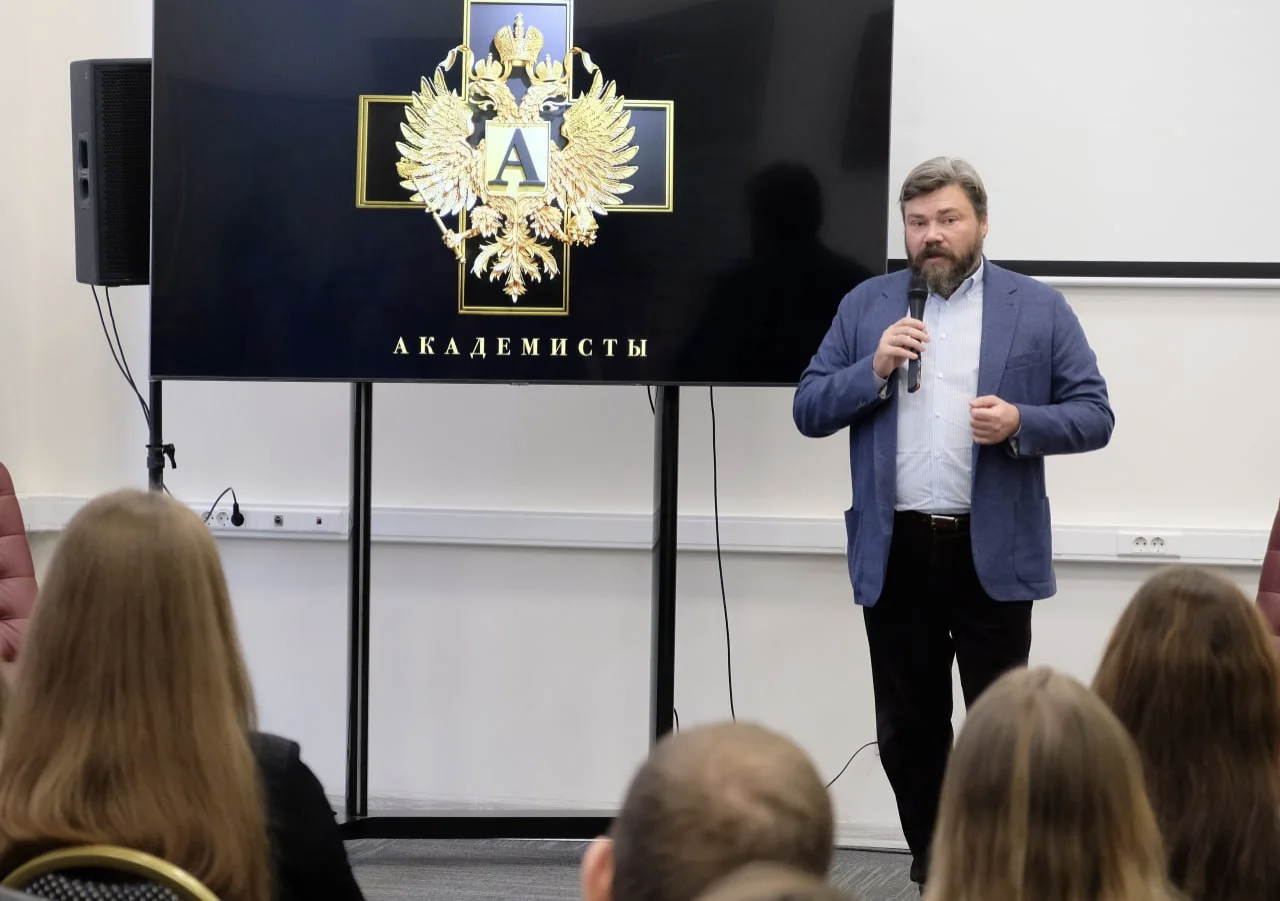
“We are promoting them”. Malofeev is preparing his people to place them in the government system
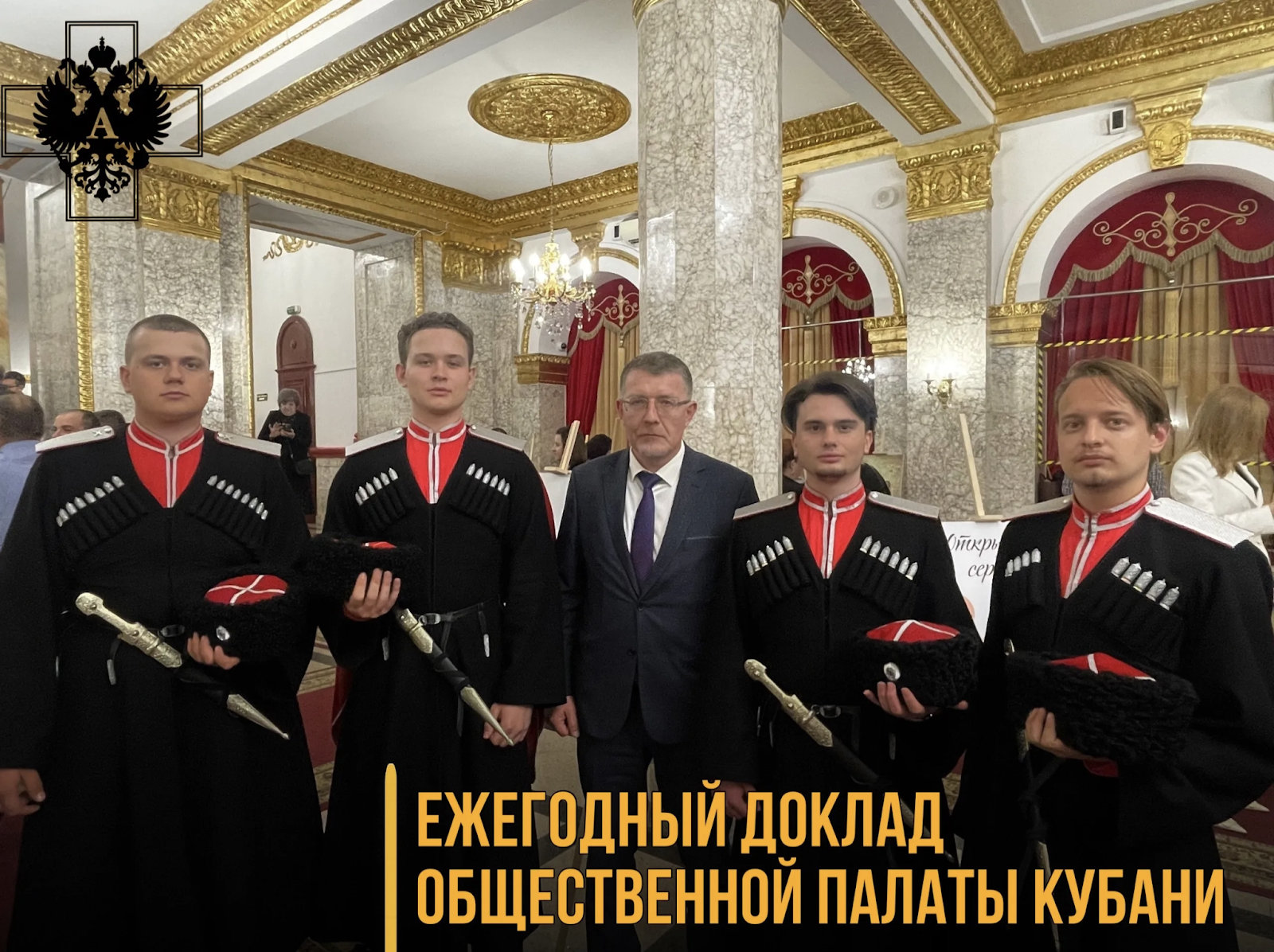
Academists are often introduced to local elites: representatives of city and regional administrations. For example, in the Ivanovo region, academics met with the head of the region, Stanislav Voskresensky; Moscow academists met with the governor of the Chelyabinsk region, Alexey Teksler; and Kuban academics were invited to listen to a report by the Public Chamber of Kuban on the state of civil society.
The Chairman of the St. Petersburg Legislative Assembly, Alexander Belsky, also spoke about the Academists: “We see that these are serious young people. We recently had a meeting with them — it was an open and clear dialogue. We see young people who are not motivated by the idea that they must be involved in power or have any questions related to funding. None of that is present. These are good, decent young people, well-raised. One could even say they are idealistic.”
The personnel that the state prepares for itself, without the Academists and Malofeev, apparently, do not satisfy him. Here is what Izyumov answers to the question of why the Academists are needed and why it would not be more logical to use the structures of the Federal Agency for Youth Affairs (Rosmolodyozh):
The Federal Agency for Youth Affairs (Rosmolodyozh) is a federal executive authority in Russia that provides state services and manages state property in the field of national youth policy.
“Because the Federal Agency for Youth Affairs is an inorganic structure. A completely different approach to work is needed here. I am someone who has a critical view of the actions of our current government and the system in general. I understand that the only effective method of achieving some positive change is through an active evolutionary path. For this, we need many people who can do more than just post online about their greatness. We need people who will have the skills of public administration and will be intellectual.As for the quasi-governmental organizations with which one has to interact by virtue of service, the “Young Guard of United Russia” is completely dead and only exists due to the budget, and it exists only in Moscow and St. Petersburg, while the regions are struggling significantly. “The Movement of the Firsts” is a truly state-run movement, but competing there is pointless. It is a non-ideological entity, and even local officials do not really know what to do with it.We can take the position of a reserve. We are preparing ideological personnel in our paradigm, whom we can promote. If the personnel meet the criteria: they are not just good Russian people who love the black-yellow-white flag, but those who are capable of writing documents, working with programs, and so on. Then we promote them. We have successful cases — guys who are assistants to deputies, employed in city administrations, in youth parliaments. Gradually, work is progressing, but the state is not in a hurry to share its resources.”