
Putin holds annual call-in show in Moscow
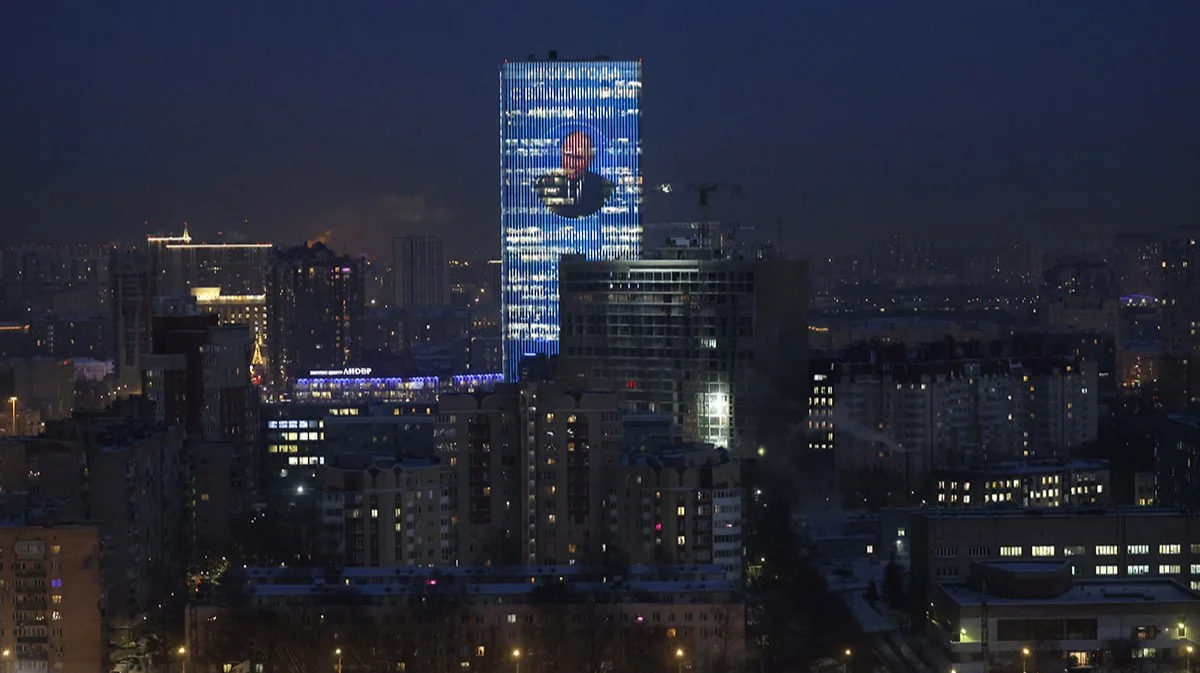
A digital image of Vladimir Putin seen on a business centre building in St. Petersburg, 18 December 2024. Photo: EPA-EFE/ANATOLY MALTSEV
This year’s Direct Line call-in show with Vladimir Putin has begun in Moscow, with Putin due to answer questions from a carefully vetted audience of journalists and members of the public.
For the second year in a row, the event has been combined with Putin’s annual press conference. We will be bringing you a summary of updates and significant announcements from the Direct Line.
On the Russian economy
The Russian economy is in a “stable state” despite all the challenges, including those “from the outside”, Putin said, noting that inflation remained a “worrying sign” at 9.2-9.3%.
Putin claimed, however, that economic growth in Russia was faster than EU economies, and that real wages in the country had increased by 9%.
“Is Russia’s victory closer now?”
“There is movement all along the front line, every day. Our fighters are … regaining territory by the square kilometre,” Putin said when asked by the hosts if Russia’s “victory” in Ukraine was closer now, wishing Russian soldiers “good luck” and the “soonest return home”.
An internally displaced woman from Russia’s western Kursk region, where a Ukrainian incursion has been ongoing since August, asked Putin when local residents could “go home” and whether the territory seized by Kyiv would be recovered.
“No doubt about it,” Putin said, but added that he could not “name the date”, as fighting in the region continued.
On the Oreshnik missile
When asked whether the Oreshnik ballistic missile, which Russia test-launched on a target in Ukraine’s Dnipro last month, was in fact modified Soviet technology, Putin stressed that the Oreshnik was a “modern, cutting-edge weapon”, but noted that “everything done in any field” relied on previous developments.
Putin then reiterated that the Oreshnik could not be intercepted by other missile systems, suggesting “a high-tech duel” to Ukraine’s Western allies to test that claim. “Let them identify targets in Kyiv, concentrate air defence and missile defence systems there, and we will strike.”
When asked by Kremlin spokesperson Dmitry Peskov why Oreshnik — which means “hazel” in Russian — was so named, he said: “Honestly? I don’t know.”
On a ‘weak Russia’, Trump, and compromising with Ukraine
When asked by NBC News correspondent Keir Simmons how he would compromise with US president-elect Donald Trump from a position of weakness once he takes office, Putin said they had not spoken “for over four years” but that he was ready to meet with him “any time” .
Appearing peeved by Simmons’ question, Putin stressed that Simmons “was allowed to work in Russia without limits” despite the “persecution” of Russian press by the West, adding: “You and those who pay your salary in the US would very much like Russia to be in a weak position. But we have become stronger over the past two to three years. We have become a sovereign country, we have little dependence on anyone, and we are strengthening our defence capabilities.”
Putin said that Russia had “always strived for compromise”, and a deal with Ukraine was “nearly reached” in Istanbul in late 2022, which Putin claimed was abandoned after former UK Prime Minister Boris Johnson — whom he referred to as a “man with a good haircut” — derailed the agreement by telling Kyiv to fight “to the last Ukrainian”.
Putin also commented on the murder of the head of Russia’s Nuclear, Biological and Chemical Protection Troops, Lieutenant General Igor Kirillov in Moscow on Tuesday, calling it “a terrorist attack”.
“This murder was committed in a way that endangered the lives of many. The Kiev regime has repeatedly committed such terrorist attacks against many Russian citizens,” Putin said, adding that Russia had “never heard” Western journalists condemn such attacks.
On Syria: ‘We never waged war there’
In response to a question about the collapse of the Russian-backed regime of Bashar al-Assad in Syria, Putin claimed that Russia had never deployed ground troops and only had two military bases in the country. “We never waged war there,” he said.
Putin added that 10 years ago, Russia “had come to Syria” so that “a terrorist enclave would not be created there like in Afghanistan”, noting that in his opinion, Russia had “achieved this goal”.
According to Putin, he has not met with Assad since his arrival in Moscow, but plans to do so in the near future.
On ‘dialogue without preconditions’
Putin said Moscow was ready to hold dialogue with Ukraine “without preconditions” while contradictorily referring to a series of prerequisites he spelled out in June ahead of Ukraine’s Peace Summit in Switzerland, which included a list of ultimatum-like demands such as the withdrawal of all Ukrainian troops from the entirety of Ukraine’s Donetsk, Luhansk, Zaporizhzhia and Kherson regions, despite the fact that Russian forces do not fully control any of the territories at present.
He also referred to Ukrainian President Volodymyr Zelensky as “illegitimate” and said that while Russia would “talk to anyone, including Zelensky”, it could only sign agreements with “those who are legitimate”, namely Ukraine’s parliament, Verkhovna Rada, and its speaker.
On abortions
Putin said the issue of abortions in Russia was a “sensitive” one that could not be resolved during a press conference: “We have to consider religious beliefs and demographic issues, but we also have to think about the welfare of Russian families and a woman’s right to choose.”