
Dream ticket
As Georgia’s slide into autocracy continues, Europe appears to be losing faith it can reverse the process
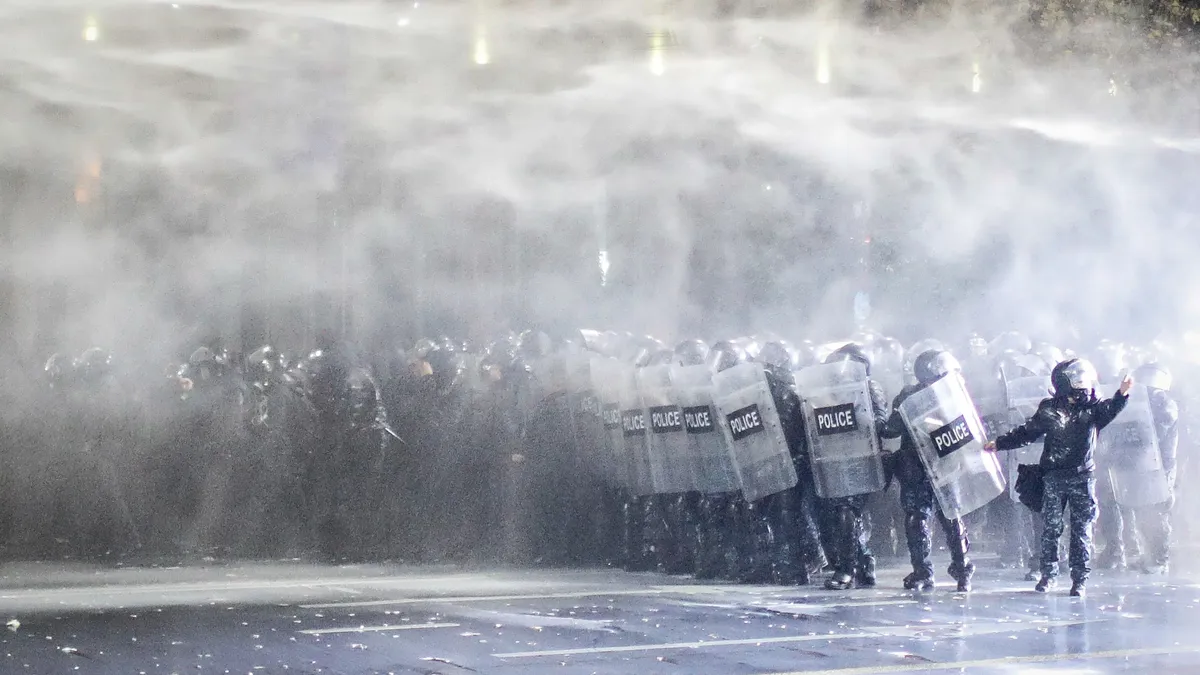
Police use water cannons and tear gas to disperse protesters in front of the parliament building in Tbilisi, Georgia, 29 November 2024. Photo: EPA / David Mdzinarishvili
Though it may stop short of creating a one-party state in the South Caucasus, Georgian Dream has begun the process of banning its three biggest political rivals on the grounds that they pose a threat to its democratic mandate, an incredible step for a country that less than two years ago was granted EU candidate status.
While the opposition will fight the ruling party’s attempt to ban their activities through legal channels, and has pledged to take the case to the European Court of Human Rights if necessary, even that may prove to be a dead end as frustrated politicians in the European establishment have begun calling for Georgia’s suspension or even expulsion from the Council of Europe over its democratic backsliding.
The big three
Georgian Dream, the political juggernaut created by shadowy billionaire Bidzina Ivanishvili that has run the country since 2012, first announced that it would ban its political opponents last year. Though the decision drew strong criticism from the West, whose active support for the Georgian government coupled with significant financial largesse were both rapidly withdrawn, Georgian Dream has stuck to its guns and on 28 October submitted a petition to the Constitutional Court signed by 88 of its deputies, demanding it ban the party’s opponents for their supposedly “unconstitutional” activities.
Though it had initially threatened to ban all pro-Western forces, Georgian Dream ultimately submitted a list of the country’s three most popular opposition parties to the Constitutional Court — the United National Movement (UNM), the former ruling party that was founded by jailed former president Mikheil Saakashvili; the Coalition for Change, created by politicians who split from the UNM; and Lelo for Georgia, which is led by Mamuka Khazaradze, the founder of TBC, one of Georgia’s largest commercial banks.
In addition to banning the parties themselves, Georgian Dream’s legal filing to the Constitutional Court provides for restrictions on the public activity of specific politicians representing those parties. Announcing that the government was no longer applying for a blanket ban on the opposition, the speaker of the Georgian Parliament, Shalva Papuashvili, explained that the remaining opposition parties were not popular enough to pose a threat to Georgian Dream, though he added that they could always be added to the list at a later stage if necessary.
The arguments used by Georgian Dream to vilify the country’s entire opposition echo those it has used for years against former president Mikheil Saakashvili, who has been in prison on a litany of charges including embezzlement since 2021.
The government accuses the opposition of undermining “the peaceful restoration of Georgia’s territorial integrity and attempting to provoke active military actions between Georgia and Russia,” as well as “the attempted overthrow and violent replacement of Georgia’s constitutional order and assistance to a foreign power in violating Georgia’s independence,” the latter being a reference to the events of 4 October, when a group of protesters broke through a fence and entered the courtyard of the Georgian president’s residence, leading the authorities to open a criminal case for an attempted coup d’état that saw several dozen protesters detained.
Following Georgian Dream’s contested victory in last year’s parliamentary elections, one of the very first things the new parliament did was establish a commission — which it described as an equivalent to the Nuremberg trials — to investigate the alleged misdeeds of Saakashvili's UNM government, which ran Georgia from 2004 to 2012.
This summer, six opposition leaders: Nika Gvaramia, Nika Melia, Zurab Japaridze, Giorgi Vashadze, Mamuka Khazaradze, and Badri Japaridze, were sentenced to six months in prison for their refusal to testify before the commission, though Khazaradze and Japaridze were pardoned by Georgian President Mikheil Kavelashvili after their party, Lelo for Georgia, agreed to take part in local elections in early October that were being boycotted by the rest of the opposition.
“This was not an adventure and not stupidity, but precisely a chronicle of betrayal.”
The commission blamed Saakashvili’s government for provoking Georgia’s 2008 war with Russia, which it said had damaged Georgia’s “territorial integrity”, as it saw 111 additional settlements in South Ossetia come under Russian control, as well as the Kodori gorge in Abkhazia. “This was not an adventure and not stupidity, but precisely a chronicle of betrayal,” said Georgian Prime Minister Irakli Kobakhidze.
Party’s over
Georgian Dream ran its entire 2024 election campaign on the importance of it winning a big enough majority in parliament to allow it to amend the constitution, for which it required at least 113 of the 150 seats. However, it only managed to secure a total of 89.
Since Georgian Dream so successfully ruined its relationship with the European Union in the run up to the elections, the independent media have increasingly voiced concerns that the real reason the party is so fixated on winning enough seats to amend the constitution is to remove Article 78, which obliges the state to spare no effort in pursuing membership of European structures.
Opposition media are actively discussing a scenario in which, after eliminating its main competitors, Georgian Dream could claim that it had responded to the demands of the Georgian public and to the advice of its Western partners to call early elections, in which, with its main rivals out of the picture, it could easily secure a constitutional majority.
Most Georgian Dream deputies who continue to speak to journalists have said that the removal of the constitutional requirement to join the EU and NATO is not even under consideration within the party, and that the country is still committed to joining the EU, albeit only “while preserving its dignity”. The same deputies also claim that there has been no discussion of early elections and insist that Georgian Dream is not afraid of its political rivals. However, any decision to call an early election is unlikely to be made by rank-and-file deputies.
Several other Georgian Dream luminaries including Tbilisi Mayor Kakha Kaladze have disingenuously made the argument that European darlings Ukraine and Moldova have banned certain opposition parties, despite the fact that the ban only applies to extremists that espouse violence, advocate hatred and call for the overthrow of the government.
To Strasbourg?
Georgia’s Constitutional Court, which convenes in the country’s second city Batumi, is expected to take nine months to consider the ruling party’s application, and though the opposition has no confidence in the objectivity of the judges, its politicians nevertheless intend to take an active role in the process.
One of the leaders of the Coalition for Change, Nika Gvaramia, believes that the number of parties in the lawsuit was reduced to three to speed up the proceedings; otherwise, he says, it could take the court years to question representatives of each one.
Members of the Lelo for Georgia party have also pledged to travel to Batumi as frequently as necessary to fight Georgian Dream’s ban, and it has also filed its own countermotion demanding that the court declare the government’s proposed ban on its biggest opponents unconstitutional.
Meanwhile, Saakashvili’s UNM believes that recourse to Strasbourg is its only real hope. “Everyone knows that the Constitutional Court decides nothing and cannot deliver impartial justice. Georgian Dream has managed to gain full control over even the court’s composition, except for two judges,” says one of its leaders Levan Bezhashvili, who adds that the European Court of Human Rights “clearly supports us”.
According to him, “Georgian Dream has failed to kill the idea of the National Movement, the idea of patriotism, the idea of a successful Georgian state, a European Georgia. And when they could not rid themselves of these ideals through elections, they were forced to introduce brutal constitutional amendments in the Russian style.”
“The banning of the democratic opposition would, in practice, lead to the establishment of a one-party dictatorship.”
With such an approach, Georgia will not only be denied membership of the European Union but could also face being suspended or even expelled from the Council of Europe, according to its co-rapporteurs for Georgia, Edite Estrela and Sabina Ćudić.
Noting Georgia’s “rapid democratic backsliding”, the Council of Europe co-rapporteurs have warned that “the banning of the democratic opposition would, in practice, lead to the establishment of a one-party dictatorship and would be incompatible with membership in the Council of Europe.”
“If Moldova has shown in its parliamentary elections that Europe can defeat Russia, and Ukraine proves every day that Europe is worth fighting for, Georgia, once the leading country of the Associated Trio, has turned into a one-party dictatorship, straying from the path of European integration and falling into Putin’s embrace,” UNM chair Tina Bokuchava said at the EU Eastern Partnership Parliamentary Assembly in Yerevan, Armenia, on 29 October, accusing Georgian Dream of refusing “to hear the truth”. As if to illustrate her point, Georgian Dream’s own delegation of MPs to the assembly declined to attend the session.