
Оригинал материала
Putin administration developing plan to sell Russians on a peace deal, investigation finds
The Putin administration has begun developing a set of propaganda talking points designed to sell a potential peace deal with Ukraine to the Russian public, according to an investigation by the Dossier Center.
The initiative reportedly began in late winter. An internal presentation, obtained by the Dossier Center, that was prepared for associates of Kremlin Deputy Chief of Staff Sergey Kiriyenko warns that continuing the war could require a general mobilisation and a full conversion of the economy to wartime footing. Among the risks listed are resource depletion, tax increases, business layoffs, drone strikes, and a demographic crisis.
The most probable peace scenario, according to the document, involves parallel agreements between the U.S. and Russia and between the U.S. and Ukraine. In this case, the Donetsk and Luhansk regions would be ceded to Russia, the division of the Kherson and Zaporizhzhia regions would be fixed along the current frontline, Russian troops would withdraw from the Sumy and Kharkiv regions, European sanctions would remain in place while American sanctions would be lifted, and Volodymyr Zelensky would remain in power in Ukraine.
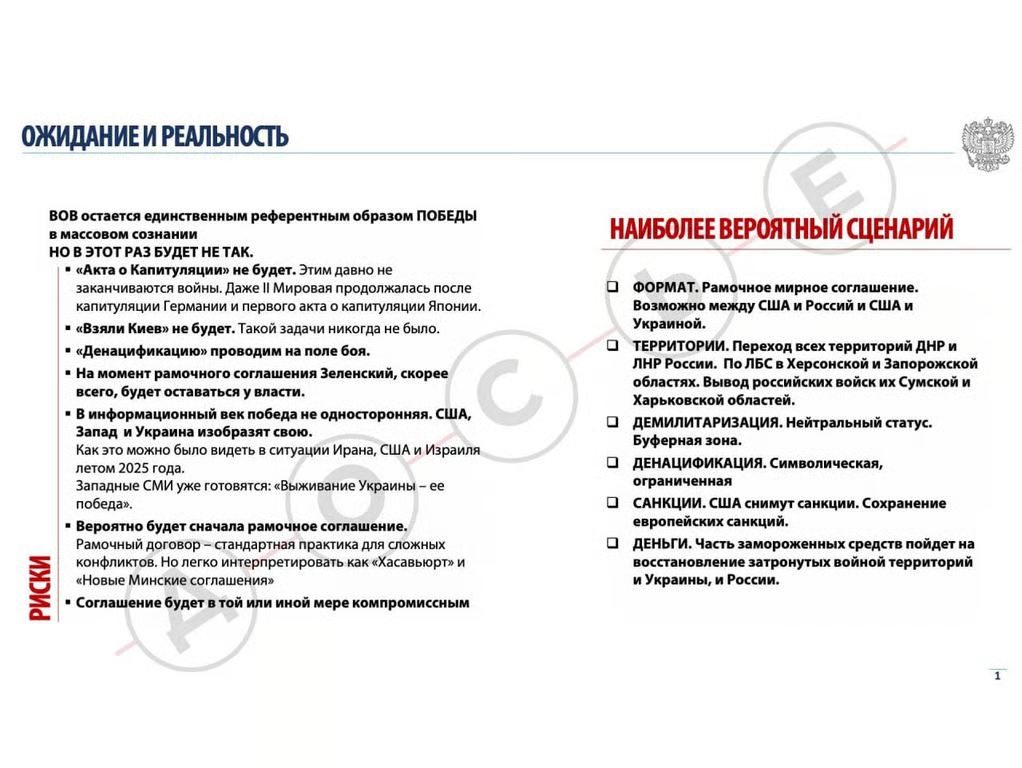
The presentation has no connection to the actual state of negotiations and more likely reflects the expectations of the administration’s political team. It does not lay out an anticipated timeline.
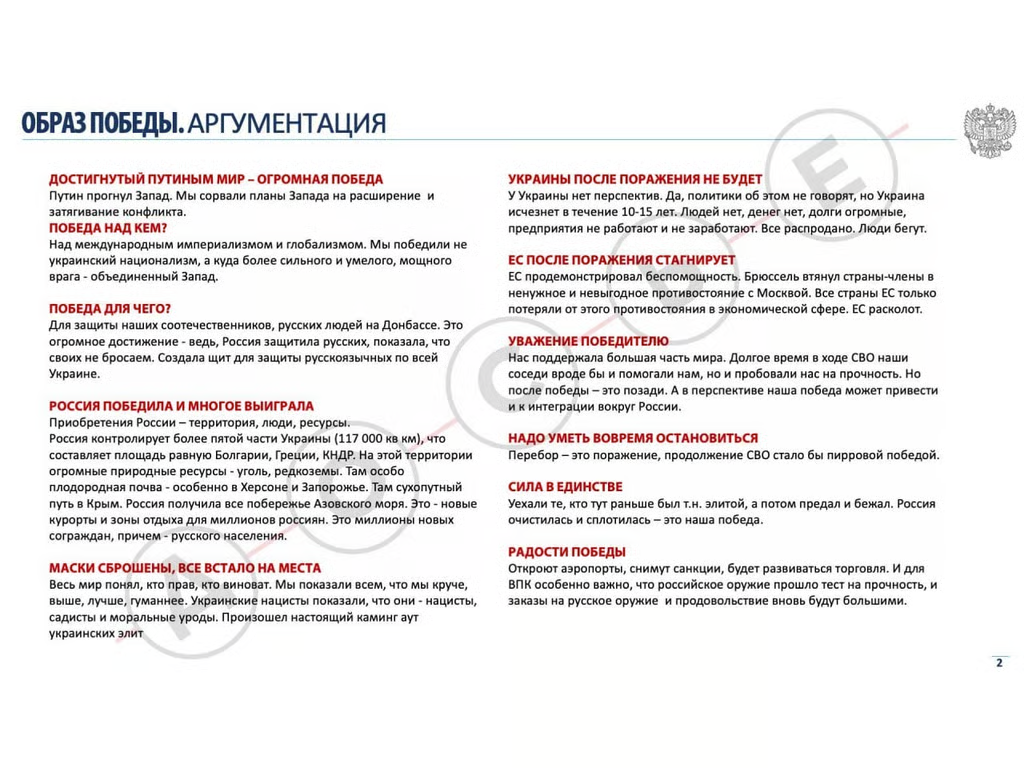
The talking points framing all of this as a Russian “victory” hold that the war allowed Russia to “prevent a humanitarian catastrophe in Donbas,” that its army proved itself “the most combat-ready in the entire world,” and that it withstood a global standoff against 50 countries. The administration's key achievements, the presentation says, include territorial gains, a land corridor to Crimea, and the acquisition of millions of new Russian-speaking citizens. The document also states that Russia has “cleansed itself” of elites who “betrayed it.”
For ordinary Russians, according to the presentation, the end of the war would bring “good news”: talk of normalisation, social programs, business success stories, a “controlled thaw” in cinema and literature, the return of political humour, the rehabilitation of the word “peace,” and a limited amnesty. The document makes no mention of lifting internet blocks.
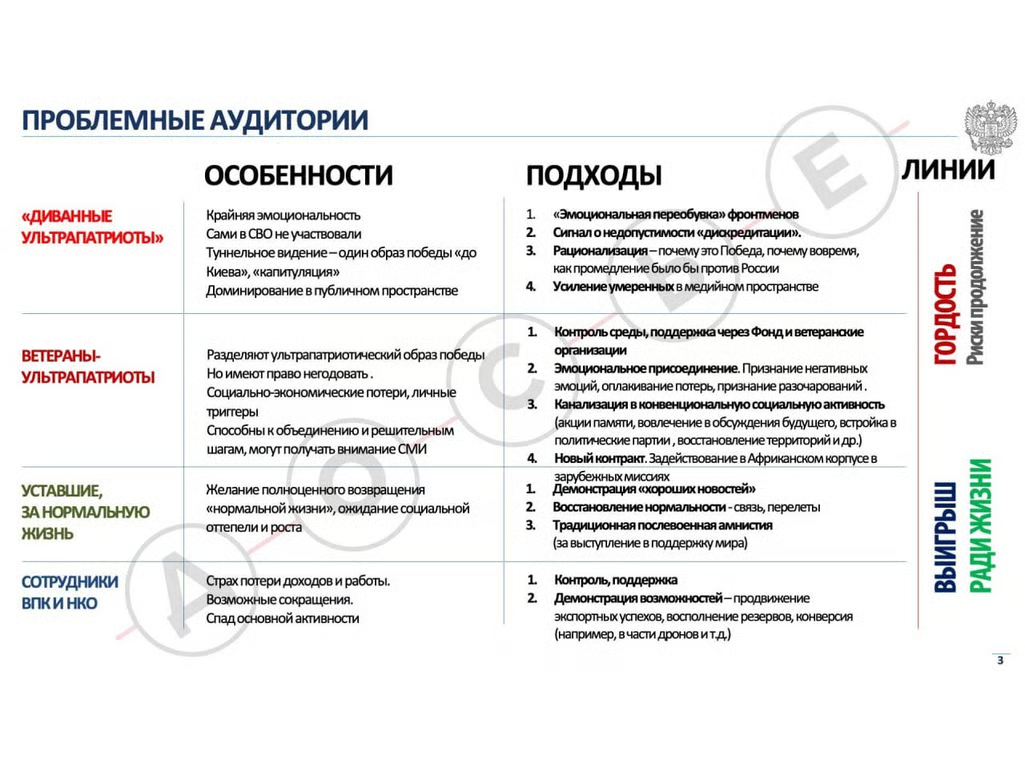
The presidential administration regards pro-war “Z bloggers” as one of its more difficult audiences. Some of these “ultra-patriots,” the Dossier Center writes, may perceive the end of the war as a defeat. To manage this, the administration proposes an “emotional pivot” by loyalist bloggers, pushing radical voices out of the media space, and the marginalization of those who might “devalue the victory.” Anyone who continues to express outrage would face the threat of criminal prosecution.
Whether Putin will approve any of this remains unknown. He himself has given no public sign that he sees the war as nearing its end.