
Оригинал материала
Between Putin and the Pope. The head of Russia’s Catholics resigned for 'health reasons’. But sources say the real reason was his anti-war stance
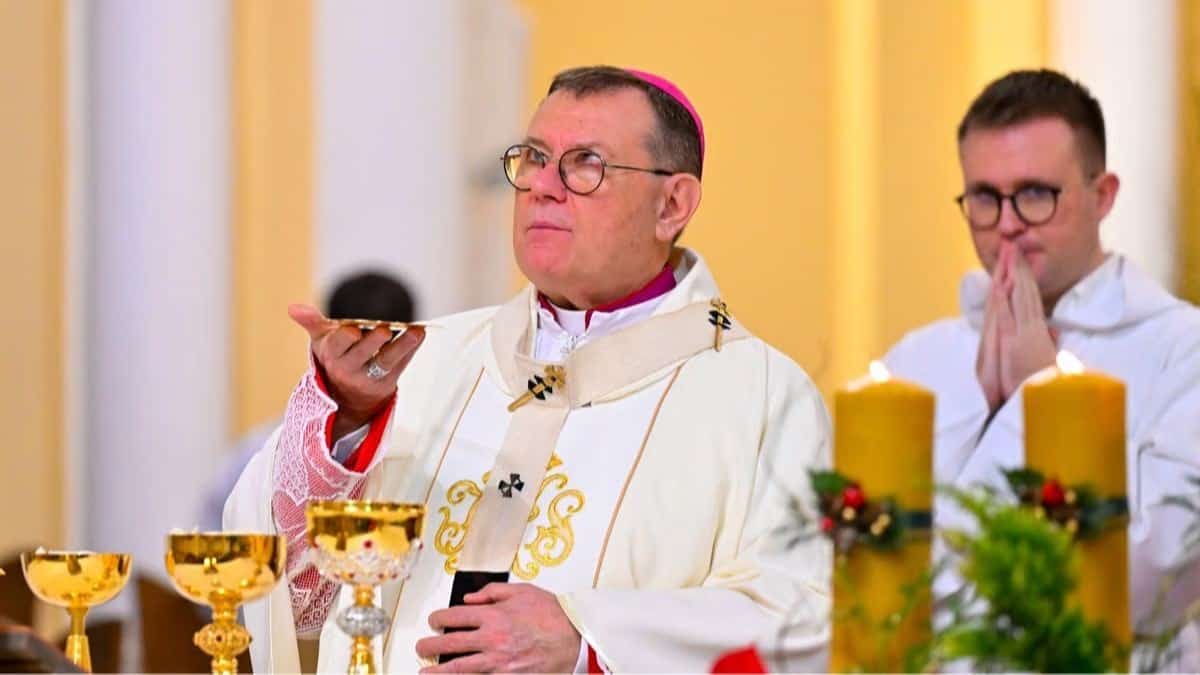
The head of Russia’s Catholics resigned for 'health reasons’. But sources say the real reason was his anti-war stance
On 2 May, Pope Leo XIV accepted the resignation of Archbishop Paolo Pezzi, the Metropolitan of the Archdiocese of Our Lady of Moscow and the official head of Russia's Catholic Church. Pezzi cited health issues as the official reason for his departure. However, sources in the Russian Catholic community tell Novaya Gazeta Europe that their top leader actually left at the insistence of Kremlin or FSB officials displeased with his public opposition to the war against Ukraine. Pezzi’s politics may also have overstepped the Holy See’s preference for “equidistant” relations with all states, including the war’s belligerents.
The new acting archbishop is Pezzi’s former auxiliary, Nikolai Dubinin, a more Kremlin-loyal pick who also happens to be the archdiocese’s first native-born leader. Dubinin referred to Pezzi, who will continue to live as a priest in Moscow, a “good shepherd who dedicated his soul to his flock”.
Born in Italy, Pezzi began serving as a priest in Russia in the early 1990s. He was appointed head of the archdiocese in 2007 and became a Russian citizen in 2011. His farewell address dismissed “conspiratorial” reasons for his resignation but also revealed considerable friction with the state. “Our difficult conditions revealed divisions, especially in families, but also in [church] communities, where people are beginning to quarrel deeply, if not openly,” he said, clearly alluding to the war in Ukraine. He concluded by calling for a “prayer for unity” and the “readiness for reconciliation”.
On the first day of Russia’s full-scale invasion of Ukraine, Pezzi signed an anti-war statement by the Conference of Catholic Bishops of Russia, which he chaired. The bishops warned that the war would bring “death and destruction” and target a nation that had suffered greatly alongside Russia in previous wars. The authors appeared to be taking aim at Putin, noting that “there will come a strict reckoning for the military action being undertaken.” They firmly stated that God was not on the side of the aggressor, as Patriarch Kirill and the Russian Orthodox Church had proclaimed.
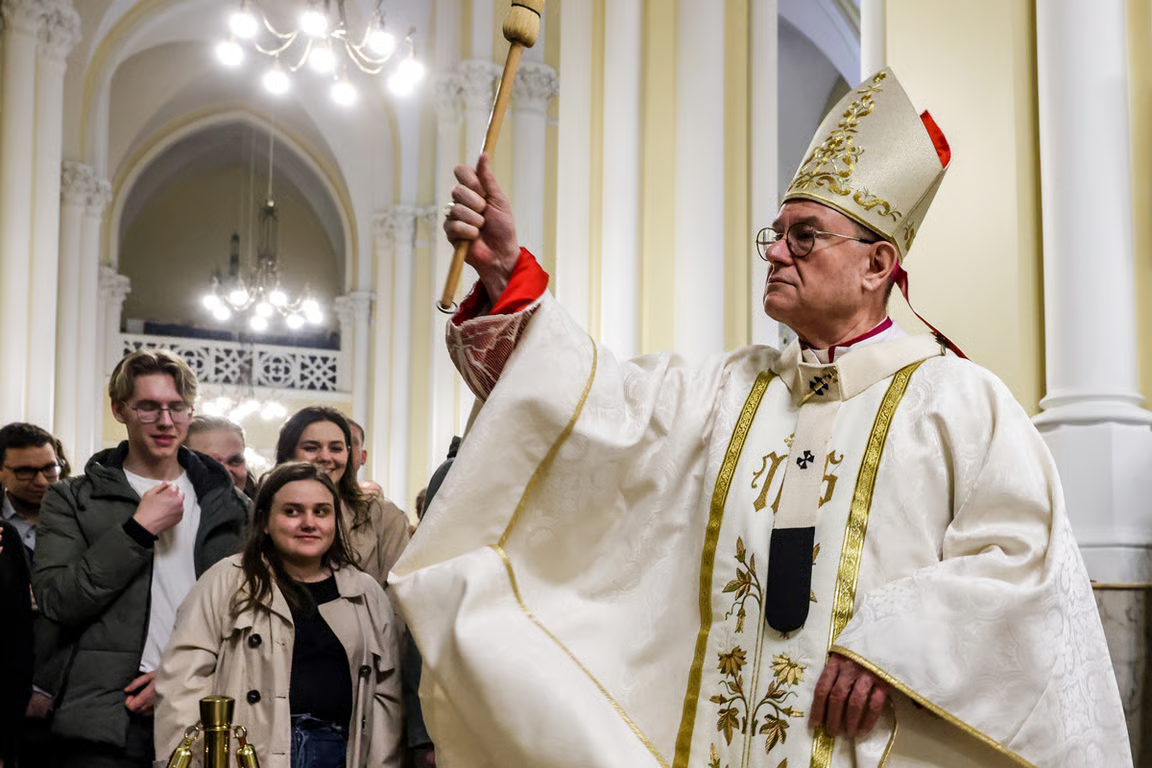
In September 2022, Pezzi criticized Russia’s mobilisation drive as a violation of the faithful’s conscience, describing the officially-termed “special military operation” as a “full-scale military conflict” that threatened the world’s existence. He also evoked Pope Pius XII’s statement on the first day of the Second World War, comparing its initiators with those in the Kremlin: “Nothing is lost by peace; everything may be lost by war.”
Pezzi condemned the invasion again on its second anniversary, arguing that societal depression and moral apathy had taken hold as Putin’s war reached a deadly stalemate.
In October 2024, Novaya Gazeta profiled several Russian Catholics who faced state repression for their messages of peace. The Moscow-based deacon Alexander Shvedov was deported. Churchgoer Galina Borisova was sentenced for “discrediting the Russian army” after affixing the Latin words “No bellum” (no to war) to a Russian flag at a temple in the capital. One Catholic in St. Petersburg was arrested at a protest against mobilisation, and another was sentenced to more than six years in prison for suspected participation in the Vesna youth movement.
Pezzi was in state propaganda’s crosshairs even before the full-scale war. During a wave of protests following the arrest of opposition leader Alexey Navalny in February 2021, he gave an interview to an Italian religious media outlet. On one hand, Pezzi said that “the role of Robinhood that the West sees in Navalny is slightly exaggerated.” On the other, he justified the protests as “peaceful and civilised,” calling them a valid response to systemic corruption that pervaded all levels of government. The police crackdown on protestors was excessive and unfounded, he said.
After this commentary, Russian state media released a hit-piece on Pezzi in the vein of Soviet-era anti-western propaganda. In a textbook case of whataboutism, RenTV labelled Pezzi a “Navalnist” and said the “famous Italian should best remember the corruption in his own country.”
The Russian Orthodox Church (ROC) initially welcomed Pezzi’s appointment as the Catholic archbishop. The Italian priest spoke little Russian and was therefore seen as unlikely to aggressively seek out Orthodox converts. This was a welcome change from the previous Archbishop Tadeusz Kondrusiewicz, a fluent Russian speaker born in the Soviet Union and accused of “proselytizing” for Catholicism.
That understanding lasted until the full-scale war. But when forced to choose between the Christian imperative of honesty and loyalty to President Putin, the priest fell out of favour.
Little is known about the political views of Russia’s new archbishop. Nikolai Dubinin has typically evaded commenting on politics, giving carefully worded responses in interviews. In 2020, he declined to answer a question from Novaya Gazeta about Catholics of the Eastern rites, who follow Orthodox rituals while recognising the Pope’s authority, infuriating the ROC.
Orthodox nationalist circles have tried to fill the gaps in Dubinin’s biography with conspiracy theories. Most prominently, they seized on leaked documents from a “synodal path” conference chaired by Dubinin in St. Petersburg in June 2022. The discussions touched on the participation of LGBT believers in church life, with one participant proposing that the church improve its competence in working with LGBT people. That was enough to spark a conspiratorial uproar.
A Telegram channel linked with the “Association of Orthodox Experts” and a nationalist military group published a “dossier” accusing Dubinin of being the “de facto coordinator of the LGBT-Catholic movement” — a potent charge given Russia’s ban on so-called “LGBT propaganda” and the “LGBT movement”.
Pope Francis officially allowed the “partial blessing” of same-sex couples in December 2023. If Russian authorities followed their laws to the letter, the Catholic Church would thus be banned in Russia as a participant in an “LGBT movement.” Orthodox protestors once even blocked churchgoers from Moscow’s Cathedral of Immaculate Conception, though the police eventually dispersed the crowd.
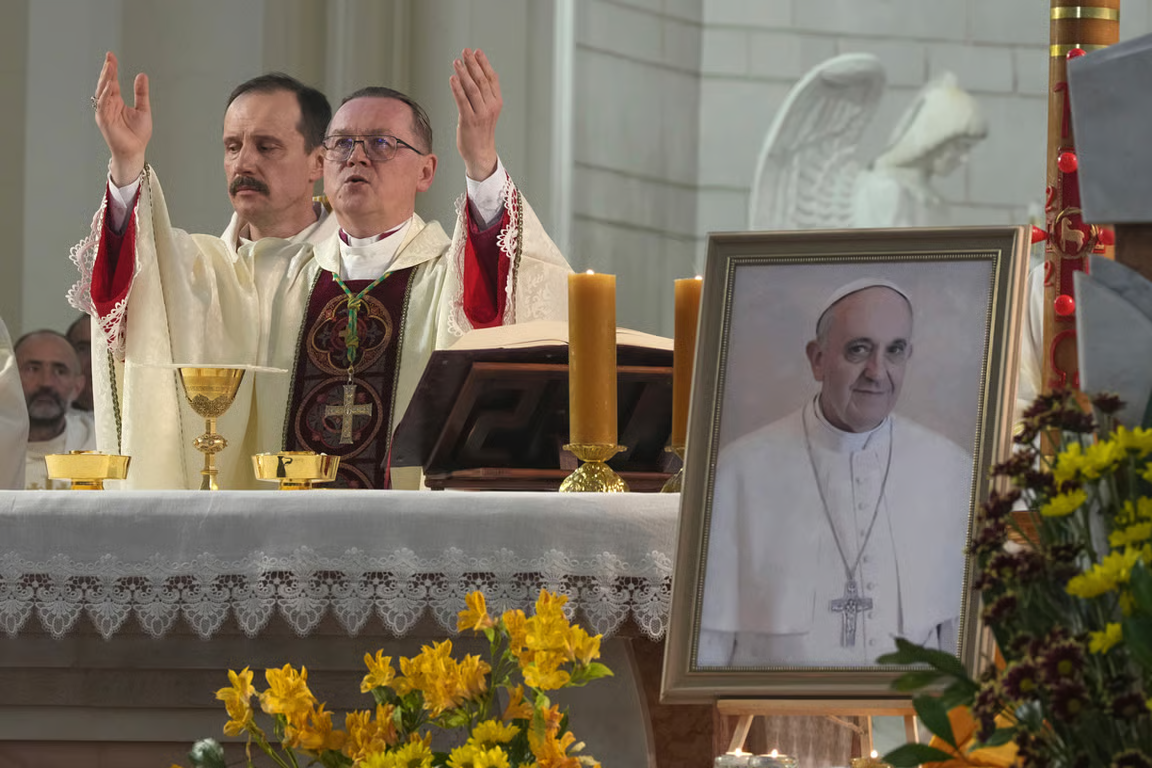
The Catholic Church is still the largest religious organisation in the world, with a long history of coexisting with a range of regimes, including authoritarian and totalitarian ones. Even so, its situation in modern Russia is unprecedented. Catholic social teachings are developing against the flow of “traditionally Russian spiritual-moral values” promoted by the state, diverging on the topics of war and peace, civic life, and the rights and dignity of LGBT people.
That does not stop the authorities from recognising Catholicism as a “traditional religion”. Moscow sees the Vatican as a “friendly state”, making use of its intermediary role to maintain relations with the West. Last June, Putin held a phone call with Pope Leo XIV which praised the Vatican for impactful humanitarian work. The Holy See has facilitated prisoner exchanges between Russia and Ukraine, notably the transfer to Russia of Metropolitan Jonathan (Yeletskykh), a former colleague of the ROC Patriarch Kirill (Gundyaev) from the Leningrad spiritual academy.
Moscow may see a geopolitical hope in continuing to work with the Vatican. If so, replacing Russia’s chief Catholic bishop with a Kremlin-aligned alternative is a natural move.