
Оригинал материала
Russia carries out massive attack on Kyiv region, including Oreshnik missile strike. Experts say the assault, which killed two and injured over 80, is part of a destructive new pattern
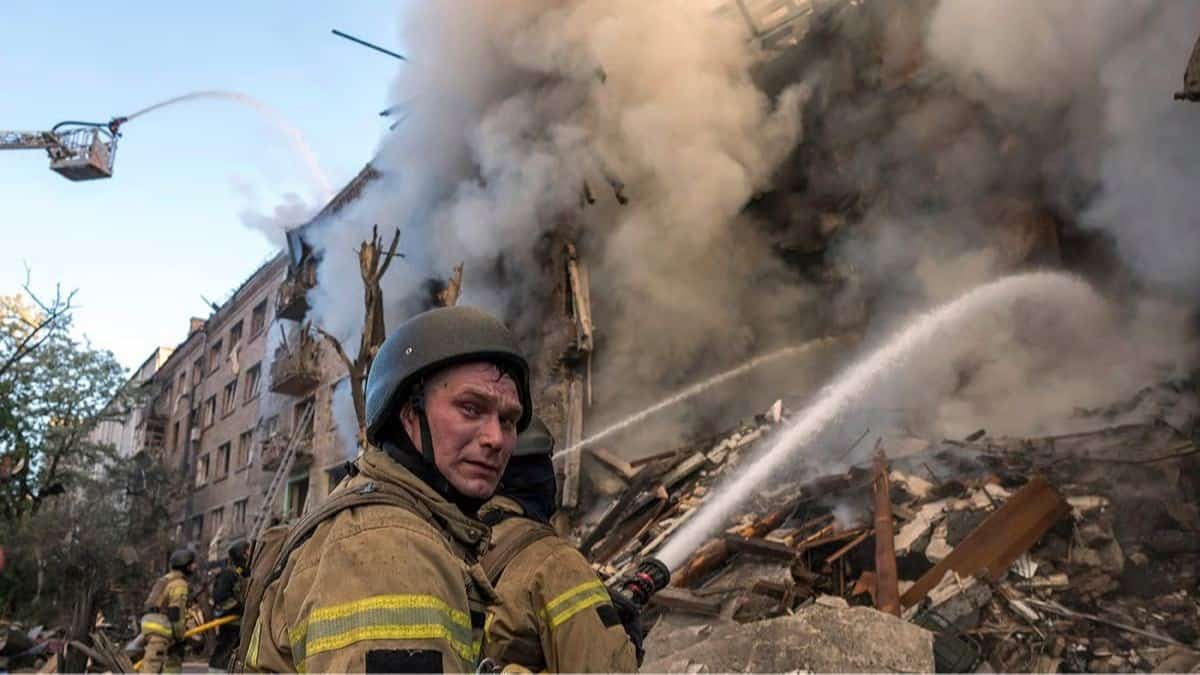
Experts say the assault, which killed two and injured over 80, is part of a destructive new pattern
Over the weekend, Russia struck Ukraine with its hypersonic Oreshnik missile for the third time since the start of its full-scale invasion, hitting the town of Bila Tserkva in the Kyiv region. At the same time, the Russian army carried out a large-scale combined attack on the Ukrainian capital, killing at least two people and injuring at least 81, according to local authorities. At least 40 sites were damaged, including Foreign Ministry buildings, an opera house, and the National Chernobyl Museum.
Nonetheless, military experts who spoke to Novaya Gazeta Europe noted that the Oreshnik is “still raw” and cannot yet reliably hit its targets. They also cautioned that the deadly combined attack on Kyiv portends a bigger threat, as Moscow seems likely to carry out more of these strikes in the weeks ahead.
The Russian military carried out a major missile and drone attack on Kyiv and the wider region on Saturday night. According to Kyiv Mayor Vitali Klitschko, at least two people were killed and at least 81 injured.
Ukraine's State Emergency Service reported fires and damaged infrastructure at at least 40 sites, including apartment buildings, a business centre, a market, a shopping mall, and a supermarket. Also hit were Foreign Ministry buildings, an opera theater, and the National Chernobyl Museum. Ukrainian Foreign Minister Andrii Sybiha noted that it was the first time Foreign Ministry offices had been damaged in an attack since World War II.
In the Kyiv region, local authorities reported at least two people killed and at least nine injured. More than 30 residential buildings were damaged, along with stores, businesses, medical facilities, educational institutions, and vehicles.
Russia also targeted other regions of Ukraine with drones. Eleven people were injured in Cherkasy and nine in the Odesa region, according to Ukrainian authorities.
In total, Ukrainian President Volodymyr Zelensky reported at least 83 people injured across the country. He said Russia used approximately 90 missiles, 36 of which were ballistic, along with 600 drones. “Unfortunately, we didn't manage to take down all of the ballistics,” he said. He added that Kyiv, the primary target of the attacks, suffered the greatest damage.

“Putin can't even pronounce the word 'hurrah' clearly anymore – slurs and mumbles – yet he is still vanquishing residential buildings with his missiles … Launched his ‘Oreshnik’ against Bila Tserkva. They really are unhinged. It is important that this does not pass without consequences for Russia,” Zelensky wrote on X.
Shortly afterward, the Russian Defence Ministry confirmed the Oreshnik strike, claiming it had been carried out “in response to Ukrainian attacks on civilian targets on Russian territory”. The ministry also stated that it had deployed Iskander missiles, Kinzhal hypersonic missiles, Zircon cruise missiles, and drones.
Zelensky had warned the previous day that, according to Ukrainian, US, and European intelligence, Russia was preparing a “combined strike” involving the Oreshnik. The assault came after Vladimir Putin's accusation that Ukrainian forces had carried out a “terrorist attack” on a dormitory at a teachers' college in Starobilsk, in the Russian-occupied part of Ukraine's Luhansk region, on 22 May. Russia's Emergency Ministry reported 21 people killed in that strike.
In total, Ukraine's Air Force reported that Russia used 90 missiles and 600 drones, making it one of the largest aerial bombardments of the war. Ukrainian forces said they shot down or jammed 55 missiles and 549 drones of various types.
Retired Ukrainian Army Colonel Roman Svitan told Novaya Gazeta Europe that “this Oreshnik launch is essentially another pre-production test” and that “the missile is still raw”.
"They haven't figured out how to aim it accurately. This time again, the dummy warheads came down in an open field," he added.
Svitan suggested the real target had been Kyiv itself, but the missile missed. He described the overall attack as unremarkable by recent standards, though he noted that nearly all the drones used were strike-capable. Most of the drones and about half of the missiles were intercepted.
Svitan also predicted that strikes of this kind will recur roughly once a week. “The number of munitions used may vary, but attacks on Kyiv are now the new normal in this war,” he said.
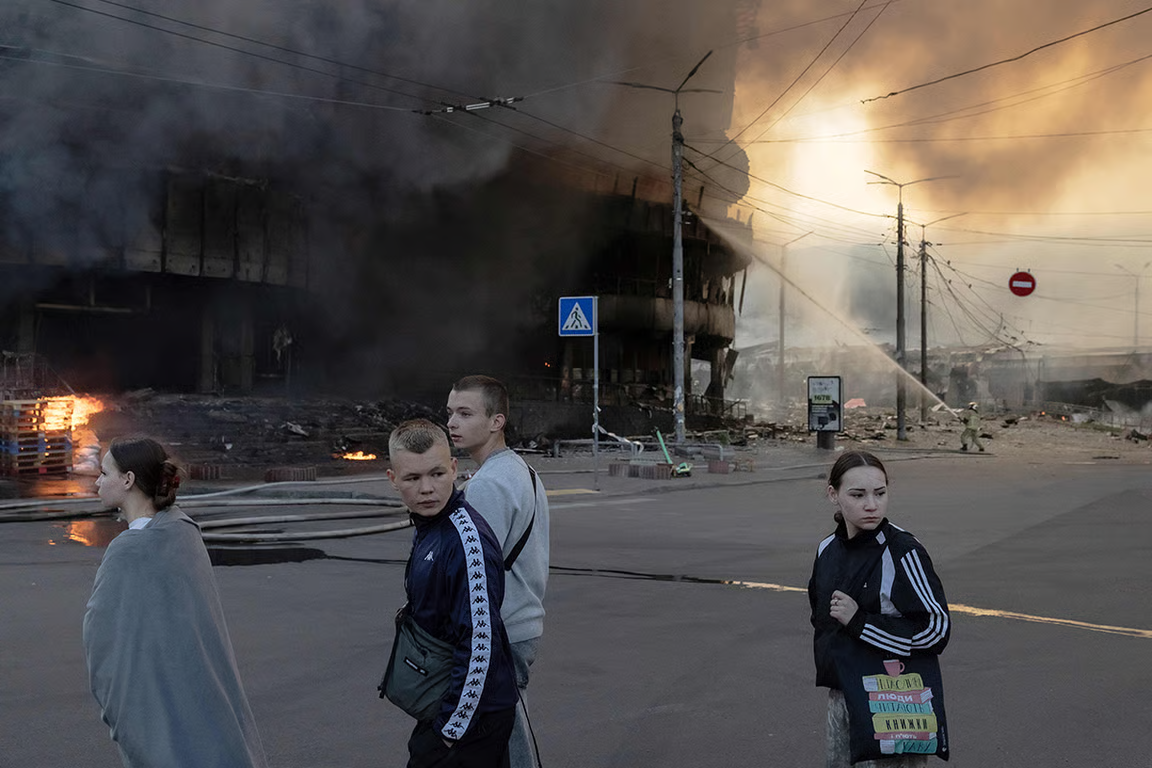
Military and political analyst Oleksandr Kovalenko told Novaya Gazeta Europe that the attack left extensive damage to civilian infrastructure across every district of the capital. He highlighted that the damage was especially bad around the Lukianivska metro station, where a shopping centre and market were completely destroyed.
“This was a combined attack — a mass strike using both missiles and multiple types of drones,” he said. “The last attack of this kind took place on 18 May. Russia has been spacing these strikes about a week apart.”
The Bila Tserkva strike marked Moscow’s third use of the Oreshnik missile since the full-scale war began. It was first deployed on 21 November 2024 in a strike on Dnipro, and used a second time on 9 January 2026, targeting the Lviv region.
“If this missile does not carry a nuclear warhead, it is no more dangerous than two Iskander-M missiles,” Kovalenko said. “In its conventional form, it is just a very expensive hunk of metal that achieves nothing of particular value, apart from the frightening appearance of 36 descending exo-atmospheric dummy bodies in six separating blocks.”
He argued the missiles still lack both precision and serious destructive power: on impact, they release energy equivalent to roughly 30 kilograms of TNT — less than the warhead on a Shahed-136 drone. “But it makes for great footage for Russian propaganda,” he added.
Despite the devastating toll of the night's bombardment, Kovalenko noted it was not the most intense attack to date; the night of 13–14 May, for instance, involved a greater total volume of munitions. In his view, these strikes are now a systematic feature of Russia's campaign. “In a week's time, expect another attack involving no fewer than 50 missiles and 500 drones,” he said.