
Translated material
Is it worth reading memoirs?
 The famous Leningrad linguist, a student of the great Shcherba, Professor Lev Rafailovich Zinder, many years ago told me that he never reads memoirs: “All lies!” - my interlocutor concluded, by no means inclined to categorical. It was in the late 60s, there were few interesting memoirs. Khodasevich - one of my favorite books - was available only in typewriting.
Even today I do not agree that everything is in the memoirs, but it is undoubted that in any memoir texts there are not just understatements, but entire zones of silence. Once the wonderful editor Mael Isaevna Faynberg, who issued Anastasia Ivanovna Tsvetaeva among many other memories (recently they had already been released with the 6th publication), told me about the texts of Ariadne Efron: “What do you want from a woman with such a fate-she was forced to constantly lie!”
Even the silence made by the memoirist with good goals is not to offend, not to reveal other people's secrets, not to distort someone’s appearance, they cannot be tested, since they cannot be checked, even such silence can be relatively harmless, but can be perceived as a obvious and even malicious lie. Well, if the narrative is built around the faces of outstanding, unusual, if contemporaries of the described conflicts are still alive - we are inevitable here: Aut Bene, Aut Nihil actually characterizes how we try to write about the living - or about their relatives, friends, colleagues.
 I must say that the memories, where, of course, the narrator and his loved ones are good and wise, first of all, few read: they are almost always false. The narrator should be able to go into the shadow, even telling about himself. Unless the young Akhmatova could write as if about herself - of course, not in memories, but in verses - "I put on a narrow skirt to seem even slimmer."
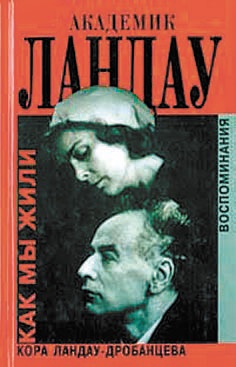
In the memoirs, a similar plot could be fed at best in the key of self -irony - examples of this can be found in the memoirs of our contemporary Tatyana Ivanovna Zaslavskaya. The memoirs of the Landau wife of Landau-Drobantseva over the past 10 years are released a separate book for the second time and use the undoubted attention of readers-which, however, often happens with texts of a scandalous nature.
The Zakharov Publishing House does not bother with any reference apparatus-I would say that it does not bother at all. So it remains not clear than the 1999 publication and the new -2008. Different from the type of text, allegedly destroyed by the indignant academicians -dorses and colleagues Landau, mentioned in the annotation of the typewritten version of the text. Well, we will be content with what is.
Among my peers were people who knew Lev Davidovich Landau before the 1962 disaster, who handed over the famous “Theorinum” and attended seminars in the “Kapichnik”. I myself saw Landau only once, already seriously ill, - in the courtyard of the hospital of the Academy of Sciences of the USSR, where a nurse, barely reaching his shoulder, took him by the arm. I came to visit my teacher V.N. Sidorova stood in the yard for quite some time, lifting her head in anticipation until Vladimir Nikolaevich opened the window of his ward - I don’t remember on which floor. I read Landau's wife Landau “how we lived” I read only now, and I have not seen the film on this book, which was held on the first channel of TV in Gordon's Closed Show. I hope that Ilya Khrzhanovsky, who has long been working on the feature film about Landau, will rely on other sources than this strange narrative.
I was repeatedly convinced that a theoretist (the great scientist is no exception) in this professional quality is not suitable for the heroes of the novel or film: the reader does not find an object to which he can empathize. Much more educated and possessing more sophisticated taste than the chemist-chemist Kora Droban-Tseva-they take up the description of the everyday life of L.D. Landau, would be in a difficult situation. It is not surprising that her story does not tell us anything about Landau - the great physics and the Nobel laureate.

But after all, we will learn very little about Landau as a person, since what is presented to us is a stereotype. According to this stereotype, a real scientist must be scattered, indifferent to money and fame, but with at least one that is not characteristic of a simple mortal line, for example, an amazing memory.
Or weakness to beautiful women. Or ... - in general, understandable.
A car accident, which deprived the world of a great physicist, “gave” the Kore, instead of a lung in everyday life, diffused and mysterious Dau, a mutilated patient who could die at any moment and certainly could not do without unceasing help. But along with the disappearance of the previous Dau, the central conflict of history about how they lived: this (pre -agreed) freedom of DAU to love other women, which, after the first 12 years of marital fidelity, became seriously enjoyed, and jealousy that blessed Kore.
So, the “nerve” of the narrative, up to the incident in 1962, is determined by the dynamics of relations between lovers, later between the spouses, then - inside the formally preserved marriage. The author, frankly, does not owns a pen: stories about rose bouquets, about chiffon dresses, about crystal vases and carpets, about the desire to keep their form in order to like her husband, about the attitude of Landau to other ladies, whom he, in his expression, “mastered”-what he informed his wife in letters about-it was simply awkward to read about all this.
A woman who writes in Russian will write: “I set the table for dinner”; Our author writes: "I served the table." At the same time, it “served” and much more, more precisely, many, moreover, a combination of “hairdressers” beauty with the platform and plots, except perhaps in boulevard novels, gives rise to the text, in comparison with which the professionally-mother “Nikolai Nikolaevich” Yu.Aleshkovsky would like to supply the AD USM Dolphini vulture.

Landau-Krobantsev’s bark was a beautiful, energetic, not very educated woman with a bad character and, as can be seen from the book, with incredible conceit and lack of a sense of tact and measure. She hardly wanted the reader to remember her like this-but any of any voluminous text is ruthless: he deprives the author of “vestments”.
I note that the copyright holder of this publication, according to the weekend, is I. Landau, the son of Lev Davidovich, now - a professor at the University of Berne. This, of course, does not mean that he is responsible for the content of the book. But the book also has an editor - this is Irina Evgenievna - by the way, the daughter of a famous Soviet journalist. The editor in a certain framework is still responsible for the text-for example, for the fact that names or geographical names are not distorted in it.
Landau Cora repeatedly with undisguised contempt writes about how at the Institute of Neurosurgery. Burdenko came to her husband “some kind of psychologist Lurie,” who drew her husband with a drawn sheet of paper with the image of crosses and circles. On the following pages, the work of a psychologist with Landau is described in the same tonality, and it is emphasized that psychologists in such cases lead to selfish motives -they write their dissertations due to the misfortunes of patients. Unlike a wide reader who is addressed to the book “How we lived”, I.E. Bogat could have guess that in this case it was a glorified Soviet neuropsychologist Alexander Romanovich Luria.
Let me remind you that in the mid-60s, only a neuropsychologist could make at least a relatively accurate diagnosis to a patient with brain injury: tomography and even more so the magnetic resonance method entered the medical practice much later. Who at least once in those years visited A.R. Luria at the Institute. Burdenko will no longer forget his virtuoso and largely unique analysis methods.
"Why are you even writing about this book?" - a friend asked me, who once read the edition of 1999. to answer quite simply: in order for the reader who has grown up during this time to know that he is holding in his hands. Those who are interested in the personality of the great physicist L.D. Landau, with interest, will read the materials recently posted on the website of the network magazine “Notes on Jewish History” (h ttp: //berkovich-zametki.com/2008/zametki/ nomer12/zheitk0.htm ).