
Translated material
Parliament will still become the hope of Russia
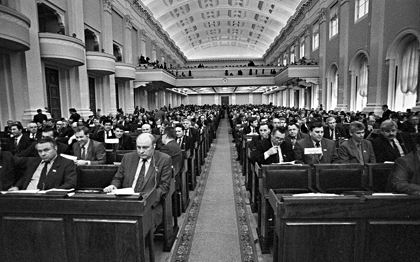
20 years ago, on May 16, 1990, for the first time after the acceleration of the All -Russian Constituent Assembly by the Bolsheviks on January 19, 1918, the parliament democratically elected on a multi -party basis gathered. Despite the clumsy design - the congress and the bicameral Supreme Council - in its structure, the volume of powers and the mood of most deputies, he, throughout the post -October history of Russia, had the greatest signs of a full -fledged parliament. Then Russia was a parliamentary republic, since the head of state was not the president, but the speaker.
This event became one of the climax of the Russian democratic revolution. The parliament, perceived as the highest authority, stopped the reaction in March 1991, when troops were introduced into the center of the capital, and in August 1991. The fact that supporters of democratic reforms relied on parliament helped the non-violent and evolutionary nature of the changes in 1990-1991. But the parliament, chosen during the revolutionary upsurge, quickly “obsolete”. Therefore, already in the spring of 1992, it was necessary to hold new parliamentary elections, or, as offered by the Democratic Russia movement, elections to the Constituent Assembly. After all, everyone considered it natural that the parliament chose in the atmosphere of legal chaos and the fever of a crisis of the fall of 1993 had the authority for only two years. Although in the newly created State Duma there were a lot of bright and strong deputies, probably from a professional point of view, it was the best composition of the Russian parliament.
Democratic parliament - the icon of civil society
The decomposition of civil society immediately affects parliament. Further, the feedback mechanism is turned on: the lower the prestige of the parliament, the dirtier the mores are in it (to reject the good law of another faction, and then, after stylistic editing, offering it as your own - this is already in the order of things), the lower the level of personnel stuffed into lists ...
Yes, 20 years ago there was no such developed civil society, but this was compensated by a powerful emotional rise, hopes, confidence in the demand for talents. I am convinced that a new public climb, a new impulse to democracy and the rule of law will return faith to parliamentarism and a new, honestly and freely chosen parliament of Russia, will not only again become a “place for discussions”, but will also turn out to be the center of political life.
1989-1990, Soviet society also met with a laid out stagnation, disappointed in the dumps of the “apical perestroika”, split on top of the bottom with ideological disputes. From this social magma, a protoparty began to be released. But this path of public self -organization was deadly. The real mass organizations were wide associations of civilian activists who grew up around many groups based on protection or defending quite private topics or in support of specific candidates for elections to the USSR Congress. The support of the press gave a lot, which then-differently, of course-advocated democratic reforms.
Since the spring of 1988, such a form of wide coalition was appeared at its core as “popular fronts”. In the republics, a national anti -imperial factor was a consolidating feature, environmental problems, the protection of cultural monuments, the memory of repressions, the fight against corruption and bureaucrats were already added to it. In Russia, such new forms of civil activity as clubs of voters served as a unique center of public crystallization. From the broken, seemingly hopelessly decomposed and corrupted by the communist totalitarianism of society, with its all -pervasive fear and lies, civil society began to grow rapidly. Then there was a unification of the candidates of democratic orientation and their support groups in the Coalition “Democratic Russia”, which became the winner in the 1990s February elections.
Now the public-state device is quickly turning into party-government. Again, an important political role began to play a government based on the parliamentary majority. It was the winning party who received the right to nominate candidates for the post of heads of constituent entities. National elections have become only purely “list”, the same trend at the regional and local levels. The only constitutional source of power was essentially a party, the list of which received the majority in the elections (or he was recorded).
Critical was the amendment to the Constitution to increase the term of office for deputies and the President of Russia for a year. This is a fundamental measure: our practice shows that just in five years of dominance in parliament, the ruling party manages to complete the transformation into a “party in power” - a political monopolist not controlled by society. In the same way, in six years, the president manages to create his own party with hardware methods.
I do not like the system of dominance of purely list-pavements. This in countries with strong democratic traditions leads to bureaucratization and political corruption, and already with us ...
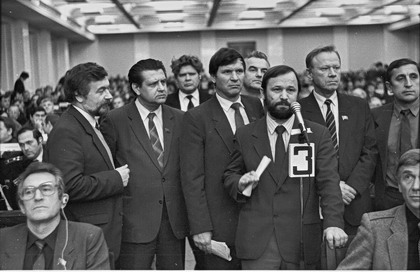
In 1989-90, Russia went through the crucible of a real public political struggle, the Democrats knew how to unite the coalitions of civil and political forces around themselves. Thus, real leaders of civil society were brought up. And the system of party elections, on the contrary, forms the type of politician-cat, obedient and faceless details of the party machine. Yes, a strong demagogue or an influential tycoon can overcome the elections using unworthy techniques. But in the majority system, their destiny is one place. No “steam locomotives”, pulling the string of representatives of the new political nomenclature, are impossible in such a situation.
I would like, when really competitive free elections return to our country so that they go mainly according to the majority principle, and public organizations have the right to nominate candidates and to participate in the elections.
The author is a member of the Coordinating Council of the movement "Democratic Russia (1991-2003), head of the information and analytical service of the OOD" For Human Rights "