
Translated material
What to teach? Who to teach? How to teach?
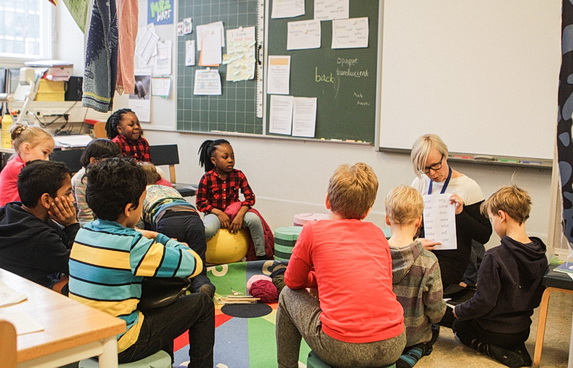
Perhaps there is no other public institution that people would be so unhappy throughout their history as a school. Are there many attractive images of teachers in the world literature? Are there many adults, with a kind word, remembering the school, where they studied? Some of the teachers will still be remembered by good, but the school ... Are there many parents who are satisfied with the school where their offspring study?
It seems that society wants something from the school that the school in principle is not able to give.
The problems of the school come down to three questions: what to teach, to whom to teach, how to teach. True, there is another question, what kind of money to teach, and the problem of the relationship of the school and the state. All this together makes up a tightly twisted ball, from which it is almost impossible to pull out a separate thread for a more detailed consideration. But still we will try.
What to teach?
As long as I live, I remember these thousands of times the words heard: the school should prepare its pupils for a future life. They live at another time, in another world. Here the school should prepare them. Wait, and we know what this future will be? Could we predict today? How can you prepare for the future, which is unknown and variable? This school cannot.
What can she? A good school is capable of only one thing: to convey the knowledge and experience accumulated by its predecessors to the young generation. Moreover, we still know well that from this experience it will be necessary, in demand by our descendants, and what will not be useful. One hundred and fifty years ago, the democratic community violently discussed the problem of studying in the gymnasiums of the “dead” languages - Latin and ancient Greek, everyone was very sorry for the poor gymnasium students who were supposed to gently conjugate the Latin verbs. The democratic community eventually won: “dead” languages were excluded from the school curriculum. But today in St. Petersburg there is a classic gymnasium, where these languages are again in the program and the competition in which is a hundred people in place.
Young people will grow up and they will figure it out that of the knowledge gained for them will be relevant, and what will remain unclaimed. They will decide for themselves whether they agree or not with the picture of the world that the school formed in them. They probably will refuse a lot and dispute a lot. But they will know what they refuse and what they dispute. In no other way. And we have no right to decide for them.
And maybe we still know something about the future that awaits our descendants? If we look at the life we have lived, at the life of previous generations, we can say with a significant degree of confidence: the world will become increasingly changing, these changes will occur at more and more speed. Here, to life in this rapidly changing world and we must prepare our children. But this is the problem of not the content of education, but its organization. The organization of education, those relations that develop at school, school order teach no less than the content of the subjects taught, and maybe more. I don’t remember the lessons in the first grade at all, and I remember how to put our hands on the desk, get up when we were taught to fold our hands on the desk, I remember very well.
A student of Russian primary school spends 4 years (a huge part of his life, from 7 to 11 years) locked in four walls of his class, with the same teacher, surrounded by the same classmates. How can he prepare for life in a changeable world in such conditions?
The American primary school is designed for 5 years. But every year the student begins with a new teacher (they have teachers of grade 1, grade 2, etc.) and with new comrades. Every year he has to adapt to new conditions again, learn to work with other people, learn a new space. And you try to transplant our student from one place to another - he will protest and perceive it as a punishment. Yes, this will be a punishment.
Here I imagine the perplexed question of my colleagues: "But what about the formation of the team?"
Unfortunately, the modern Russian school in this regard has not gone so far from the Sovetskaya school. The team still remains one of the highest values of this school. The habit turned out to be so strong that many teachers still believe that they teach 3B class, or 5a, and not specific Petya, Kolya or Natasha. The school administration forces teachers to calculate the percentages of time and unsuccessful, those who study without “triples” and with “triples”, and a particular student name of the rivers disappears behind this digital. He can only spoil reporting if he put him what he really deserves. But all these 3B or 5A are just a formally bureaucratic abstraction. The only reality is precisely the specific Kolya and Petit, it is they who teach them with greater or less success. And their future largely depends on how much we teach them on our own, at our own peril and risk of making decisions without looking around, not hoping at the shoulder of a friend.
Let's look at the photos of school premises in developed countries. Will we see 35 - 40 students in first grade? Do we often notice tables or desks for two students? In these classes, each student from the first day receives his space, his own place, his own table. Sometimes it seems to me that if we once landed all the first -graders in Russia for individual tables, then after 12 - 15 years we would have received another society and another country.
And the student tables that are in many classes of Finland in free order, each from its own angle, and not built in three columns, like ours? Here it is, a demonstration of the principle “each in itself”, no one is built into a collective whole, is not part of something.
And then the relationship “teacher - student” acquires a different character. The teacher does not stand against the class, he is not the one who broadcasts. From him, the strings are not drawn to everyone, but to everyone. He is for each senior comrade, mentor and assistant in the difficult matter of knowledge.
Now we will do an experiment. We invite a group of high school students to the classroom and offer them to eat. There are no less tables than children. Maybe even more. But schoolchildren will still get into one or several piles more pierced to each other. They are so accustomed to the years of their studies at school. Well, then they will vote the same. And the position in the surrounding world will be chosen in the same way. And in the power of the TV they will find themselves together with everyone.
In our school, cheating at each other is a prevailing practice for centuries. This persistence is amazing, with which many of our students prefer to rewrite other people's nonsense and mistakes, instead of thinking with their own heads. This is because they believe another than themselves.
Why not write off in America? There, this practice is almost completely absent. Not only because the spirit of competition lives there: why will I give me to write off my competitor? But because there no one considers himself stupid than others there.
True, as we know, the grass breaks through even through asphalt. Recently, they told me how in one of the most elite schools in St. Petersburg one seventh grader hit another and, explaining his act, said: “He came too close to me.” Of course, it’s not good to fight. But, it seems that in the new generation more and more young people will appear on guard of their personal space, ready to make their independent choice in any life situations.
And I would like the school not to slow down this process, but to contribute to it.
Photo: from the site TERVE all about Finland
In February, 4 years have turned 4 years since the beginning of the publication of the “Real News” information bulletin , produced in St. Petersburg by a group of activists of the opposition and democratic movement. During this time, 84 issues of the publication were already published.
The “real news” arose in early 2015 as a way to confront aggressive pro-government propaganda, for many residents of St. Petersburg and Veliky Novgorod, the source of honest and objective information, free of propaganda and hatred.
The publication is designed for a politically not engaged to the reader (in St. Petersburg it spreads on weekdays in evening streams, mainly at the "sleeping" metro stations) .
The Bulletin "Real News" is a non -party and inter -party publication. Members of Parnas, Solidarity, Yabloko, Open Russia and other opposition organizations participate in its distribution.
All NN numbers can be seen in the archive at: https://goo.gl/xvsxxo
The ballot is published exclusively at the expense of its readers and publishers. Those who wish to support the publication can do this by transferring any amount to the Sberbank card 2202 2009 5985 2003 or Yandex-Koshelk 410014250793357.