
Translated material
Mirror of our customs
Digest on the book of Aquarius G., and Sidorenko S. “Law and Justice” was prepared by Vladimir Berman
The moral of a typical policeman in any state depends on the moral norms of most citizens. In societies where people prefer to understand with extra -court, extraordinary means, and police prefer to follow this tradition. There, the police without serious ties in the authorities, without bribes, is not only useless, but also dangerous.
The authors of the book under discussion, analyzing the work of the police of countries that cannot be attributed to democratic and developed, note that there usually a policeman charges regular tribute from persons employed in his service by any business. Opera of those who are busy with prohibited activities are much more. The requisitions may include free dinners in a restaurant with drinking, prostitutes' services, and percentage of income. Danes are paid in exchange for patronage, a tolerable attitude to illegal crafts, for warning about checks, and other help. Police requisitions are a permanent expense item. They increase the cost of goods and services, that is, they are transferred to consumers.
According to the authors, the dependence on the location of the police chiefs has become one of the most dangerous risk factors for Russian entrepreneurs. In modern Russia, no commercial bank is created if there are no higher officials of law enforcement agencies among its founders or patrons. Entrepreneurs know that we can’t do business without paying tribute to the police and other warding bodies.
If there is no respect for the laws in people, then almost every member of society is a potential police client, a concluded, the number of which is determined by the power of police units, courts, convoy troops, and the number of places in places of imprisonment. This is especially characteristic of countries where the "elite", that is, the ruling bureaucracy is the foundation of the authoritarian regime and assigns most of the social product, leaving all the rest of the crumbs. In such societies, violence and repression become the inevitable norm. The "elites" have a predominantly "power" type of thinking: to publish as many prohibiting and punitive laws as possible, to tighten all kinds of sanctions, and it is better to plant and shoot more often. These acts are always more willing to be financed than the development of education and culture.
For taxpayers of such states, the content of the police and other law enforcement agencies does not guarantee security. At the right time, you can not get help. We have to support private guards at their own enterprise or in the entrance of their house.
* * *
Russia is a world leader in the level of corruption of bureaucracy, the number of which has increased by at least three times compared to the Soviet period. Our police and bureaucracy most dangerously harm Russian society in the fact that criminalized entrepreneurs are actually selected into the business sphere of the country.
There are many who want to establish trusting, friendly relations with police officers, police colonels and generals. After all, the police have serious authority, more than other state bodies. The multimillion -dollar mansions of Russian police generals were not built at the expense of wages. These are expressed “signs of attention” of status “friends” expressed in the suitcases. This corruption income of police officers is many times higher than their official salaries over the years of service. The police are not in the loser and the rank lower. The heads of mid -level operational units have informal “surcharges” for fulfilling very specific requests of entrepreneurs and financiers. And ordinary police officers, for example, employees of the GBDD, are not averse to collecting tribute from ordinary citizens. The activities of law enforcement law enforcement officers (even without taking into account the costs of private security structures, for the security services of corporations and banks) are by our company in amounts that exceed the budget financing of the police several times. This is one of the reasons for the poverty of tens of millions of Russians.
For the years that have expired after the start of market reforms in Russia, not a single anti -corruption law suitable for the work was adopted. Not a single attempt was made to mobilize and organize the work of law enforcement agencies to combat corruption in power. Financial fraud, with damage to taxpayers for hundreds of billions of dollars, is the work of the army of domestic corrupt officials in the power or cooperating with the authorities. This speaks, first of all, about the mafia nature of our "elite", of the ruling of morality in her ranks.
Rare trials over embezzlers cannot mislead. All representatives of the authorities are practically tied with corruption relations, the property declaration of any official is always incomplete, he hangs on the hook. Therefore, the sentences, pronounced by “pocket” courts even ministers and governors, are made only for the others, so that they observe the loyalty of authoritarian power. Naturally, such a struggle of law enforcement agencies with corruption does not make any impression on corrupt officials. Those who made their way to high positions in the structures of power are vitally interested in this struggle and in the future would remain a show -off.
The lack of a systemic struggle of law enforcement agencies with total corruption, primarily at the highest levels of federal and regional authorities, turns into huge theft, the amount of which, according to a number of economists, exceed the country's annual budget. Stolen capital is exported to offshore and developed countries where families of many officials are moving to live. Russia turns into a colony. This negates the prospects for the development of the domestic economy, an increase in the living standards of Russians.
In relation to representatives of the highest level of power, under any of their offenses, the police are powerless. And not only because of the tough warning by the generals of their subordinates not to persecute senior officials, but also by virtue of various protective documents and laws that ensure immunity from persecution. Moreover, it is in the midst of high -ranking officials that the most dangerous and destructive for the state and society of theft are committed. In fact, in Russia there was a mechanism of total predation, the main participants of which were business structures, banks, almost all law enforcement officers, bureaucracy, and legislators. Law enforcement agencies are actually busy serving the interests of exclusively in power, owners of corporations - to the detriment of the rest of the country's population.
* * *
The authors of the book noticed that in almost any service environment, selfish people always predominate, careerists - pretensors, hypocrites, lyceums, loudly swearing in any reason in their devotion to the interests of the nation, the state, giving their violent career, acquiring bustle for agricultural ministry. Singing praise and health resorts in honor of their bosses and heads of these bosses on countless buffes, such “servants of the Fatherland” in excess and in law enforcement agencies.
The police of many countries are not able to effectively fight against the drug mafia, primarily because the generals of these law enforcement agencies are included in the privileged social layer to which the vast majority of the leaders of the drug mafia together with the vodka and tobacco “kings” belong. They are “sponsors” of politicians, churches, medical institutions, sports, orphanages, and in some cases and prisons. The powerlessness of the police against organized crime, primarily in the areas of drug dealer, smuggling of weapons, antiques, drug trafficking, largely comes from the fact that special services actively cooperate with organized crime structures, using their capabilities for the implementation of long -term plans to undermine the economy and the military potential of their geopolitical opponents. Cooperation of this kind is accompanied by the protection of the leaders of the People's Commissariat from the police at a very high level of power.
* * *
The reason that the police cannot make a completely socially useful institution is the technology of career selection of personnel. Nine tenths of successful quarries in the police are made only in career groups: from ordinary friendly companies really capable of professionals who help each other on occasion to groups of those who are obsessed with only career goals and specialize in self -serving services to officials and influential owners. It is the participants of the groups of those who are obsessed with career goals that almost absolutely filling out the highest posts - to the general levels inclusive.
The leading motives of their activities are not the need and problems of the police. Their main concerns were and remains to ensure the interests of higher managers, heads of territorial administrations, a successful “fit” into political shares according to the requirements of authoritarian power. They are preoccupied with the fulfillment of requests and appeals of the nearest "friendly" environment. This turns police structures into a means of maintaining mainly interests of the command staff, their family needs, the interests of leading politicians, close business captains, and other persons of personally useful socially significant persons. Such an algorithm for the "official" activities of most higher police officials is indestructible until the system of evaluating and monitoring the work of law enforcement agencies is changed.
* * *
The authors indicate a special danger to the state and society of the current extremely dysfunctional situation in the judicial system. Unfinished legal proceedings in Russia are not only a consequence of the dependence of the judicial system on the executive authorities. The members of the judicial community themselves show interest in obtaining a solid bribes, they themselves are included in the processes of redistribution. Such judges arrange the executive branch and semi -criminal Russian business, because it is easy to agree on mutually beneficial conditions with them. Guarantees of the inviolability of judges without guaranteeing their high moral level played a cruel joke with our state and society: the speed and degree of corruption of judges surpassed these processes even in the police and the prosecutor's office. The prices for corrupt services in the field of legal proceedings are now higher than that of all other law enforcement officers. Offended property “according to the law” is now perhaps the most profitable criminal legal arbitrariness, which is affordable or only powerful financial and industrial corporations or state law enforcement agencies.
The conclusions of the authors are unambiguous and gesture. The multimillion-dollar Russian bureaucracy is engaged in embezzlement, bribery, and in some places banal theft. The authorities are completely accepted: cowardly, thieving, who was around the bureaucracy around - an excellent tool for managing the current “democratic procedures” of the formation and filling of the authorities and management of society with their people. This is the same administrative resource, which in the practice of "state construction" is more effective than even serious financial resources.
That is why corruption for the current authoritarian political regime is not an object of attack on destruction, but rather the only way to maintain supremacy over the bureaucracy, with which something else can be done somehow.
* * *
The period of the history of Russia, when the police and the courts, like medieval conquerors, are allowed to rob the inhabitants of the city taken by impunity, should ever end. The authors hope that then there will be worthy people in law enforcement agencies. The question is - will the source of political will appear at the highest levels of political power, capable of allowing people who have retained conscience, honor and human dignity to consolidate in law enforcement agencies? Will this power get political will to bring all the components of the Russian law enforcement system into a state comparable at least with German or French?
The authors believe that with a skillful organization of the sanitation process of a Russian law enforcement system, satisfactory results can be achieved in an acceptable time. Along with the real separation of the authorities, political competition and the control of representative bodies, the work of law enforcement agencies, it is useful to establish intra -human regulatory structures in the latter. They must have powers to remove the official by the official from his post. Then the fertile system of mutual reporting will rapidly gain momentum and launch the technology of self -cleaning of the personnel of law enforcement agencies to states, when the contours of the law enforcement in their activities and official ethics.
_____________________________________
Aquarius G., and Sidorenko S. "Law and justice." -St. Petersburg: Publishing House "ABC-classic", 2008 ..
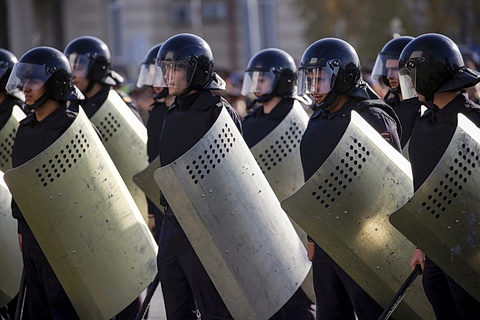
Photo: 11/08/2019. Police Parade in Rostov-on-Don in honor of the day of an employee of the internal affairs bodies of the Russian Federation. Valery Matytsin/TASS