
Translated material
Owl of Owls, Gagar and Gulls
Tomorrow, July 22, is the continuation of the silent cinema program in the voice acting of modern composers, which is in the Moscow Museon Moscow Art Park. Two films of Dzigi Vertov will show - “The sixth of the world” and “Eleventh”, music - “Metro 3”. Maxim Semenov - about the beginning and end of the revolution, captured by the Autonomous Cam of Vertov.
In the evenings, people gather in the parks. Pleasant music plays, in neat trays they sell sandwiches collected according to the New York model, and among the magnificent design flower beds are happy couples. In Moscow, summer.
The audience buys soft drinks. The couples are seated on wooden benches. The musicians tuned in, and the movie show began. The bearded guy on the right cigares a cigarette for a long time. The girl saw something funny on the screen and now whispers about it in her friend's ear. “I see you! How, you serve the capital! And people still suffer! "
This is rushing from the screen of the stream of interpreters. Give the "sixth part of the world" Jigi Vertov. Klota film, film-promising. Hundreds of operators from the Black Sea to the frozen shores of the North, from Leningrad to the border with awakening China, were removed for him by Soviet people. Their crafts. Their everyday life. Their holidays. Their faces. A small airplane flies above the sixth part of the world, and everything that happens in the world can be seen from its cab. Who is at the helm? The believer would say that God. But no, this is not a god, this is a man, since the kingdom of the old gods ended and the kingdom of people has come.
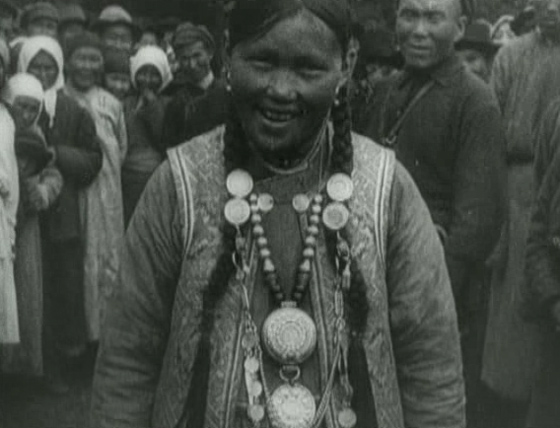 Frame from the film "Sixth of the world"
This kingdom is amazing. For the first time since the time of Adam, man commands animals. The animals are not afraid of him, they are submissive to his will. The Soviet man commands owls, seagulls and gagars, he is an autocrat of sheep and protein, the lord of poultry and cattle. Nature seeks to reward him for work. Wheat pours a river, huge sturgeons and belugas themselves sail to the fishermen, the boxes full of fruits, as if by magic, are packaged and form entire towers. And this amazing abundance belongs to everyone. That is, to all. From the Vogul, who gripping his teeth, the rope, and Ostyak, who is trying to call for spirits, to an employee of the weaving factory or Ukrainian stooper. Any worker, even if his mind is still captured by old prejudices, builds a socialist state. And this is grandiose and fun. Very fun.
And also in the yard of the 20s. And even if you believe in God, then you can believe in him, because soon we will still build communism. And you will go into him, because you are also a citizen of the Soviet Union. The world's first state, where a person has committed human exploitation.
In 1926, in the newspaper Kino, Vertov was called the "epic realist." This definition is suitable for Vertov exactly half. He is Epic, but Epic (and any artist in general) cannot be a realist, since any artistic creation implies the selection of individual parts of reality and their interpretation. Vertov creates an epic narrative, and if it were text in some hopelessly dead language, we would with complete confidence attribute it to Hesiod or Titus Lucretius Kar-so high the test of his poetry is. The heroes of this epic are the yarrous Soviet people, agriculture, machine production and communism, winking at us from the screen with Ilyich bulbs in peasant huts or smiling a liberated woman of the East, who had just removed the Chard. And the fact that tons of grain, furs and caviar will go to the countries of the capital, which have fallen into the frame, does not bother anyone. In the end, capital is living its last days, and soon all these fans of Foxtrot, colonialists in massive cork helmets, giggling girls who are enthusiastic at the amusing dances of African Americanists, and always smiling young people will be replaced by smiling workers and peasants.
- Tajiks! Kazakhs! Turkmen! And you, the inhabitants of the distant village! You are the sixth of the world, the Soviet people! Know that thanks to your work in the parks, music still sounds, and the exploiters are busily add cream to their morning coffee. But soon, very soon their power will end. Because we will build communism.
Watching the “sixth part of the world” is incredibly interesting. Vertov seeks to show the whole diversity of Soviet people, all the numerous options for life that make up a single Soviet state, and although in places his picture turns into an endless exhibition of achievements of the national economy, these achievements with such excitement were removed that it is simply impossible not to admire them.
But time goes. Musicians begin to play something new, and the “eleventh” appears on the screen. Only a few years have passed, and the airplane no longer flies over the Soviet land, and the camera does not seek unlike living faces. It seems that we see all the same successes in the construction of socialism, but something has changed in the tonality of the narrative.
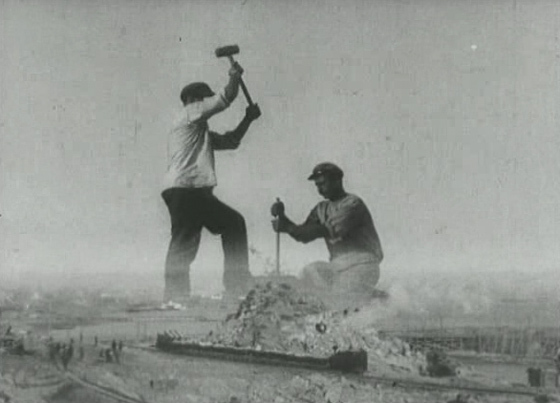 Frame from the movie "Eleventh"
Here are the millennial rocks of Ukraine. Among them are the bones of the Scythian. For more than two thousand years they lay in the ground, but now they are restless. Huge giants - Soviet workers - walk over the mountains, explode, hammer the stones with mighty hammers, drive piles into the ground: they build the largest power station in Europe, simultaneously creating a new world, transforming nature, from which you should not wait for mercy. The universe around us requires a violent transformation, and Ilyich’s strict profile peeps out of the waters of the new power station.
If for Dovzhenko Ukraine was a metaphor country, which he looked at with love and sometimes with irony (a show of live jazz exposed many parody places of Zvenigora, not so obvious with a traditional symphonic accompaniment), then for Vertov Ukraine is a point on the map of the Soviet Union, which gives a certain amount of coal and bread necessary to create new production facilities. Yes, the theme of industrial production was also affected in the “sixth of the world”, but there it sinks in an endless polyphony, is lost between hunting and gathering, balancing with campaigns and foxtrot. Now the frame is cruel and excellent mechanical unity.
The Soviet government was established eleven years ago and already casts doubt on the value of the existing diversity. The harsh and wary Red Navy and the Red Army, guarding the construction, and even Voroshilov himself passes past us on a horse begin to flicker in the frame - is checking if everything is calm. After all, we live in the enemy environment. And then the fortress walls of the Kremlin - a new symbol of folk freedom, will cut into the fabric of the frame so anxiously.
Vertov includes in the “eleventh” large plans of persons, but they are lost against the backdrop of countless mechanisms, how workers running around the huge factory halls are lost, where cyclopic machines occupy the entire space. In this endless kingdom of gears, a person himself suddenly turns out to be only a detail necessary for the uninterrupted operation of factories and factories, and it is customary to throw out a worn or worthless detail. Somewhere there, peasants are still harvesting bread, but Stalin's modernization is already looking out of the frame, hello from the next era.
In the aforementioned note from the newspaper “Kino”, they wrote about Vertov: “He fell in love with the epic of the revolution, he became interested in the magnificent disrespect for the small, Kutza, random life of small, kutsiy, random people, he was intoxicated by the enthusiasm of her scope, the magnitude of its scale, he was imbued with respect for strict fantastic, the harsh realism of her work.”
During the viewing of the “eleventh”, it seems that, carried away by the grandeur of the revolution, Vertov looked at these small and kutsi people, for the sake of whose happiness it was committed. He wanted to see them with giants, and the production of giants requires a certain scruste of skill. And at some point, little choupe people are tired of being giants and wanted a little random life. And then the revolution lost.
Vertov’s films look like museum wonders, and we are surprised at their avant -garde form, not noticing that we have incomprehensible messages, letters sent to the void, since all their addressees have long died. We got a good job, got parks, live music and pleasant comfort. And let the dead burify their dead. But when in the frame of construction and fields they are replaced by fiery interitors, it suddenly seems that we all lost something very important. Here are which of us can call himself the Lord of the owl, gagar or gulls? I can't.